


More news on this day
Rail investigators in the United Kingdom are examining how two passenger trains collided near Bedford, north of London, in a crash that killed a train driver and left at least nine people in critical condition, according to multiple news reports and official public statements released over the weekend.
Get the latest news straight to your inbox!
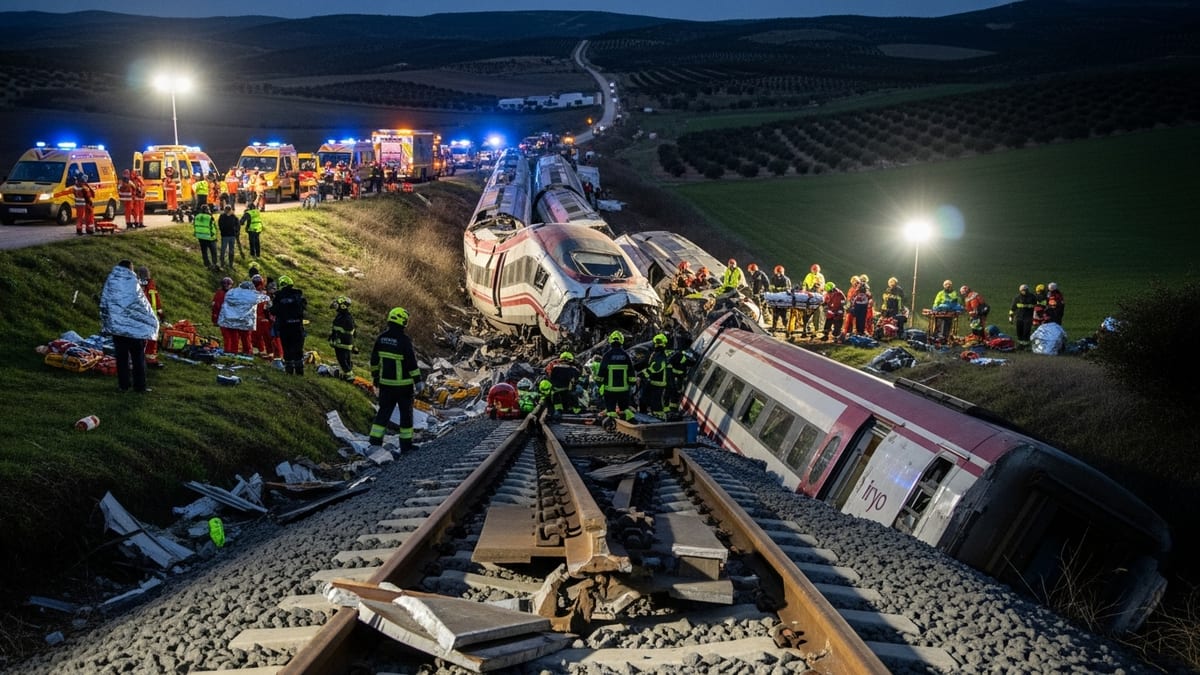
Major incident on busy London commuter corridor
Publicly available information indicates that the collision occurred on the afternoon of Friday 19 June on a main line that carries frequent commuter and intercity services into London St Pancras. Reports describe a southbound East Midlands Railway service striking the rear of another passenger train heading toward the capital on the same route, with multiple carriages damaged and some derailed.
Initial figures reported by national and local media point to one fatality, the driver of the moving train, and dozens of injured passengers. Around 80 people were taken to hospitals across the region for assessment and treatment, with more than two dozen remaining under care on Saturday and at least nine listed in critical condition.
Images shared by broadcasters and on social media show a dense emergency response, including ambulances, fire crews and air ambulances positioned along a road running parallel to the track. Passengers are seen being treated at the roadside, some on stretchers and others sitting wrapped in foil blankets, while damaged carriages lean at angles beside the rails.
The crash prompted the declaration of a major incident in the Bedford area, one of the busiest stretches of railway in the UK and a key artery for commuters traveling between the East Midlands and central London.
Police and accident investigators focus on cause
British Transport Police and regional police forces are reported to be leading the initial response, with the Rail Accident Investigation Branch expected to conduct a detailed, independent inquiry into how a rear-end collision occurred on a heavily signalled main line. Published coverage notes that rail investigators typically examine potential issues ranging from signalling and communication to train protection systems, track conditions and human performance.
According to early summaries in UK and international media, one of the trains is understood to have been stationary or slowing significantly when the other service ran into the back of it at relatively low speed. That scenario raises questions about whether the driver of the moving train received adequate warning, had sufficient opportunity to brake, or may have been suddenly incapacitated.
Specialist teams are expected to download and analyse data from on-train recorders, which log speed, braking and signalling information, as well as examine the condition and configuration of lineside signals and any automatic protection technology. Investigators are also likely to interview crew members, passengers and control room staff to piece together a precise timeline of events in the minutes leading up to the impact.
Rail safety experts quoted across several outlets note that it is too early to draw firm conclusions, but highlight that modern UK signalling and protection systems are designed to prevent collisions of this type, particularly on intensively used intercity routes.
Passengers describe chaos and serious injuries
Accounts from passengers published by British broadcasters and newspapers describe a sudden, violent jolt as the trains collided, throwing people from seats and into fittings. One traveller reported being “thrown forward” before seeing fellow passengers with broken limbs and significant head injuries, while others recalled carriages filling with cries and confusion as people searched for loved ones and tried to understand what had happened.
Several passengers told reporters they used emergency hammers to break windows and help others leave damaged carriages, while those with minor injuries assisted people who could not walk. Others described waiting in crumpled coaches for paramedics and firefighters to reach them, using mobile phones to reassure family members as information slowly emerged.
Photographs from the scene show emergency workers using ladders and portable platforms to access carriages resting at awkward angles beside the track. Some images indicate that the leading cab of the rear train sustained significant damage, focusing attention on how well modern rolling stock protects crew in the event of a collision.
Hospitals in the region activated major incident protocols, reallocating staff and resources to handle the influx of casualties. Reports suggest that injuries ranged from fractures and lacerations to serious trauma requiring intensive care, with clinicians expected to treat and assess patients over several days.
Spotlight on UK rail safety record
The Bedford collision is being widely discussed in the context of the UK’s generally strong rail safety record. Over recent decades, serious train-to-train collisions with multiple fatalities have become increasingly rare, as older rolling stock has been replaced and signalling systems upgraded.
Recent incidents, such as the 2020 derailment near Stonehaven in Scotland and a 2024 collision between passenger trains in Wales, have already prompted recommendations on infrastructure resilience, vegetation management and driver support systems. The latest crash is likely to renew debate over how effectively those lessons have been implemented across the wider network and whether further investment is required on busy main lines into London.
Commentary in specialist transport publications notes that the forces involved in even relatively low-speed rail collisions can be severe, particularly for crew in leading cabs and passengers near the ends of trains. Analysts suggest that the Bedford accident may lead to closer scrutiny of crashworthiness standards, internal fittings, and the design of driver workspaces in newer electric multiple units.
Publicly available statements from rail unions and passenger groups indicate growing calls for a comprehensive review of safety systems on crowded commuter corridors, alongside support for the families of those killed and injured and for staff who witnessed the events.
Disruption for travelers and next steps in the investigation
The collision brought significant disruption to one of the principal rail routes into London, with services suspended or heavily reduced while emergency operations and recovery work continued. Passengers traveling between the Midlands, Bedfordshire and the capital faced cancellations, bus replacements and extended journey times on Friday evening and into the weekend.
Network managers are reported to be inspecting rails, sleepers and signalling equipment in the affected area to determine when full services can safely resume. Damaged rolling stock must be recovered and removed for detailed examination, a process that can take several days depending on the extent of destruction and site accessibility.
According to standard practice in the UK, the Rail Accident Investigation Branch is expected to release a preliminary update once initial evidence has been reviewed, followed by a full report that may include safety recommendations for train operators, infrastructure managers and regulators. That process often runs in parallel with any separate inquiries by workplace safety bodies and, where relevant, law enforcement.
For travelers, the incident serves as a stark reminder of the residual risks that remain even on networks with strong overall safety records. For investigators and rail industry leaders, the focus in the coming weeks will be on understanding precisely how two modern passenger trains came to collide on a key commuter artery and what changes may be needed to reduce the chance of such a tragedy being repeated.