


More news on this day
A rear-end collision between two passenger trains near Bedford in central England has left 28 people in hospital, with nine reported to be in critical condition and one train driver dead, according to multiple news reports published on June 20, 2026.
Get the latest news straight to your inbox!
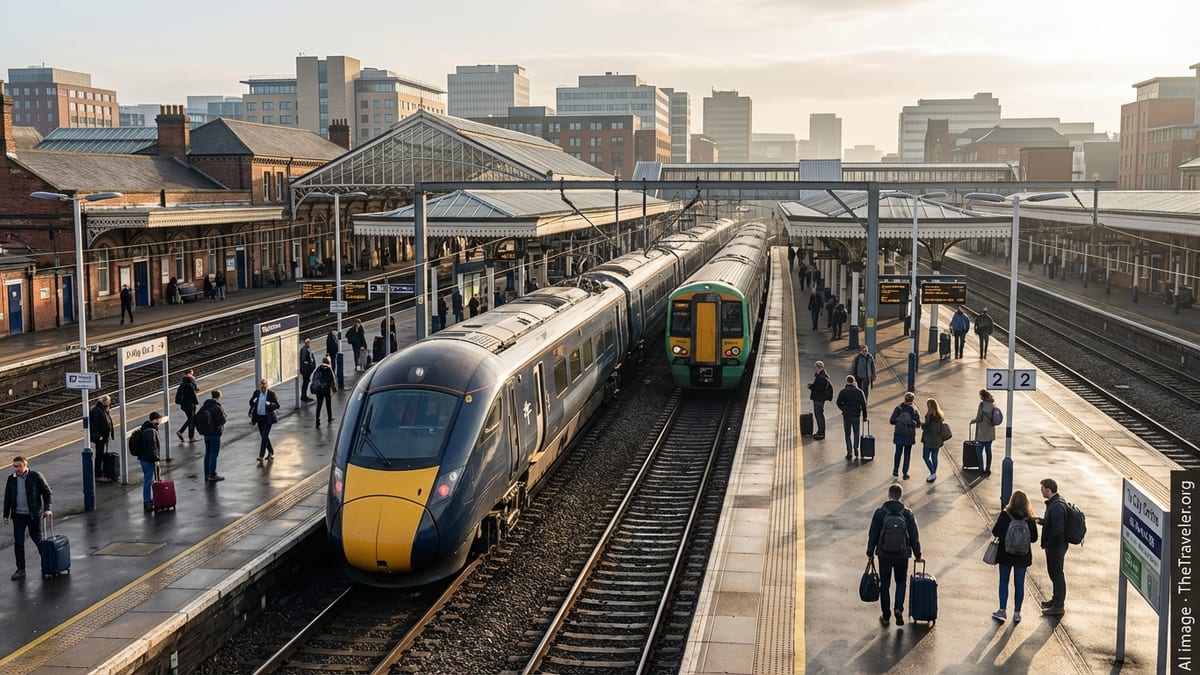
Collision on Busy Commuter Corridor North of London
Publicly available information indicates that the crash occurred late on Friday afternoon near Bedford, a key junction on the main rail corridor linking the English Midlands with London St Pancras. Two London-bound services were involved: one train traveling from Corby and another from Nottingham, both operated on a busy section of track used heavily by daily commuters and long-distance passengers.
Reports describe a rear-end impact in which the following train struck the back of the service ahead of it. Images circulated by British media and shared across social platforms show carriages standing nose to tail on the embankment, with the rear train visibly compressed at the front. Emergency vehicles are seen lined up on a parallel access road, with passengers gathered nearby under the supervision of response teams.
The incident has been classified as a major one in regional coverage, reflecting both the scale of the rail operation affected and the number of people requiring medical treatment. Rail services through the Bedford area have faced significant disruption, with delays and diversions affecting travel into and out of London as investigators and recovery crews work at the site.
Casualties and Hospitalizations After the Impact
According to open reports from international and UK-based news outlets, more than 80 people received medical attention following the collision. Of these, 28 remained in hospital on Saturday, with nine described as being in critical condition. The driver of one of the trains was killed in the crash, making this one of the most serious passenger-train incidents in Britain in recent years.
Accounts collected by broadcasters and newspapers indicate that many passengers in the rear train experienced a sudden and violent jolt, with some describing being thrown forward into seats and bulkheads. Coverage notes a mix of injuries, ranging from broken limbs and deep cuts to suspected spinal trauma and head injuries, typical of abrupt deceleration events in confined spaces.
Health services in the region have been managing a complex mix of minor to life-threatening cases. Public information suggests that some patients were treated and discharged relatively quickly, while others required transfer to specialized trauma centers. The presence of nine individuals in critical condition underscores the severity of the forces involved when two heavy trains collide on the move.
Emergency Response and Passenger Evacuation
Photographs and video shared widely in UK and international media show a large, coordinated response involving ambulance crews, fire and rescue services, and transport-focused emergency teams. Access roads parallel to the railway were used as staging points, enabling rapid triage and treatment just yards from the stricken trains.
Passengers were seen standing or sitting beside the tracks, some with visible bandages and others wrapped in foil thermal blankets. Reports emphasize that many individuals, though shaken, were able to walk unaided from the carriages. Others required stretchers and medical support to move safely away from the scene.
Specialist crews worked to secure the trains, check for structural damage to the carriages, and ensure that there were no fire, fuel, or electrical hazards before full-scale recovery operations began. Operators also undertook detailed headcounts and manifest checks to confirm that all passengers and onboard staff had been accounted for, a process that can take hours in a large-scale incident.
Investigation Focuses on Signaling and Operational Factors
Rail accident investigators and transport-focused police teams have opened a comprehensive inquiry into the circumstances of the crash. Publicly available statements outline a broad focus that typically includes train speeds, signaling behavior, and any potential human or technical errors that may have contributed to the rear-end collision.
Investigators are expected to analyze data from onboard recorders, which capture information such as braking patterns, throttle settings, horn use, and communications between drivers and control centers. These electronic records, together with trackside signaling logs and radio transcripts, will be key in reconstructing the chain of events in the minutes leading up to the impact.
Specialists are also examining the condition of the rolling stock and track infrastructure, including any recent maintenance history in the area. Weather and visibility at the time of the collision, as well as traffic density on the corridor, are likely to be among the contextual factors considered as part of the wider safety review.
Implications for Rail Safety and Future Travel
Britain’s rail network is frequently cited in international comparisons as having a strong safety record, with serious multi-train crashes relatively rare in the decades leading up to this incident. Recent high-profile rail accidents in Europe and elsewhere have nonetheless sharpened attention on signaling systems, maintenance standards, and capacity pressures on busy corridors.
The collision near Bedford is expected to prompt renewed discussion about investment in digital signaling, train protection systems, and real-time monitoring technologies designed to prevent trains from occupying the same block of track. Travel-industry observers note that such systems, once fully deployed, can reduce the likelihood of rear-end collisions even when human error or localized failures occur.
For travelers, the immediate impact has been felt in delays and rerouted services on a major route linking regional centers with London. Over the longer term, published commentary suggests that the incident may influence how operators schedule services on congested lines, how incidents are communicated to passengers, and how quickly alternative transport is provided when major disruptions occur.
Tourism and business travel in and out of London rely heavily on the reliability of mainline rail corridors such as the one passing through Bedford. As investigators work to clarify what happened and why, attention in the travel sector is likely to focus on how lessons from this crash are translated into tangible safety and resilience upgrades across the wider network.