


More news on this day
A United Airlines long haul flight crossing the Pacific Ocean diverted to San Francisco International Airport after reports of a security issue in the cabin, prompting an emergency declaration and a dramatic but ultimately safe landing that left passengers facing disrupted travel but no reported injuries.
Get the latest news straight to your inbox!
Mid Pacific Flight Turns Back Toward California
Publicly available aviation tracking data and specialist aviation coverage indicate that a United Airlines Boeing 777 operating a transpacific service from Honolulu’s Daniel K. Inouye International Airport to an Asian destination began reversing course over the Pacific on June 8, 2026. The wide body aircraft had already covered a significant portion of its westbound route when the crew initiated a turn back toward the US mainland instead of continuing across the ocean.
Reports describe the crew declaring an emergency and broadcasting the standard 7700 transponder code used in distress situations, which immediately elevated the flight’s priority within regional air traffic systems. The aircraft then descended from its cruise altitude and headed northeast toward the California coast, positioning for a diversion to San Francisco International Airport, a key hub for United Airlines’ Pacific operations.
Flight tracking visualizations show the jet stabilizing on a track that brought it to within roughly 100 miles of the coast before commencing approach sequencing. The change in routing, altitude, and speed contrasted sharply with the smooth, steady profile typical of long haul transpacific flights, underlining the seriousness with which the cockpit crew appeared to treat the situation.
Although the aircraft had departed from Honolulu, the diversion decision effectively shifted the center of the incident to the Bay Area, where San Francisco International Airport’s emergency protocols and ground infrastructure were brought into play to receive the aircraft and its passengers.
Onboard Security Concern Reported as “Level One” Situation
Aviation focused outlets reviewing radio communications and operational records report that the crew informed controllers of what was described as a level one security situation in the cabin. Within aviation security frameworks, such language typically refers to a potential threat that warrants heightened caution without immediate evidence of a violent act or confirmed weapon on board.
Details of the cabin event remain limited in public reporting, with no indication that passengers or crew suffered physical harm. Current coverage does not suggest that restraints, injuries, or structural damage were involved. Instead, the information points to a scenario that raised sufficient concern to justify interrupting the transpacific crossing and securing the aircraft and everyone on board at a major US gateway.
Observers note that the response fits a broader trend in commercial aviation where potential security issues are met with conservative decisions, particularly when flights are far from suitable diversion airports. With the aircraft still on the eastern side of the Pacific, returning to the well equipped facilities of San Francisco offered more options for law enforcement, screening, and onward travel arrangements.
Aviation analysts commenting in published reports highlight that, in the post 9/11 security environment, carriers and crews often err on the side of caution when any suggestion of a threat emerges inside the cabin, even if the incident later proves to have been a misunderstanding or a low level disturbance.
Diversion to San Francisco and Safe Landing
According to flight tracking histories and incident summaries compiled by aviation news and enthusiast sites, the United Airlines 777 followed a relatively direct path from its mid ocean position toward San Francisco once the diversion decision was made. The aircraft remained airborne long enough to manage fuel and weight considerations and then positioned for an approach consistent with emergency handling but without reports of technical complications on final descent.
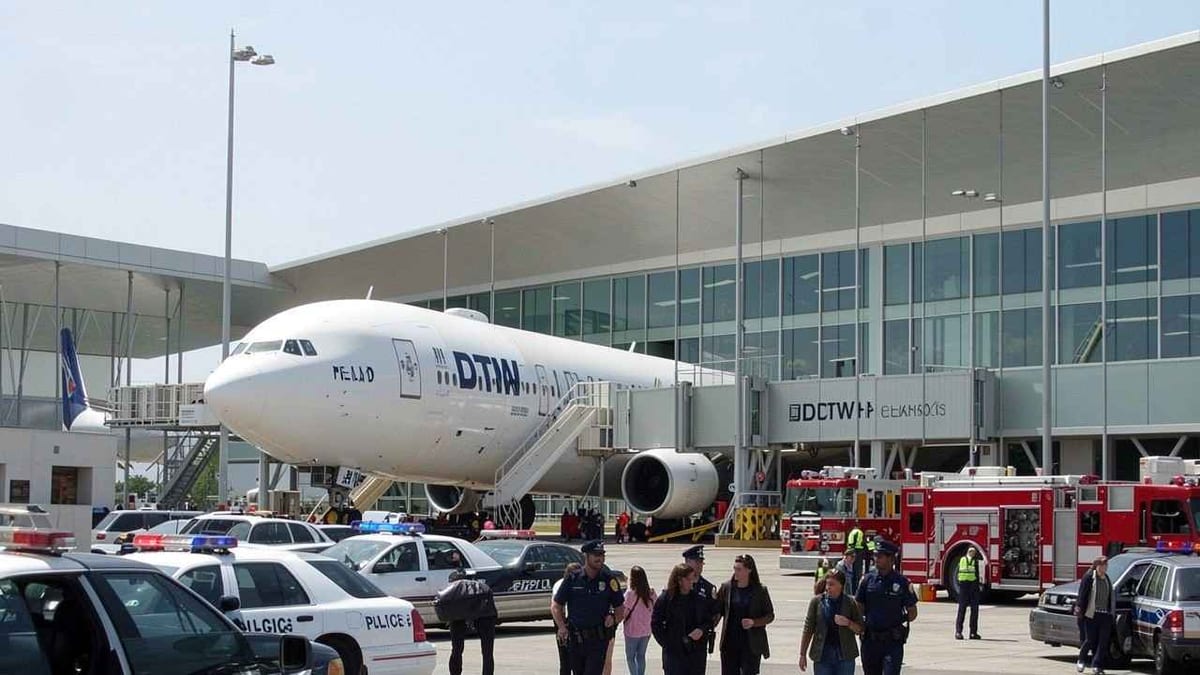
The jet landed safely at San Francisco International Airport, where images and descriptions published by local and aviation outlets indicate that it exited the runway and was met by emergency vehicles and airport personnel. There have been no public indications of injuries to passengers or crew during either the in flight portion of the incident or the landing itself.
San Francisco International Airport, one of United’s primary hubs, is equipped with extensive emergency response capabilities, including on site fire and rescue services and secure remote stands suitable for handling aircraft involved in potential security events. The diversion allowed specialists to meet the flight on arrival, and passengers were held on board or moved in a controlled manner while the situation was assessed.
Available coverage suggests that the aircraft was later taken out of its normal rotation pending inspections and any necessary security related checks, a standard response when an in flight emergency involves potential threats inside the cabin rather than purely mechanical issues.
Passenger Disruption and Broader Travel Impact
While initial reports center on the safe outcome of the landing, the diversion created significant disruption for travelers who had expected to continue across the Pacific. Because the flight turned back to the US mainland instead of continuing to its overseas destination, passengers faced missed connections, schedule changes, and overnight delays, outcomes that are now common in major diversion incidents.
Accounts compiled by aviation forums and travel news sites from recent United diversions on other routes illustrate how such events can cascade through an airline’s operation, straining available seats, crew schedules, and airport resources. In similar security and mechanical incidents, passengers have reported lengthy waits for rebooking, hotel arrangements, and baggage handling as airlines attempt to stabilize their networks following the unexpected arrival of a wide body aircraft at a non scheduled airport.
For San Francisco International Airport, already one of the country’s busiest international gateways, the arrival of an additional long haul aircraft under emergency conditions added pressure to ramp and gate operations. However, publicly available flight status data for the surrounding period show that the broader schedule at the airport continued with only localized delays, suggesting that the impact, while disruptive for those on board, was largely contained operationally.
Travel industry commentators note that diversions of long haul aircraft can also affect flights several days later, as aircraft and crews are repositioned. The latest incident contributes to an ongoing conversation among frequent flyers and consumer advocates about how airlines communicate with passengers during in flight emergencies and how compensation and care are handled when trips are significantly altered.
Spotlight on United’s Pacific Operations and Safety Record
The diversion over the Pacific comes at a time when United Airlines has been expanding its long haul services from San Francisco, particularly to destinations in Asia and the broader Pacific region. Financial and planning documents released in recent months show a marked increase in the carrier’s Asia Pacific capacity from the Bay Area, underscoring San Francisco’s role as a strategic gateway for the airline.
The latest event adds a new chapter to a long history of challenging Pacific operations for United, a carrier that has previously dealt with serious but nonfatal engine incidents and turbulence events on routes linking San Francisco and Honolulu with overseas destinations. In several of those cases, crews successfully returned aircraft to major airports after declaring emergencies, reinforcing both the inherent risks of long overwater flights and the capacity of modern commercial jets and training regimes to manage them.
Aviation safety specialists routinely emphasize that diversions triggered by security alerts or technical concerns are evidence of safety systems functioning as intended. From that perspective, the mid air turn back toward San Francisco reflects a cautious, procedural response designed to minimize risk to passengers and crew.
Even so, the accumulation of high profile incidents across the industry continues to shape public perception of air travel. The latest United diversion over the Pacific is likely to feed ongoing scrutiny of airline security procedures, crew training, and communication practices, particularly on flights that spend many hours far from alternate airports and rely heavily on robust planning to respond to rare but consequential in flight events.