


More news on this day
United Airlines has delayed the launch of 10 new routes from its Chicago O’Hare hub after federal regulators ordered sharp cuts to the airport’s summer flight schedule, forcing carriers to scale back planned growth to protect safety and reduce chronic congestion.
Get the latest news straight to your inbox!
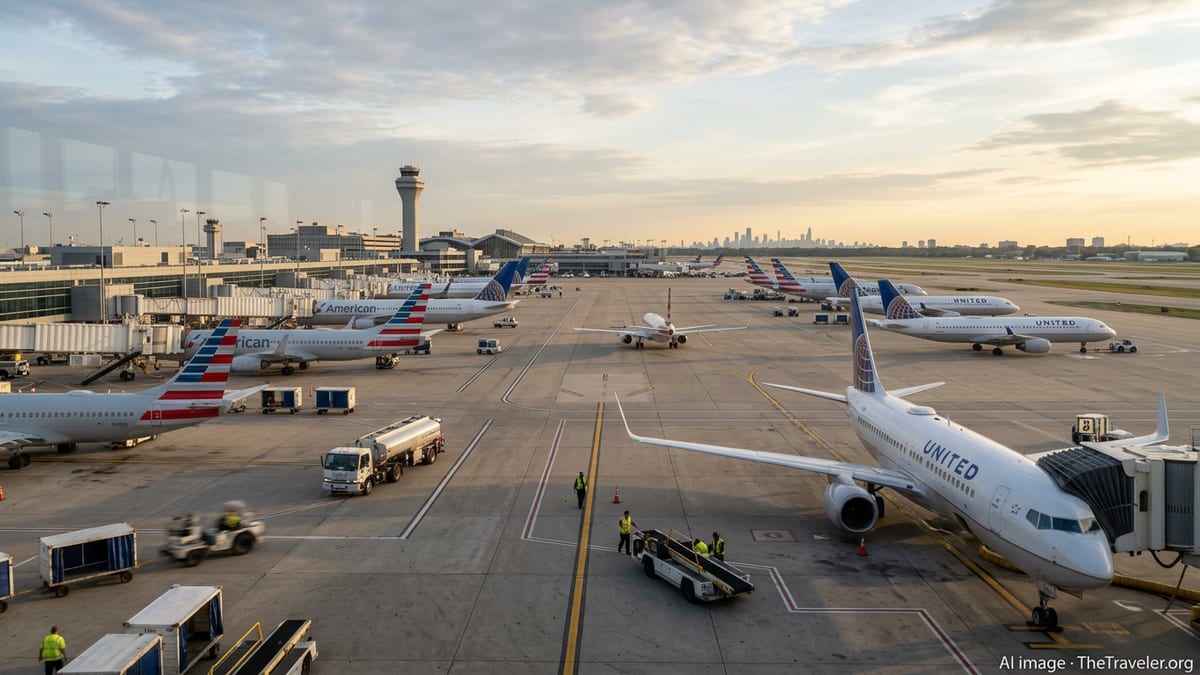
FAA Limits Trigger Network Rethink at Chicago O’Hare
Publicly available federal records show that the Federal Aviation Administration has imposed temporary operating limits at Chicago O’Hare International Airport for the peak 2026 summer season, capping total daily operations at roughly 2,700 flights. The cap represents a reduction of about 10 to 12 percent from what airlines had scheduled, according to agency documents analyzing planned activity.
The order is framed as a response to persistent delays and mounting congestion at one of the country’s busiest hubs. FAA data indicate that runway and taxiway construction, together with aggressive schedule growth by major hub carriers, have pushed the airfield close to its practical limits during peak hours. The agency’s stated goal is to keep traffic within what it describes as a safe and manageable range while major airfield work continues.
Under the temporary rules, airlines serving O’Hare are required to trim peak-period flights rather than reduce overall passenger capacity through larger aircraft alone. This structure places particular pressure on frequent short-haul services and new, unlaunched routes that had been scheduled but not yet operating.
United, which maintains its largest hub at O’Hare, is among the carriers most directly affected by the summer cap, alongside American Airlines. Network planners have been forced to rework schedules that were built months in advance, weighing which additions can proceed and which must be deferred.
Ten New Regional Routes Put on Hold
According to published coverage and schedule filings, United had planned a cluster of new regional routes from O’Hare to smaller Midwestern and Mid-Atlantic communities beginning later this year. These additions were part of a broader strategy to deepen the carrier’s presence in secondary markets and restore connectivity that had been reduced during earlier rounds of consolidation and pandemic-era cuts.
Instead, the airline is now deferring the launch of 10 of those routes until after the FAA’s summer limitations expire. The affected services are primarily short-haul flights operated by regional partners, linking O’Hare to smaller cities that rely heavily on hub connections for access to the broader network.
Published reports indicate that several of these markets, including college towns and small industrial centers, had been preparing for the start of new O’Hare service as early as late summer or early autumn. With the capacity cap in place, those start dates have been pushed back, in some cases into the shoulder season or later in the year, as United prioritizes maintaining core frequencies on already established routes.
The decision to delay new launches rather than cut deeper into existing schedules reflects how carriers typically respond to mandatory capacity reductions. Routes that have not yet begun service are often the easiest to postpone because they do not immediately displace existing travelers, aircraft routings or airport staffing patterns.
Impact on Smaller Cities and Regional Connectivity
The postponement of 10 O’Hare routes is being felt most acutely in smaller cities that depend on hub connections for both business and leisure travel. Publicly available airport communications from several regional fields around the Midwest and Great Lakes region have highlighted revised timelines for the start of United’s O’Hare flights, pointing directly to the FAA’s cap on summer operations as the key factor.
For local travelers, the delay can mean longer drive times to larger airports or additional connections through alternative hubs. Communities that had marketed new O’Hare links as tools for economic development and talent retention must now adjust expectations and messaging until firm launch dates are restored. Some local airport authorities have described the postponed routes as “deferred,” not canceled, but have acknowledged uncertainty around precise startup timing.
Travelers with existing bookings on tentative inaugural flights are being re-accommodated onto other itineraries or offered alternative dates where possible. Because the routes had not yet entered regular operation, the broader disruption is limited compared with a sudden cancellation of long-standing services. Nonetheless, the deferrals underscore how federal airspace and airport capacity decisions can ripple far beyond a single large hub.
Reports from traveler forums and regional news outlets suggest that demand in many of these smaller markets remains robust, particularly for direct access to a major global hub like O’Hare. The challenge, in the short term, lies less in demand than in how much flight activity regulators will allow on the airport’s constrained airfield during the busiest travel months.
United’s Strategic Balancing Act at Its Largest Hub
United’s decision to delay the 10 new O’Hare routes illustrates the balancing act the airline faces at its largest hub. On one side, the carrier has invested heavily in growing Chicago’s role as a connecting gateway, with new long-haul services and increased domestic frequencies. On the other, the FAA’s summer cap places a firm ceiling on how many takeoffs and landings can occur each day.
To navigate this constraint, airlines typically prioritize flights that carry the greatest mix of local and connecting traffic, support key corporate contracts, or feed high-yield international services. In practice, this often protects established mainline routes and heavily used bank structures while pushing experimental or lower-volume additions further down the list.
Industry analysts note that United is unlikely to abandon the delayed routes altogether if they fit into its longer-term strategy for the Midwest. Instead, the deferrals may become a test of how quickly the carrier can redeploy capacity once regulators ease temporary limitations and airfield construction milestones are met.
The current situation also underscores the competitive dynamics at O’Hare. With both United and American vying for share at a constrained hub, capacity decisions take on added weight. The timing and composition of any future schedule ramp-up will likely reflect not only regulatory relief but also how each carrier positions itself against its main rival in Chicago.
What the FAA Cap Means for Travelers Through O’Hare
For passengers, the immediate effect of the FAA’s cuts is a somewhat leaner schedule at O’Hare during peak summer months, but potentially more reliable operations. By trimming the number of daily flights, regulators aim to reduce the cascading delays that can result when a tightly packed schedule collides with thunderstorms, air traffic control restrictions or airfield construction closures.
Public data on past delay patterns show that O’Hare’s performance can deteriorate quickly when demand outstrips runway and taxiway capacity, particularly in the late afternoon and evening waves. The FAA’s temporary cap is designed to keep operations within a range that allows recovery from disruptions without spilling into widespread cancellations.
Travel experts recommend that passengers connecting through O’Hare build in additional connection time where possible, especially during the height of the summer storm season, and remain alert to schedule changes as airlines continue to adjust their operations under the cap. United’s deferral of 10 new routes may reduce the number of new options from smaller cities in the near term, but it also reflects an effort to keep the existing network running as smoothly as possible under tighter regulatory limits.
Looking ahead, the trajectory of O’Hare’s schedule will depend on how quickly construction projects progress and whether the FAA judges that the airfield can safely handle higher levels of activity. Until then, carriers like United must continue to weigh growth ambitions against a finite number of daily slots, with regional communities watching closely to see when long-promised routes finally take flight.