


More news on this day
United Airlines has canceled more than 300 flights as severe thunderstorms over Chicago O’Hare and major East Coast hubs triggered sweeping disruptions across the carrier’s network at the height of the 2026 summer travel season.
Get the latest news straight to your inbox!
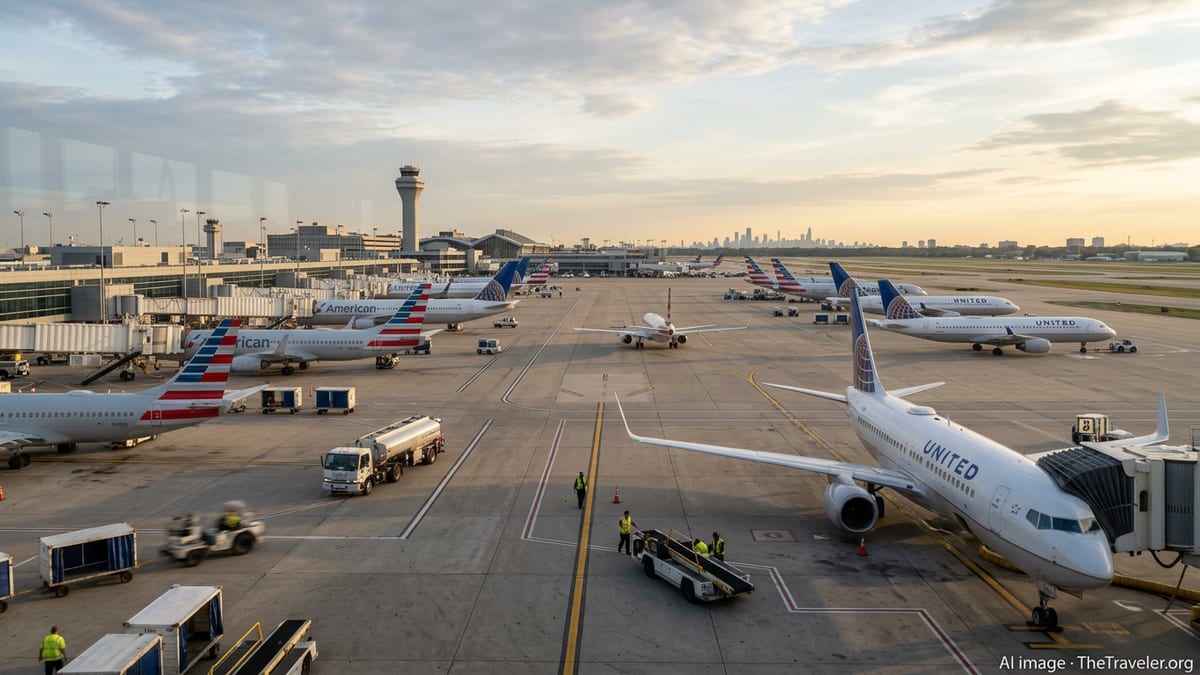
Storm Cells Slam Chicago and East Coast Corridors
The latest round of cancellations followed fast-moving storm systems that brought intense rain, lightning, and strong winds to the Midwest and Northeast, prompting ground stops and extensive air-traffic control restrictions. Publicly available aviation data for July 27 and July 28 shows lengthy departure delays and rolling hold orders at Chicago O’Hare, with some flights waiting hours for takeoff slots as storm cells repeatedly redeveloped over the region.
Chicago O’Hare, United’s largest hub, bore the brunt of the disruptions as thunderstorms reduced the number of usable runways and forced controllers to slow arrival and departure rates. At times, average delays for traffic bound for O’Hare stretched well beyond typical summer slowdowns, rippling across the airline’s domestic network.
At the same time, stormy conditions along the Eastern Seaboard affected operations at Newark Liberty, LaGuardia, Washington-area airports, and other East Coast hubs that play a central role in United’s connecting traffic. With storms firing in multiple metropolitan areas, the airline’s tightly timed schedule had little slack to absorb a wave of weather-related interruptions.
Combined, these factors drove a sharp spike in same-day cancellations for United, pushing the number of scrubbed flights into the hundreds and leaving aircraft and crews out of position for subsequent rotations.
Travel Waivers and Network Strain for United Passengers
In response to the volatile forecast, United activated a series of weather waivers covering key East Coast airports and Chicago, allowing travelers on affected itineraries to rebook within a limited timeframe without change fees. The waivers, updated repeatedly through late July, were intended to encourage customers to shift out of peak disruption windows and reduce congestion on the busiest days.
Despite those measures, the concentration of cancellations at large hubs meant that many passengers faced lengthy waits for alternative flights. With peak-season load factors already high, available seats on later departures and next-day services were quickly exhausted on popular routes, particularly between Chicago and major East Coast cities.
Reports from travelers and flight-tracking dashboards indicated that some customers encountered multiple rebookings as rolling delays turned into outright cancellations when aircraft or crew could not reach their next departure point in time. Others saw their itineraries re-routed through secondary hubs or required overnight stays before continuing to their destinations.
Air passenger rights advocates note that, when disruptions are attributed to severe weather and air-traffic restrictions, travelers in the United States are generally entitled to refunds if a flight is canceled and they choose not to travel, but not to government-mandated cash compensation for delays. Instead, airlines exercise discretion in providing hotel or meal assistance during major events.
FAA Capacity Limits and an Already Tight O’Hare Schedule
The latest wave of cancellations comes during a summer in which O’Hare is already operating under tighter federal limits. Earlier in 2026, the Federal Aviation Administration ordered a reduction of more than 300 scheduled flights per day at the airport during the peak travel season, after on-time performance in previous summers sagged amid high traffic volumes and frequent convective weather.
United, which had planned a significant expansion of operations at its Chicago hub this year, has since trimmed thousands of departures from its summer timetable and scaled back new routes to smaller Midwestern cities. Even with those cuts, schedules for June through August remain substantially higher than in 2025, leaving little margin when thunderstorms or air-traffic staffing constraints arise.
Aviation analysts suggest that the combination of elevated baseline schedules, federal caps designed to keep the airfield manageable, and a notably stormy summer pattern in the Midwest and Northeast has created a fragile operating environment. When severe weather forces controllers to reduce arrival or departure rates for safety, carriers like United can find themselves with more flights planned than conditions safely allow to operate on time.
The result is an environment where a single severe weather day at O’Hare or along the East Coast can generate a cascade of downstream disruptions. Once hundreds of flights are canceled in a short span, it may take days for aircraft, crews, and passenger itineraries to fully normalize.
Wider Impact Across the U.S. Summer Travel Season
United’s latest cancellations underscore a broader pattern of weather-driven disruptions across the U.S. aviation system in 2026. Multiple major storm events since late spring have led to waves of delays and cancellations at hub airports, particularly in the Midwest and Northeast, where convective storms and low visibility can quickly throttle capacity.
Industry data and published coverage indicate that United, like its large competitors, has repeatedly issued weather waivers for clusters of airports along the East Coast this summer, often spanning New York, New Jersey, Washington, and mid-Atlantic cities. Each new round of storms has tested the resilience of airline schedules built around high utilization of aircraft and crews.
Travel advisers are increasingly encouraging passengers to book early-morning departures and allow extra connection time when flying through weather-prone hubs such as Chicago O’Hare and Newark during the heart of storm season. Early flights typically have a better chance of operating before afternoon thunderstorms build, while longer layovers can provide a buffer when delays begin to stack up across the system.
For now, forecasters and aviation planners expect the combination of robust summer demand, constrained airport capacity, and unsettled weather patterns to keep pressure on operations through at least the Labor Day travel period. For United customers, that means monitoring itineraries closely, taking advantage of waivers when they appear, and preparing for the possibility of last-minute changes when storms once again move in over Chicago and the East Coast.