


More news on this day
Thousands of U.S. air travelers faced extended waits on July 3 as a combination of severe weather systems, federal ground delay programs and longstanding air traffic control staffing gaps pushed more than 4,500 flights into delay, exposing how fragile the national airspace network remains at the height of the summer holiday rush.
Get the latest news straight to your inbox!
Storm Cells and Ground Programs Squeeze the National Airspace
Tracking data and federal airspace advisories for July 3 show a patchwork of thunderstorm activity across key regions, including the Midwest and parts of the East Coast, forcing traffic managers to meter arrivals and departures into major hubs. When cells park over busy corridors, control centers typically respond with ground delay programs that cap the number of flights allowed to land each hour, with knock-on effects rippling across the country.
Publicly available information from the National Airspace System status portal indicates multiple traffic management initiatives in effect heading into the Independence Day period, with average delays stretching beyond half an hour at some airports and substantially longer during peak push times. Each individual program is designed to preserve safety margins, but together they compress capacity just as demand surges for holiday travel.
Weather-driven constraints can be particularly disruptive when they intersect with hub-and-spoke airline networks. A storm-induced slowdown at a single Midwest or Northeast hub can strand aircraft and crews that are scheduled to operate later departures to the West Coast or smaller regional cities, gradually transforming a localized weather event into a nationwide gridlock that travelers experience as rolling delays throughout the day.
By early evening on July 3, flight-tracking tallies showed more than 4,500 delayed operations across U.S. airports, a level of disruption comparable with other recent high-impact days in June when thousands of passengers were affected by storms layered on top of tight operating margins.
Chronic ATC Staffing Shortages Amplify Weather Impacts
Alongside convective weather, chronic staffing gaps in key air traffic control facilities continue to constrain how much traffic the system can safely handle, especially during complex weather events. Recent federal workforce reports and industry analyses describe a controller workforce that has shrunk over the past decade while flight activity has steadily rebounded, leaving some facilities reliant on mandatory overtime and reduced arrival rates during busy periods.
Independent assessments of the U.S. air traffic control workforce note that several high-density areas, including the New York region and parts of California, have been operating below optimal staffing levels. In practice, this means that when storms arrive or visibility worsens, the number of aircraft that can be safely managed per hour often has to be reduced more sharply than in a fully staffed environment, leading to longer lines of holding aircraft and extended ground queues.
Government accountability reviews published in late 2025 linked sustained staffing shortfalls with measurable increases in systemwide delays, as control centers slow the flow of flights to match available personnel. To mitigate risk, the FAA has leaned on traffic management initiatives such as miles-in-trail restrictions and reroute programs that space out aircraft more conservatively, decisions that collectively contribute to the kind of holiday-period gridlock seen on July 3.
Travel data from recent weeks suggests that these structural constraints are not isolated to a single day. Mid-June operations recorded more than 4,000 delays across over 60 U.S. airports during one severe-weather episode, underscoring how quickly disruption grows when staffing and weather pressures coincide.
Key Hubs Struggle as Delays Cascade Across Networks
The brunt of the July 3 disruption fell on major hub airports and dense regional corridors that serve as the backbone of domestic travel. Large connecting complexes in California, Illinois, Colorado, the Upper Midwest and the Northeast all reported elevated delay levels as storm cells, arrival caps and local staffing limits converged. Even where outright cancellations remained relatively contained, long lines for departure slots and extended arrival holding patterns meant that aircraft and crews struggled to remain in position for later legs.
Recent coverage of individual airports illustrates how localized programs can ripple outward. A ground delay program at New York’s LaGuardia, introduced in response to high winds and additional airspace constraints, has already produced average arrival delays of about an hour on some days, placing extra pressure on the broader New York airspace. On the West Coast, busy Fourth of July schedules into San Francisco and Los Angeles have left little slack to recover from thunderstorms or temporary runway restrictions.
Because many regional airlines operate tight, multi-stop rotations for each aircraft and crew, a delay of an hour or more on an early segment can cascade into missed connections and late-night disruptions far from the original problem airport. That pattern was evident during a mid-June event when a concentration of delays in the Chicago area translated into widespread timetable slippage at airports as distant as the Mountain West and the Southeast.
On July 3, a similar dynamic emerged across multiple hubs, with flight boards at large airports showing packed columns of departures pushed back by 30, 60 or 90 minutes, and some carriers turning to tactical cancellations to reset their networks before the peak of the holiday weekend.
Passengers Face Crowded Terminals and Uncertain Timetables
For travelers, the convergence of 4,500-plus delays translates into crowded gate areas, stretched customer service resources and uncertain arrival times. With aircraft and crews often out of position, some passengers have reported multiple rolling departure time changes before finally boarding, as airlines juggle limited assets between routes to minimize the number of outright cancellations.
Consumer-facing disruption reports for 2026 already point to a pattern of elevated delays linked to severe weather and staffing constraints, particularly at peak travel times. When a major holiday period coincides with convective storm forecasts, the likelihood of significant schedule upheaval increases, even on routes that are themselves unaffected by storms but rely on aircraft cycling through impacted hubs.
Public travel advisories and aviation analysts consistently recommend early-morning departures when possible, as those flights are less exposed to accumulated delays from earlier segments. They also encourage passengers to build extra connection time on days when the airspace is saturated and to monitor airline channels frequently, since schedules can shift several times in the hours leading up to departure.
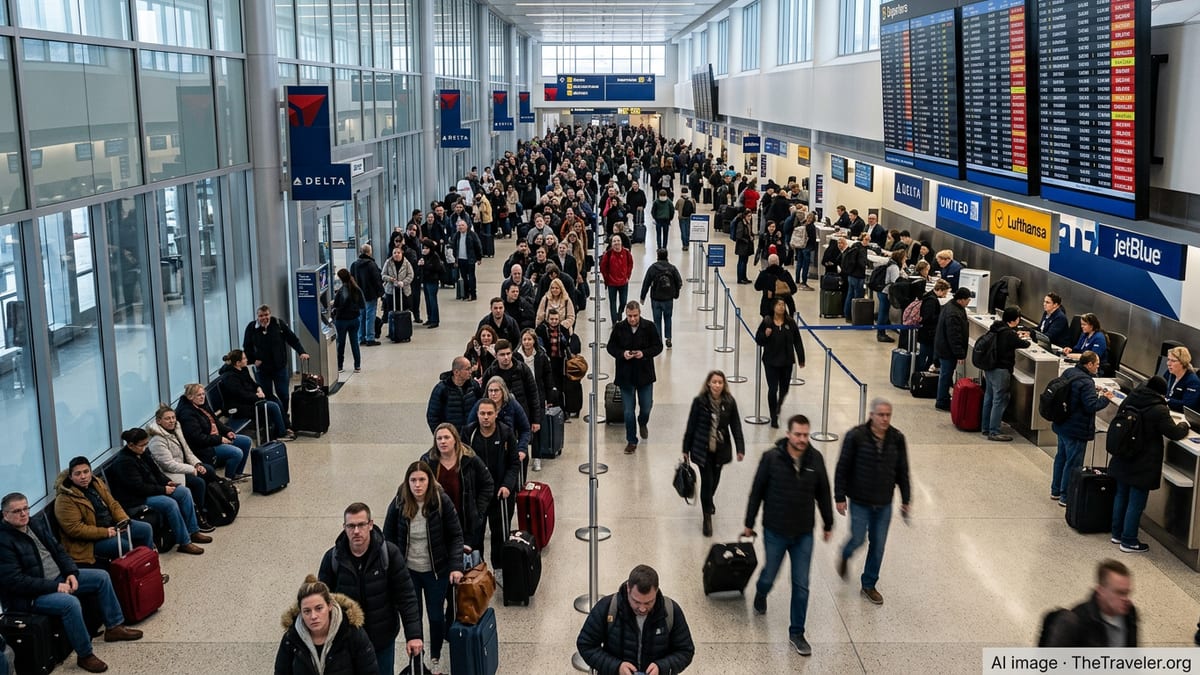
At many airports on July 3, terminal scenes reflected this guidance in real time, with long lines forming at rebooking desks and self-service kiosks as travelers sought alternative routings, and airport concessions filling with passengers waiting out extended holds on the ramp and in the air.
Structural Fixes Lag Behind Surging Summer Demand
The latest wave of disruption arrives as policymakers, regulators and industry groups debate how to modernize the U.S. air traffic system to cope with current and future demand. Government workforce plans released for the 2026 to 2028 period outline ambitions to streamline training pipelines and deploy scheduling tools intended to use existing controller resources more efficiently, but these initiatives take years to translate into fully certified personnel at the busiest facilities.
Industry data providers note that scheduled seat capacity at major U.S. airports continues to grow into the summer of 2026, driven by recovering business travel and strong leisure demand. Busiest-airport rankings for July highlight hubs that are already grappling with both historical congestion and documented staffing constraints, suggesting that peak-period vulnerabilities could persist without more aggressive capacity and staffing measures.
Analysts of recent disruption trends argue that a sustainable solution will likely require a combination of investments in controller hiring and retention, further deployment of modern navigation and surveillance technology, and closer alignment of airline schedules with realistic airport and airspace capacity. Until then, days like July 3, when more than 4,500 flights fall behind schedule due to the twin pressures of weather and staffing gaps, are expected to remain a recurring feature of the U.S. travel landscape.
With the remainder of the Independence Day weekend still unfolding, attention is focused on whether improving weather windows and incremental recovery in aircraft and crew positioning will be enough to clear the backlog, or whether the system’s tight margins will allow today’s gridlock to spill into subsequent travel days.