


More news on this day
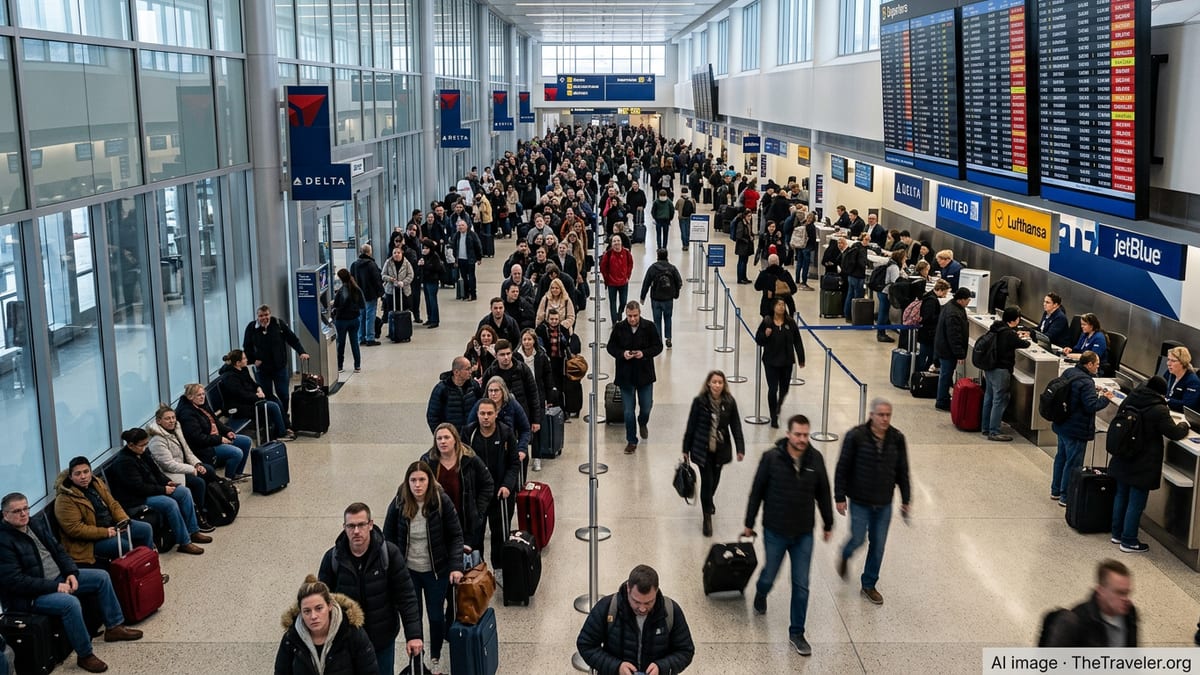
Thousands of US air travelers are facing hours-long delays and rolling disruptions at major hubs this week, as severe weather, staffing gaps, aging technology and peak-summer traffic combine to strain an already fragile aviation system.
Get the latest news straight to your inbox!
Live data shows mounting delays at key airports
Real-time dashboards built on Federal Aviation Administration data indicate elevated delays across several of the country’s busiest hubs on Monday, August 24, 2026, including New York area airports, Chicago O’Hare, Dallas Fort Worth and Denver. Publicly available status pages show many of these airports under a mix of ground delay programs, arrival metering and volume-related restrictions, with average departure waits stretching beyond an hour at the most congested fields.
The FAA’s operations summary, updated throughout the day, lists multiple traffic management initiatives in effect, reflecting a system that continues to run close to its limits. National advisories over recent weeks have included repeated ground delay programs for Seattle, Denver and Nashville, as well as flow constraints in key air traffic control centers, amplifying knock-on effects for connecting passengers nationwide.
Independent trackers that aggregate domestic flight performance report that only about three-quarters of US flights have arrived on time in recent months, with delays concentrated at the largest hubs. In some cases, specific routes into major connecting airports are routinely running with average arrival delays of nearly an hour, pointing to a structural capacity squeeze rather than isolated bad luck for today’s travelers.
Weather volatility and a fragile network
This latest wave of disruption comes on the heels of several intense weather events that have battered the system through August. Thunderstorms across the Northeast late last week led to extensive delays at Newark, Kennedy, LaGuardia and Philadelphia, with average waits reported near or above 90 minutes at some airports as arrival and departure rates were sharply reduced.
In the Midwest, a recent outage at a Minneapolis-area air traffic control facility forced a temporary ground stop and diversions affecting traffic over ten states. Published coverage of that incident described aircraft being held on the ground or rerouted around the affected airspace, causing widespread ripple effects for flights into Chicago, Detroit and other regional hubs as crews and aircraft wound up out of position.
Farther west, a Pacific storm system tied to Hurricane Lala disrupted flights between Los Angeles and Hawaii earlier this month, closing two major airports in Hawaii and delaying other transpacific services. While most operations have since resumed, carriers are still working through residual scheduling challenges, especially for long-haul fleets that have limited flexibility when earlier rotations are pushed off schedule.
These events underscore how vulnerable the hub-and-spoke network remains to localized shocks. When severe weather closes runways or forces traffic managers to meter arrivals into a key hub, hundreds of downline flights can be delayed as aircraft and crews wait to be released into constrained airspace.
Staffing shortages and aging technology add pressure
Operational reports over the past month highlight that staffing shortfalls in both air traffic control and airport operations are compounding weather-related strains. In late July, the FAA slowed arrivals into several New York area airports and Philadelphia due to a combination of storms and controller staffing challenges, prompting cascading delays across the East Coast and beyond.
Denver International Airport has also seen significant disruption tied to resource constraints. Local coverage from earlier in August documented a ground delay that extended average departure waits to well over two hours, with the FAA attributing the slowdown in part to staffing and in part to high winds. For travelers connecting through Denver, those delays often translated into missed onward flights and overnight stays.
Technology has been another point of failure. A nationwide ground stop involving a major US carrier in late July, widely attributed in public discussion to problems in its internal IT and device-management systems, halted departures for roughly two hours and disrupted schedules for more than a thousand flights. Even after the immediate issue was resolved, passengers reported knock-on delays on subsequent trips in August as aircraft rotations and crew schedules took time to realign.
Transportation statistics from recent years show that so-called “national aviation system” factors such as non-severe weather, air traffic control constraints and airport operations are responsible for a significant share of delay minutes. This suggests that without meaningful investment in staffing, infrastructure and software resilience, periods of high demand will continue to expose vulnerabilities throughout the network.
Peak summer demand magnifies every disruption
The current crunch is landing at the height of the US summer travel season, when schedules are dense and aircraft are flying near capacity. Industry analyses of DOT performance data indicate that major hubs including Atlanta, Dallas Fort Worth, Chicago O’Hare and Denver consistently rank among the nation’s most delay-prone airports during busy months, simply because there is little slack in the system when anything goes wrong.
On days with intense thunderstorms or localized outages, it is common for large hubs to see thousands of delayed passengers within a few hours. A recent snapshot from late July counted nearly 3,000 delayed flights and close to 80 cancellations across the United States in a single day, with Atlanta, Chicago, Dallas, Denver and the New York area shouldering much of the impact. When aircraft arrive late into these hubs, the effect cascades to smaller spoke airports whose departures depend on inbound equipment arriving on time.
Travelers’ experiences shared in public forums mirror these statistics. Reports from New York’s Kennedy Airport earlier this month described terminals crowded with stranded passengers after widespread cancellations and multi-hour waits, with some flights eventually returning to the gate when flight crews neared federally mandated duty limits. Similar accounts from other major hubs highlight repeated delays attributed to “equipment,” “crew availability” or “flow control” as airlines juggle tight turnarounds.
Because aircraft and staff are heavily utilized during the summer, carriers have limited ability to add backup planes or spare crews when shock events hit multiple regions at once. As a result, even short-lived outages or weather cells can trigger rolling disruptions that persist for days, especially when storms recur in the same corridors.
What passengers can expect in the coming days
Publicly available planning documents suggest that elevated delay risk will likely persist as long as summer storm patterns and heavy demand continue. The FAA’s advisory database for August shows a steady drumbeat of ground delay programs, reroutes and flow restrictions affecting both coastal and inland hubs, indicating that the system is already running at reduced margins before any new disruption arises.
Analysts tracking flight performance note that while on-time percentages have inched up compared with the worst months of winter 2026, the improvement has been uneven. Some carriers and airports have added buffer time to schedules or adjusted departure banks to smooth traffic peaks, but that added resilience often comes at the cost of longer scheduled travel times for passengers.
For travelers flying this week, the data points to a familiar set of practical implications: early-morning departures remain less vulnerable than late-evening connections, smaller regional routes into big hubs are often the first to be cut when capacity is constrained, and tight layovers are increasingly risky at the busiest airports. Passenger-rights resources emphasize the importance of monitoring flight status in real time, understanding rebooking options through airline apps and being prepared for same-day changes when thunderstorms or operational alerts start to stack up across multiple hubs.
With no single cause and no quick fix, the current aviation chaos reflects overlapping structural challenges in US air travel. Until staffing, infrastructure and technology catch up with demand and weather volatility, passengers at the country’s largest hubs are likely to face more days when a routine trip turns into a prolonged wait on the tarmac or in a crowded terminal.
FAA Air Traffic Control System Command Center Daily Summary
FlightCheck Live US Airport Delays Dashboard