


More news on this day
Air travel across the eastern United States entered a fresh period of turmoil this week as a combined 4,367 flight delays and 210 cancellations snarled operations at Atlanta, New York JFK and Boston Logan, intensifying concerns about a broader U.S. aviation crisis in the peak summer travel period.
Get the latest news straight to your inbox!
Storms, Staffing Gaps and System Strain Converge
Publicly available tracking data show that Atlanta Hartsfield-Jackson, New York’s John F. Kennedy International and Boston Logan International have emerged as some of the hardest-hit hubs in a new wave of disruptions, with thousands of passengers facing missed connections and overnight delays. The latest figures of 4,367 delays and 210 cancellations across these airports in a single operating window point to a system already operating close to its limits.
Published coverage and meteorological summaries link the spike in disruption to a combination of strong summer thunderstorms sweeping across the Southeast and Northeast, as well as ongoing staffing constraints in air traffic control and ground operations. Weather-related route restrictions have forced aircraft into holding patterns around Atlanta and New York, while crew time-out rules have made it more difficult to recover schedules once delays pass the three-hour mark.
Analysts note that the pattern fits a broader national picture in 2026 in which relatively small operational shocks quickly cascade into large-scale disruption. Industry data compiled earlier this year already described some of the worst U.S. aviation chaos since the pandemic era, with major hubs such as Atlanta, New York and Boston repeatedly flagged for elevated delay and cancellation rates.
Historic performance statistics underscore how vulnerable these hubs can be. Atlanta regularly ranks among the world’s busiest airports by passenger volume, while New York JFK and Boston Logan are central to transatlantic and business travel flows. Even modest reductions in capacity at any one of these airports can quickly ripple across domestic and international networks.
Atlanta: World’s Busiest Hub Under Pressure
At Atlanta Hartsfield-Jackson, the current wave of delays and cancellations builds on months of operational strain. Earlier analyses of U.S. airports in 2026 highlighted Atlanta as a recurring problem point, with large clusters of cancellations on peak travel days and widespread knock-on delays to connecting traffic through the hub.
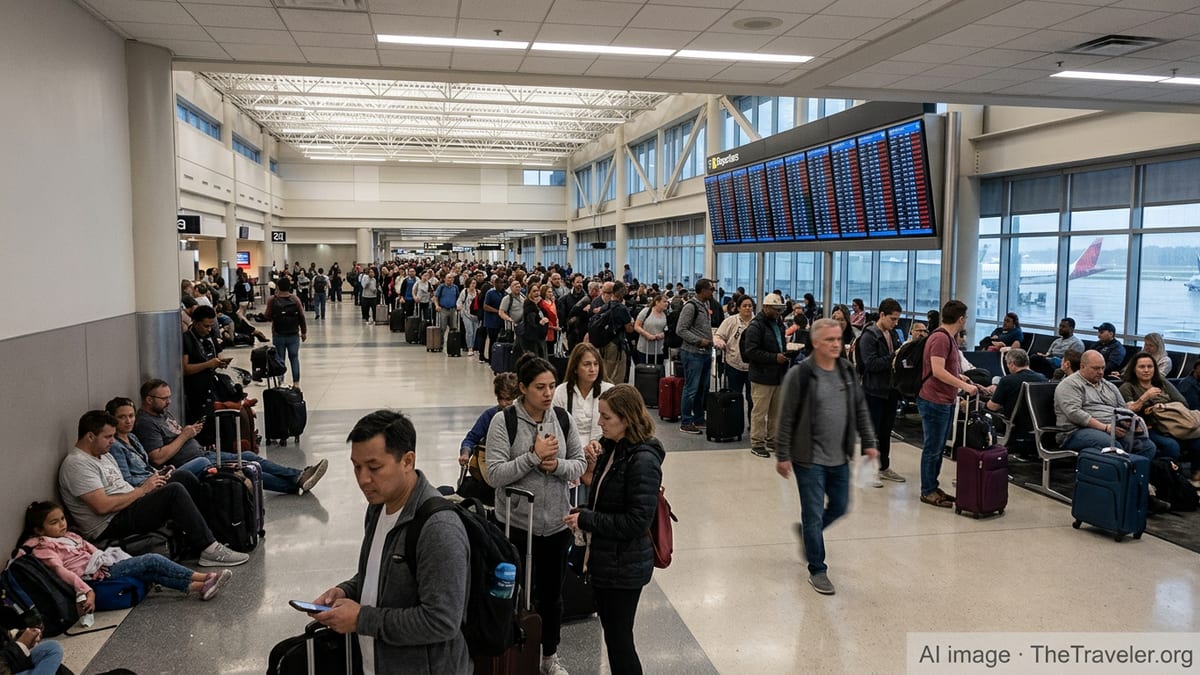
Recent passenger accounts and airline operations reports describe scenes of crowded concourses, long lines at rebooking desks and extended waits for available aircraft and crew. Weather patterns have been particularly disruptive around Atlanta in recent weeks, with strong thunderstorm cells repeatedly limiting arrivals and departures and prompting ground stops, especially during late afternoon and evening bank periods.
Technical and logistical challenges have added to the pressure. Earlier in the summer, publicly available commentary from frequent flyers flagged fueling issues and ramp congestion at the airport, which compounded weather-related hold times. While those problems were localized in time, they illustrate how a single infrastructure bottleneck at such a large hub can amplify delays across an entire day’s schedule.
Data from policy research and transportation oversight bodies also show that Atlanta generates some of the highest total passenger delay hours in the country over multi-year periods. That long-term backdrop makes the latest figures of hundreds of delays and dozens of cancellations in one surge appear less like an anomaly and more like a continuation of a chronic structural challenge.
JFK Gridlock Highlights New York Bottlenecks
New York’s JFK airport has once again emerged as a flashpoint for disruption, with a significant share of the 4,367 delays clustered around transcontinental and transatlantic departures. Travelers transiting through Terminal 4 and Terminal 5 have reported extended ground holds, last-minute gate changes and flights that push from minor delay into outright cancellation late in the evening.
New York’s constrained airspace and runway capacity have long been identified in aviation studies as a major source of national delays, with a large percentage of U.S. passenger disruptions originating in or flowing through the metropolitan area. Weather-related slowdowns over the Atlantic approaches and along the Eastern Seaboard often force JFK arrivals into holding patterns, compressing turnaround windows and leaving little margin for schedule recovery.
Social media posts and online discussion boards over the past 24 hours describe passengers remaining onboard aircraft at JFK for hours before flights were eventually scrubbed, as well as large crowds at rebooking counters into the early morning hours. While such accounts are anecdotal, they align with broader data showing many JFK departures operating significantly behind schedule during the disruption period.
Published commentary from airline and aviation analysts suggests that JFK’s role as both an international gateway and a domestic connector magnifies the knock-on effects of any local disruption. When transatlantic flights depart late or are canceled, aircraft and crews are knocked out of position for subsequent legs, feeding further delays into domestic routes the following day.
Boston Logan Feels the Ripple Effects
Boston Logan International, while smaller than Atlanta and JFK, has been feeling the sharp edges of the current crisis as delays and cancellations ripple along the Northeast corridor. Reports from recent days highlight repeated disruptions on short-haul routes linking Boston with mid-Atlantic and Southeastern cities, as well as schedule instability on business-heavy routes to major hubs.
Travelers passing through Boston have described an accumulation of moderate delays that, when combined with tight connection times, result in missed flights and overnight stays. Because Logan hosts a mix of domestic shuttle services and long-haul international flights, extended delays on either side of the network can leave gates and crews out of position for subsequent waves of departures.
Historical performance data show that Boston has typically posted slightly better on-time metrics than some of the larger coastal hubs, but recent summers have narrowed that gap. As weather systems linger over New England and air traffic control sectors become saturated, even routine afternoon thunderstorms have begun to trigger strings of delays that last deep into the night.
Industry observers point out that Boston’s physical constraints, including limited room for additional runways and terminals, leave relatively few options for rapid capacity expansion. As travel demand continues to grow in 2026, the airport’s operational resilience is being tested more frequently, and the latest wave of disruptions is likely to intensify pressure for infrastructure and procedural upgrades.
Growing Calls for Long-Term Fixes to a National Problem
The latest disruption affecting Atlanta, JFK and Boston is feeding into a broader debate over the resilience of the U.S. aviation system. Policy briefs and transportation committee reports published in 2026 describe mounting passenger delay hours, rising cancellation counts and repeated instances where relatively routine weather turns into multi-day operational crises.
Experts cited in those analyses point to several structural issues, including aging air traffic control technology, persistent staffing shortages in key facilities, limited runway capacity at major coastal hubs and airline scheduling practices that leave little slack in the system. When storms or technical problems occur at multiple airports at once, the network has few buffers to absorb the shock.
Industry groups and passenger advocates are calling for a mix of short-term and long-term measures, ranging from accelerated hiring and training for controllers and ground staff to expanded investment in modernizing navigation and surveillance systems. Some proposals also focus on revisiting airline scheduling and slot allocation policies at congested hubs, with the goal of reducing chronic over-scheduling during peak hours.
For now, travelers are being urged by consumer groups and travel advisers to build additional time into itineraries, especially when connecting through large hubs such as Atlanta, JFK and Boston. With more than 4,300 delays and 210 cancellations recorded in the latest wave of disruption, the 2026 travel season is underscoring how quickly the U.S. aviation system can tip from manageable congestion into widespread crisis when conditions turn unfavorable.