


More news on this day
U.S. airlines and regulators are racing to reinforce the national air network ahead of an expected 2026 travel boom, tightening schedules, refocusing hubs and investing in reliability in a bid to prevent a repeat of the mass delays and cancellations that defined several recent peak seasons.
Get the latest news straight to your inbox!
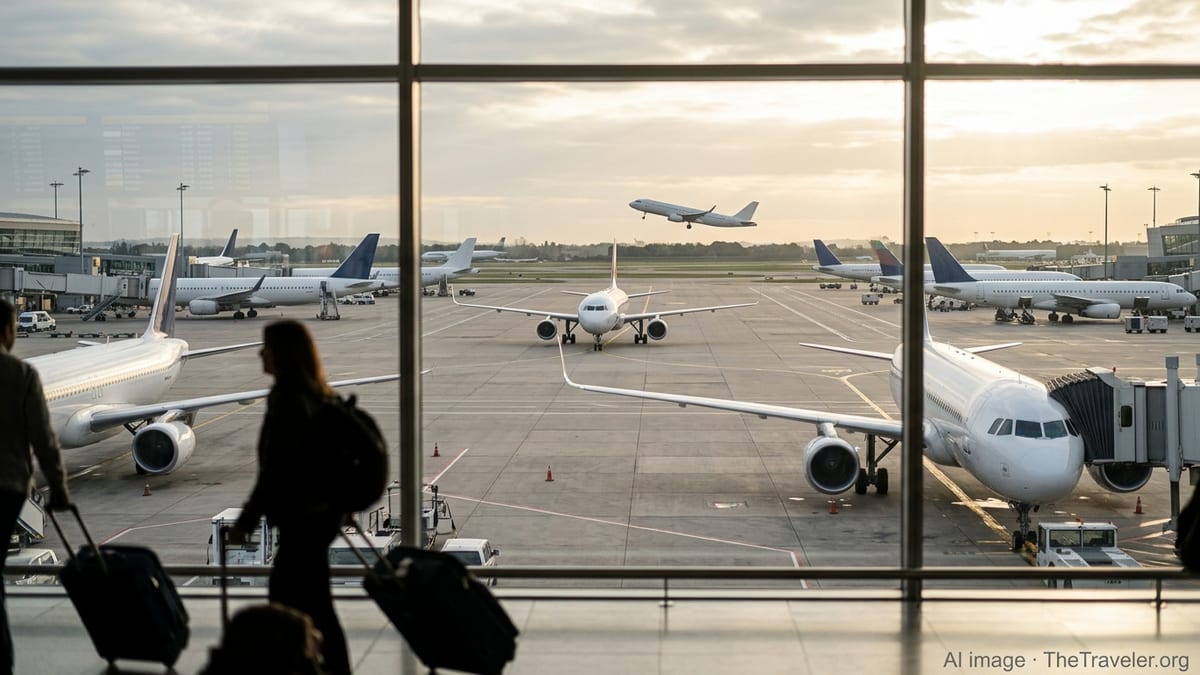
Aviation Forecasts Signal Pressure Point in 2026
Recent federal forecasts and industry analysis point to 2026 as a pivotal year for U.S. aviation, with passenger volumes moving further above pre‑pandemic levels while operational capacity remains constrained. The latest Aerospace Forecast from the Federal Aviation Administration projects continued growth in system passengers through the decade, underpinned by a steadily expanding U.S. economy and resilient domestic demand. That growth is expected to push already busy hubs closer to their operational limits unless networks are rebalanced and infrastructure pressures are addressed.
Published data shows that U.S. system passengers in 2025 already exceeded 2019 levels, particularly on domestic routes, even as airlines contended with staffing shortages, air traffic control constraints and aging infrastructure. Regulators and carriers now appear to be using that experience as a template for 2026 planning, prioritizing schedule realism and network resilience over raw capacity growth. The shift marks a departure from the rapid ramp‑up that followed the pandemic recovery, when some carriers pursued aggressive expansion that later collided with operational bottlenecks.
Industry outlook reports from consulting and finance firms describe an environment where demand remains strong, but tolerance for service meltdowns has sharply diminished among both travelers and policymakers. Airlines are being pushed to design networks that can withstand weather disruptions, staffing variability and regional conflicts that can abruptly close portions of global airspace. In that context, the concept of a fortified, fortress‑style network has gained traction as carriers consolidate strength at key hubs and add redundancy to domestic and near‑international flows.
Fortress Hubs and Flight Caps Reshape Network Maps
Across the country, major hubs are being reengineered to serve as more resilient control points in airline networks. Chicago O’Hare, projected by federal data to handle more than 3,000 flights on peak days in summer 2026, has become a test case for tighter coordination between regulators and airlines. Adjusted scheduling and capacity management at O’Hare are intended to curb chronic congestion and reduce the risk of cascading delays that can ripple across the national system.
On the East Coast, extended federal limits on flights at Newark Liberty International Airport are continuing to influence airline strategy through at least late 2026. Earlier seasons saw severe delays, long tarmac waits and elevated cancellation rates as staffing shortages and construction intersected with heavy traffic. The present flight caps are forcing carriers to concentrate operations, prioritize higher‑value routes and channel more connecting traffic through alternative hubs viewed as more stable.
These measures are part of a broader move toward what analysts describe as a fortress network model. Rather than spreading growth thinly across many congested airports, airlines are focusing on a smaller number of highly defended hubs where they control a strong majority of capacity, can command operational resources and can more easily reroute passengers when disruptions occur. The approach is visible in the way several large carriers are reinforcing primary hubs in Dallas–Fort Worth, Atlanta and Charlotte while trimming frequencies at secondary, delay‑prone airports.
Carriers Trade Hypergrowth for Reliability and Strategic Expansion
While aggregate capacity is still rising, the pattern of growth is changing. Public statements and investor presentations from U.S. carriers in recent months highlight a pivot from hypergrowth to disciplined expansion anchored in reliability metrics. Frontier Airlines, for example, has outlined a 2026 reset that emphasizes a smaller, more efficient fleet, higher completion factors and targeted route additions instead of the rapid, wide‑ranging expansion that characterized its earlier strategy.
Other operators are taking a different path to the same objective. Breeze Airways has emerged as one of the fastest‑growing carriers in the U.S. by focusing its 2026 network on underserved city pairs and secondary airports, often using new Airbus A220 aircraft to stitch together mid‑sized markets that bypass crowded hubs entirely. This point‑to‑point emphasis is intended to relieve pressure on traditional fortress hubs while creating new options for travelers who previously relied on connections through the largest airports.
Allegiant and other leisure‑focused airlines are likewise adding nonstop links from regional airports to Florida, the Southwest and other holiday destinations, particularly in early and mid‑2026. Industry observers note that by lifting some leisure demand away from the biggest connecting hubs, these networks can act as safety valves, reducing the volume of discretionary traffic flowing through airports that are most vulnerable to systemic disruption.
Infrastructure, Scheduling and Technology Form a New Defensive Line
The effort to build a more resilient U.S. aviation network before 2026 also features a wave of infrastructure, scheduling and technology initiatives. Large carriers have announced multiyear investments in terminal modernizations and concourse expansions at key hubs, including major projects in Dallas–Fort Worth and Miami, aimed at easing pinch points at gates and security checkpoints. These physical upgrades are being paired with more conservative scheduling practices that limit peak‑hour congestion and provide additional buffer time for aircraft turns.
Operational data tools are playing an increasingly prominent role. Airlines and the FAA are deploying more sophisticated forecasting systems to anticipate storms, traffic imbalances and airspace constraints hours or even days in advance. According to published coverage, this allows network planners to preemptively trim schedules, reroute flights or reposition crews before disruptions escalate into widespread cancellations. Some carriers are also integrating customer‑facing technology that automatically rebooks passengers and offers alternative routings when irregular operations occur, reducing the strain on call centers and airport staff.
Regulators, for their part, are using flight caps, slot coordination and targeted staffing surges at control centers to help manage pressure at known chokepoints. Policy discussions around long‑term hiring for air traffic controllers and investments in navigation and surveillance systems indicate a recognition that network resilience requires both airline action and public‑sector support. Together, these measures form a layered defensive line intended to keep the system functioning even when parts of the network come under stress.
Balancing Growth Ambitions With the Risk of Travel Chaos
Looking ahead to the latter half of the decade, the U.S. industry faces a delicate balancing act. FAA projections anticipate moderate but steady growth in passenger numbers from 2026 onward, with domestic travel remaining the backbone of demand. Carriers are eager to capture that growth, including on new international routes and long‑haul leisure services, but they are under pressure from travelers, investors and regulators to avoid overextending the system.
Analysts note that several high‑profile operational meltdowns since 2022 have reshaped expectations around what constitutes acceptable performance. Large‑scale cancellation events, once viewed as rare and unavoidable, are now seen as strategic failures that can erase years of brand goodwill. As a result, airlines are increasingly willing to sacrifice some short‑term capacity in order to preserve on‑time performance and schedule integrity, a tradeoff that aligns with the emerging fortress network philosophy.
If the current wave of adjustments succeeds, the summer peaks of 2026 and 2027 could mark a turning point in how U.S. air travel weathers disruption. With fortified hubs, diversified point‑to‑point networks, more realistic schedules and deeper coordination with regulators, the U.S. aviation system is attempting to surround future travel chaos with layers of protection. For passengers, the outcome will be measured not in growth statistics but in fewer text alerts announcing that yet another flight has been canceled.