


More news on this day
Passenger traffic on US commuter rail systems is climbing back toward pre-pandemic levels, but at a slower pace than other transit modes, reflecting lasting shifts in work patterns and raising questions about how agencies should redesign peak-focused services for a more flexible, hybrid-commute era.
Get the latest news straight to your inbox!
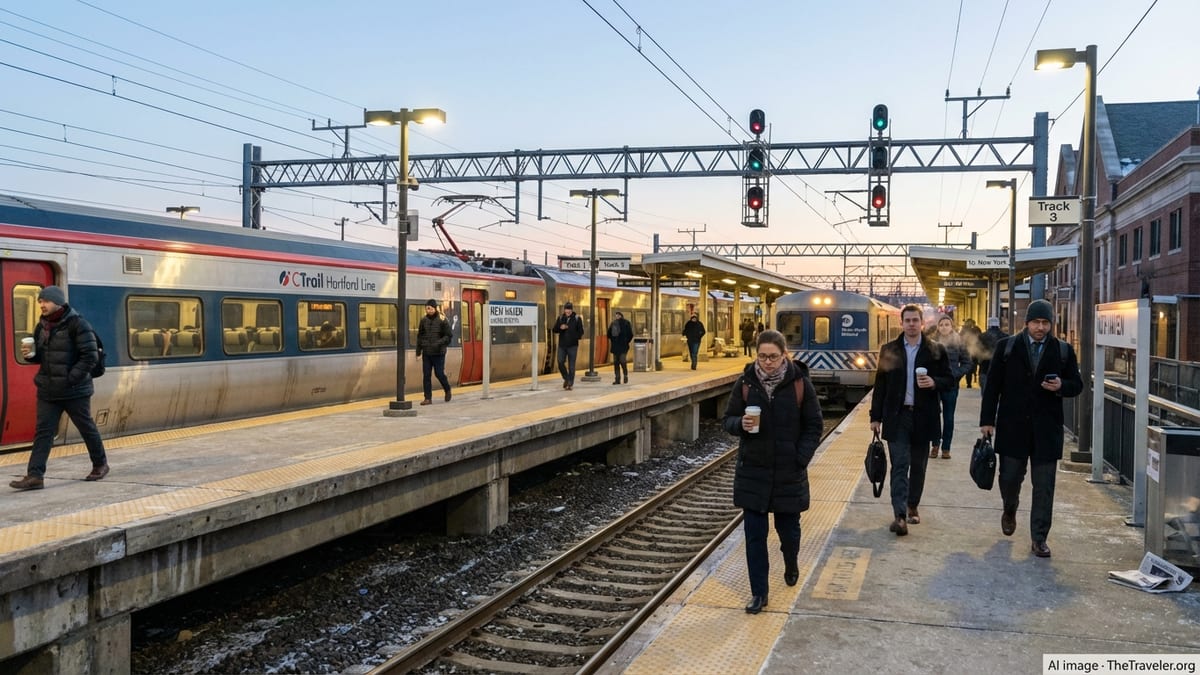
Recovery slows on traditional commute corridors
Recent national data compiled from the American Public Transportation Association and the Federal Transit Administration indicate that commuter rail remains one of the slowest transit modes to recover riders compared with 2019 benchmarks. By early 2024, analyses cited by transportation research groups placed commuter rail recovery at roughly two-thirds of pre-pandemic ridership, trailing bus and light rail, which have generally reached closer to four-fifths of former volumes.
Industry assessments describe a clear break from historic patterns. Before 2020, commuter rail lines into major downtowns were structured around dense peaks in the morning and evening, carrying office workers who traveled five days a week. Publicly available information now shows that hybrid schedules have flattened those peaks, with more riders traveling three or four days a week and spreading trips across a wider range of hours.
Reports from federal oversight agencies reviewing ridership and finance trends note that this structural change has slowed the return of traditional monthly pass holders, a crucial revenue source for commuter railroads. Even where overall passenger counts are improving, revenue per rider can lag because travelers are mixing discounted passes, occasional tickets, and promotional fares that were introduced to lure riders back.
Across the 31 US commuter rail systems tracked in recent nationwide evaluations, only a small group has fully matched or exceeded 2019 ridership to date. Smaller and fast-growing regions with diversified travel patterns appear to be recovering faster than legacy networks tied heavily to a single central business district, according to synthesized findings from think tanks and state planning documents.
Hybrid work reshapes peak demand and fare strategies
Transportation research organizations point to hybrid work as a primary driver of the lag in commuter rail usage. Studies of post-pandemic commute behavior suggest that telework has settled at roughly four times its pre-2020 share of workdays, sharply reducing the number of peak-period trips into downtown job centers. This is particularly acute in financial and professional-services hubs that once filled long rush-hour trains.
To adapt, many commuter rail agencies have adjusted schedules away from the sharp peaks that defined pre-pandemic operations. Public timetables now show more evenly spaced service during the day, additional off-peak and weekend trips, and in some cases scaled-back frequencies at the very height of rush hour. The intent is to capture a growing share of discretionary and non-work trips while still accommodating commuters who retain traditional office hours.
Fare policy has become another central tool. Several major commuter rail systems have rolled out flexible pass products, such as five- or ten-trip bundles designed for hybrid workers, alongside reduced off-peak fares. Publicly available announcements describe experiments with systemwide fare cuts, regional fare integration with buses and subways, and targeted promotions for events and airport travel, reflecting a broader push to treat commuter rail as an all-day regional service rather than a niche for nine-to-five office workers.
Analysts note that this transition carries financial risk. Federal emergency aid provided a temporary buffer for rail operators, but that funding is phasing down just as new travel patterns harden. Agencies must balance the goal of rebuilding ridership through lower or more flexible fares with the need to close structural budget gaps once extraordinary federal support ends.
Investment in rolling stock and corridors continues
Even as ridership recovery remains incomplete, significant capital investment is flowing into corridors used by commuter trains. The US Department of Transportation has highlighted billions of dollars in recent federal commitments for passenger rail, including funds from the Bipartisan Infrastructure Law that support rolling stock replacement, station accessibility upgrades, signal modernization, and capacity improvements on shared freight and passenger lines.
Grant announcements from the Federal Transit Administration show that several commuter rail systems are replacing aging railcars to improve reliability and accessibility. New equipment is intended to reduce maintenance-related delays, provide additional capacity for periods of renewed growth, and make trains more appealing to occasional riders accustomed to driving, particularly through features such as level boarding, improved climate control, and better onboard information systems.
On key intercity and regional corridors, commuter operators stand to benefit from federally backed projects that expand track capacity or remove bottlenecks. Investments on the Northeast Corridor and other high-traffic routes include new bridges, tunnels, and station reconstructions that are expected to reduce travel times and improve on-time performance for both commuter and intercity trains, potentially making rail a more competitive option against driving.
State rail plans released in the past year also describe targeted extensions of commuter rail lines, new infill stations, and passing tracks aimed at supporting higher frequencies. These projects often predate the pandemic but are being reassessed in light of updated ridership forecasts, with some states emphasizing flexibility so that infrastructure can support a mix of traditional commute trips and growing off-peak demand.
Regional contrasts highlight different recovery paths
The national picture masks sharp differences among regions and systems. According to compiled APTA data and state reports, commuter rail networks that serve diversified travel markets, including airports, universities, and suburban job clusters, are generally seeing stronger and more stable ridership growth than lines dedicated primarily to downtown office cores.
Some Sun Belt and Western commuter rail services, which entered the pandemic with lower baseline usage but strong population growth, have reported passenger levels at or above their 2019 totals. These systems often benefit from continued in-person employment in logistics, manufacturing, and service sectors, combined with highway congestion that makes rail an attractive alternative for longer trips.
By contrast, legacy networks in older metropolitan areas have contended with slower returns to downtown offices and prolonged construction or reliability issues on shared infrastructure. Public meeting materials and budget documents from these agencies frequently describe substantial uncertainty about long-term demand, leading planners to model multiple future scenarios rather than a single forecast.
Researchers emphasize that farebox recovery and broader economic conditions also shape regional outcomes. In higher-cost metropolitan areas where commuter rail has historically relied on premium pricing, some riders have shifted permanently to remote work or driving, particularly if parking remains subsidized by employers. In other regions, integrated fare policies and investment in feeder bus routes have helped sustain commuter rail by making it easier to complete door-to-door trips without a car.
What slower recovery means for riders and planners
The slower rebound in commuter rail passenger traffic is prompting agencies to rethink the fundamental role of these systems. Rather than focusing solely on weekday office workers, planning documents increasingly describe a vision of regional rail that serves a broader mix of riders throughout the day, including students, shift workers, and leisure travelers.
For riders, the shift may bring more frequent off-peak and weekend options, modernized trains, and improved stations, even if some peak-period express services are reduced or restructured. Passenger surveys summarized in agency reports suggest growing interest in reliability, cleanliness, and real-time information, reflecting a view of rail as one travel choice among many rather than a default.
For planners and policymakers, the central challenge is aligning long-lived rail investments with uncertain travel behavior. National statistics cited by federal agencies show that overall transit ridership is rising at a healthy pace year over year, but commuter rail’s lag underscores how deeply the traditional five-day commute has been disrupted. As hybrid work patterns stabilize, agencies are expected to continue refining service patterns, fare products, and capital plans to capture new types of trips.
The next several years will likely determine whether US commuter rail can transition from a narrowly defined rush-hour mode to a more flexible regional backbone. Passenger traffic trends so far suggest that recovery is possible, but will depend on sustained investment, careful attention to evolving travel needs, and a willingness to move beyond pre-pandemic assumptions about who rides and when.