


More news on this day
Thousands of air travelers across the United States are facing another turbulent day as live tracking data shows 116 cancellations and roughly 4,430 delays, snarling operations for Alaska, United, American, Delta, PSA and other airlines at some of the country’s busiest hubs.
Get the latest news straight to your inbox!
Major Hubs From Dallas to Seattle Log Heavy Disruptions
Publicly available flight-status dashboards for Wednesday, May 27 indicate that delays and cancellations are spread across a wide arc of major airports, including Dallas, Atlanta, Seattle, Newark, Denver, Houston, Washington, San Francisco and Detroit. The pattern reflects a familiar strain point in the US air travel system, where issues at just a handful of large hubs quickly ripple nationwide.
Industry data aggregators that track departures and arrivals in real time show that the bulk of today’s delays are concentrated within, into or out of the United States, with several thousand flights arriving late or departing behind schedule. While the precise mix between mainline and regional operations evolves throughout the day, the disruption is clearly broad-based rather than confined to any single airport or corridor.
Reports indicate that Dallas–Fort Worth, Atlanta’s Hartsfield–Jackson, Seattle–Tacoma, Newark Liberty, Denver International and Houston’s key airports are all working through queues of late-running services. Washington-area airports, including Reagan National, along with San Francisco and Detroit, are also reporting elevated delay counts, underscoring how congestion at coastal and interior hubs can compound each other.
Travel pattern analyses suggest that many of the affected flights are part of dense hub-and-spoke schedules, meaning a delay on one leg often cascades into missed connections and further schedule adjustments across the network. That dynamic translates raw delay numbers into a much larger passenger impact as travelers miss onward flights or are forced into extended rebooking windows.
Alaska, United, American, Delta and PSA Under Network Pressure
Today’s disruption is hitting several of the largest US carriers, with Alaska Airlines, United Airlines, American Airlines, Delta Air Lines and regional operator PSA Airlines all showing elevated delay counts on live tracking platforms. These airlines collectively operate a large share of departures at the affected hubs, which makes their performance a bellwether for the wider system.
For American and Delta, disruptions at Atlanta, Dallas, Detroit and other key cities are especially significant, because those hubs sit at the core of their domestic networks. United and Alaska are seeing knock-on effects through Denver, Houston, San Francisco and Seattle, where late-arriving aircraft can quickly compress already tight turnaround times and push subsequent departures further behind schedule.
Regional carrier PSA, which operates flights on behalf of larger brands, is also logged among today’s disrupted operators, particularly at East Coast hubs such as Washington. When regional affiliates encounter delays, travelers often experience them as disruptions to the mainline brand, even though the flights are operated by separate companies under capacity agreements.
Historical reporting from government air travel consumer data shows that these airlines typically maintain on-time performance rates in the upper 70 to upper 80 percent range over longer periods, with cancellations representing a small fraction of total operations. On intense disruption days such as this, however, even a modest rise in cancellations and a sharp increase in delays can translate into thousands of impacted passengers.
Weather, Congestion and Operational Constraints Intersect
Recent coverage of similar mass disruption days highlights a mix of contributing factors that often align to produce elevated cancellation and delay counts. These can include bands of unsettled weather that slow arrivals and departures, air traffic control initiatives that meter the flow of flights into crowded airspace, and airline-specific challenges such as maintenance backlogs or crew reassignments.
Analyses from aviation-focused outlets describing earlier events this month and in recent weeks have pointed to severe thunderstorms, low visibility and high winds as recurring triggers for large spikes in delays across multiple hubs. When such conditions appear at or near major connecting airports like Dallas–Fort Worth, Atlanta or Chicago, carriers may be required to hold departures on the ground or extend in-flight holding patterns, compressing schedules and creating downstream congestion.
Operational experts note that once a hub falls significantly behind schedule, recovering the timetable can take many hours even after weather improves. Aircraft and crews may be out of position for later flights, and airport resources such as gates, ground handling teams and deicing equipment can become bottlenecks. The result is that passengers may still be facing delays long after the original triggering event has passed.
In today’s case, the distribution of disruptions across multiple cities suggests both localized weather and broader congestion are likely in play, rather than a single nationwide outage or technical problem. Tracking tools show scattered delays across regions rather than a uniform halt, indicating that airlines and air traffic managers are attempting to maintain movement while balancing safety and flow-control requirements.
Passenger Impact: Missed Connections and Overnight Stays
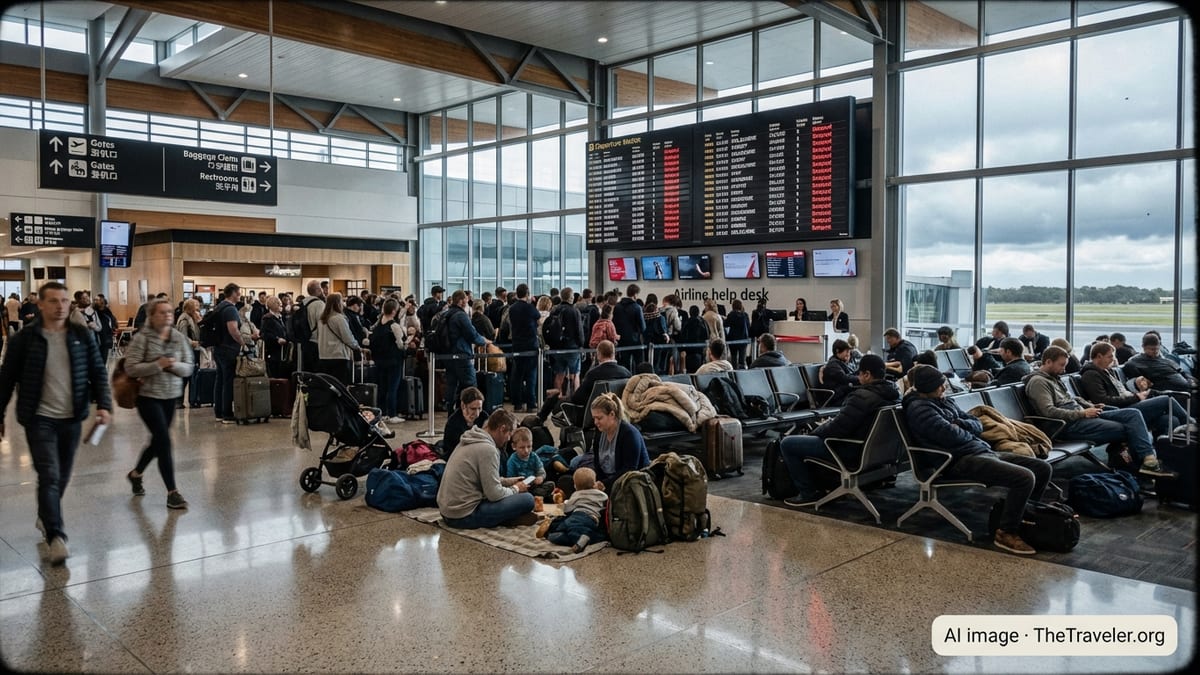
For travelers, the operational numbers translate into long lines at customer service counters, crowded gate areas and a surge of same-day itinerary changes. With more than four thousand flights running late and over one hundred canceled, many passengers are reporting tight or missed connections, extended tarmac waits and unexpected overnight stays in hub cities.
Recent guidance summarized by consumer advocates during previous disruption events emphasizes that the immediate options often depend on the cause of the delay and each airline’s individual policies. In cases where weather is a key factor, cash compensation is generally limited, but airlines may offer rebooking on the next available flight and, in some cases, meal or hotel vouchers when delays stretch deep into the night.
Publicly available information from the US Department of Transportation’s airline customer service dashboard highlights that policies on meals, hotel accommodations and ground transport vary widely between carriers, especially when disruptions are classified as outside the airline’s control. Travelers are encouraged to review airline commitments and to retain receipts for any essential out-of-pocket expenses that arise while waiting for new flights.
Passenger-rights services and legal information platforms also note that travelers on international itineraries connecting through US hubs may fall under a different set of protections, particularly when flights to or from certain foreign jurisdictions are involved. That can occasionally broaden options for reimbursement or rerouting, but it can also add complexity as rules differ between countries and between domestic and international segments.
What Travelers Can Do Right Now
With cancellations and delays still evolving throughout the day, aviation analysts and travel advisors consistently recommend that passengers monitor their flight status frequently through airline apps and independent tracking services. These platforms often update more quickly than airport departure boards, enabling travelers to adjust plans before they reach the airport or while they are in transit.
Where possible, same-day travelers are advised to allow extra time for security screening and to prepare for potential gate changes, longer boarding windows and reissued boarding passes as airlines reshuffle aircraft and crews. For those with tight connections through heavily affected hubs such as Dallas, Atlanta, Seattle or Newark, it may be beneficial to proactively speak with airline agents or use digital tools to explore alternative routings.
Recent disruption-day coverage also highlights the value of flexibility, such as traveling with carry-on luggage only when practical, so that passengers can move more easily between flights without waiting at baggage claim. Travelers booked on later services may find that voluntarily moving to earlier or less congested flights, if available, helps avoid the worst of peak delays.
As the day progresses, the key indicators to watch will be whether total delay counts begin to plateau and decline and whether cancellation numbers stay contained. For now, the combination of 116 cancellations and more than 4,400 delays underlines how quickly America’s air travel network can become strained when multiple hubs and major carriers face pressure at the same time.