


More news on this day
Non European travelers heading to Europe this summer are running into a major change at passport control, as the region’s new biometric border system beds in with a mix of delays, confusion and patchy implementation.
Get the latest news straight to your inbox!
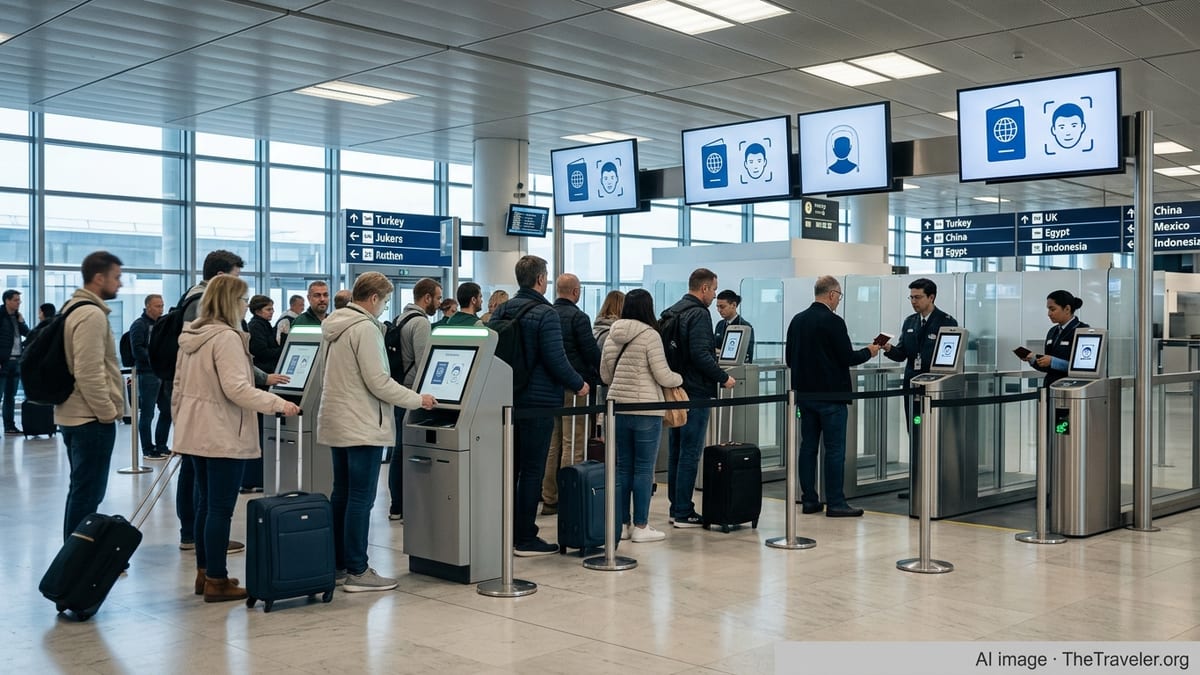
What the New Entry Exit System Actually Does
Europe’s new Entry Exit System, widely referred to as EES, is a digital border database that replaces manual passport stamping for most non EU nationals entering or leaving the Schengen area and several associated countries. Instead of a simple ink stamp, travelers are now enrolled with biometric data, including a facial image and digital fingerprints, alongside passport details and the exact time and place of entry and exit.
Publicly available information from European institutions indicates that the system began a phased launch on 12 October 2025 and is gradually being activated across external air, land and sea borders. The goal is to create a single record of every short stay, making it easier to enforce the region’s 90 days in 180 days rule, detect overstays and reduce identity fraud.
For individual travelers, however, the most visible change is at the checkpoint itself. First time visitors under the new rules must complete a one off biometric registration before being cleared, a process that can take several minutes per person when technology or staffing is under pressure. Subsequent trips within three years can be faster because the data is already stored, but reports suggest that many travelers are only now encountering EES for the first time as they head into the 2026 peak season.
Early Rollout Brings Bottlenecks at Airports and Ports
Industry groups and travel providers have been warning for months that introducing new biometric steps in the middle of a busy travel cycle would test already stretched infrastructure. Airport trade bodies cited analyses in late 2025 showing that border control processing times at some hubs rose by as much as 70 percent during initial trials, with waiting times stretching to several hours during peak periods.
Those concerns have begun to materialize. Coverage from various European outlets in recent weeks describes passengers at major airports facing extended queues at dedicated EES kiosks before they can even reach a border officer. Short haul leisure travelers with tight schedules are proving particularly vulnerable, with some reports of missed departures after biometric lines moved more slowly than expected.
Sea crossings are also feeling the impact. At the Port of Dover, a key gateway between Britain and France, long vehicle lines built up during a recent holiday weekend as French border staff collected EES data from non EU passengers before boarding. Public reports note that wait times eased only after the additional checks were temporarily scaled back, highlighting how quickly the new procedures can strain older terminals that were never designed for mass biometric capture.
Patchwork Implementation Leaves Travelers Guessing
Although EES is an EU wide project, its rollout has been intentionally progressive, leaving member states with some discretion over timing and local procedures. Official documents describe a multi month transition period, during which border posts can ramp up from limited testing to full biometric enrollment. In practice, that has created a patchwork of experiences that is confusing many visitors.
At some airports and ferry ports, biometric kiosks and automated gates are already fully in use for non EU arrivals, and passengers are being told to expect the new checks every time they cross. At others, hardware is in place but only activated during quieter hours, with officers reverting to old style passport stamps at peak times to keep queues moving. Land crossings and smaller regional airports are often further behind, meaning that even frequent travelers struggle to predict what will happen at a given checkpoint.
The picture is complicated further by differing approaches to temporary relief. Recent coverage from Greece and other Mediterranean destinations indicates that authorities there intend to keep EES operational but may suspend the biometric steps during intense summer peaks if lines become unmanageable. Neighboring countries including Italy and Portugal have publicly signaled that they do not plan blanket exemptions for particular nationalities, adding to the sense that rules can change from one border to the next.
Families, Transit Passengers and UK Travelers Hit Hardest
While most non EU visitors are subject to the same basic procedures, some groups are experiencing more disruption than others. Families with young children are finding that the requirement to capture fingerprints and photographs for each traveler adds complexity, particularly when kiosks are not well adapted for smaller passengers. Reports from early test weekends in countries such as Italy suggest that multi generational groups can take significantly longer to process than solo business travelers.
Transit passengers and those with short connection times are another pressure point. Airlines and airport operators have highlighted cases where travelers transferring between non EU and Schengen flights underestimated the time needed to clear EES enrollment on their first arrival. When small technical glitches arise at kiosks, the additional minutes can quickly erode the margin for making a tight onward flight, especially at already congested hubs.
British travelers, who moved from EU free movement to third country status after Brexit, are now firmly within the EES framework. Travel advisories and media coverage in the United Kingdom describe a wave of confusion, with some holidaymakers unaware that their first post launch trip to Europe would involve biometric registration. Given the heavy flow of UK leisure traffic to Spain, Portugal, Greece, France and Italy each summer, even modest extra processing times per person have the potential to create sustained queues at popular resorts.
How Travelers Can Prepare for a Rough First Summer
Despite the teething problems, European institutions and industry bodies continue to frame EES as a long term investment that will eventually speed up crossings once most regular visitors are enrolled and automation matures. For the 2026 summer season, however, the consensus in publicly available analyses is that travelers should plan for a system that is still finding its feet.
Practical advice from airports, airlines and travel organizations converges around a few core recommendations. Non EU passengers are being urged to arrive earlier than they might have in previous years, especially for morning wave departures and peak weekend sailings. Choosing routes that offer more generous connection times, and avoiding very tight self made transfers between terminals or modes, can provide a buffer if biometric registration takes longer than expected.
Travelers are also being encouraged to pay close attention to guidance from their departure airport, carrier and destination country in the weeks before travel, since local rules on kiosk use, pre registration options and potential exemptions are still evolving. As more border posts complete their first wave of enrollments and refine procedures, experiences should gradually stabilize, but for now Europe’s ambitious biometric border upgrade is introducing as many headaches as it aims to solve.