


More news on this day
The United States is keeping 11 African nations on its highest Level 4 “Do Not Travel” advisory list following a November 9 update, underscoring persistent security, health and political risks that global travelers must weigh when planning trips to the continent.
Get the latest news straight to your inbox!
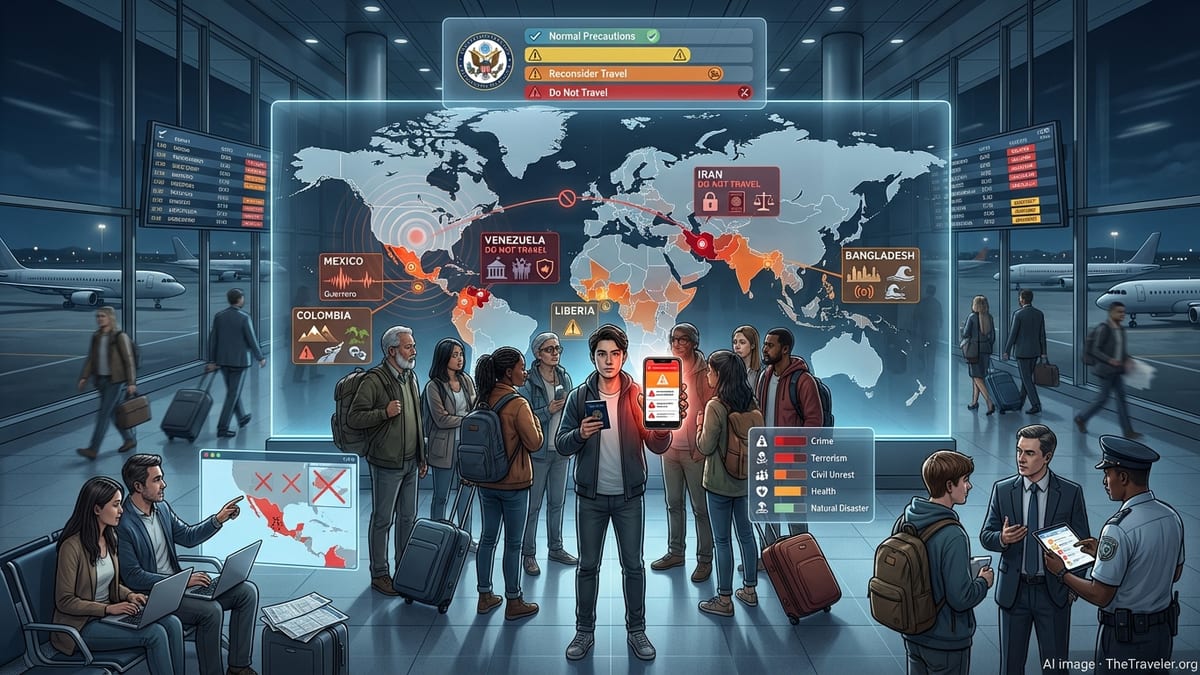
Which African countries remain at Level 4
Publicly available data compiled from the U.S. State Department’s advisory feed and recent media coverage indicates that 11 African states are currently covered by an overall Level 4 “Do Not Travel” advisory. As of November 9 and 10, 2026, these are Burkina Faso, Central African Republic, Chad, Democratic Republic of the Congo, Libya, Mali, Niger, Somalia, South Sudan, Sudan and Uganda.
A live tracker of U.S. advisories drawing on the State Department’s feed lists these 11 alongside non-African destinations such as Afghanistan, Iran, Russia, Syria, Ukraine and Yemen at Level 4 on November 10, 2026. While Gaza is also listed at Level 4, it is not counted among the African total. The State Department’s own advisory pages for countries including Central African Republic, Chad, Mali and Somalia describe a combination of armed conflict, terrorism, crime, kidnapping and limited consular access as key reasons for the highest alert level.
Regional coverage from African and international outlets notes that the latest update did not newly add most of these states but instead reconfirmed existing Level 4 status, in some cases stretching back several years. Uganda’s presence on the list, for example, has drawn particular attention in tourism-focused reporting, as the country is simultaneously promoted internationally for wildlife tourism and adventure travel.
The November 9 advisory refresh came shortly before the U.S. government implemented a separate federal health order affecting passengers who have recently transited the Democratic Republic of the Congo, reflecting how security and health considerations can overlap in shaping official risk assessments.
What a Level 4 advisory actually means for travelers
According to State Department guidance documents and travel-advisory FAQs, Level 4 represents the highest of four advisory categories and is reserved for destinations where there is a greater likelihood of life-threatening risks. The department advises that U.S. citizens not travel to countries under Level 4 and, if already present, depart when it is safe to do so. Officials also stress that the U.S. government may have very limited ability to provide assistance on the ground when conditions deteriorate.
Background material on the advisory system explains that Level 4 decisions can be based on factors such as widespread armed conflict, terrorism, crime, civil unrest, health emergencies, natural disasters, or a combination of these risks. In some cases, specific regions within a country may be assessed at an even higher level than the national rating, but an overall Level 4 advisory signals that severe threats are not confined to one isolated area.
Despite the strength of the language, State Department documents clarify that a Level 4 designation does not legally prohibit private travel. Airlines may continue serving affected destinations, and some tour operators still run trips where local partners believe conditions are manageable. However, the warning can influence travel insurance coverage, employer travel policies and university risk thresholds, which often treat Level 4 countries as off-limits for organized travel.
Information portals hosted by U.S. government agencies urge prospective travelers to review country advisories in detail, enroll in the Smart Traveler Enrollment Program, and consider how they would respond if commercial flights were suspended or if communications networks failed in a Level 4 environment.
Diverse risks behind the African Level 4 list
The 11 African countries currently at Level 4 share the same headline designation, but underlying conditions differ considerably from state to state. In the Central African Republic, Mali, Niger, Somalia, South Sudan and parts of the Democratic Republic of the Congo, long-running internal conflicts, the presence of armed groups, and limited state control over territory feature heavily in external risk assessments.
Advisory texts for Libya and Sudan emphasize active fighting, political instability and unpredictable security conditions, including airstrikes, clashes between armed factions and frequent disruptions to basic services. In Burkina Faso and Chad, reported concerns include attacks by extremist organizations, roadside bombs and incidents targeting both security forces and civilians, especially in border regions.
Uganda’s listing has a different profile in some recent coverage. Reports highlight a mix of domestic security challenges and spillover concerns linked to violence and health emergencies in neighboring Democratic Republic of the Congo, including an Ebola and Bundibugyo virus disease outbreak that has driven a separate “avoid all travel” notice from the U.S. Centers for Disease Control and Prevention for certain eastern DRC provinces. Analysts note that while most tourist itineraries in Uganda are far from the affected border zones, risk calculations can still be influenced by cross-border movement and regional instability.
Across much of the Level 4 group, constrained medical infrastructure, limited evacuation options and, in some cases, the temporary closure or reduced staffing of foreign embassies heighten perceived risk. These structural factors mean that even localized incidents can escalate quickly for visitors without robust contingency plans.
Impact on tourism, aviation and regional economies
The persistence of 11 African countries on the U.S. Level 4 list comes at a challenging time for regional tourism boards and airlines trying to rebuild long-haul traffic. Industry commentators point out that while Americans can, in theory, still book travel to Level 4 destinations, many large U.S.-based operators avoid marketing trips that would contradict the advisory language.
Destination marketing organizations in East and Central Africa have been working to distinguish relatively stable national parks and safari circuits from higher-risk border areas. However, when an entire country appears in red on widely shared advisory maps, that nuance can be lost. Tourism businesses in neighboring Level 2 and Level 3 countries also express concern in media interviews that some travelers may choose to avoid whole regions of Africa when headlines highlight Level 4 warnings.
Airlines factor government advisories into route planning alongside operational and insurance considerations. On some Level 4 routes, foreign carriers have scaled back direct services, leaving travelers more dependent on multi-stop itineraries through regional hubs. This in turn can increase journey times and costs for essential travel, including humanitarian, business and diaspora trips that continue despite the warnings.
Economists who track African tourism and investment flows note that sustained perceptions of insecurity can discourage not only leisure travel but also hotel development, conference bookings and foreign direct investment. In countries already grappling with conflict or political transition, the loss of high-spending international visitors and business travelers can further strain fragile public finances.
How travelers can monitor changes and assess personal risk
Security analysts and travel-risk specialists emphasize that official advisories are only one tool among many for assessing whether a trip is appropriate. Travelers considering essential journeys to or near Level 4 countries are encouraged in public guidance to combine multiple sources: State Department advisories, CDC health notices, local news, airline bulletins and information from reputable risk-intelligence providers.
One independent tracking site that aggregates official data from the United States, United Kingdom and Canada shows updates checked approximately every 30 minutes, illustrating how quickly conditions can shift. Changes in advisory levels are logged with dates, offering a historical view of whether a country has been steadily high-risk or has only recently spiked due to a specific crisis.
Travelers who decide to proceed to nearby but lower-level destinations often adjust itineraries to avoid land borders with Level 4 states, schedule extra connection time in regional hubs, and confirm that their travel insurance does not exclude cover for incidents linked to war, terrorism or disease outbreaks. Some policies stop covering non-essential trips once a Level 4 advisory is in place, while others maintain benefits provided the trip was booked before the advisory changed.
As of November 10, 2026, the U.S. Level 4 roster for Africa remains unchanged from the latest update, but observers expect that both upgrades and downgrades are possible in the months ahead as security and health situations evolve. For now, the presence of 11 African nations on the highest warning tier serves as a stark reminder that travelers need to match their risk tolerance and preparation levels to on-the-ground realities, not just to flight schedules and promotional imagery.