


More news on this day
The United States has raised its travel advisory for Venezuela to the highest Level 4 category, warning Americans not to travel to the country and urging those already there to consider immediate departure amid heightened security and political risks.
Get the latest news straight to your inbox!
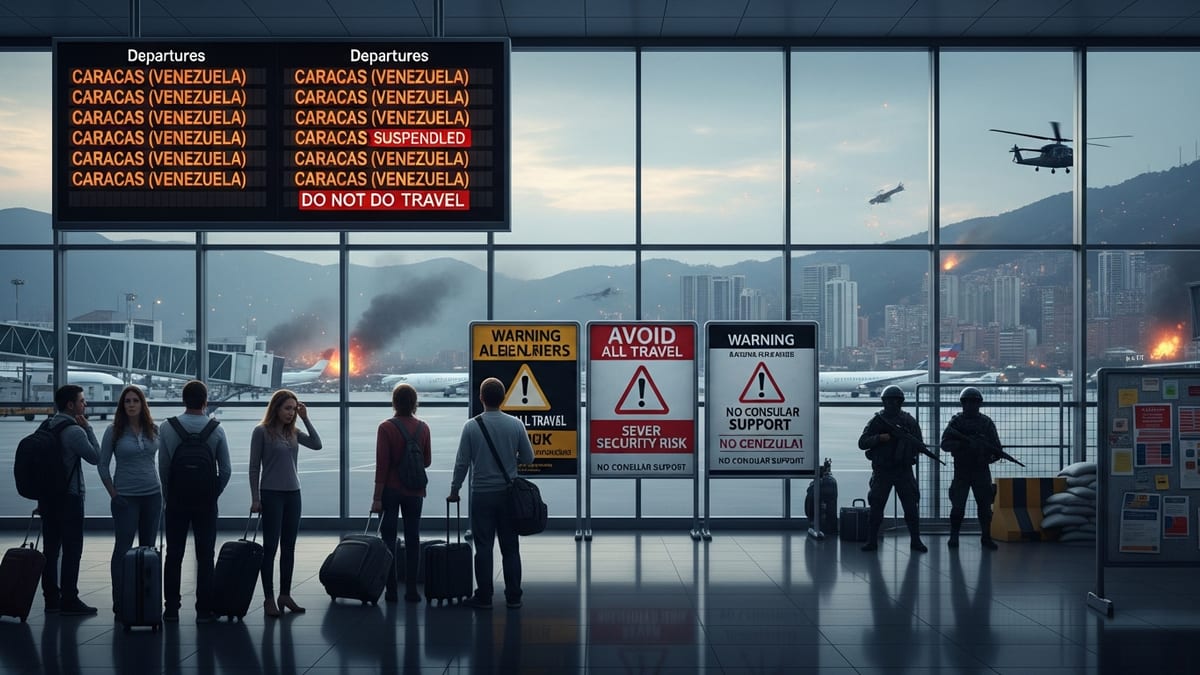
Advisory Raised Back to Level 4: Do Not Travel
The latest advisory moves Venezuela back into the U.S. State Department’s most severe risk category, Level 4: Do Not Travel. Publicly available information indicates that the decision follows a fresh review of security conditions, human rights concerns and instability linked to the evolving crisis between Washington and Caracas.
According to recent State Department travel guidance, a Level 4 advisory signals a greater likelihood of life-threatening risks, and warns that U.S. government assistance inside the country may be severely limited. Level 4 is typically reserved for destinations facing armed conflict, widespread crime, or breakdowns in essential services, and it is the highest warning U.S. travelers can receive.
Previous advisories for Venezuela had already highlighted chronic security issues, but the latest change formalizes a renewed assessment that conditions for visitors have deteriorated further. The new notice underscores that travel to Venezuela is strongly discouraged for tourism or nonessential purposes.
Reports indicate that the reassessment came after a period in which officials briefly considered easing restrictions as limited diplomatic and commercial links showed signs of reopening. That window has now effectively closed, with the United States again directing its citizens to avoid travel.
Escalating Security Concerns on the Ground
Recent alerts describe a complex mix of security threats for foreign visitors, ranging from political volatility to the activities of armed groups and criminal networks. Published coverage notes that informal militias and pro-government collectives have been reported at roadblocks on key routes, heightening the risk of confrontations for travelers moving between cities or to border crossings.
Urban crime remains a major concern, with longstanding issues such as carjackings, kidnappings, armed robberies and home invasions frequently cited in open-source security assessments. The overall environment, combined with intermittent shortages of basic goods and fuel, has made it more difficult for residents and visitors alike to move safely around the country.
Publicly available advisories also warn that detention risks have grown more acute, particularly for foreign nationals who might be perceived as having links to political or security interests. Reports point to cases of lengthy detentions, interrogation and limited access to legal safeguards, contributing to the decision to reinforce the highest advisory level.
In addition, regional tensions and the prospect of further confrontations around the U.S. intervention in Venezuela have raised fears that travelers could be caught up in fast-moving developments. Analysts tracking the situation emphasize that rapid changes on the ground could impact access to airports, major highways and border crossings with little advance warning.
Limited Consular Support and Flight Disruptions
The updated advisory stresses that, in a Level 4 environment like Venezuela’s, U.S. consular support is significantly constrained. The absence of a fully functioning embassy presence inside the country, combined with security and logistical barriers, limits the ability of U.S. personnel to reach citizens who encounter trouble.
Travel information provided by the U.S. government explains that in such contexts, emergency assistance may be delayed or impossible. Evacuation options are particularly uncertain when commercial flights are reduced and airspace controls become entangled in wider political disputes.
The situation around air connectivity has been fluid. Public documents show that the United States and Venezuela previously discussed reestablishing direct air links, and some international flights had begun to resume via regional hubs. Subsequent instability, however, has complicated these efforts, with both sides periodically restricting routes and carriers in response to broader diplomatic tensions.
Travel experts note that reliance on connecting flights through neighboring countries, followed by overland transfers, exposes travelers to additional risks. Road journeys from border regions into major Venezuelan cities are frequently cited as among the most vulnerable legs due to crime, checkpoints and varying levels of state control.
Health System Strain and Infrastructure Challenges
Beyond immediate security threats, health and infrastructure conditions are central to the upgraded advisory. International assessments continue to describe a healthcare system under heavy strain, with shortages of medicines, equipment and specialized staff undermining the country’s capacity to handle routine and emergency care.
The State Department’s general guidance on Level 4 destinations highlights that limited medical resources can quickly become a critical problem during crises, accidents or disease outbreaks. For travelers, this means that serious illness or injury may require medical evacuation, which can be complex, costly and, in some cases, not feasible.
Power outages and interruptions in water supply have also been widely documented, affecting everything from hospitals and airports to hotels and telecommunications. These disruptions can impede communication with family and support networks outside the country, and may complicate any attempt to leave quickly if circumstances deteriorate further.
Travel risk analysts caution that these systemic issues are unlikely to be resolved in the short term. While some areas may appear calm day to day, the combination of fragile infrastructure and limited institutional capacity leaves Venezuela vulnerable to sudden shocks, an underlying factor in the continued Level 4 designation.
What the Advisory Means for Travelers and the Industry
For individual travelers, the renewed Level 4 status carries clear implications. The advisory signals that nonessential trips should be canceled or postponed, and that those currently in Venezuela should carefully assess their personal safety, access to reliable transport, and the feasibility of departure options.
Travel insurers often treat Level 4 destinations as high-risk markets, and some policies may exclude coverage for incidents that occur after a warning is issued or raised. Industry observers expect that tour operators and airlines will continue to scale back offerings that involve Venezuelan destinations, further limiting choices for would-be visitors.
For the broader travel sector, the move underscores how quickly geopolitical and security dynamics can reshape route networks across Latin America. Carriers and booking platforms must continuously recalibrate schedules, risk assessments and refund policies as advisories change, while travelers are reminded of the importance of monitoring official guidance up until the day of departure.
Regional tourism bodies and neighboring countries are also watching developments closely, as shifting flows from Venezuela-bound traffic can affect demand patterns across nearby hubs. For the foreseeable future, however, the latest U.S. advisory makes clear that Venezuela will remain effectively off-limits for most American travelers.