


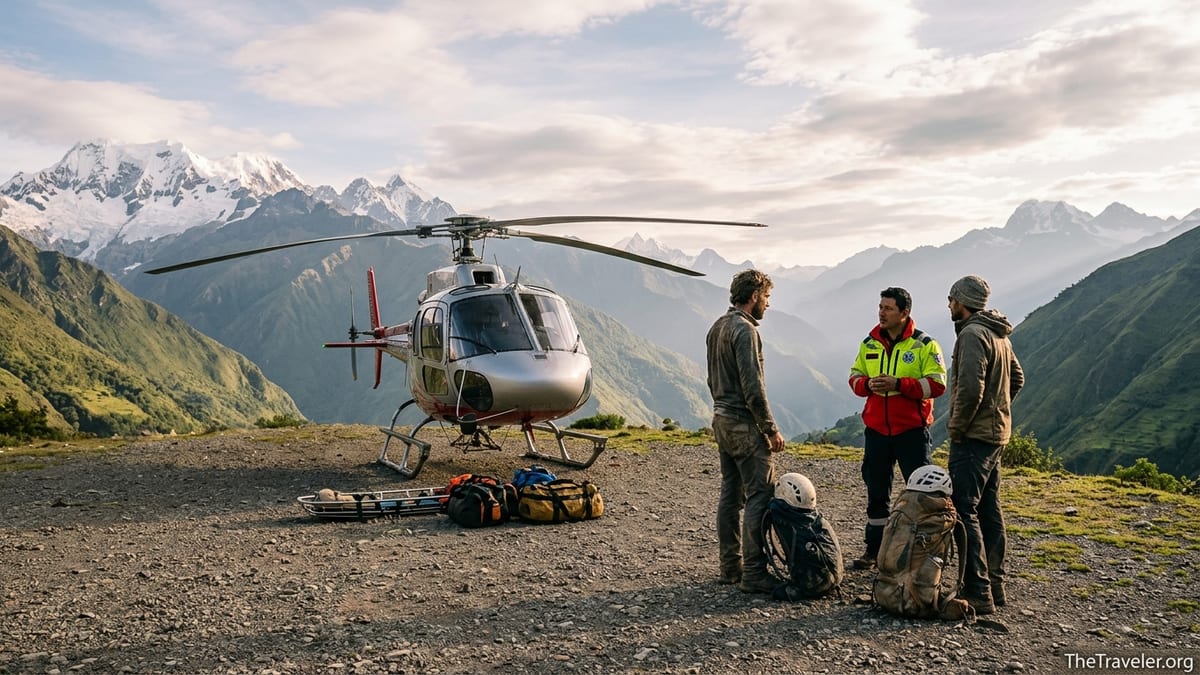
For many travelers, Ripcord is the name that comes up when planning remote expeditions, high-altitude treks, or off-the-grid safaris. It combines emergency rescue and evacuation with optional comprehensive travel insurance, and it is marketed squarely at people going far beyond city breaks and beach resorts. If you are thinking about using Ripcord travel insurance for the first time, understanding how it actually works on the ground can make the difference between peace of mind and expensive surprises.
Get the latest updates straight to your inbox!
What Ripcord Actually Is And Who It Is For
Ripcord Rescue Travel Insurance is a specialized product built for adventure and remote-area travel rather than casual city getaways. It is offered in partnership with Redpoint Resolutions, a company that runs medical and security evacuations worldwide. In practice, that means Ripcord is as much a rescue and logistics provider as it is an insurance brand. Instead of just reimbursing you after the fact, its operations team can arrange helicopters, ground transport, and medical flights when things go wrong far from home.
For a first-time buyer, it helps to picture real trips rather than abstract coverage. Think about a weeklong climbing course in the North Cascades, a 10-day safari in Tanzania that includes bush flights and remote tented camps, or a trek to Everest Base Camp with several days above 14,000 feet. These are the kinds of itineraries where Ripcord is most commonly recommended, because conventional travel insurance often stops at the “nearest appropriate facility,” while Ripcord policies can include evacuation all the way back to your home hospital, subject to policy terms.
Ripcord is available to most U.S. residents, though at the time of writing it is commonly noted as not being sold in a few states such as New York, Alaska, Maryland, and South Dakota, and it cannot cover travel to certain sanctioned countries. If you live in or are traveling to one of those places, you may need to look at alternative providers. But for a Colorado skier headed to Chile or a California climber flying to Nepal, Ripcord is squarely in its element.
It is also important to understand what Ripcord is not. It is not a basic budget travel policy for a long weekend in Paris, and it is not a simple medical evacuation membership like some low-cost air ambulance programs. Ripcord’s strength is in combining substantial evacuation limits with the option to add traditional trip insurance benefits, but you pay a premium for that focus.
Key Coverages First-Time Buyers Should Understand
For most travelers, Ripcord’s headline feature is its medical evacuation and rescue benefit. Recent plan summaries commonly show evacuation limits around the hundreds of thousands of dollars per person, often cited around 750,000 dollars of combined evacuation protection on comprehensive plans. That matters because a helicopter rescue from a Himalayan valley or a medical air ambulance from East Africa to Europe can run into the high five or even six figures, particularly if you need a medical team on board.
Alongside evacuation, Ripcord policies typically include emergency medical expense coverage, often around 100,000 dollars on many brochures. That kicks in if you break an ankle on Kilimanjaro and need surgery in Moshi, or if you develop severe altitude sickness in Peru and require a few days in a private clinic in Cusco. For U.S. travelers, who often find that domestic health insurance excludes or limits overseas care, this medical benefit can be just as important as the evacuation piece.
Many Ripcord plans also bundle standard travel insurance benefits: trip cancellation up to 100 percent of insured trip cost, trip interruption (commonly up to around 150 percent of trip cost), baggage delay and loss, travel delay, missed connections, and accidental death and dismemberment. There is usually an option to add Cancel For Any Reason coverage that reimburses a portion, often around 75 percent, of your trip cost if you cancel for a reason not otherwise covered, such as changing your mind about political risk in a destination.
However, exclusions matter. Ripcord brochures typically list certain very high-risk sports such as BASE jumping, hang gliding, or technical cave exploration as excluded. A recent public statement from an expedition operator in the European Alps also noted that some highly technical high-altitude expeditions were not accepted for coverage despite Ripcord’s adventure branding. If you are joining a 7000-meter peak climb, a ski-mountaineering trip above 6,000 meters, or a polar expedition, you need to have a very specific conversation with Ripcord or a broker about whether that exact itinerary is insurable.
How Pricing Works, With Realistic Cost Examples
Ripcord is typically more expensive than mass-market travel insurance, and first-time buyers are often surprised by the quotes. Pricing is based mainly on your age, total insured trip cost, trip length, and destination risk. Comprehensive travel insurance with evacuation is often described as costing somewhere in the range of 5 to 11 percent of your trip price for many travelers, though your personal quote may fall outside that band.
Consider a 45-year-old traveler from California booking a 10-day guided trek to Everest Base Camp priced at 4,000 dollars, plus 1,500 dollars in flights, for a total insurable cost of 5,500 dollars. A comprehensive Ripcord policy that includes cancellation, medical, and rescue could easily run a few hundred dollars for this itinerary. By contrast, a more basic travel insurance plan without specialized rescue might come in closer to mid-hundreds for the same trip. You are paying extra for the higher evacuation limits and the adventure focus.
Now look at a simpler case: a 35-year-old skier going to Japan for a week of resort skiing with some sidecountry runs, total trip cost around 3,000 dollars. A medical evacuation and rescue only option from Ripcord, where available, might start a little over a hundred dollars for a week according to older pricing examples, while newer plan years show many travelers paying more once age and risk factors are included. An annual evacuation-only plan can cost several hundred dollars but might make sense if that same skier also has trips planned to Chile and the Alps in the same year.
Finally, pricing can vary for family trips. A couple in their 60s taking a 15,000 dollar Galapagos cruise might see quotes that feel high compared to online “cheap insurance” ads but remain modest when you compare them to the potential cost of a helicopter evacuation from a small island to mainland Ecuador and then an air ambulance to Miami, which can reach over 100,000 dollars without any insurance in place. The key for first-time buyers is to compare the premium not only to trip cost but to realistic worst-case bills.
Real-World Scenarios: How Ripcord Works When Things Go Wrong
The easiest way to understand Ripcord on your first purchase is to trace through real-world scenarios. Consider a guided climbing trip to Ecuador that includes three peaks over 5,000 meters. On summit day of Cotopaxi, a climber slips on ice, breaks a leg, and cannot be safely walked down. The guide radios for help. With Ripcord, once you or the guide contacts the 24/7 operations center, the team can coordinate a ground or helicopter evacuation depending on weather and location, arrange admission to a private hospital in Quito, and then, if medically necessary and covered by the policy, organize a medical flight home once the patient is stabilized.
Or imagine a traveler on a remote safari in northern Tanzania, staying in mobile tented camps far from paved roads. After several days of stomach pain, she develops suspected appendicitis. The lodge manager calls the emergency number on her Ripcord documents. The operations center may first arrange for a bush plane or helicopter to a regional hospital in Arusha, then liaise with doctors there. If local surgery is feasible and safe, the medical benefit can cover those costs, but if the level of care is insufficient, the evacuation coverage can step in to organize a longer-range transport, potentially all the way back to her home city hospital if the policy and medical assessment support that move.
Even less dramatic problems can justify the coverage. A surfer in Indonesia might suffer a deep coral cut that becomes badly infected. Ripcord’s assistance can help locate a clinic that actually has appropriate antibiotics, coordinate payment or guarantees where possible, and decide whether a medical evacuation to Singapore or Australia is warranted. For many travelers, that logistical expertise and decision-making support is as valuable as the financial reimbursement.
However, real-world use also highlights limitations. Some expedition operators have reported being turned down for coverage for particularly extreme itineraries, while others praise Ripcord for successful evacuations from high camps and remote glaciers. Traveler forums contain both stories of smooth claims and cases where documentation requirements delayed reimbursement. The lesson for first-time users is to view the policy as a powerful, but not unlimited, tool: it works best when the trip matches what the policy was designed for and when you follow the process carefully.
Eligibility, Destinations, And Activity Restrictions
Before buying Ripcord for the first time, confirm that both you and your destination are eligible. Ripcord has historically been sold to residents of most U.S. states but not all, with New York and a handful of others often excluded. In addition, standard documentation shows that it does not insure trips to certain countries subject to U.S. sanctions or high-level government restrictions, commonly including places such as Iran or North Korea. If your itinerary includes a stop in one of these countries, you will need to speak directly with Ripcord or a broker to understand what, if anything, is covered.
Activity restrictions are equally important. While Ripcord markets itself as adventure-friendly, it still follows the usual insurance logic of excluding the very highest-risk activities. Publicly available materials frequently mention exclusions for things like BASE jumping, hang gliding, and certain forms of cave diving or technical spelunking. Some high-altitude expeditions, especially those above common commercial trekking peaks, may also sit outside standard acceptance criteria. A European guiding company, for example, has publicly stated that Ripcord would not cover their most extreme climbs even though the marketing images suggested otherwise.
For a first-time buyer, the practical step is to make a written list of the riskiest activities on your trip and confirm them. If you are skiing off-piste with a certified guide but staying within a resort boundary, that is different from multi-day ski mountaineering on glaciers with crevasse rescue. A hike to 3,500 meters in the Alps is not the same as a summit attempt on a technical 6,500-meter peak. Email Ripcord or a specialist agent with your itinerary, elevations, and guiding details, and ask specifically: “Are all of these activities covered for both medical expenses and evacuation under this plan?”
Also pay attention to pre-existing medical conditions. Ripcord policies can sometimes include a waiver of the pre-existing condition exclusion if you purchase the policy shortly after your first trip deposit and meet other criteria. If you take medication for blood pressure, have a cardiac history, or live with diabetes, you should assume nothing. Ask whether your condition is considered pre-existing, whether it is covered, and what documentation you might need if it causes problems on your trip.
Buying Your First Ripcord Policy Step by Step
When you are ready to buy Ripcord for the first time, treat it like booking a major element of your trip, not a last-minute add-on. Start as soon as you pay your initial trip deposit. That timing can be important for securing features like the pre-existing condition waiver or Cancel For Any Reason coverage, both of which often require purchase within a limited number of days from your first payment to a tour operator or airline.
The purchase process generally starts online or with a broker. You will enter your departure and return dates, your age, state of residence, destination countries, and total trip cost. For a complex itinerary, resist the urge to guess. If you have domestic flights to the international gateway, side trips to other countries, or back-to-back guided programs, clarify exactly which portions you want to insure. A climbing trip that includes a week in Lima, a domestic flight to Cusco, a trek in the Cordillera Blanca, and a post-climb beach extension in northern Peru should be described in full.
Next, decide whether you want comprehensive travel insurance plus rescue, or an evacuation-only product where that is still offered. Travelers who already have substantial trip cancellation coverage from a premium credit card might opt for evacuation and medical coverage from Ripcord only. Others, especially those putting 8,000 dollars or more into a guided expedition or cruise, choose the full bundle so that they do not have to juggle multiple companies in an emergency.
Before you pay, read at least the summary of coverage and the key exclusions. Look for the definition of “covered reasons” for cancellation, the exact wording around medical evacuation back home versus to the nearest appropriate facility, and requirements for how and when to notify Ripcord in an emergency. If English is not your first language or you are not used to reading insurance documents, consider asking a trusted friend or your tour operator to go through it with you. A 20-minute review before purchase can prevent very expensive misunderstandings later.
Using Ripcord In An Emergency And Filing A Claim
Once you have purchased Ripcord, save the documentation somewhere obvious. Print the confirmation page that lists your policy number and emergency phone numbers, and store it with your passport. Take a photo of the card or email and save it on your phone. Many problems on the road are compounded simply because no one can find the right phone number when stress is high and connectivity is poor.
If something serious happens, your first step after ensuring immediate safety is usually to contact Ripcord’s 24/7 assistance center as soon as reasonably possible. On a guided trip, your expedition leader or safari camp manager may do this for you. They will be asked for basic information: your name and policy number, location, what happened, current condition, and what local resources are already in play. The assistance team then works with local providers to decide on the best evacuation or treatment plan within the bounds of your coverage.
For less urgent medical issues or for trip cancellation and delay claims, documentation becomes the critical factor. If you cancel a trip because of a covered illness, you are likely to need a doctor’s note specifying the diagnosis and date of onset, proof of payments made to your tour operator and airlines, and a copy of their cancellation terms. If your luggage is delayed on the way to a ski trip in Chamonix and you buy replacement clothing and rental gear, every receipt helps. Travelers who keep a simple digital folder of documents on their phone often find the claims process smoother.
It is worth acknowledging that, as with most travel insurers, you can find mixed reviews of Ripcord’s claims process in online forums. Some travelers describe quick approvals and fair reimbursements; others report frustration with requests for additional paperwork or disputes over what counts as “medically necessary” evacuation. As a first-time user, set realistic expectations: this is insurance, not a blank check. The better your documentation and the closer your situation aligns with the written policy, the more likely your claim is to be paid without surprises.
The Takeaway
Using Ripcord travel insurance for the first time is less about finding a magical safety net and more about deliberately matching a specialized product to a specific kind of trip. For routine vacations to well-served urban destinations, mainstream travel insurance may be perfectly adequate. Where Ripcord tends to shine is in the gray zones of modern travel: remote mountain ranges with limited rescue infrastructure, bush safaris where the nearest paved road is hours away, or complex itineraries where you truly want the option of being brought all the way home if something serious goes wrong.
For many adventure travelers, the premium can feel high until you picture the alternative. A helicopter rescue from a glacier, a medical air ambulance across continents, or a week in a private foreign hospital can easily cost many times more than the trip itself. A well-chosen Ripcord policy, properly understood and used, turns those unpayable bills into managed logistics and insured risks. The key is to do your homework up front: confirm that your itinerary and activities are eligible, understand what is covered and excluded, save the contact details, and keep meticulous records if you need to file a claim.
If you are planning your first serious expedition or remote adventure, Ripcord is worth a close look alongside its competitors. Take the time to compare coverage wordings, not just marketing language. Talk to your guide service or safari operator about the evacuations they have actually seen. Then buy the coverage that fits your own risk tolerance, health, and budget. Used thoughtfully, Ripcord can be a powerful partner in making your most ambitious trips not only exciting but also responsibly protected.
FAQ
Q1. Is Ripcord travel insurance worth it for a regular city vacation?
For most mainstream city trips with easy access to hospitals, a standard comprehensive travel insurance policy is usually sufficient. Ripcord is generally most valuable for remote, adventure-focused travel where local rescue infrastructure is limited and high-cost evacuation is a realistic possibility.
Q2. Does Ripcord always fly me back home if I am injured abroad?
Not always. Ripcord’s medical evacuation benefit can include transport back to your home hospital when medically necessary and allowed by the policy, but in some cases the appropriate response is transfer to the nearest suitable facility. The specific language in your plan governs when and where you can be evacuated.
Q3. How much does Ripcord typically cost compared with other travel insurance?
Ripcord is often more expensive than mass-market plans. Comprehensive coverage is frequently in the range of several percent of your insured trip cost, while evacuation-only options can start just over a hundred dollars for a short trip. Your actual quote depends heavily on age, destination, trip cost, and length.
Q4. Can I buy Ripcord if I live in any U.S. state?
No. Ripcord has historically not been available to residents of certain states such as New York, Alaska, Maryland, and South Dakota, and availability can change over time. You should check current eligibility for your state of residence before planning around Ripcord.
Q5. Are extreme sports like BASE jumping or high-altitude mountaineering covered?
Many very high-risk activities are excluded, including sports such as BASE jumping and some highly technical expeditions. Even if the marketing imagery shows adventurous activities, you should confirm in writing that your specific sport, altitude, and route are covered before you rely on the policy.
Q6. How soon should I purchase Ripcord after booking my trip?
It is usually best to buy as soon as you make your first trip payment. Early purchase often allows access to features like pre-existing condition waivers or Cancel For Any Reason coverage, which typically require buying within a limited time window after your initial deposit.
Q7. What documents will I need if I have to file a claim with Ripcord?
You will usually need proof of payments, booking confirmations, relevant medical records or doctor’s notes, and receipts for any extra expenses like replacement gear or hotels. Keeping digital copies of everything in one place makes the process far easier.
Q8. Does Ripcord cover trips to any country I choose?
No. Ripcord does not cover travel to certain countries subject to sanctions or severe government restrictions, and there may be additional destination-based limitations. Always verify that every country on your itinerary is insurable under the plan you are considering.
Q9. If I already have good health insurance, do I still need Ripcord’s medical coverage?
Many domestic health policies either exclude international treatment or require you to pay upfront and claim later, and they rarely include evacuation. Ripcord’s medical and evacuation benefits are designed to fill those gaps, especially in places with limited medical infrastructure, even if you have strong home-country coverage.
Q10. How do I know if Ripcord is better for my trip than a cheaper competitor?
Compare more than just price. Look closely at evacuation limits, whether they will take you home or only to the nearest facility, which activities are covered, and real-world feedback from travelers doing similar trips. For remote, technical, or high-altitude itineraries, Ripcord is often among the stronger options, but for simple itineraries a well-reviewed mainstream insurer may be more cost-effective.