


Medical evacuations are the nightmare scenario most travelers never plan for. A broken leg on Kilimanjaro, a stroke on an Antarctic cruise, or high-altitude sickness in the Himalaya can trigger rescue and air ambulance bills that run into the tens or even hundreds of thousands of dollars. For adventure travelers, Ripcord Rescue Travel Insurance is one of the best-known names promising evacuation from the point of emergency all the way home. But should you actually trust Ripcord for emergency evacuation coverage, and in which situations does it make sense to pay for it?
Get the latest updates straight to your inbox!
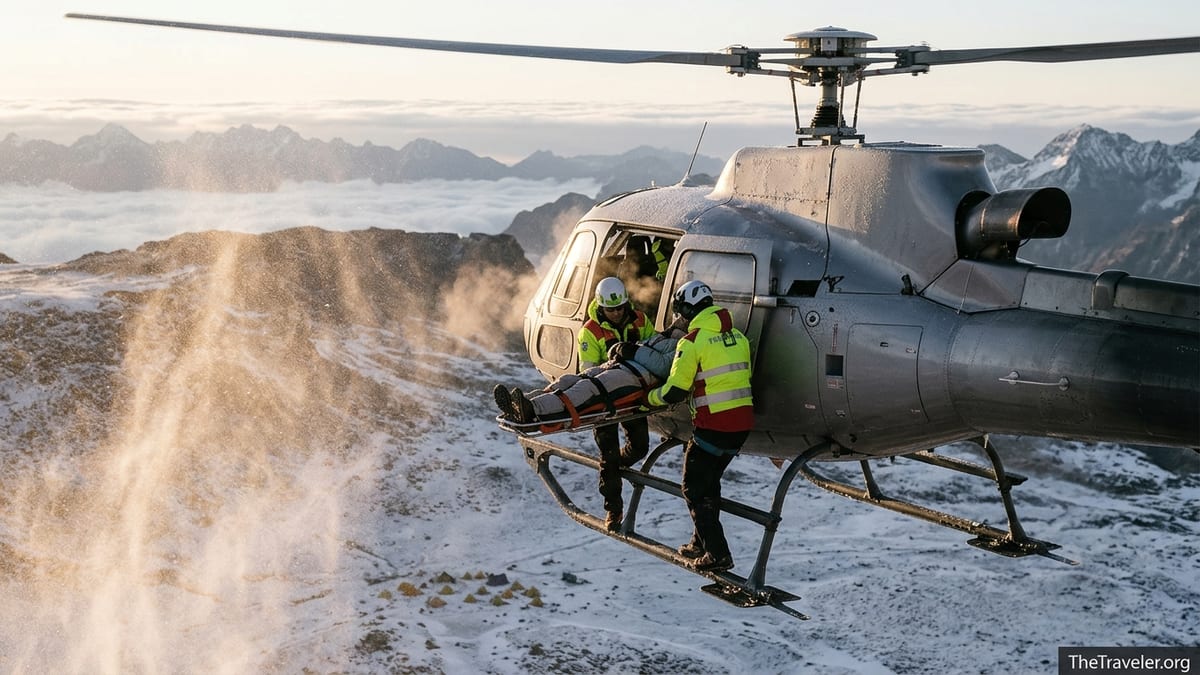
What Ripcord Travel Insurance Actually Offers
Ripcord Rescue Travel Insurance is a program offered by Redpoint Travel Protection, part of Redpoint Resolutions, a company that specializes in remote rescue and medical evacuation. At its core, Ripcord combines two elements many travelers previously had to buy separately: comprehensive travel insurance for trip costs and medical bills, and evacuation and rescue services from the point of emergency back to your hospital of choice at home. The plan is marketed squarely at adventure travelers heading to places like Kilimanjaro, Everest Base Camp, remote Alaska, or safaris in Africa.
According to Redpoint’s own plan comparison, Ripcord’s medical evacuation benefit is designed to move you from the point of emergency directly to your home hospital of choice, up to a stated limit, instead of only to the nearest “adequate” medical facility. The summary of benefits shows an evacuation and rescue limit of up to around 1 million dollars per person on many itineraries, along with separate sub-limits for search and rescue, security evacuation, and the transport of mortal remains. In practice, this means that if you shatter an ankle in a crevassed glacier field in Patagonia, Ripcord’s obligation is not just to get you to a local clinic but to coordinate onward transport home once that is medically appropriate.
Ripcord policies also bundle in standard travel insurance protections like trip cancellation and interruption up to 100 or 150 percent of trip cost, emergency medical expense coverage typically around 100,000 dollars as secondary coverage, baggage loss and delay, missed connection, trip delay, and optional cancel-for-any-reason benefits. Some travelers, especially guided expedition clients, choose an “evacuation only, no travel insurance” membership that provides rescue and evacuation services but not trip cancellation. That setup can appeal to people who already have strong trip interruption coverage through a premium credit card but know those cards rarely cover true rescue from the field.
Eligibility is generally focused on U.S. citizens and legal residents ages 0 to 90 for travel inside and outside the United States, though state-by-state availability and specific terms vary. Pricing is calculated mainly based on your age, trip cost, and length of travel, which means a 30-year-old heading on a two-week trekking trip will likely pay much less than a 70-year-old on a six-week expedition cruise. Real-world quotes reported by travelers for a two-week high-altitude trek, including full evacuation and travel insurance, commonly fall in the mid-hundreds of dollars, although exact prices shift with inflation and benefit choices.
How Ripcord Evacuation Coverage Works in Practice
On paper, evacuation benefits can sound abstract, so it helps to imagine concrete scenarios. Suppose you are climbing Kilimanjaro and develop pulmonary edema at 5,000 meters. Your guides get you down by stretcher to a trailhead, and the park’s ground evacuation service delivers you to a small regional hospital. With a traditional travel insurance policy that only covers evacuation from “hospital to hospital,” your coverage might begin only at the local facility and transport you from there to a larger hospital within Tanzania, not necessarily home. With Ripcord, the promise is broader: once you are stabilized, their operations team can coordinate and pay for an air ambulance flight all the way back to your chosen hospital in the United States, within the limits of the policy.
Another example is a remote expedition cruise, such as Antarctica or the High Arctic. If a passenger on a Zodiac landing breaks a femur on sea ice, local infrastructure is minimal. A Ripcord-style plan is designed so the insured traveler or expedition doctor calls a dedicated 24/7 hotline staffed by medical and security specialists. That team then charters or coordinates a helicopter to the nearest airstrip, arranges a fixed-wing medevac to a regional center like Punta Arenas or Ushuaia, and, if necessary, an ICU-configured jet home. Each leg, from the initial extraction near the accident site to hospital admission back home, is part of the same evacuation chain.
Important, though, is the trigger for evacuation. Ripcord’s materials specify that medical evacuation typically requires hospitalization plus an emergent medical condition. This means minor injuries that can be treated as an outpatient in a clinic, such as a simple sprained wrist, are unlikely to qualify for a chartered air ambulance. Similarly, “rescue services” such as search and rescue in technical terrain have their own limits; the plan summary notes a distinct search limit, often around the mid-five-figure range, which would apply to operations like finding and extracting a missing climber in a storm.
Travelers should also understand that Ripcord integrates rescue, medical direction, and trip insurance claims within one program. In practice, if you press SOS on a satellite device or call their emergency number, you are interacting with one company that coordinates logistics, speaks to local authorities, arranges payment guarantees for hospitals, and later processes your insurance claim. For people who want to avoid arguing over payment with a hospital in a foreign language while injured, that one-stop model is a key selling point.
Where Ripcord Stands Out Compared to Other Options
To decide whether you should trust Ripcord, it helps to compare it with the two main alternatives travelers use for evacuation: general travel insurance policies from big brands, and evacuation-only memberships from specialized companies like Global Rescue or Medjet. Many standard travel insurance plans sold through airlines or comparison sites do include “emergency medical transportation,” but usually with two important limitations. First, they may only pay to take you to the nearest suitable medical facility as determined by the insurer, not to your doctor at home. Second, they often do not include search and rescue from the field; you must already be in a medical facility for transport to begin.
By contrast, Ripcord’s marketing and plan language emphasize rescue and evacuation “from the point of emergency” for adventure travelers. For a mountaineer on a remote ridge or a backcountry skier in Alaska, that distinction matters. If you break a leg 15 kilometers from the trailhead with no road access, an evacuation-only membership that focuses on field rescue can cover the helicopter or technical rope rescue that actually gets you to definitive care. Some travel insurance products, especially those bundled with credit cards, explicitly exclude such “emergency rescue” situations, leading experienced climbers and trekkers to seek out companies like Ripcord that clearly include them.
Compared with other evacuation-focused brands, Ripcord’s comprehensive model is its differentiator. Companies like Global Rescue offer membership programs that provide field rescue and medical transport but do not cover trip cancellation, baggage, or standard travel insurance benefits. Similarly, some rescue memberships coordinated through mountaineering clubs include rescue up to a stated limit but leave you to arrange separate medical insurance and trip protection. Ripcord’s integrated approach means one payment and one provider, which many guided expeditions prefer because it simplifies pre-trip paperwork for clients.
Price-wise, Ripcord is rarely the cheapest option on the market. General travel insurance policies that cover only hospital-to-hospital evacuation and no field rescue can often be significantly less expensive. Likewise, bare-bones evacuation-only memberships designed for frequent travelers can appear cheaper per trip when amortized over multiple journeys. The trade-off is scope: Ripcord is positioned as a premium product for people undertaking objectively higher-risk or more logistically complex journeys, where cutting corners on evacuation could be a false economy.
Fine Print You Must Read Before Relying on Ripcord
Trust in any evacuation plan, including Ripcord, comes down to understanding the fine print. One of the most important distinctions is between medical evacuation and search and rescue. Medical evacuation usually begins once you have been located, stabilized, and, in many cases, admitted to a hospital. Search and rescue covers the process of finding and extracting you from the field. Ripcord’s plan summary specifies a separate search limit, which is typically much lower than the headline evacuation maximum. In a complex multi-day search involving multiple helicopters or specialized rescue teams, it is possible to reach that limit quickly.
Altitude, technical terrain, and activity type exclusions are also critical. Adventure travelers heading to places like Everest Base Camp, Aconcagua, or the Cordillera Blanca should verify in writing that trekking or climbing at their intended maximum altitude falls within the plan’s covered activities. Some general travel insurers quietly cap coverage at certain elevations or exclude mountaineering that requires ropes or specialized gear. Ripcord positions itself for adventure sports, but the onus is still on the traveler to confirm that, for example, off-piste skiing beyond resort boundaries, technical ice climbing, or helicopter skiing are explicitly covered and not written off as excluded “extreme sports.”
Geopolitical and security triggers add another layer. Ripcord and its parent company offer optional security evacuation benefits with their own limits, sometimes around six figures, for situations like political unrest, terrorism, or natural disasters requiring evacuation. However, there are often exclusions for war, nuclear incidents, or traveling against government travel advisories. A traveler considering a trip to a region with civil unrest, for instance, needs to study whether going there while the U.S. State Department has issued a “Do Not Travel” advisory would void certain benefits.
Finally, pre-existing medical conditions and timing of purchase matter. Like many travel insurers, Ripcord may offer a waiver of pre-existing condition exclusions if you buy the policy within a set number of days after your initial trip deposit and insure the full nonrefundable trip cost. If you wait until just before departure to purchase, certain pre-existing conditions may be excluded from medical and evacuation coverage. For a traveler with a heart condition planning a high-altitude trek or a remote cruise, that distinction could determine whether an evacuation for complications will be covered at all.
Real-World Costs and Value: When Ripcord Makes Sense
Emergency evacuations are expensive enough that even approximate numbers are sobering. A basic air ambulance flight from the Caribbean back to the U.S. can easily run tens of thousands of dollars. A long-range ICU-configured jet from East Africa or Asia to North America can climb into the low six figures once crew, medical staff, landing fees, and ground ambulances at both ends are included. Add the cost of an initial helicopter extraction in the field, and total bills that match or exceed the high six-figure evacuation limits on plans like Ripcord’s are not unrealistic in worst-case scenarios.
For example, consider a paragliding accident in the Himalaya or a backcountry skiing injury in Alaska’s Chugach Range. The evacuation might involve a local helicopter to a regional hospital, followed by stabilization, then a multi-leg fixed-wing air ambulance flight home. Even if each segment appears relatively short, the specialized equipment and staff quickly inflate costs. Travelers who have experienced such events and shared their stories publicly often describe being grateful they carried a rescue-focused evacuation plan, because negotiating and funding each leg independently while injured would have been overwhelming.
From a value perspective, Ripcord makes the most sense for travelers whose itineraries combine three factors: remoteness, limited local medical infrastructure, and high physical risk. Climbers on Denali, trekkers to Everest Base Camp, hunters in rural Alaska, or safari-goers far from major hospitals are classic examples. A traveler on a short city-break to London or Paris, by contrast, might find that a less expensive, mainstream travel insurance policy that includes basic hospital-to-hospital evacuation and robust medical coverage is enough, especially given the density of good hospitals and emergency services.
Another scenario where Ripcord can be compelling is multi-week or high-dollar trips where trip cancellation is a major concern. Expedition cruises to Antarctica or the Arctic, high-end photographic safaris, and guided climbs often require large nonrefundable deposits. Ripcord’s combination of trip cancellation coverage up to 100 percent of trip cost and evacuation to home can, in such cases, protect both the financial and medical sides of the risk equation. The incremental cost of a more specialized policy can feel justified against the possibility of losing tens of thousands of dollars in prepaid arrangements and then facing a five- or six-figure evacuation bill on top.
Common Pitfalls and How to Avoid Them
Even good evacuation coverage can fail travelers if they misunderstand how to use it. One recurring pitfall is assuming that any “emergency medical transportation” language includes search and rescue from the field. Many credit card benefits and basic policies cover only transportation between medical facilities once local authorities or others have already rescued you to a hospital. Travelers who assume that pressing SOS on a satellite device will automatically trigger a covered helicopter rescue can be disappointed if they never purchased dedicated rescue-inclusive coverage from a provider like Ripcord.
Another common mistake is underinsuring trip cost in an attempt to save on premium. Because evacuation coverage is often linked to trip cost and purchase timing, listing an unrealistically low trip cost can jeopardize eligibility for pre-existing condition waivers or cancel-for-any-reason benefits. For a remote expedition, shaving a few hundred dollars off the reported trip cost might save a small sum upfront but expose you to much larger financial risk if you need to cancel or evacuate for a reason tied to a pre-existing condition.
Travelers also sometimes overlook altitude and activity exclusions buried within policy documents. A hiker who buys coverage for an Everest Base Camp trek needs to check not just that trekking is covered but that the maximum elevation reached on the route is within the policy’s limits and that helicopter evacuation in Nepal is not excluded. Similarly, backcountry skiers must verify that out-of-bounds or heli-skiing is not carved out as a prohibited extreme sport. Ask the insurer directly, in writing, if necessary, rather than relying on generic marketing language about adventure travel.
Finally, communication in an emergency is crucial. Ripcord’s model assumes you or someone on your behalf will contact their assistance center as soon as possible. Waiting until after a local operator has already arranged a helicopter or private plane, then asking Ripcord to reimburse an unexpected bill, may create complications, especially if the provider was not authorized or the transport was not deemed medically necessary. The safest practice is to make their emergency number part of your guide’s pre-trip briefing and to contact them early, even if local rescue teams are already responding.
The Takeaway
So, should you trust Ripcord Travel Insurance for emergency evacuation coverage? For the right traveler, the answer is generally yes, with careful attention to the details. Ripcord has built its reputation around serving adventure and remote-travel markets, offering high evacuation limits, rescue from the point of emergency, and integrated trip insurance benefits. The company’s relationship with organizations that specialize in climbing and expedition travel underscores that it is a known player in the serious adventure space, not a generic travel insurance brand dabbling in high-risk activities.
However, trust should never be blind. Ripcord is not the cheapest option on the market, and its value depends heavily on where you are going, what you are doing, your health profile, and how comfortable you are with the residual risks. A traveler on a cultural trip through Western Europe may find little added benefit compared with a standard travel insurance plan. A mountaineer on a remote Alaskan peak, on the other hand, could find Ripcord’s rescue capabilities invaluable if a storm, fall, or sudden illness turns a dream expedition into a survival situation.
The best approach is to start with your itinerary and risk profile, then work backward. Map out the real-world scenarios that concern you, from helicopter rescue off a glacier to medevac from a small island clinic. Ask Ripcord and competing providers specific questions about those situations, including altitude limits, activity coverage, geographic restrictions, and who pays what in a layered rescue. Read the policy wording, not just the glossy summary. If, after that exercise, Ripcord is the plan that clearly addresses your highest-consequence risks, it is a reasonable choice to trust for evacuation coverage.
Ultimately, evacuation insurance is something you hope to buy and never use. For travelers heading well off the beaten path, especially to high-altitude, polar, or wilderness environments, a provider like Ripcord can turn a catastrophic emergency into a survivable logistical problem. That peace of mind, coupled with the financial protection against staggering evacuation costs, is why many expedition guides, mountaineers, and adventure travelers continue to choose specialized evacuation coverage despite the higher premium.
FAQ
Q1. Does Ripcord really evacuate you all the way home, not just to the nearest hospital?
In many cases Ripcord’s benefits are designed to transport you from the point of emergency to your home hospital of choice, within policy limits and when medically appropriate. This goes beyond the “nearest adequate facility” standard typical of many basic travel insurance policies, but the exact obligation in your case will depend on the specific plan wording and medical assessment at the time of the incident.
Q2. Is Ripcord worth the price compared with cheaper travel insurance?
Ripcord is usually more expensive than mainstream travel insurance because it targets higher-risk, more remote trips and combines trip protection with rescue-focused evacuation. For a simple city break or resort vacation, a cheaper plan might be sufficient. For remote expeditions where a helicopter or long-range air ambulance is a realistic possibility, the extra cost can be justified by the broader rescue capabilities and higher evacuation limits.
Q3. How much evacuation coverage do I really need for an expedition?
Evacuation costs vary widely, but long-distance air ambulances and complex rescues can easily run into the low six figures. Plans like Ripcord that offer evacuation and rescue limits around the seven-figure mark provide a substantial buffer against worst-case scenarios. At a minimum, adventure travelers heading to remote or high-altitude regions often look for six-figure evacuation limits and specific confirmation that both field rescue and hospital-to-home transport are covered.
Q4. Does Ripcord cover helicopter rescue during trekking or climbing trips?
Ripcord markets itself specifically to adventure travelers and typically includes rescue from the point of emergency, which can involve helicopters where appropriate and available. However, coverage can depend on altitude, type of activity, and local regulations. If you are planning a trek or climb where helicopter evacuation is common, such as Kilimanjaro or the Everest region, you should confirm in writing that helicopter rescue at your planned maximum altitude is covered.
Q5. Can I rely on my premium credit card’s travel insurance instead of Ripcord?
Premium credit cards often include some emergency medical transportation benefits, but these usually apply from hospital to hospital and may exclude search and rescue from the field, high-altitude activities, or remote expeditions. Many experienced mountaineers and guides treat card benefits as a helpful supplement, not a replacement, for dedicated rescue-inclusive evacuation coverage from providers like Ripcord when heading into genuinely remote or high-risk environments.
Q6. Does Ripcord cover pre-existing medical conditions?
Like many travel insurers, Ripcord may offer a waiver for pre-existing conditions if you purchase coverage within a certain window after your initial trip deposit and insure the full nonrefundable cost. If you buy late or underinsure your trip, some conditions could be excluded from medical and evacuation benefits. Travelers with known health issues should pay close attention to these rules and consider calling the company to clarify how their condition would be treated.
Q7. What is the difference between “evacuation only” and full Ripcord coverage?
Evacuation-only options focus on rescue, medical evacuation, and related assistance services but do not include trip cancellation, trip interruption, baggage, or other standard travel insurance benefits. Full coverage bundles those travel insurance protections with evacuation and rescue. Evacuation-only plans can be attractive to frequent travelers who already have strong medical and cancellation coverage but want a dedicated rescue solution for remote trips.
Q8. Are there destinations where Ripcord will not provide evacuation?
All evacuation providers, including Ripcord, have geographic and security-related limitations. Travel to areas under active armed conflict, subject to certain government sanctions, or flagged by severe travel advisories may be excluded or restricted. Before booking a trip to a politically unstable region or one under significant travel warnings, you should confirm with Ripcord whether full benefits apply and under what conditions.
Q9. How do I actually contact Ripcord in an emergency?
After purchasing a policy, you receive emergency contact details, including international phone numbers and sometimes instructions for registering satellite devices. In a real emergency, you or someone on your behalf should contact their assistance center as early as possible, even as local rescue teams are mobilizing. That allows Ripcord’s coordinators to work with local authorities, approve transportation, and ensure that the evacuation fits within both medical best practices and policy terms.
Q10. If local rescuers arrange a helicopter before I call Ripcord, will I still be covered?
Coverage in such cases can be more complex. Many insurers, including Ripcord, prefer or require that they coordinate evacuation logistics directly. If a helicopter or private transport is arranged without their involvement, reimbursement may depend on whether the transport is later deemed medically necessary, reasonable in cost, and within policy terms. Whenever possible, someone should contact Ripcord before committing to expensive private transport, even if that call happens while local rescuers are still on scene.