


Vancouver International Airport, better known as YVR, is compact and well signed, but landing in a new city with bags in tow can still feel overwhelming. Taxis remain one of the simplest ways to get from the terminal doors to your hotel. This guide walks you through how the official taxi system at YVR works today, including fixed-zone fares, where exactly to find the taxi stands at Domestic, International and South Terminals, what to expect with luggage, and when a cab is genuinely the easiest option compared with train or rideshare.
Get the latest updates straight to your inbox!
How the Official Taxi System at YVR Works
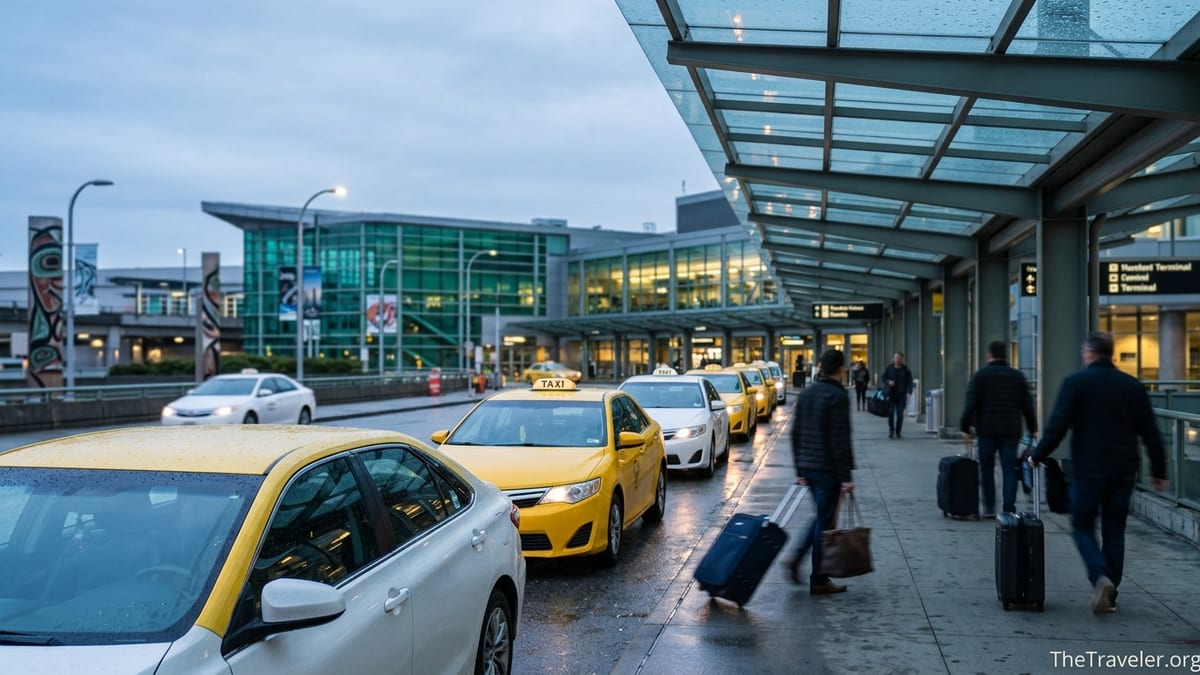
Vancouver International Airport licenses a group of local taxi companies to operate directly from the terminal curbs. These cabs line up at dedicated taxi stands and are dispatched by curbside hosts, so you do not need to call ahead or use an app. After you clear customs or collect your bags, you follow the signs for “Taxis” and join the queue; a host will direct you to the next available car.
For trips leaving the airport, YVR uses a fixed-zone fare system rather than having the driver switch on the meter. The airport and the provincial Passenger Transportation Board publish a zone map that divides Metro Vancouver into colored areas with set prices from YVR to each zone. The idea is that a visitor landing at the airport can see roughly what a trip to downtown Vancouver, Richmond, Burnaby or North Vancouver will cost before getting into a car, which reduces surprises and disputes.
Those fixed fares only apply for trips starting at the airport. If you are taking a taxi in the other direction, from your hotel back to YVR, regular metered rates apply unless you are using a completely separate flat fare from locations such as Canada Place Cruise Ship Terminal. In that case, the driver follows a different official schedule published by the Passenger Transportation Board that sets flat fees between the cruise ship pier and YVR, which is especially useful during the Alaska cruise season.
Within the zones, if your hotel or rental is on the boundary between two areas, the rules state that the lower fare should be used. If two or more passengers share a taxi but plan to be dropped at different addresses, the zone price applies up to the first stop. After that, the driver can legally switch to the meter to calculate the extra distance and time for the second and later drop-offs, so the total cost will typically end up higher than a single direct ride.
Where to Find Taxi Pickup Areas at Domestic and International Arrivals
YVR’s main terminal is shaped like a wide "U" with Domestic flights on the south side and International and U.S. flights on the north side. Taxi stands sit directly outside the Arrivals level at both ends. Coming off a Canadian domestic flight, you collect your luggage and exit into the public arrivals hall, then follow “Ground Transportation” and “Taxi” signs down to Level 1, also called the Airport Services Plaza. Doors in the low 20s, such as Door 24, open out to the covered roadway where taxis, hotel shuttles and buses wait in single-file lanes.
If you are arriving from the United States or an international destination, you will exit into a separate Arrivals hall on the north side of the terminal. From there, signs point you through customs, then toward "Taxis" and "Passenger Pickup." You will typically exit through doors numbered in the high teens, for example Door 17, before crossing the road at marked crosswalks to reach the taxi loading areas. It is a short walk of about one or two minutes on flat pavement that is suitable for rolling suitcases.
In both Domestic and International Arrivals, YVR uses curbside staff and clear pavement markings to separate regular public pickup, taxis and commercial vehicles. When you reach the outdoor curb, do not follow private cars into the public pickup lane. Instead, stay close to the doors and look for signs that specifically say “Taxis” and for uniformed hosts wearing high-visibility vests. The hosts will typically ask for your destination, glance at the zone chart on their stand, and then send you to a designated car.
Travelers with mobility challenges or those needing an accessible taxi should tell the host right away. YVR notes that accessible cabs can be requested via the curbside host or by using small courtesy phones mounted along the Arrivals curb. These vehicles have ramps or lifts and space for non-folding mobility aids, but in busy periods they may take a few extra minutes to arrive from the holding area, so it is worth planning a small buffer if you have a tight connection to a ferry, seaplane or bus.
Understanding Fixed-Zone Fares and Typical Costs
The YVR taxi zone map is the key to understanding how much you will pay. While exact prices change from time to time due to fuel and regulatory reviews, the structure remains stable. Downtown Vancouver hotels, such as those around Robson Street, Coal Harbour or Yaletown, fall into central Vancouver zones that are set at a fixed fare from YVR. In practice, visitors commonly report paying in the ballpark of 35 to 45 Canadian dollars for a standard cab ride to most downtown locations, depending on the precise zone and any tolls or extra stops.
Closer destinations in Richmond, like the hotels along Bridgeport Road or by Richmond Centre, sit in some of the lowest fare zones from the airport. A run to a typical Richmond hotel often works out in the mid-20 Canadian dollar range, which can be only slightly more expensive than two or three adult Canada Line train tickets if you factor in the airport add-on surcharge. Meanwhile, crossing the bridge to cities like Burnaby, New Westminster or North Vancouver usually pushes the fixed fare higher because of longer distance and bridge traffic; travelers typically see totals in the higher 40s or low 50s to some of these suburbs.
The zone system also sets rules for add-ons. Drivers are not supposed to tack on their own surcharges beyond what is listed. Officially, the only extras allowed are things like tolls for using paid bridges or highways where applicable, a cleaning fee if a passenger soils the vehicle and a small fee if you request an en route stop that takes extra time. There is no luggage surcharge per bag from YVR under the zone system, and you should not be charged extra simply because you have a large suitcase.
To avoid confusion, you can ask the host at the taxi stand to confirm the flat fare before you get into a cab. Many stands have a printed zone chart, and some drivers keep laminated copies in the back seat pocket. If you suspect a problem, such as a driver insisting on using the meter from the airport when a zone fare should apply, note the taxi company name, vehicle number and time, and then speak with another host or, later, the company or airport. Issues are relatively rare, but as with any major airport worldwide, being politely informed is the best protection.
South Terminal and Airport South: Taxis, Shuttles and Transfers
YVR’s South Terminal, often called Airport South, is a smaller building on the south side of Sea Island that handles regional airlines and floatplane connections to coastal communities. If you land here on carriers serving Vancouver Island or small B.C. towns, you will exit into a more relaxed, low-rise terminal rather than the large main building. The taxi stand sits directly outside the South Terminal doors, and only a limited set of Richmond-based companies, such as Richmond Taxi, Garden City Cabs and Kimber Cabs, are authorized to pick up there.
Because Airport South is closer to Richmond and a bit further from downtown Vancouver’s bridges compared with the main terminal, your fixed fare may differ slightly depending on the exact zone chart used by the operating companies. In general, however, you can expect similar ballpark pricing: a short ride into central Richmond may cost around what you would pay from the main terminal, and a trip to downtown Vancouver will usually sit somewhere in the high 30s to mid 40s Canadian dollars. Always check the posted fare information at the stand or with the driver if you are unsure.
If you are connecting between the main terminal and South Terminal, a free courtesy shuttle bus marked for the South Terminal circulates roughly every 20 minutes during operating hours. Stops at the main terminal are normally on Level 3 near the Domestic and International check-in areas. Many travelers use this shuttle to transfer between a major airline flight and a regional or seaplane departure, rolling their luggage on board. Taking a taxi for this short hop is usually unnecessary unless you have very limited mobility or the shuttle is not running at the time you need it.
Taxis at South Terminal are also an option if you have bulky gear, such as fishing equipment or sports gear, and want a direct ride to a Richmond hotel, a marina or a ferry terminal. In that case, it is worth telling the dispatcher or driver what you are carrying when you get in. They can fold down rear seats if needed or call for a larger vehicle. For most standard checked bags, however, a regular sedan taxi is sufficient.
Luggage, Vehicles and Traveling With Groups
Standard Vancouver taxis serving YVR are typically four-door sedans or small minivans with conventional trunks. A typical mid-size sedan can comfortably handle two large checked suitcases and two carry-on bags in the trunk, with smaller backpacks stored at passengers’ feet inside the cabin. If your group is a family of four each carrying a large suitcase, you may be more comfortable waiting a few extra minutes for a minivan cab, which offers additional cargo space while still being charged at the same zone fare.
At the taxi stand, you can ask the curbside host to place you specifically in the line for larger vehicles if you know you have more bags than average. Drivers are accustomed to handling everything from ski bags in winter to cruise luggage in summer. They will usually load and unload the trunk for you, but in busy periods they will appreciate if you place smaller items, like daypacks or laptop bags, inside the car yourself so the line keeps moving.
If you are traveling with unusual or oversized items, such as boxed bicycles, musical instruments or sports equipment, it is worth briefly explaining this to the host before being assigned a car. For example, a traveler arriving for a cycling trip with a bike in a hard-shell case might be directed toward a minivan taxi instead of a sedan. In some cases, if the item truly will not fit safely in a standard taxi, you may need to consider a pre-booked private vehicle or an airport hotel shuttle with more space.
Families and groups often debate whether two regular taxis or one rideshare van is the better option. At YVR, there is no price discount for filling every seat in a taxi. The fixed-zone fare applies to the car, not per person, so four adults splitting a 40 Canadian dollar fare to downtown Vancouver will each pay about 10 dollars, which is competitive with individual train tickets, particularly if they have heavy luggage and would otherwise need another transfer after the Canada Line.
When a Taxi Is Easier Than Transit or Rideshare
Vancouver’s Canada Line train is an efficient way to get from YVR to downtown, but there are clear scenarios where a taxi is simply easier. The most obvious is when you have bulky or multiple bags and would need to navigate several station escalators, elevators and street crossings before reaching your hotel. For instance, a couple arriving from Europe with two large checked bags and two carry-ons, headed to a hotel in the West End west of Burrard Street, might find that the train plus a 10 to 15 minute sidewalk walk feels like too much after a long flight. A taxi will drop them right at the hotel entrance in around 25 to 35 minutes, depending on traffic.
Cabs also make sense when you are traveling late at night or very early in the morning. Although the Canada Line runs from early morning to late at night, there are overnight gaps, and some suburban buses operate only hourly in the small hours. A traveler landing at 1:00 a.m. and staying in eastern Burnaby or near the North Shore’s Lonsdale area may find that a taxi is the only realistic same-day option. Similarly, if you are arriving during heavy rain, which is common from October through March, loading bags directly into a taxi a few steps from the terminal doors can be worth the extra cost.
Rideshare services such as Uber and Lyft operate at YVR with their own pickup areas. However, they sometimes experience price surges during peak periods like Friday evenings, cruise ship changeover days or during major conventions and sports events. In those moments, it is not unusual for the cost of a rideshare trip from the airport to approach or even exceed the fixed taxi zone fare to the same destination. If you open a rideshare app and see a high estimate or a long wait time, walking to the official taxi stand is usually the more predictable option.
Finally, taxis can reduce stress for first-time visitors who are unfamiliar with Vancouver’s geography. Drivers are used to common requests like "a hotel near Canada Place," "a rental in Kitsilano near the beach," or "the Telus office in downtown." While you should always have an exact address handy, especially for short-term rentals, experienced drivers often know major hotels and landmarks by name and can take a route that balances speed and traffic conditions without you watching a map.
Practical Tips for Using Taxis Safely and Smoothly at YVR
To make your YVR taxi experience smooth, start by heading straight to the marked taxi stand and ignoring any unofficial offers. As in many airports worldwide, legitimate drivers will never approach you inside the terminal to offer a ride. All authorized airport taxis wait in line outside and are managed by the hosts. If someone in the Arrivals hall offers a "cheaper" or "faster" ride, decline politely and continue to the official curbside queue.
Before getting into the cab, confirm with the driver that you are on a fixed-zone fare from the airport. You can ask something simple like, "This is a flat fare from YVR to downtown, right?" Many drivers will automatically reassure you and may even mention the approximate total. Once on the road, you can watch for a small card or sticker inside the car that lists contact information for the taxi company in case you need to follow up about a lost item or a concern.
Payment is straightforward. Most airport taxis in Vancouver accept major credit cards and debit cards in addition to cash. If you plan to pay by card, it is wise to ask at the start of the journey, particularly if you are arriving from overseas and have limited Canadian currency on hand. At the end of the trip, the driver will present a receipt on paper or via a small payment terminal. Tipping practices in Vancouver are similar to the rest of Canada; many passengers add around 10 to 15 percent on top of the fare, rounding up to a convenient amount.
If you do have a problem, such as being charged contrary to the posted fare or feeling that the route taken was unreasonably long, keep your receipt and note the taxi company and cab number. You can then contact the company directly or, in more serious situations, the Passenger Transportation Board or YVR’s customer relations team. These complaints help regulators identify patterns and keep the system fair for future travelers, though most visitors find their rides are efficient and uneventful.
The Takeaway
Vancouver International Airport’s taxi system is built around simplicity and predictability, with fixed-zone fares from the airport, clearly marked pickup areas at Domestic, International and South Terminals, and a mix of sedans and minivans that can handle typical luggage loads. For many travelers, especially those carrying bags, arriving late at night or heading to destinations beyond the downtown core, a taxi remains the easiest way to start or end a trip.
By knowing where to find the stands, understanding that flat fares apply only from the airport outbound, and being aware of basic expectations around luggage and tipping, you can step off your flight and into a cab with confidence. Combine that with a realistic sense of when a taxi beats transit or rideshare, and you will be well equipped to navigate YVR calmly, even after a long-haul journey.
FAQ
Q1. Where exactly are the taxi stands at YVR?
They are located directly outside the Arrivals level at both Domestic and International sections of the main terminal, and just outside the doors at the South Terminal. Follow the "Taxi" signs after collecting your luggage and you will be guided down to the correct curb.
Q2. How much does a taxi from YVR to downtown Vancouver usually cost?
Prices depend on the official zone but most visitors can expect to pay somewhere in the mid 30 to mid 40 Canadian dollar range from the airport to common downtown hotel areas under the current fixed-fare system.
Q3. Do taxis from YVR charge extra for luggage?
Under the airport zone fare rules, taxis do not add a per-bag luggage fee for normal suitcases. The fixed-zone fare covers you and your standard luggage, although a cleaning fee can be applied if a passenger soils the vehicle.
Q4. Can I pay by credit card in YVR taxis?
Yes. Most licensed taxis serving YVR accept major credit cards and debit cards as well as cash. If you want to be certain, confirm payment options with the driver before the trip starts.
Q5. Is it better to take the Canada Line train or a taxi?
The train is usually cheaper and fast for light travelers heading to central downtown stations. A taxi is often more convenient if you have heavy luggage, are traveling late at night, have limited mobility, or are going to neighborhoods that require transfers beyond the Canada Line.
Q6. How do taxis work at the South Terminal (Airport South)?
At the South Terminal, a smaller taxi stand sits right outside the main doors and is served by a limited group of Richmond-based taxi companies. Fares to Richmond and Vancouver are broadly similar to those from the main terminal, and there is also a free shuttle connecting South Terminal with the main building.
Q7. Are there accessible taxis available at YVR?
Yes. Accessible taxis equipped for wheelchairs and other mobility aids can be requested directly from curbside hosts or through courtesy phones along the Arrivals curb. They may take a few extra minutes to arrive during busy times.
Q8. When is taking a taxi from YVR worth the extra cost?
A taxi is particularly worthwhile if you are tired after a long flight, carrying multiple or bulky bags, arriving very late or early when transit is limited, traveling in poor weather, or heading to suburbs where transit would require several transfers.
Q9. What should I do if I think a taxi overcharged me?
Keep your receipt and note the taxi company name, cab number and time of travel. You can contact the company directly or raise the issue with airport customer service or provincial regulators. Having the details makes it much easier to review the trip.
Q10. Is it safe to accept taxi offers from drivers inside the terminal?
No. At YVR, legitimate taxis wait at the official stands outside. Drivers should not solicit rides inside the building. For safety and to ensure fixed fares, always use the marked taxi queue and follow instructions from airport staff.