


Touching down at Vancouver International Airport is only the first step if your real destination is Victoria on Vancouver Island. The good news is that this is a well-traveled corridor with several reliable ways to get from YVR to Victoria, from classic BC Ferries sailings via Tsawwassen to quick floatplane hops and full bus-and-ferry packages. The best choice depends on your budget, schedule, luggage and comfort level with transfers. This guide breaks down the main options and how they work in practice so you can choose the route that fits your trip.
Get the latest updates straight to your inbox!
Understanding the Route from YVR to Victoria
Vancouver International Airport (YVR) sits on Sea Island in Richmond, a suburb south of downtown Vancouver. Victoria is on the southern tip of Vancouver Island, separated from the mainland by the Strait of Georgia. There is no bridge or road between the mainland and the island, which means you must cross by air or by water at some point.
For most travelers, the backbone of the journey is the BC Ferries route between Vancouver (Tsawwassen terminal) and Victoria (Swartz Bay terminal). The crossing itself takes roughly 1 hour 35 minutes, and ships generally run at least every two hours, with more frequent sailings at busy times in summer and on long weekends. Tsawwassen terminal is about 35 to 45 minutes by road from YVR in light traffic, while Swartz Bay is about 30 to 40 minutes by road from downtown Victoria.
The other main axis is air. You can fly by floatplane between the Vancouver area and Victoria’s Inner Harbour, or by conventional aircraft between YVR and Victoria International Airport (YYJ). Flight time is around 25 to 35 minutes, but total door-to-door time depends heavily on check-in, security and transfers at each end. In many cases, the overall journey time by air and by bus-plus-ferry ends up surprisingly similar.
Because there is no single “best” route, planning usually starts with your priorities. If you want a scenic, lower-cost way and do not mind a few transfers, the bus and ferry options work very well. If time and convenience matter more than price, floatplanes or a through flight to Victoria can be worth the premium.
BC Ferries via Tsawwassen: The Classic Route
BC Ferries operates the main vehicle and passenger ferries between Tsawwassen on the mainland and Swartz Bay near Victoria. This route handles a large share of traffic between Vancouver and Vancouver Island and runs year-round. On a typical day you will see morning sailings starting as early as around 7:00 and frequent departures through the afternoon and evening, with extra sailings added in peak holiday periods.
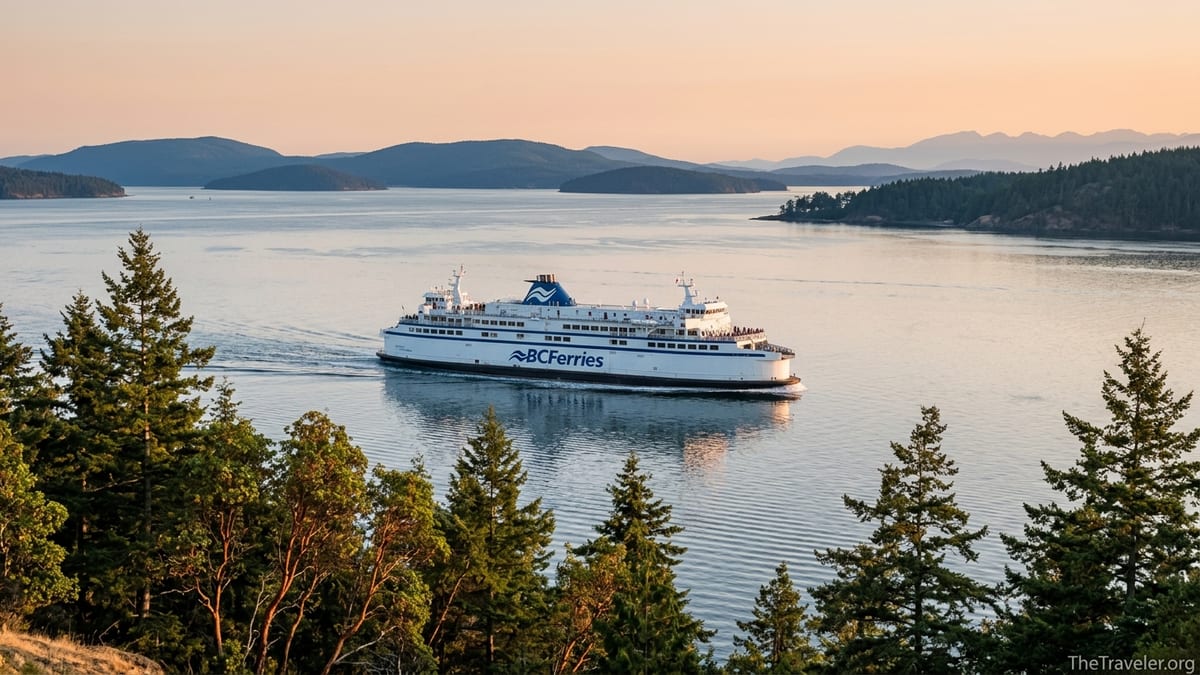
For most leisure travelers, the experience is part of the trip. Large “Spirit” or “Coastal” class vessels have plenty of indoor and outdoor seating, a self-serve cafeteria, coffee bars and small shops. On a clear day, you can stand on the outer decks and watch the ship weave through the Gulf Islands, with frequent sightings of seals and occasionally whales. The crossing time is about an hour and a half, but check-in and loading add another 30 to 60 minutes to your schedule, especially if you are driving a rental car and have a reservation.
Cost depends on how you travel. As a foot passenger, you pay a per-person fare plus a smaller fee if you take a bicycle. If you bring a car, you pay a combined vehicle-and-driver rate plus a per-person fare for extra passengers. It is common for a car and two adults to pay a total in the low hundreds of Canadian dollars round trip, depending on season and reservation fees. Walking on without a car is much cheaper, often comparable to what you would expect to pay for a regional bus ride plus a separate ferry ticket.
Reservations are strongly recommended if you plan to drive onto the ferry in summer, on holiday weekends, or during Friday and Sunday peak periods. With a reservation, BC Ferries typically asks drivers to arrive between 30 and 60 minutes before departure. Walk-on passengers do not need reservations, but on the busiest days, terminals can still be crowded, and you may want to arrive earlier for peace of mind.
Bus and Ferry Combinations Direct from YVR
If you would rather not juggle city buses and taxis, the most straightforward option from the airport is a through-ticketed coach and ferry package. Operators partner with BC Ferries Connector to offer combined bus and ferry services between YVR and downtown Victoria. You buy a single ticket that covers the coach from the airport to Tsawwassen, the ferry sailing, and the onward coach from Swartz Bay to downtown Victoria.
In practice, this looks like arriving at YVR, clearing immigration and baggage claim, and then following signs to the long-distance bus area in International Arrivals. There you check in at a coach counter, typically branded as BC Ferries Connector, Wilson’s or Skylynx. Staff confirm your reservation, tag your luggage for under-bus storage and direct you to the coach. The bus then drives straight to Tsawwassen terminal, boards the ferry, and you stay on board or go up to the passenger decks during the crossing.
Once the ferry arrives at Swartz Bay, the same coach drives off the ship and continues down the highway to Victoria. Usual drop-off points include downtown hotels, the bus depot area near the harbour, and sometimes additional stops in Greater Victoria. Total travel time from YVR to downtown Victoria is commonly around 4 to 5 hours, depending on the particular departure you book and traffic conditions around Vancouver.
Prices for these coach-and-ferry packages are typically higher than buying a simple ferry ticket as a walk-on passenger, but they bundle multiple legs into one reservation and reduce the risk of mis-timed transfers. They are especially attractive if you are arriving with jet lag, traveling with children, or carrying bulky luggage. One important detail is schedule matching: daily departure times are set to meet specific Tsawwassen sailings, so reading the timetable carefully and building in buffer after your flight arrival is key.
DIY Transit and Rental Car Options via Tsawwassen
More independent travelers sometimes choose to piece together their own route using public transit or rental cars. From YVR, the Canada Line rapid transit connects the airport to Bridgeport Station in just a few minutes. From there, a regional bus runs to Tsawwassen ferry terminal. This method is cheaper than booking a through coach, and you pay transit fares comparable to other big cities plus the standard walk-on passenger fare for the ferry itself.
The trade-off is complexity and potential crowding. On busy weekend mornings, the bus to Tsawwassen can be packed with foot passengers headed for the ferry, and luggage space is limited. Travel time from YVR to the terminal via Canada Line and bus can easily take 60 to 90 minutes once you factor in waiting for the next bus connection and walking from the stop to the terminal building. It is a solid choice for budget travelers or those familiar with transit systems, but less ideal after a long-haul flight with multiple suitcases.
Renting a car at YVR is another widely used option. Major brands operate desks in the terminal and car pick-up is across from arrivals in the parking structure. In light traffic, driving from the airport to Tsawwassen terminal takes about 35 to 45 minutes, mostly along Highway 99 and a short connector to the ferry causeway. Once at Tsawwassen, you follow signs for vehicle check-in and join the appropriate lane. You pay the vehicle-and-driver fare at the toll booths and, if you booked ahead, present your reservation to ensure space on that sailing.
A rental car gives you maximum flexibility at the Victoria end. After disembarking at Swartz Bay, you follow the highway south to Victoria, roughly a 30 to 40 minute drive in typical conditions. This works well for travelers planning to explore beyond Victoria, such as up-island to Nanaimo, Parksville, Tofino or the Cowichan Valley. It does add cost in the form of rental fees, insurance, fuel and ferry vehicle charges, so it is most economical when shared among two or more people or when you will use the car extensively on Vancouver Island.
Floatplane Flights: Fast and Scenic
Floatplanes give you one of the quickest and most scenic ways to travel between the Vancouver area and Victoria. Harbour Air and other seaplane operators run frequent services from the Vancouver Harbour flight centre downtown and from a floatplane base near YVR’s south terminal to Victoria’s Inner Harbour. Flight time is usually around 30 to 35 minutes, and planes are small, typically seating fewer than 20 passengers.
For someone already at YVR, connecting to a seaplane involves a short shuttle or taxi ride from the main terminals to the floatplane facility on the south side of the airport, or taking the Canada Line and walking to the downtown waterfront for departures from Vancouver Harbour. Check-in is generally more relaxed than big-airport security, and you may be asked to arrive 30 to 45 minutes before departure. Because the aircraft are small, luggage allowances are more restrictive than on a major airline, with typical included checked and carry-on limits adding up to around 20 to 23 kilograms before excess fees apply.
Fares vary by demand, time of day and flexibility. It is common to see one-way fares that are higher than a YVR to YYJ economy ticket on a large carrier, especially if booked close to departure. On the other hand, you land directly in downtown Victoria, steps from many hotels and the Inner Harbour attractions. This direct downtown-to-downtown effect can save enough ground transport time to offset the longer check-in and security required at the main airports.
Weather is the main operational wildcard. While floatplane companies are experienced with local conditions, low cloud or fog sometimes causes delays or cancellations, particularly in fall and winter. Most operators have policies to rebook or refund when weather prevents flying, but if you have a tight connection, especially onward international flights, floatplanes carry more risk than the more weather-resilient ferries.
Conventional Flights into Victoria International Airport
Another way to handle the YVR to Victoria leg is to fly a conventional aircraft. This splits into two scenarios. In the first, you arrive from elsewhere and connect onward at YVR to a short flight to Victoria International Airport (YYJ) on the Saanich Peninsula. In the second, you skip YVR entirely by booking your long-haul ticket to land in Victoria in the first place.
On the YVR to YYJ sector, major carriers typically operate multiple daily flights, especially in peak months. The airborne time is short, around 25 to 30 minutes, but you must allow for domestic check-in, security, possible delays, and baggage claim at each end. By the time you add 60 to 90 minutes of airport processes on both sides, the total gate-to-gate journey can easily stretch to a few hours. After landing at YYJ, you still need to cover about 30 to 40 minutes by taxi, rideshare, shuttle bus or local transit to reach downtown Victoria.
Costs for this option depend heavily on how the segment is ticketed. If Victoria is simply the last leg of an international itinerary, the additional price over stopping in Vancouver is sometimes modest, and you gain the convenience of checking luggage through to your final destination with protected connections. If you buy a separate YVR–YYJ ticket, last-minute one-way fares can feel expensive compared with ferries or even floatplanes, especially when you add the time involved.
Booking all the way to Victoria from your origin often makes the most sense if your schedule is tight, you are uncomfortable with self-connecting through ferry terminals, or you are traveling in winter when storms are more common. You give up the ferry scenery and may pay more than other options, but you simplify your day and avoid the stress of managing multiple operators on your own.
Luggage, Timing and Practical Considerations
Luggage and timing are the two factors that most often trip up travelers on the Vancouver to Victoria run. On BC Ferries and the bus-and-ferry packages, standard suitcases are easy to handle. Coaches store large bags in the underfloor compartment, and you keep smaller items with you. On the ferry, walk-on passengers can use luggage carts and racks on the vehicle deck or carry bags to seating areas, though there is no formal checked luggage system like on an airline.
On floatplanes, strict weight limits matter. Operators weigh both people and bags to balance the aircraft, and standard fares typically include only modest baggage allowances. If you are arriving from overseas with two large suitcases each, you may find that excess baggage fees on a seaplane make this option less attractive. In that case, a coach-and-ferry combination or a conventional flight with standard checked baggage rules may be better suited.
Timing is the other major piece. For a same-day connection from an incoming flight at YVR to a ferry via Tsawwassen, many locals aim for a 3 to 4 hour buffer between scheduled landing and ferry departure if they are picking up a rental car. This allows for immigration, baggage claim, rental car pick-up, the 40-minute drive to the terminal and the required pre-departure check-in window. If you are taking a coach from YVR to the ferry, choose a departure that leaves enough cushion after your arrival so that a minor delay does not jeopardize your reservation.
In summer, traffic to Tsawwassen and lineups at the terminal can be heavy on Friday afternoons, Saturday mornings and holiday Mondays. BC Ferries sometimes warns that popular sailings can sell out of vehicle space well in advance, while foot passengers usually still get on even if cars are turned away. If your schedule is not flexible and you are driving, consider traveling midweek or at off-peak times of day, or be ready to wait for a later sailing if you arrive without a reservation on a busy weekend.
Should You Fly into Victoria Instead of Vancouver?
Deciding whether to fly into Victoria instead of Vancouver is one of the most important choices in planning your trip. If Victoria is your only or primary destination, and you can find a reasonably priced long-haul ticket that connects straight to YYJ, skipping YVR and the ferries makes the most sense. You reduce the number of moving parts, avoid the risk of missing a ferry or bus connection after a delayed flight, and arrive closer to your hotel with familiar airport processes at each step.
On the other hand, many travelers are drawn to the ferries and seaplanes as part of the West Coast experience. Cruising through the Gulf Islands on the upper deck of a BC Ferries vessel on a sunny evening can be a highlight in its own right. Arriving in Victoria’s Inner Harbour by floatplane, with the parliament buildings and Empress Hotel in view, is another classic British Columbia moment. If you value those experiences and have time to spare, routing through Vancouver and taking one of these surface or floatplane options adds a memorable layer to your journey.
Price is a mixed picture. Depending on sales and seat availability, flying into Victoria directly can be slightly more expensive or occasionally cheaper than flying into Vancouver and buying separate bus, ferry or floatplane tickets. Families and groups sometimes come out ahead by flying to Vancouver and using a rental car on the ferry, spreading vehicle and fuel costs across multiple people. Solo travelers carrying light luggage may find that a direct flight with local transit in Victoria is both simpler and cost-effective.
Finally, consider your tolerance for complexity and your arrival time. If your transoceanic flight lands at YVR in the late afternoon or evening, it may be hard to align with a same-day ferry and onward travel to Victoria without a very late arrival. In that case, booking through to Victoria or planning an overnight stay in Vancouver before continuing the next day can save stress. Early-morning or mid-day arrivals, by contrast, usually work well with bus-and-ferry combinations or rental cars.
The Takeaway
Traveling from Vancouver International Airport to Victoria is not a one-size-fits-all journey. You can approach it as a simple point-to-point connection by flying into Victoria International Airport, or you can treat it as a scenic mini-adventure across sea and sky, using BC Ferries or floatplanes. Each option has its own mix of cost, time, luggage handling and complexity.
For many visitors, a coach-and-ferry package from YVR to downtown Victoria strikes an attractive balance between convenience and price, especially on a first trip or when hauling sizable luggage. Independent travelers who enjoy driving and plan to explore Vancouver Island often prefer a rental car and ferry via Tsawwassen. Time-pressed visitors and those who value a smooth, single-ticket itinerary lean toward flying directly into Victoria or connecting at YVR to a short hop to YYJ.
Whichever route you pick, build in extra time, pay attention to seasonal ferry and flight schedules, and think honestly about how you handle transfers after a long flight. With a little planning, the journey between Vancouver and Victoria can be one of the most memorable parts of your trip, not just a stretch to be endured between airports.
FAQ
Q1. How long does it take to get from Vancouver International Airport to Victoria by ferry and bus?
In normal conditions, a through bus-and-ferry trip from YVR to downtown Victoria takes around 4 to 5 hours door to door, including the 1.5 hour ferry crossing.
Q2. Do I need to reserve BC Ferries in advance if I am walking on without a car?
Reservations are optional for foot passengers and most people simply buy tickets at the terminal, though arriving early on holiday weekends and peak summer sailings is wise.
Q3. How much time should I allow between my flight arrival at YVR and a reserved ferry from Tsawwassen if I am driving?
Many locals aim for at least a 3 to 4 hour buffer between scheduled landing and ferry departure to cover immigration, baggage claim, rental car pick-up and the drive to the terminal.
Q4. Are floatplanes from Vancouver to Victoria safe, and what about bad weather?
Floatplane operators are well regulated and experienced, but low cloud or fog can delay or cancel flights, especially in fall and winter, so tight onward connections are not advisable.
Q5. Is it cheaper to fly directly into Victoria or to fly into Vancouver and then take the ferry?
Prices vary by season and sales; sometimes a through ticket to Victoria costs slightly more, while at other times flying to Vancouver plus a ferry or bus can be cheaper, especially for groups.
Q6. What is the easiest option from YVR to Victoria if I have a lot of luggage?
A through coach-and-ferry service from YVR to downtown Victoria is usually the easiest, since staff handle checking large bags under the bus and you avoid tight airport-style weight limits.
Q7. Can I rent a car at Vancouver Airport, take it on the ferry, and return it in Victoria?
Some rental companies allow one-way rentals between Vancouver and Victoria, but availability and drop fees vary, so you need to check terms carefully when you book.
Q8. How far is Victoria International Airport from downtown Victoria, and how do I get there?
Victoria International Airport is about 30 to 40 minutes by road from downtown, with taxis, shuttles and local buses offering options at different price points.
Q9. Are there evening or early-morning ferries that work with late or early flights into YVR?
BC Ferries runs early and late sailings on many days, but specific times change seasonally, so you should confirm schedules and consider an overnight near YVR if your flight arrives very late.
Q10. If I get seasick, should I avoid the ferry and take a plane instead?
The Tsawwassen to Swartz Bay route is relatively sheltered and ships are large, but if you are very prone to motion sickness, a short conventional flight or direct arrival in Victoria may feel more comfortable.