


The Vatican Museums are one of the world’s great art collections and also one of Europe’s most intense sightseeing experiences. A little planning ahead on tickets, timing and what you want to see can turn a crowded, overwhelming visit into a memorable highlight of a Rome trip. This guide brings together the latest practical information with clear examples so you can navigate the museums, reach the Sistine Chapel without stress and make the most of your time inside the Vatican walls.
Get the latest updates straight to your inbox!
Essential Facts: Opening Hours, Seasonality and What to Expect
The Vatican Museums occupy a vast complex inside Vatican City, with more than 50 galleries arranged in a one-way route that eventually leads to the Sistine Chapel. For most of the year the museums are open Monday to Saturday, generally from 8:00 to 19:00, with last entry in late afternoon. In practice, this means that if you book an entry time at 16:00 or 16:30, you will still have enough time to walk the main route and reach the Sistine Chapel before closing, but you will need to keep a steady pace.
Sundays are normally closed, with one notable exception: the last Sunday of most months, when entry is free in the morning and the museums close early in the afternoon. This free Sunday sounds attractive, but in reality it is often the single busiest day of the month. For example, on a typical free Sunday in April or May, queues before opening can already snake around the Vatican walls by 8:00, and galleries feel packed by 10:00. First-time visitors who want to appreciate the art without severe crowding are usually better choosing a regular paid day.
Seasonality matters. The busiest months are typically late March through early November, especially around Easter, spring school vacations, and the European summer holiday period from June to August. In practice, that means a Wednesday in late July at 10:00 will feel very different from a Tuesday in mid January at 14:30. In low season, walk-up tickets sometimes remain available on the official site until the day before, while in peak season popular morning slots often sell out weeks ahead.
In recent years the Vatican Museums have also experimented with evening openings on certain days from spring through autumn. These night entries, often on Fridays and sometimes Saturdays, usually start around 19:00 or 19:30 and run to late evening. They offer a quieter way to see the museums, with smaller tour groups and a softer atmosphere in the courtyards. If you are comfortable navigating with lower natural light and slightly reduced services inside, these evenings can be an excellent option.
Choosing and Booking Tickets: Official Site, Skip-the-Line and Tours
The most economical and straightforward option for most visitors is a timed-entry ticket purchased directly from the official Vatican Museums booking system. Standard adult admission is typically in the mid-twenties in euros, plus a small online booking fee per person. As an example, if the base ticket is around 20 to 22 euro, the final price with booking fee often lands near 25 to 27 euro per adult. Youth and child discounts are usually available if you enter the correct birth year when booking.
On busy spring and summer dates, official timed tickets for prime morning slots such as 9:00 or 9:30 can sell out, sometimes leaving only late afternoon times. Third-party resellers often still show availability for those same mornings, bundling admission with “skip the line” access and sometimes a short guided visit. These products can easily cost 50 to 80 euro per person or more. The key distinction is that all advance Vatican tickets, whether bought directly or via a reseller, already include fast-track entry compared with people lining up to buy on the day. In other words, for a typical July morning at 9:00, a standard official e-ticket lets you bypass the long cash-desk queue in much the same way as most “skip-the-line” labels on reseller sites.
Guided tours, however, add real value for visitors who want structure and context. Official Vatican Museums group tours with a staff guide tend to be relatively competitively priced compared with private companies, often coming in around 40 euro for a 2 to 3 hour tour of the museums and Sistine Chapel. Private or semi-private tours run by external operators, especially those that include priority entry to St Peter’s Basilica via the group corridor from the Sistine Chapel, are more expensive. It is common to see prices above 100 euro per adult for a 3-hour small-group “early access” tour that starts before normal opening to let you see the Raphael Rooms and Sistine with thinner crowds.
When deciding, consider your priorities and budget. A couple visiting Rome in October might opt for official timed tickets at 8:30, arriving ten minutes early, which gives them flexibility to wander at their own pace for under 60 euro total. A family of four traveling in August, concerned about kids getting tired and lost in the crowds, might book a guided tour with headsets for around 120 to 150 euro per adult and a reduced child rate so the guide can keep the group together and point out kid-friendly highlights.
Must-See Highlights: From the Pinecone Courtyard to the Sistine Chapel
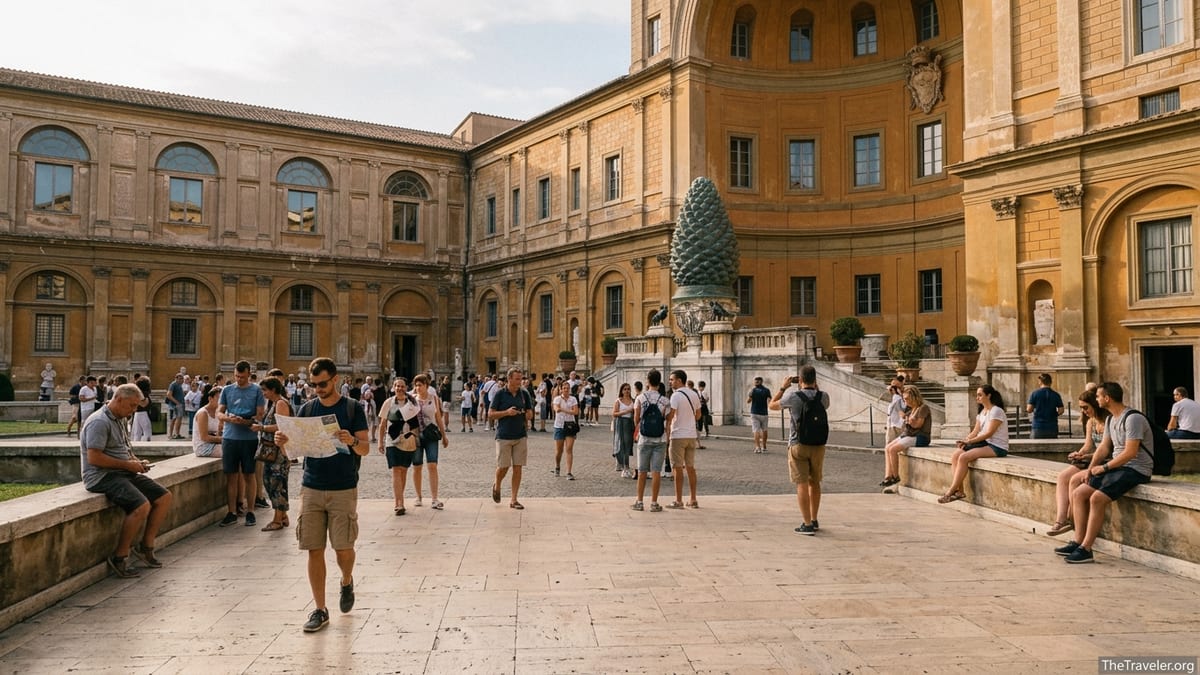
With thousands of works on display, it is impossible to see everything in one visit. Having a short list of highlights can help you stay focused. Most itineraries begin by passing through the Courtyard of the Pinecone, an open-air space named after an enormous ancient bronze pinecone sculpture. In good weather this courtyard offers a moment of breathing space before you enter the denser interior galleries.
One of the first striking areas inside is the Pio-Clementine Museum, known for its classical sculpture. Here you will find the famous Laocoön group and the Apollo Belvedere, two statues that shaped European ideas of ancient art. Just behind, the Gallery of the Candelabra, Gallery of Tapestries and Gallery of Maps form a spectacular sequence of long corridors leading toward the heart of the museums. The Gallery of Maps, in particular, is a favorite for many visitors: its frescoed depictions of Italian regions and coastal towns run the length of a high-ceilinged hall, with windows opening toward the Vatican Gardens and gold detailing glimmering overhead.
A key stop is the Raphael Rooms, a series of papal apartments decorated by Raphael and his workshop. Even if you are not an art historian, it is worth pausing in the Stanza della Segnatura to see “The School of Athens,” a fresco that gathers ancient philosophers under a grand architectural setting. In high season, this room can feel crowded, but even a few minutes near the center allow you to appreciate details such as the figure of Plato pointing upward and the apparent portrait of Michelangelo seated on the steps.
The final destination for most visitors is the Sistine Chapel. This is technically a functioning chapel, so the atmosphere is more solemn. Photography is not allowed and staff regularly ask visitors to remain quiet. The ceiling painted by Michelangelo, including the famous Creation of Adam panel, is smaller in real life than many people expect, yet packed with detail. In busier times you may find yourself shoulder to shoulder with other visitors; in quieter evening sessions you might find pockets of space along the side benches where you can sit and look up for several minutes. It is worth planning to spend at least 10 to 15 minutes here if the crowds and flow of people allow.
Beating the Crowds: Best Times, Routes and Realistic Timing
Experienced guides often agree on one thing: the first two hours of the day and the last hour before closing are usually the least crowded inside the museums. For example, entering at 8:00 on a Monday in late April, you might find the first galleries still relatively calm, giving you time to linger in the sculpture courts. By 10:30, the same route can feel like a slow-moving queue. Conversely, arriving at 15:30 or 16:00 in October might mean you miss some minor side rooms but enjoy a quieter experience in the Raphael Rooms and corridors.
Plan your route with your energy levels in mind. The standard path from entrance to Sistine Chapel commonly takes 2 to 3 hours with moderate stops. If you like to read labels and take photos in every hall, 4 hours is realistic. Visitors with limited stamina or traveling with young children should prioritize. One practical approach is to move steadily through the early sections, pausing briefly in the sculpture galleries, and then slow down in the areas that matter most to you, such as the Gallery of Maps, Raphael Rooms and Sistine Chapel. If you are especially interested in a specific collection like the Pinacoteca (painting gallery) or the Etruscan artifacts, consider heading there first using the internal signage, then rejoining the main route later.
Outside factors also affect crowd levels. Wednesday mornings can be busier in St Peter’s Square because of the papal audience, which starts around 9:00 or 10:00 and draws large crowds. While the museums operate independently, many visitors combine the two activities, so overall foot traffic in the area is elevated. Friday evening openings, when available from spring to autumn, often attract fewer large coach groups, resulting in a calmer visit. As a concrete comparison, a traveler who visited on a Friday evening in June reported walking straight into the museums within minutes using a timed ticket, while the same traveler described a 30-minute security line for a 10:00 entry in mid-July.
Allow buffer time for security. Even with a pre-booked ticket, you will pass through airport-style screening. On a typical busy morning this can take anywhere from 10 to 30 minutes, and occasionally longer around Easter or on days when large pilgrim groups arrive at the same time. If your timed slot is 9:30, aim to be outside the entrance by 9:00 so you can clear security comfortably without rushing.
Dress Code, Security and Practical On-the-Day Logistics
The Vatican Museums and Sistine Chapel enforce a modest dress code similar to that of many churches in Italy. In practice, this means shoulders and knees should be covered. Sleeveless tops, very low-cut shirts, shorts or skirts significantly above the knee, and hats are not permitted in the most strictly controlled areas. Staff at the museum entrance and near the Sistine Chapel may ask inappropriately dressed visitors to cover up. Local vendors around the Vatican walls sell inexpensive light scarves or shawls for a few euros, which many travelers purchase last-minute to cover shoulders or tie around the waist as a longer skirt.
Security is thorough but straightforward. All bags pass through an X-ray scanner and visitors walk through metal detectors. Large backpacks, rolling suitcases and bulky items are not allowed in the galleries; there is a cloakroom area near the entrance where you may be asked to deposit such items free of charge and collect them at the end. Practical daypacks, small handbags and camera bags are generally fine. It is sensible to carry only what you need: a light layer for air-conditioned areas, a water bottle that can be resealed, and perhaps a small snack. Eating is restricted to designated areas such as the self-service cafeteria and bars near the courtyards.
Photography is allowed in most parts of the museums without flash, although tripods, drones and professional lighting equipment are prohibited. The Sistine Chapel is an exception: no photos or videos are permitted. Staff members frequently remind visitors to put away phones and cameras here, and it is worth respecting the rule both out of courtesy and to avoid being approached. If you want detailed images of the frescoes, consider buying a small official book or postcard set from the bookshop near the exit instead.
Food, restrooms and breaks require a bit of planning because of the one-way route. There are snack points and cafeteria-style dining areas partway through the museums, typically around the main courtyards. Prices are higher than street cafés outside the walls, but still practical for a quick lunch or coffee. Many visitors choose to have a substantial breakfast near the Vatican, enter for a morning visit, then exit for a late lunch in the Prati neighborhood, where you can find everything from takeaway pizza al taglio to sit-down trattorias within a 10-minute walk.
Combining the Museums with St Peter’s Basilica and the Dome
Many travelers plan to see both the Vatican Museums, including the Sistine Chapel, and St Peter’s Basilica on the same day. This is perfectly possible, but order and timing matter. The basilica is free to enter, but it has its own security line that can grow long, especially in the late morning when coach groups and organized pilgrim visits arrive. A common strategy is to visit the basilica very early, around 7:30 or 8:00, when queues are short, then move to the museums for a late-morning or early-afternoon slot.
Some guided tours include direct access from the Sistine Chapel into St Peter’s Basilica through a side corridor reserved for groups. With these, you usually start in the museums, finish in the Sistine Chapel and then follow the guide into the basilica, avoiding the main square security line. Once you exit into the basilica using this route, you cannot re-enter the museums on the same ticket, so this option works best if you are content with a single continuous visit rather than moving back and forth.
Climbing the dome of St Peter’s is a popular extra. There is a separate ticket for this, with the option to take an elevator partway and then climb stairs, or climb all the way by foot for a slightly cheaper price. For example, recent pricing has been in the range of the low to mid teens in euros for the elevator-plus-stairs option, with a small discount for the all-stairs route. On busy summer days the dome line can stretch around the inside of the basilica, so if it is a priority you should factor this into your schedule. A realistic combined day might look like this: basilica at 7:30, dome climb at 8:30, coffee break at 9:30, Vatican Museums timed entry at 11:00, exit the museums mid-afternoon and enjoy a late lunch nearby.
If your time in Rome is limited, consider splitting the Vatican sights across two half-days to reduce fatigue. For instance, you might visit the basilica and dome on one early morning, then return another afternoon or evening solely for the museums. This approach is especially helpful in hot months when standing in lines and crowded galleries for many consecutive hours can be draining.
Planning for Different Travelers: Families, Art Lovers and Mobility Needs
Every traveler experiences the Vatican Museums differently. Families with young children often benefit from shorter, more focused visits. For a family with children aged 7 and 10, a guided small-group tour of about 2.5 hours that highlights Egyptian mummies, animal sculptures and the most famous frescoes can keep everyone engaged better than a long self-guided wander. Some tour companies and independent guides in Rome specialize in kid-friendly Vatican visits that incorporate treasure-hunt style maps or story-based commentary; these typically cost more than standard adult-focused group tours but can transform a potentially tiring experience into something memorable.
Serious art lovers may prefer the opposite approach. Rather than rushing from gallery to gallery, they might choose a quiet winter afternoon to spend extra time in the Pinacoteca, where works by Caravaggio and Raphael are displayed with fewer crowds, or focus on lesser-visited sections such as the Etruscan and Gregorian Egyptian Museums. In this case, an audio guide or detailed printed guidebook can be more useful than a brisk group tour, allowing for long pauses and backtracking where permitted by staff.
Visitors with limited mobility should know that the Vatican Museums provide elevators and accessible routes, though these may require assistance and can deviate from the standard one-way flow. It is advisable to contact the museums in advance by email or to speak with staff at the information desk near the entrance to request an accessibility map. Wheelchair users and one companion are often eligible for reduced or complimentary entry, subject to current policies and documentation. In real terms, this can mean entering through special access points and using lifts between levels while staff guide you along slightly different corridors to reach the same highlights, including the Sistine Chapel.
Regardless of your profile, pacing is key. Plan small breaks in courtyards or café areas, carry water and avoid scheduling another intense sightseeing block immediately afterward. Many travelers who try to combine a full morning at the Colosseum with an afternoon at the Vatican on the same summer day later report that both experiences blurred together from fatigue. Giving the museums a dedicated slot, even if just three unhurried hours, makes the encounter with the art far more rewarding.
FAQ
Q1. Do I really need to book Vatican Museums tickets in advance?
Yes, advance booking is strongly recommended, especially from March to November. Same-day tickets at the door are limited and can involve long lines, while an official timed-entry ticket reserves your slot and usually lets you enter through a much shorter security queue.
Q2. What is the difference between an official ticket and a “skip-the-line” ticket?
An official timed ticket from the Vatican already allows you to bypass the walk-up ticket line. Many “skip-the-line” tickets sold by resellers simply bundle this type of access with extras such as a small-group tour, an audio guide or a different cancellation policy, usually at a higher price.
Q3. How much time should I allow for the Vatican Museums and Sistine Chapel?
Most visitors should plan on 2.5 to 3 hours inside the museums, which is enough to follow the main route and spend time in the Raphael Rooms and Sistine Chapel. Art enthusiasts who want to explore side collections in detail may want 4 hours or more.
Q4. Is there a dress code, and how strict is it?
Yes. Shoulders and knees should be covered, and clothing that is excessively revealing is not permitted. Enforcement is usually strict at the museum entrance and before the Sistine Chapel. Carrying a light scarf or shawl to cover up is an easy way to comply.
Q5. Can I visit St Peter’s Basilica without a tour if I have a Vatican Museums ticket?
Yes. Your museum ticket does not include the basilica, but the basilica itself is free to enter via St Peter’s Square, subject to its own security line and opening hours. Only certain guided tours use the direct corridor from the Sistine Chapel into the basilica.
Q6. Are photos allowed inside the Sistine Chapel?
No. Photography and video are not allowed in the Sistine Chapel, even without flash. Staff members routinely ask visitors to put away cameras and phones. Photos are allowed without flash in most other parts of the museums.
Q7. What is the best time of day to visit to avoid crowds?
The first entry of the morning and the last entry of the afternoon are typically the quietest. For example, an 8:00 or 8:30 entry on a weekday or a late-afternoon slot in shoulder season often feels noticeably less crowded than mid-morning in high summer.
Q8. Can I exit the museums for lunch and come back in on the same ticket?
No. Vatican Museums tickets are valid for a single continuous visit. Once you exit through the turnstiles at the end of the route, you cannot re-enter on the same ticket, so plan any food or restroom stops inside before you leave.
Q9. Are the Vatican Museums suitable for young children?
Yes, but the visit can be tiring. The long walking distance, crowds and solemn atmosphere in the Sistine Chapel can challenge younger kids. Shorter, kid-focused tours or carefully planned self-guided visits with frequent breaks work best for families.
Q10. What if official Vatican tickets are sold out for my dates?
If your preferred time is sold out, you can check for alternative slots on the same day, look for an official guided tour that still has availability, or consider a reputable third-party tour that includes admission. Evening openings, when scheduled, also sometimes have more last-minute space.