


More news on this day
A dramatic video showing one of Royal Caribbean International’s newest mega-ships appearing to barely clear a bridge has raced across social media, captivating viewers and reigniting scrutiny of how the world’s largest cruise vessels are engineered to navigate tight, low-slung waterways.
Get the latest news straight to your inbox!
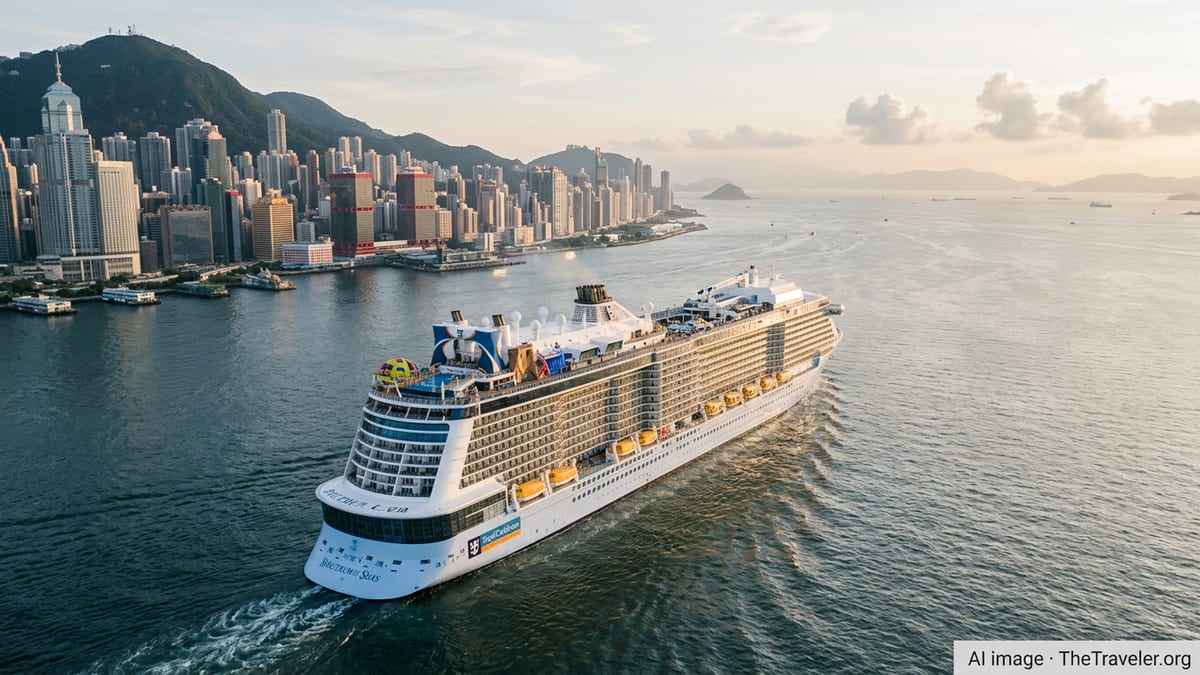
Viral clip captures tense bridge transit
The widely shared footage shows the vast cruise ship approaching a bridge with what appears to be only a sliver of sky between the vessel’s upper decks and the bridge span. As the ship glides beneath, observers on shore and on board can be heard reacting to the seemingly razor-thin clearance, with some online commenters questioning whether the vessel would fit at all.
The video’s perspective emphasizes the sheer scale of the ship, a hallmark of Royal Caribbean’s latest generation of vessels designed to carry thousands of passengers and extensive onboard attractions. From common camera angles at water level, the gap between a ship’s highest point and a bridge deck can look vanishingly small, even when engineering calculations allow for a safety margin.
The clip has quickly circulated across platforms where cruise enthusiasts regularly trade footage of close passes, tight turns and harbor maneuvers involving some of the world’s biggest passenger ships. Many viewers have compared it to earlier viral moments featuring Royal Caribbean’s Oasis-class and Icon-class ships threading under bridges in Europe and North America.
While the video has been received as a nail-biting spectacle, cruise specialists note that such transits are carefully modeled in advance, and that visually dramatic clearances are often far less marginal than they appear on screen.
How cruise giants are designed to clear bridges
Cruise ships that regularly sail itineraries requiring passage beneath low bridges are built with those structures firmly in mind, according to publicly available technical information from naval architects and cruise-line materials. Designers work from published bridge heights, local tidal data and expected load conditions on the vessel to calculate its “air draft,” or the distance from the waterline to its tallest fixed point.
Royal Caribbean’s largest ships provide well-known examples of this design approach. Information published about earlier Oasis-class vessels describes how features such as funnels and masts can be retracted or shaped to slip under key bridges along their routes, sometimes leaving just a couple of feet of spare room under optimal tidal conditions. For newer mega-ships, similar considerations apply, with engineers balancing guest amenities atop the vessel against the practical limits of existing port infrastructure.
Computer simulations, scale-model testing and harbor trials are typically used to verify that a new ship can transit critical chokepoints before it begins regular service. These processes account not only for still-water clearance, but also for factors such as squat, a hydrodynamic effect that can cause a moving vessel to sit lower in the water, and wind forces that may affect handling near a bridge span.
As a result, what appears in videos as a last-second gamble is usually the outcome of years of design work and route planning, with clearance margins determined long before paying passengers are on board.
Port planning, tides and timing behind the scenes
Port authorities and cruise operators routinely coordinate on the timing of bridge transits for large vessels, drawing on detailed tide tables and real-time water-level data. Publicly available harbor information shows that air clearance under fixed bridges can vary by several meters between low and high tide, making departure and arrival windows critical for very tall ships.
For mega-ships like Royal Caribbean’s newest flagships, that can mean sailing under certain bridges only at carefully chosen times, sometimes during the night or early morning when tides are lowest and traffic is lighter. Harbor pilots, who are highly familiar with local currents and winds, typically board well before the transit and take navigational control for the passage through constrained waters.
Under these conditions, vessel speed is adjusted to minimize hydrodynamic effects while still maintaining steerage, and tugs may stand by if additional control is needed. The result is a slow-motion sequence that seems hair-raising to casual viewers but is choreographed in advance, with contingencies planned if conditions deviate from expectations.
The new viral video has led many cruise followers to ask why ships continue to be built so large that they must rely on such tight margins. Industry watchers point to the popularity of big-ship amenities, as well as the economic efficiencies of carrying more guests per sailing, as key reasons for continued growth in size.
Public fascination with mega-ship close calls
The latest clip joins a long-running online genre of videos featuring large vessels threading under bridges, pivoting in narrow harbors or docking in high winds. Cruise ships, container vessels and car carriers often become viral stars when their maneuvers are filmed from dramatic angles along waterfronts.
For Royal Caribbean in particular, each new class of ship tends to generate a wave of attention as it undertakes sea trials and delivery voyages, including passages under notable bridges on the way to homeports. Published coverage of previous deliveries has highlighted shots of massive hulls sliding under spans with minimal visible clearance, images that have become part of the brand’s visual identity.
Travel analysts note that while such moments can cause anxiety for some viewers, they also underscore the scale of modern cruise tourism and the engineering behind it. The contrast between towering superstructures and aging bridge designs offers a vivid illustration of how maritime travel has evolved more quickly than some of the infrastructure that serves it.
The latest video’s viral spread suggests that public appetite remains strong for these made-for-social-media spectacles, even as they pose fresh questions about how far cruise lines can push ship dimensions within the constraints of existing ports and waterways.
Renewed questions about size, safety and future ship design
As discussion around the clip has grown, many online commenters have raised concerns about what might happen if calculations were ever off, or if unexpected conditions arose during a bridge transit. Maritime experts cited in prior coverage of similar incidents have emphasized that modern cruise ships operate under strict safety regulations and classification rules, including limits on structural loads and stability margins.
At the same time, the steady increase in cruise-ship size over the past two decades has prompted debate within the industry about whether a practical ceiling is approaching. Analysts point to factors such as port depth, harbor turning basins, and the fixed heights of key bridges as natural constraints that may influence the design of upcoming vessel classes.
For travelers, the sight of a ship barely seeming to fit under a bridge can be both thrilling and unsettling. Cruise forums show a mix of reactions, from guests eager to book sailings that include a “bridge moment” on the itinerary, to others who say they prefer smaller ships precisely to avoid such tight squeezes.
Regardless of opinion, the new video has once again put the spotlight on how closely cruise design, port engineering and social media are now intertwined. Each fresh piece of footage of a mega-ship slipping under a bridge offers not just a striking image, but a reminder of the complex calculations required to keep modern maritime tourism moving.