


Landing at Vienna International Airport can be surprisingly smooth, provided you know what to expect from the moment the aircraft door opens. This practical arrivals guide walks you step by step through passport control, baggage claim, customs and money, before comparing your options for getting into the city or catching onward trains. All advice is based on current procedures and prices as of mid‑2026, so you can plan with realistic timings and costs in mind.
Get the latest updates straight to your inbox!
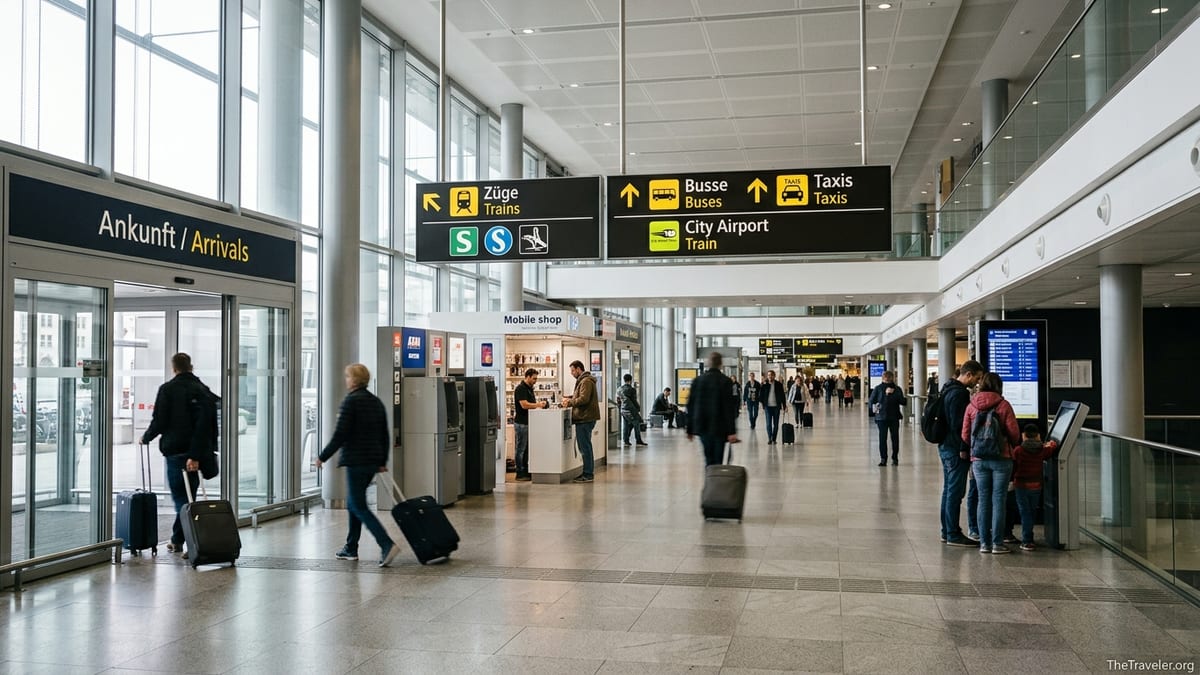
Understanding Vienna International Airport on Arrival
Vienna International Airport (VIE), often called Schwechat, is Austria’s largest airport and the main hub for Austrian Airlines as well as low‑cost carriers such as Ryanair and Wizz Air. Most international flights arrive into Terminals 1 and 3, which are connected airside and share the same arrivals level. Layout is relatively compact compared with airports like Frankfurt or Paris Charles de Gaulle, so walking distances are manageable for most passengers.
After landing, your first steps will follow a clear sequence: disembark, follow the yellow “Arrivals” and “Baggage Claim” signs, clear passport control if required, pass through the baggage hall and customs, then emerge into the public arrivals area. The arrivals level has ATMs, currency exchange, car rental counters, an information desk and access to trains, buses and taxis. Vienna Airport publishes an official terminal map and passenger guide that match what you will see on the ground, including icons for passport control, baggage claim and bus and train access.
How long the process takes depends heavily on whether you are arriving from a Schengen or non‑Schengen country, the time of day and your baggage situation. Many recent travelers report that as EU or other e‑gate eligible passengers, they often clear passport control in just a few minutes at quiet times, though peak bank‑holiday periods can produce longer lines. Allow extra time for early morning and late afternoon banks of long‑haul arrivals.
If you have a tight connection to a train or onward flight, it helps to sit close to the front of the aircraft and know in advance whether you can use e‑gates. Vienna is not generally a stressful airport to arrive into, but connections under 60 minutes from a non‑Schengen long‑haul flight can feel rushed if queues or baggage delays occur.
Passport Control: Schengen vs Non‑Schengen Arrivals
Your passport control experience at Vienna depends entirely on where you are flying in from. If you arrive from another Schengen country, such as Germany, Italy or Spain, you will usually not pass passport control on arrival at all. Instead you walk directly from the gate area towards baggage claim and customs. In these cases, the main potential bottleneck is baggage delivery, especially at peak times for intra‑European flights.
If you arrive from a non‑Schengen country, such as the United Kingdom, United States, Canada, Turkey or the United Arab Emirates, you will go through passport control before reaching baggage claim. Look for the blue signs indicating “Passport Control / Kontrolle” and choose the lane that fits your status: EU/EEA/Swiss, e‑gates where available, or “All Passports”. Many EU and some non‑EU biometric passport holders can use automated e‑gates located especially near Terminal 3’s non‑Schengen arrivals, which often reduces waiting time significantly when they are operating smoothly.
Recent passengers describe a mixed picture of waiting times. At off‑peak hours, some report walking straight through e‑gates in two or three minutes. Others arriving on busy non‑Schengen flights at Terminal 3 have experienced noticeably slower manual control lines. If you are connecting to an onward train at Wien Hauptbahnhof or Wien Mitte, aim to allow at least 45 to 60 minutes from scheduled landing to clear formalities, longer if you cannot use e‑gates or are traveling at busy holiday periods.
If you discover on landing that your passport is lost, stolen or expired, Vienna Airport hosts consular and emergency passport services for some nationalities in the publicly accessible areas of the terminal. These services are not 24/7 and can take time, so if your documents are not in order you should expect to delay any onward travel until you have resolved the issue and received clearance from the border authorities.
Baggage Claim, Customs and What Happens Landside
Once through passport control, follow the “Baggage Claim” signs to the carousel area. Flight information screens list your flight number next to the assigned belt. Vienna’s baggage hall was substantially refurbished in recent years, and transfer from gate to conveyors is usually straightforward. Many passengers report first bags from European flights arriving within 10 to 25 minutes, though long‑haul flights and very busy waves can take longer. Oversized and special baggage, such as skis and bikes, are delivered to clearly marked “Oversized Luggage” points close to the regular belts.
As your bags appear, be ready with your baggage tags in case staff conduct spot checks. If your luggage fails to appear, the Lost & Found counter for your airline or handling agent is located in or near the baggage hall. For Austrian Airlines and many Star Alliance carriers, you will typically report missing baggage to the local ground handler, who will arrange delivery to your address in Vienna or beyond once it arrives on a later flight. Keep receipts for essential purchases, as some airlines reimburse reasonable costs caused by delayed baggage.
After collecting your bags, you head through customs. As in most EU airports, you will see at least two exits: “Nothing to declare” (green) and “Goods to declare” (red). The vast majority of passengers simply use the green exit and walk straight through into the public arrivals hall. Customs officers are present and may perform random checks, especially if you are carrying large or unusual luggage. If you are bringing goods above EU allowances, such as large quantities of alcohol or tobacco or high‑value electronics bought tax‑free, use the red lane to avoid fines later.
The sliding doors at the end of customs open directly into the arrivals hall, where people wait with name signs and where you find ATMs, SIM card vendors, an information desk, cafés and the corridors leading to trains, buses, taxis and parking garages. If you have arranged a pre‑booked taxi or shuttle, your driver will usually wait in this area holding a sign with your name or the company logo, typically just to the left as you exit into public arrivals.
Money, ATMs, SIM Cards and Airport Services
In the arrivals hall you will see several ATMs from major Austrian banks which accept international cards from Visa, Mastercard and most debit networks. Using a bank ATM is usually more cost‑effective than withdrawing cash from currency exchange kiosks, which tend to offer poorer rates and higher fees. If your card or bank allows fee‑free withdrawals abroad, consider taking out a modest amount of euros at the airport to cover transport and small purchases, and then use contactless card or mobile payments for most transactions in Vienna.
Zurich‑style currency exchange counters operate at Vienna Airport as well, but their spread between buy and sell rates can be relatively high. They may be useful if you need to change leftover Swiss francs or US dollars in small amounts, but many travelers now rely on travel credit cards with no foreign transaction fees instead. Vienna’s transport system, hotels, supermarkets and restaurants are all widely equipped for cards and contactless payments, so you do not need large quantities of cash.
For mobile connectivity, arrivals halls usually host kiosks or vending machines for Austrian mobile operators offering prepaid SIM cards and eSIM activation. Typical brands include A1, Magenta and Drei. Products change frequently, but you can expect offers such as a short‑term tourist SIM with several gigabytes of data and local calls for a moderate fixed price. Another common approach is to buy an eSIM online from providers like Airalo or Holafly before departure, then simply switch it on after landing, using the airport’s free Wi‑Fi to complete activation if needed.
Other services in the arrivals zone include car rental counters from major firms such as Europcar, Hertz and Sixt, luggage wrapping, a small selection of cafés and bakeries for a quick coffee and snack, and an information desk where staff can point you towards the right platform for your train, bus or taxi. If you need wheelchair assistance or special mobility support, airline or airport staff can escort you from the gate through arrivals to your chosen onward transport, provided you have requested this service in advance.
Trains from Vienna Airport: CAT, Railjet and S7
Vienna’s strong rail connections make the train the default choice for many arriving passengers. All trains depart from the station beneath the terminal, reached by following the train icons and “Bahnhof” signs from arrivals and taking the escalators or lifts down. You will find clear signage for three main options: the City Airport Train (CAT), ÖBB Railjet long‑distance trains and the S7 suburban train operated as part of the regional transport network.
The City Airport Train is a dedicated express service linking the airport directly with Wien Mitte in about 16 minutes without intermediate stops. As of 2026, a standard one‑way ticket costs around 14.90 euros. Services run roughly every 30 minutes, and on board you can expect spacious seating and luggage racks. The CAT is especially popular with business travelers staying near Wien Mitte or connecting to the U3 and U4 metro lines. Note that CAT tickets are separate from regular Vienna public transport tickets; a normal metro or tram pass does not cover the CAT.
ÖBB Railjet and Intercity trains are long‑distance services that also stop at the airport on their way to major stations such as Wien Hauptbahnhof and Wien Meidling. If you are continuing by train to Salzburg, Graz, Linz or beyond, it can be very convenient to step directly onto a Railjet at the airport, as you avoid an additional transfer in the city. Travel time from the airport to Wien Hauptbahnhof on Railjet is about 15 minutes, and ticket prices vary depending on advance purchase and class of travel. If you already hold a domestic or international ÖBB ticket that includes Vienna Airport, you may not need to pay anything extra after landing.
The S7 suburban train is the most economical rail option into central Vienna. It usually takes around 25 minutes to reach Wien Mitte, stopping at intermediate stations such as Wien Praterstern. A standard adult ticket for the combined airport and city zones is typically in the range of a few euros, significantly cheaper than the CAT. This makes the S7 a favorite among budget‑minded travelers and locals alike. However, the S7 does not run all night and may be affected by planned engineering works, in which case ÖBB provides replacement buses or suggests alternative connections via other lines or buses.
In practice, your choice between CAT, Railjet and S7 depends on your priorities. If you value speed and simplicity and are staying near Wien Mitte, the CAT is an easy, if more expensive, option. If you are connecting to a long‑distance ÖBB train, a Railjet or Intercity service is ideal. If you want the cheapest route into town and do not mind a few extra minutes and intermediate stops, the S7 is usually the best choice. Ticket machines in the station area offer English language options and accept cards, and staff at ÖBB counters can help if you are unsure which product you need.
Airport Buses and Night Connections
Vienna Airport is also served by dedicated airport bus lines that connect the terminals to several parts of the city. The main service is the Vienna Airport Bus operated by Postbus, with routes to key hubs such as Wien Hauptbahnhof, Wien Westbahnhof and the Donaustadt area. As of mid‑2026, an adult one‑way ticket on these buses costs around 11 euros, with cheaper rates for children and return tickets. Journey times vary by route but are typically around 40 minutes to the central stations under normal traffic conditions.
Some bus lines are particularly useful for travelers staying in the western or northern parts of the city, where a direct train connection might require changing lines in the center. For example, a route connecting the airport with Vienna Westbahnhof gives convenient access to the Mariahilf and Neubau districts, popular for mid‑range hotels and shopping. Another route serves Donaustadt and the area around the Vienna International Centre, useful for conference attendees and business travelers heading to UN or corporate offices.
One advantage of the Vienna Airport Bus is its coverage during late night and early morning hours, when S‑Bahn and some Railjet services are limited. Travelers arriving on very late flights or departing extremely early may find that the airport bus is the most straightforward public transport option that runs close to their schedule. For instance, there are early morning buses reaching the airport around the opening of the first check‑in counters, and late services after midnight back into the city.
Tickets for the airport buses can be bought from machines in the arrivals and bus stop areas, from the driver on some routes or in advance online. Buses are modern and typically come with air conditioning, luggage storage, and in many cases onboard Wi‑Fi and USB charging. While they are not usually faster than train options into central Vienna, they are a reliable, comfortable alternative, especially if your accommodation is near one of the direct bus stops.
Taxis, Ride‑Hailing and Private Transfers
If you prefer door‑to‑door travel, taxis and private transfers are easy to find once you exit the customs area. Official airport taxis wait in clearly signposted ranks just outside the arrivals hall. As of 2026, a metered taxi ride from Vienna Airport to the city center typically costs in the range of 45 to 55 euros, depending on traffic, time of day and exact destination. Many travelers report average fares near the lower end of that band for journeys to central districts like Innere Stadt or Leopoldstadt during off‑peak times.
In addition to regular metered cabs, Vienna has a strong market for pre‑booked flat‑rate airport transfer companies. These services often advertise fixed prices starting from roughly the high 30s in euros for up to four passengers traveling to central districts, with slightly higher rates at night or for larger vehicles. Passengers who have used these services describe booking online, then meeting their driver just after exiting customs, usually on the left‑hand side of the arrivals hall, where representatives hold signs with passenger names.
Ride‑hailing options like Uber operate in Vienna but are integrated into the city’s regulated taxi system. Prices can be competitive with regular taxis, especially for off‑peak journeys, but surge pricing and limited vehicle availability at peak times or very late at night can reduce the advantage. If you intend to use ride‑hailing, check that your mobile data is active after landing and consider connecting to airport Wi‑Fi to request your ride from just outside the terminal doors.
For families with small children or travelers with lots of luggage, pre‑booked transfers are often the easiest solution. You can request child seats, extra space for sports equipment such as skis, or wheelchair‑accessible vehicles. Some hotels in Vienna, particularly higher‑end properties, offer their own car services from the airport, which can be arranged via the concierge in advance. When comparing costs, remember that the price of a taxi or private transfer covers the whole vehicle, so a group of four splitting a 42‑euro flat‑rate ride might pay only slightly more per person than taking the CAT.
Onward Travel in Vienna and Beyond
Once you have reached the city by train, bus or taxi, Vienna’s efficient public transport network makes it straightforward to reach most hotels and neighborhoods. From Wien Mitte, you can connect directly to metro lines U3 and U4, trams and buses that serve districts like Innere Stadt, Landstraße and Neubau. From Wien Hauptbahnhof, metro line U1, multiple tram lines and regional trains fan out to the south and west of the city. Buying a 24‑, 48‑ or 72‑hour public transport pass soon after arrival is often good value if you plan to move around frequently.
Travelers continuing by train to other Austrian cities benefit from frequent Railjet and regional services from Wien Hauptbahnhof. Typical example journeys include around 2 hours 30 minutes to Salzburg, roughly 2 hours 30 to Graz and about 1 hour to Linz when using fast services. If you booked an advance ÖBB Sparschiene ticket, check whether your journey already includes travel from Vienna Airport or starts in the city. If it starts in the city, you can still use the S7 or an airport bus to connect separately.
For trips into neighboring countries, Railjet and other long‑distance trains from Vienna connect to destinations such as Budapest, Prague and Munich, often without the need to change trains. Some travelers even land at Vienna Airport and go directly to the city’s main station to catch a night train to places like Venice or Zurich. In these cases, allow a comfortable buffer between your flight’s scheduled arrival and the train’s departure in case of delays or longer queues at passport control and baggage claim.
If you are renting a car, the car rental center is accessible from the arrivals area, with parking garages just beyond. Driving from Vienna Airport to the city center typically takes 25 to 35 minutes in light traffic via the A4 motorway. However, given Vienna’s excellent public transport, many visitors find they do not need a car during their stay unless they plan to explore rural regions such as the Wachau Valley or the Austrian Alps.
The Takeaway
Arriving at Vienna International Airport is generally a calm and efficient experience, especially if you understand the sequence of steps from aircraft door to city center. Schengen arrivals often skip passport control, while non‑Schengen passengers should expect at least a short queue, using e‑gates where available. Baggage claim, customs and the transition into the arrivals hall are all clearly signposted, with ATMs, SIM options and basic services easy to find.
When it comes to getting into Vienna, the choice between the City Airport Train, Railjet, S7 suburban train, airport buses or taxis is largely a balance between budget, time and convenience. The CAT and Railjet are fast and simple, the S7 is economical and widely used by locals, buses provide good coverage and night services, and taxis or private transfers are ideal when you want door‑to‑door comfort or are traveling in a group. With realistic expectations about timings and prices, you can turn your arrival into a smooth first chapter of your visit instead of a logistical challenge.
FAQ
Q1. How long does it usually take to get from landing at Vienna Airport to the city center?
In typical conditions, allow about 60 to 90 minutes from scheduled landing to reaching central Vienna. This includes taxiing, disembarking, passport control if needed, baggage claim and travel into the city by train, bus or taxi. If you arrive with only hand luggage at a quiet time and use the CAT or Railjet, you might make it to Wien Mitte or Wien Hauptbahnhof in as little as 40 to 50 minutes.
Q2. What is the cheapest way to get from Vienna Airport to the city?
The S7 suburban train is usually the cheapest practical option for most travelers. A combined ticket covering the airport and city zones typically costs only a few euros, significantly less than the City Airport Train or a taxi, and takes about 25 minutes to reach Wien Mitte. It suits budget travelers and anyone staying near stations served by the S7.
Q3. Is the City Airport Train worth the higher price?
The City Airport Train is worth considering if you value speed and simplicity and are staying or changing near Wien Mitte. It runs non‑stop in about 16 minutes and offers comfortable seating and easy luggage storage. However, it costs notably more than the S7, so if you are very price conscious or traveling with several people, the regular suburban train or a shared taxi might represent better value.
Q4. Can I buy public transport tickets at Vienna Airport on arrival?
Yes. In the train station area beneath the terminal you will find ÖBB and Vienna public transport ticket machines with English language options that accept cards and cash. You can buy combined airport and city tickets for the S7, as well as city passes valid on the metro, trams and buses. Separate machines or counters sell City Airport Train tickets, and airport bus tickets are available at dedicated machines, from drivers on some routes and online.
Q5. Are there ATMs and money exchange facilities in the arrivals hall?
Yes. Several bank ATMs are located in the arrivals area and accept major international cards. Currency exchange counters are also present, though they often provide less favorable rates than ATMs and card payments. Many visitors withdraw a modest amount of cash for small purchases and use cards or mobile payments for most expenses in Vienna.
Q6. Where can I buy a SIM card or arrange mobile data at Vienna Airport?
In the arrivals zone you will normally find kiosks or vending machines for Austrian mobile operators such as A1, Magenta or Drei selling prepaid SIM cards. These often include data and local calls for a fixed period. Many travelers now prefer to activate an eSIM from international providers before traveling and then use the airport’s free Wi‑Fi on arrival to finalize activation, avoiding the need to swap physical SIM cards.
Q7. How much does a taxi from Vienna Airport to the city center cost?
As of 2026, a metered taxi from Vienna Airport to central districts typically costs around 45 to 55 euros, depending on traffic, time of day and exact destination. Pre‑booked flat‑rate transfer companies often advertise slightly lower fixed prices starting from the high 30s or low 40s in euros for up to four passengers. For a group sharing one vehicle, this can be competitive with buying multiple train tickets.
Q8. What should I do if my luggage does not arrive in Vienna?
If your luggage is missing, go to the Lost & Found or baggage services desk for your airline or its handling agent in the baggage claim area. Show your baggage tag and boarding pass so staff can create a missing baggage report. They will track your suitcase and usually arrange delivery to your hotel or address once it arrives on a later flight. Keep receipts for essential items you need to buy in the meantime, as some airlines reimburse reasonable emergency purchases.
Q9. Is Vienna Airport easy to navigate for travelers with reduced mobility?
Yes. Vienna Airport is relatively compact and equipped with elevators, ramps and accessible toilets. If you request assistance through your airline in advance, staff can meet you at the aircraft door and escort you through passport control and baggage claim to the arrivals hall or your chosen onward transport. Modern trains, including many S7 and Railjet services, as well as airport buses, usually have low‑floor or ramp access, though you may wish to confirm specific connections when planning.
Q10. Are there night transport options from Vienna Airport if my flight lands very late?
There are usually late‑evening and very early‑morning bus services connecting the airport with central Vienna and major stations, even when the S7 runs less frequently or not at all. Taxis are available around the clock, and some pre‑booked transfer companies specialize in late‑night and early‑morning rides. If you know you will arrive after midnight, check current timetables for the Vienna Airport Bus and suburban trains shortly before you travel and consider a taxi or pre‑booked transfer as a reliable backup.