


Landing at Vienna International Airport, many visitors see bright green City Airport Train signs promising a fast, 16 minute nonstop ride into the city. The CAT looks convenient and reassuring after a long flight, but its ticket price is much higher than regular public transport. This guide explains exactly how the City Airport Train works in 2026, what you get for the premium fare, how it compares with cheaper options like the S7 suburban train and Railjet, and in which real life situations the CAT is genuinely worth it.
Get the latest updates straight to your inbox!
What Exactly Is the City Airport Train?
The City Airport Train, usually called CAT, is Vienna’s dedicated airport express rail service. It runs non stop between Vienna International Airport (VIE) and Wien Mitte / Landstraße station on the eastern edge of the historic center, taking 16 minutes in each direction. Trains use distinctive green and white branding and modern, air conditioned rolling stock with wide doors and large luggage racks designed specifically for travelers arriving with suitcases.
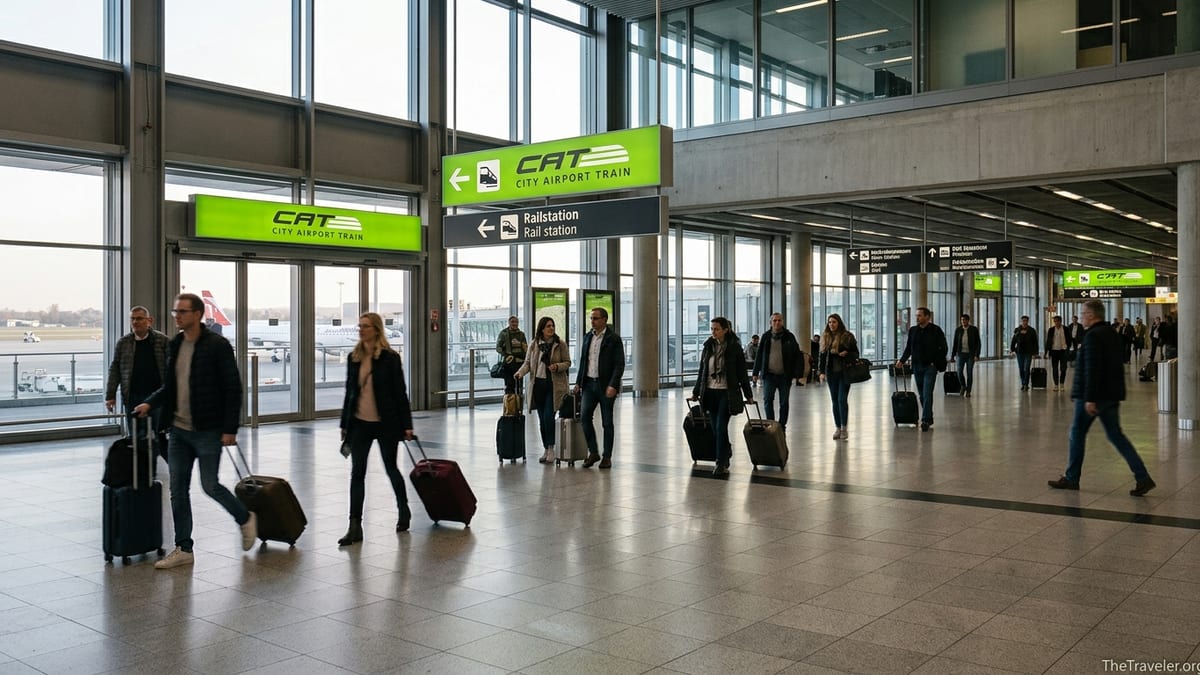
Unlike the regular S7 suburban train or long distance Railjet services, the CAT is a premium product focused on simplicity. It has only two stations, airport and Wien Mitte, clearly signed in the terminal buildings. On arrival you walk directly from baggage claim into the connected rail concourse and follow the green CAT symbols to the dedicated platforms. At Wien Mitte, the CAT has its own section of the station and is physically integrated with the City Air Terminal, where you find ticket machines, check in desks for certain airlines, and direct connections to the U3 and U4 metro lines.
The service operates every day of the year, typically at 30 minute intervals from early morning until around midnight, with slight variations by season and weekday. For example, in the current timetable a morning pattern might see departures from the airport at 06:08, 06:38, 07:08 and so on, and from Wien Mitte roughly on the quarter and three quarter hours. In practice this means that if you just miss a train you rarely wait more than 30 minutes for the next one, a rhythm business travelers quickly get used to.
Because the CAT is separate from Vienna’s integrated public transport network, its tickets are not covered by standard city passes or the usual “Kernzone Wien” local tariff. You buy CAT tickets separately, either online in advance, from bright green machines in the arrivals hall and at Wien Mitte, or from staff at the platforms. This separation is an important point when comparing CAT with cheaper but slightly slower options into the city.
Journey Time, Timetable and Onboard Experience
The headline promise of the City Airport Train is speed: 16 minutes between the airport and Wien Mitte with no intermediate stops. In practice, the trains are punctual and the journey time is reliable, because they use dedicated tracks and do not stop at suburban stations along the way. By comparison, the S7 suburban train usually takes about 25 minutes to cover the same distance, and the Vienna Airport Lines buses take roughly 22 to 40 minutes depending on the route and traffic conditions.
The typical timetable pattern in 2026 offers a CAT departure roughly every 30 minutes in both directions, with a slight increase in frequency during peak airline arrival waves in the morning and late afternoon. For example, you might land from a transatlantic flight around 08:00, clear passport control and baggage in 30 to 40 minutes, and comfortably catch the 08:38 CAT, arriving at Wien Mitte shortly before 09:00. In the other direction, an evening departure around 18:00 from Wien Mitte would get you back to the airport around 18:16, with plenty of time for a 20:00 intra European flight.
Onboard, the CAT feels more like a modern intercity train than a commuter service. Carriages have comfortable, high backed seats, generous legroom, power sockets at many seats, and stable mobile coverage for checking hotel confirmations or ordering a rideshare. Luggage racks near the doors hold large checked suitcases, while overhead shelves accommodate smaller carry ons. Because the train does not make intermediate stops, you are not constantly standing up to let other passengers pass, which many travelers appreciate after long flights.
The train is unreserved: you simply board any carriage and choose a seat. At busy times, such as Sunday evenings at the end of holiday periods, certain departures can fill up with returning holidaymakers and conference groups, but seats are usually available. Conductors check tickets on board, so you should have your digital or paper ticket ready. There is no café bar, but the short journey means most people are content with a bottle of water or coffee bought in the terminal.
Ticket Prices, Discounts and Combined Tickets
As of mid 2026, a standard adult one way ticket on the City Airport Train costs around 14.90 euros, with a return ticket priced slightly below double that to encourage round trip purchases. Children up to a certain age often travel free when accompanied by a paying adult, and there are occasional online promotions or discounts for holders of Austrian railcards, annual Vienna public transport passes or national climate tickets. These promotional fares are usually advertised prominently at the ticket machines and on posters in the terminals.
The CAT also sells combined products that bundle the airport express ride with a city public transport ticket. A common example is a “CAT plus City Ticket Vienna” package that includes one CAT journey plus either 24, 48 or 72 hours of unlimited travel on the Vienna metro, trams and buses inside the central tariff zone. For a weekend city break, a traveler arriving Friday afternoon and departing Sunday evening might choose a 72 hour package, using CAT to get into town quickly and then relying on the unified public transport ticket for everything from the Schönbrunn Palace gardens to the MuseumsQuartier.
By contrast, a regular public transport ticket from the airport to the city using the S7 suburban train or a Railjet regional service typically costs a bit over 4 euros for adults when purchased as a combined “airport to city core zone” fare. This ticket covers the entire journey from the airport to any station within Vienna’s central transport zone, including onward transfers by metro, tram or bus if completed as one continuous trip. For example, you could buy this ticket at the airport, ride the S7 to Wien Mitte, then transfer to metro line U3 to Westbahnhof without needing to pay again.
The price gap is therefore substantial. A solo traveler might pay almost three times more for the CAT than for the S7 for what is, in essence, a 10 minute time saving between the airport and Wien Mitte. For two adults, the price difference quickly approaches the cost of a taxi or pre booked transfer into central districts, which often run around 35 to 40 euros per car. Recognising this, the CAT positions itself not simply as faster transport but as a premium, comfortable link with extra add ons like city check in rather than a mere train ride.
City Check In: How It Works and Who Can Use It
One of the most distinctive features of the City Airport Train is its city check in service at Wien Mitte. For selected airlines, passengers can check in hold luggage and obtain boarding passes in the city center several hours before their flight, then travel to the airport with only hand luggage and proceed directly to security. The City Air Terminal at Wien Mitte essentially functions as an off airport check in hall connected to the station concourse.
Airlines participating in city check in vary from year to year, but they usually include Austrian Airlines and several partner carriers, as well as a handful of long haul or leisure airlines serving Vienna. The operating hours are typically aligned with daytime and evening departures, often closing at least 75 to 90 minutes before the scheduled flight time to allow transfer of baggage to the airport. Travelers should always verify current availability and cut off times with their airline or the CAT information desk before relying on city check in.
To use city check in in practice, imagine you are staying near Stephansplatz and flying home on Austrian Airlines at 18:30. After checking out of your hotel at 11:00, instead of storing bags at reception and returning later, you take the short walk or metro ride to Wien Mitte around lunchtime. At the City Air Terminal you check your suitcase for your evening flight, receive a boarding pass, and then spend the afternoon free of luggage, perhaps visiting the Belvedere or shopping on Mariahilfer Strasse. Around 16:30 you return to Wien Mitte with only a small daypack, board the CAT, and on arrival at the airport you head straight to security.
This convenience particularly appeals to business travelers and families who want to enjoy a last half day in the city without dragging luggage around museums or cafés. It can also reduce stress on busy travel days, because once you have a boarding card and your bag is checked in, the remaining journey feels more predictable. However, city check in is only available to CAT passengers with a valid ticket, and it is not offered for all airlines or flight times, so its value depends heavily on your carrier and schedule.
CAT vs S7, Railjet, Bus and Taxi: Time and Cost Compared
To decide if the CAT is worth it, it helps to compare it with other airport to city options on both time and cost. The closest alternatives are the S7 suburban train and Railjet services operated by Austrian Federal Railways, which also run directly from Vienna Airport station. The S7 takes about 25 minutes from the airport to Wien Mitte, stopping at several intermediate suburban stations. Railjet trains run between the airport and Vienna Hauptbahnhof, the main station, in around 15 minutes, and some continue onward into the city.
In practical terms, a traveler heading to an address near Wien Mitte or on metro lines U3 or U4 has a choice between the 16 minute CAT and the roughly 25 minute S7. The S7 is slower but costs a fraction of the price, and your ticket also covers onward travel within the city. For example, a budget conscious solo traveler staying near the Naschmarkt might take the S7 from the airport to Wien Mitte for just over 4 euros and then transfer to U4 at no extra cost, arriving in about 35 to 40 minutes total. A business traveler arriving late for a meeting in the nearby Landstraße district, on the other hand, might use the CAT to shave 10 minutes off the journey and benefit from the quieter, more spacious carriage.
Buses run by Vienna Airport Lines connect the airport with several key hubs, including Vienna Main Station, Westbahnhof and the United Nations district at the Vienna International Centre. Travel time ranges from about 22 to 40 minutes depending on route and traffic, with tickets usually priced slightly higher than the S7 but still significantly below the CAT. Buses can be convenient if your accommodation is close to one of their specific stops, such as near Westbahnhof or the Donaustadt area, sparsely served by direct rail from the airport.
Taxis and ride hailing services are the most flexible option and can be excellent value for small groups. Official airport taxis and pre booked transfer companies often offer fixed price rides to central districts for around 36 to 40 euros per car. For three or four travelers sharing, this can be comparable in cost to four CAT tickets while delivering a door to door journey with no need to change transport or carry luggage on and off trains. For example, a family of four staying in a hotel off Kärntner Strasse might find a fixed fare taxi for 39 euros cheaper and more convenient than spending nearly 60 euros on CAT tickets plus metro rides.
When Is the CAT Worth the Money?
Because the CAT is significantly more expensive than the S7 or Railjet, the key question for many visitors is when the extra cost is justified. The answer depends on your priorities: speed, comfort, luggage, group size and the value you place on city check in. For solo business travelers on tight schedules, especially those staying near Wien Mitte or on a direct metro line from there, the CAT’s 16 minute journey and relaxed environment can be worth the premium, particularly after a red eye or long haul flight.
Another scenario where the CAT makes sense is when you heavily use the city check in service. Imagine a couple staying in the Innere Stadt with a late evening long haul departure on a partner airline that supports Wien Mitte check in. Rolling their large suitcases 10 minutes to Wien Mitte at midday, checking in, and then spending the afternoon at leisure before returning with just hand luggage can transform the feel of the last day. For travelers who would otherwise pay extra for hotel luggage storage or who dislike navigating crowded trams with big bags, the CAT plus city check in combination has genuine value.
The CAT can also be appealing late in the evening when you want a predictably fast and safe ride straight to the city center. Although the S7 and buses offer late services too, some passengers feel more comfortable on the dedicated airport express, especially when traveling alone with luggage after dark. The clear signage, staff presence and simple two station route can give reassurance if you are unfamiliar with central European ticketing systems.
On the other hand, the CAT is generally poor value for budget travelers, backpackers and most families watching costs. A solo traveler arriving mid afternoon with no need for city check in can take the S7 to Wien Mitte or a Railjet to the main station for little more than 4 euros, then connect to the metro. Even allowing 10 extra minutes, the total door to door time to many central hotels is still under 45 minutes. For a group of three or four with heavy luggage, a pre booked taxi often beats both CAT and S7 on price and convenience, especially if their hotel is not close to Wien Mitte.
Practical Tips for Using the CAT Smoothly
If you decide the City Airport Train suits your trip, a few simple steps can make the experience smoother. First, consider buying tickets online or in the official app before you travel. This avoids queueing at machines when multiple flights arrive at once, and you can go straight to the platform. Digital tickets are accepted on smartphones, and staff on the train are used to scanning QR codes. If you prefer paper tickets, the green ticket machines in arrivals accept major credit cards and have English language menus.
Second, check the exact departure time of the next CAT before leaving the baggage claim area. Overhead displays in the terminal and at the station show the next departures for CAT, S7 and Railjet. If you have just missed a CAT and the next S7 leaves in a few minutes, you might decide that saving time overall is more important than the slightly faster express ride. Conversely, if you land in the middle of the night or at a quiet time when suburban services are less frequent, waiting 10 or 15 minutes for the CAT might make sense.
Third, plan your onward connection from Wien Mitte. The station connects directly to metro lines U3 (orange) and U4 (green), and several city bus routes. If your hotel is near Stephansplatz, Herrengasse or Museumsquartier, you can usually stay on the U3 for one or two stops. For hotels along the Ringstrasse or near Karlsplatz, the U4 can be more convenient. Many visitors underestimate how walkable Vienna’s center is; from Wien Mitte, a 15 to 20 minute walk along the Ring can take you to hotels near Stadtpark or the opera house, which might be enjoyable in good weather if you have light luggage.
Finally, remember that CAT tickets are separate from all regular Vienna transit passes. If you arrive on CAT and plan to use the metro or tram for the rest of the day, you will still need a valid city transport ticket unless you purchased a combined CAT plus city pass. Inspectors do perform spot checks on the metro and trams, and not having a valid ticket can result in an on the spot fine significantly higher than the price of a daily pass.
The Takeaway
The City Airport Train between Vienna International Airport and Wien Mitte offers a genuinely fast, comfortable and simple connection, with a reliable 16 minute journey and the distinctive benefit of city check in for certain airlines. For short business stays around Landstraße or the inner districts, or for travelers who value handing off luggage hours before their flight, CAT can be a stress reducing, premium way of starting or ending a trip.
However, the high ticket price compared with the S7 suburban train, Railjet services and airport buses means it is not the automatic choice for every traveler. Budget conscious visitors and families can save a substantial amount by using regular public transport, with total journey times only 10 to 15 minutes longer to many central addresses. Groups of three or four with heavy luggage may find that a fixed price taxi or pre booked transfer offers the best balance of cost and door to door convenience.
When deciding whether the CAT is worth it, think in concrete terms about your arrival and departure times, where in Vienna you are staying, how much luggage you have, and whether your airline supports city check in. If speed, comfort and baggage convenience rank highest, the green City Airport Train delivers on its promise. If value for money and flexibility matter more, Vienna’s excellent regular trains, buses and taxis ensure that skipping the CAT will not diminish your experience of this efficient and welcoming city.
FAQ
Q1. How much does the City Airport Train cost compared with the S7?
The CAT one way fare for adults is around 14.90 euros, while a combined public transport ticket for the S7 from the airport into Vienna’s central zone typically costs just over 4 euros, roughly a third of the CAT price.
Q2. How long does the CAT take from Vienna Airport to the city?
The CAT runs non stop between Vienna International Airport and Wien Mitte / Landstraße station in about 16 minutes, consistently faster than the S7 suburban train, which usually takes around 25 minutes with intermediate stops.
Q3. How often does the CAT run?
In 2026, the City Airport Train generally runs every 30 minutes in each direction from early morning until around midnight, with slight variations depending on the day of the week and seasonal flight schedules.
Q4. Where does the CAT arrive in Vienna and what connections are available?
The CAT terminates at Wien Mitte / Landstraße station, a central transport hub on the eastern edge of the inner city that offers direct connections to metro lines U3 and U4, several bus routes and easy walking access to the city center.
Q5. Is city check in at Wien Mitte available for all airlines?
No, city check in at the City Air Terminal applies only to participating airlines and selected flights. Availability changes over time, so passengers should check with their airline or CAT information before relying on the service.
Q6. Can I use a Vienna public transport pass on the CAT?
Standard Vienna public transport passes and zone tickets do not cover travel on the CAT, which is operated as a separate premium service. You need a specific CAT ticket unless you bought a combined product that explicitly includes the airport express.
Q7. Is the CAT worth it for budget travelers?
For most budget travelers, students and backpackers, the CAT is usually not worth the extra cost. The S7 suburban train or Railjet, combined with regular city tickets, offers a very good balance of price and travel time.
Q8. When is a taxi better value than the CAT?
A taxi or pre booked transfer can be better value for small groups, particularly three or four people with luggage, because a fixed fare of around 36 to 40 euros per car can undercut the combined cost of multiple CAT tickets while providing door to door service.
Q9. Does the CAT run late at night or very early in the morning?
The CAT covers most flight times from early morning to late evening, but there are hours during the night when it does not operate. For very early or late flights, travelers may need to rely on the S7, airport buses or taxis instead.
Q10. How do I buy CAT tickets at the airport?
You can buy CAT tickets from green self service machines in the arrivals area and at the station, from CAT staff at the platforms, or online and in the official app before you travel, with digital tickets accepted on smartphones.