


More news on this day
Vietnam’s flagship Long Thanh International Airport is entering a critical phase of construction, but emerging pressures on timelines, costs and transport links are prompting new concerns that the massive hub may again miss its intended 2026 opening targets.
Get the latest news straight to your inbox!
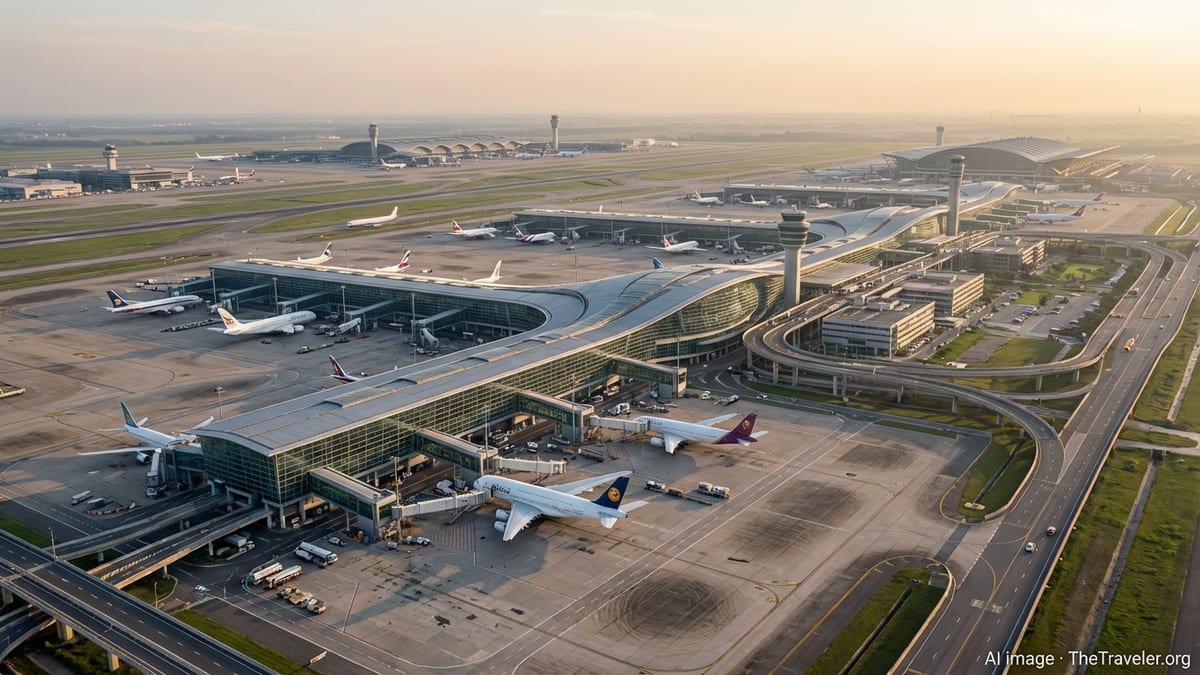
A project long seen as a solution to congestion
Long Thanh International Airport, rising in Dong Nai province about 40 kilometers east of Ho Chi Minh City, is designed to become Vietnam’s largest and most modern aviation hub. Publicly available planning documents describe a multistage development with an eventual capacity measured in tens of millions of passengers per year, intended to relieve chronic crowding at Tan Son Nhat International Airport and anchor the wider Southern Key Economic Region.
Phase one includes one passenger terminal, a runway and core technical facilities sized to handle an initial wave of international and domestic traffic. Reports indicate that after several years of delays in land acquisition and package tendering, large-scale construction ramped up from late 2023, with concrete structures for the terminal, runways and support buildings now visibly taking shape on the former rubber plantation site.
The project is framed not only as an aviation upgrade but also as a symbol of Vietnam’s growth ambitions, central to tourism strategies and investment promotion campaigns through 2030. That high political and economic profile has sharpened attention on any sign that the current schedule could slip further.
Shifting timelines raise questions over 2026 goal
Original planning for Long Thanh envisioned operations beginning in the early 2020s, but the airport’s first phase has already been pushed back multiple times. Recent public statements and local media coverage now point to a target of bringing phase one into service sometime in 2026, with some reports specifying commercial operations from late 2026 and a progressive build up of traffic into 2027.
At the same time, differing reference points for “completion” and “operation” are creating ambiguity. Some assessments emphasize mechanical completion of core facilities in the first half of 2026, while others highlight a later window for full commercial service as systems are tested and airlines gradually move flights from Tan Son Nhat. For travelers and carriers planning networks several seasons in advance, the distinction matters.
Analysts following Vietnam’s aviation sector note that the Long Thanh schedule is now tightly packed, leaving little buffer for weather disruptions, supply bottlenecks or design changes. With construction progress frequently cited in percentage terms, observers caution that the most complex work, including fit-out, systems integration and safety certification, still lies ahead and traditionally carries higher risk of delay.
Cost pressures and contractor performance in the spotlight
Concerns over potential slippage are compounded by cost and procurement challenges. Airports Corporation of Vietnam, the state-controlled operator overseeing key components of the project, faces heavy capital expenditure commitments across several major airports in the same timeframe. Public financial reports show investment needs for Long Thanh alongside large terminal expansions in Hanoi and Ho Chi Minh City, heightening sensitivity to overruns.
Local coverage has highlighted issues such as fluctuating material prices, the need to rebid certain construction packages and scrutiny of contractor performance on site. While officials have repeatedly stressed determination to meet the 2026 milestone, tight budgets and complex contractual arrangements increase the likelihood that any dispute, redesign or claim could translate into time lost on the critical path.
Anti-corruption efforts present a further layer of complexity. Vietnam has intensified oversight of large infrastructure projects, and Long Thanh is no exception. Observers note that while stricter controls can help safeguard public funds, they may also slow decision-making or approvals if documentation must be rechecked, particularly on variations and supplementary works that often emerge late in construction.
Transport links lag behind the new hub
Even if the core airport facilities are completed on time, questions remain about how easily passengers will reach Long Thanh from Ho Chi Minh City and surrounding provinces. The airport’s success depends heavily on a network of expressways, ring roads and rail connections, several of which are at various stages of planning and construction.
Reports from regional planning bodies describe delayed or phased progress on key road corridors, including links toward Vung Tau and coastal resort areas, as well as routes tying the airport to Ho Chi Minh City’s expanding ring-road system. Public commentary has warned that if ground infrastructure lags behind, early users of Long Thanh could face long transfers and unpredictable journey times, undercutting the airport’s promise of smoother travel.
There is also debate over the timing of future rail access. Long-range transport strategies envision both intercity and urban rail lines serving the airport, but these schemes remain largely on paper. Without high-capacity transit options in the early years of operation, Long Thanh may depend heavily on private cars and buses, increasing the risk of road congestion and limiting the hub’s competitiveness for time-sensitive international travelers.
Regional aviation stakes and the risk of a staggered opening
The stakes extend beyond a single project. Long Thanh is central to Vietnam’s ambition to position itself as a major aviation gateway in Southeast Asia, capturing a larger share of long-haul and transfer traffic that now flows through regional rivals. A smooth, timely opening could support the expansion plans of Vietnamese carriers and help distribute tourist flows more evenly beyond Ho Chi Minh City.
Conversely, a staggered or partial opening, in which only some flights move initially while others remain at Tan Son Nhat for longer than planned, could reduce immediate efficiency gains and confuse passengers. Airlines may be reluctant to split operations across two airports in the same metropolitan area if support services, maintenance and crew logistics become more complex and costly.
Sector research notes that each year of delay in fully realizing Long Thanh’s capacity risks foregone tourism revenue, suppressed cargo growth and continued congestion at existing facilities. With the clock ticking toward 2026, the next 12 to 18 months of construction progress, funding decisions and transport-project coordination will likely determine whether Vietnam’s most ambitious airport scheme finally meets its latest deadline or faces another round of revisions.