


Curving between Nice and Antibes on the Côte d’Azur, the Baie des Anges looks, at first glance, like just another pretty sweep of Mediterranean shoreline. In reality it is an outlier among France’s Mediterranean bays: a place where a working city, an international airport, Belle Époque hotels and a pebble beach all press up against a deep blue sea that drops steeply just a few strokes from shore. For travelers trying to choose between Nice, Cannes, Villefranche or Saint‑Tropez, understanding what makes this bay different can help you decide whether its very specific blend of urban energy and sea‑air serenity is the right fit for your trip.
Get the latest updates straight to your inbox!
A Bay Defined by a City, Not a Resort
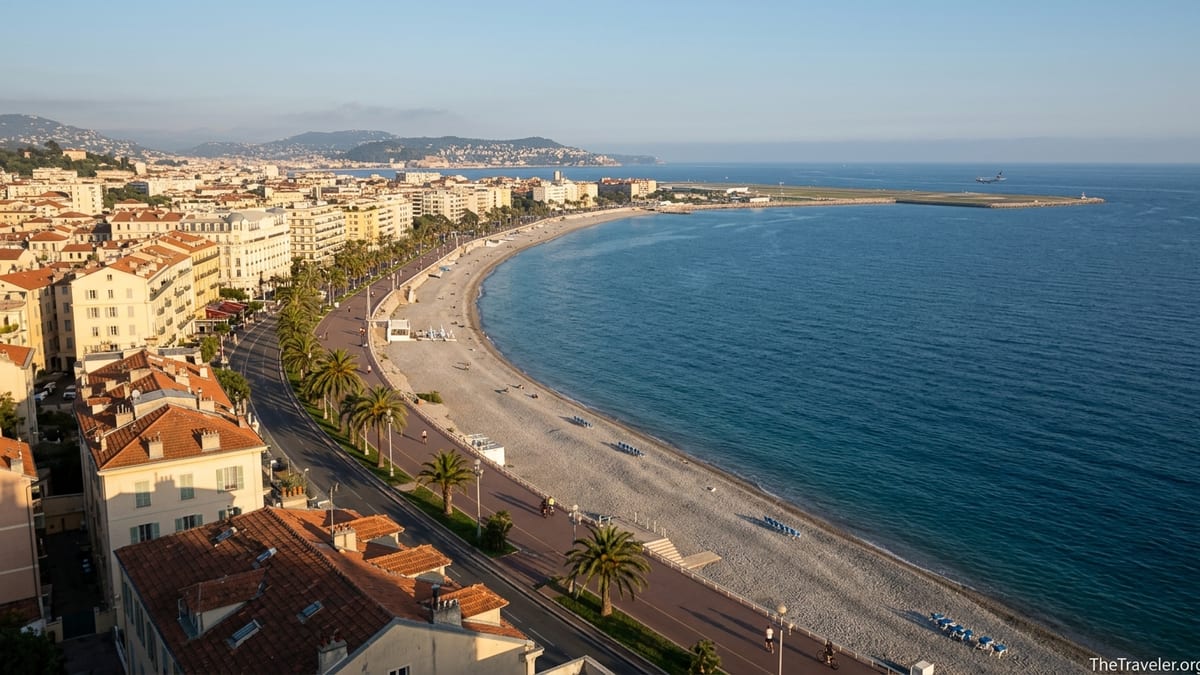
Most famous Mediterranean bays in France are built around resorts or small ports. The Baie des Anges is anchored instead by Nice, one of France’s largest cities, with trams rattling a few blocks behind the beach and Nice Côte d’Azur Airport practically in the water at the western end of the bay. From the pebbles near the Carras or Lenval sectors you can watch planes touching down every couple of minutes in summer, a striking reminder that this is one of Europe’s busiest holiday gateways rather than a sleepy harbour. In contrast, the neighbouring bay of Villefranche‑sur‑Mer feels like a sheltered amphitheatre of pastel houses and fishing boats, and the Croisette in Cannes fronts a town far more focused on its festival palace and luxury boutiques than on the everyday life of residents.
This urban context gives the Baie des Anges a different rhythm. On a weekday morning in June you will see office workers in suits commuting along the Promenade des Anglais on e‑bikes, joggers threading between dog walkers, and retirees reading the local paper on the iconic blue chairs facing the sea. It is scenery and backdrop to daily life at the same time, something you do not feel as strongly in bays dominated by second homes and seasonal visitors such as the Golfe de Saint‑Tropez.
The city also means access. From Nice‑Ville station it is roughly a 20‑minute walk or a short tram ride down to the waterfront, so you can be at the water’s edge with a simple train ticket, rather than needing a rental car or boat transfer. Travelers often base themselves in Nice for this reason and then day‑trip out to more enclosed bays like Villefranche or La Ciotat, treating Baie des Anges as their reliable, easy‑to‑reach “home” shoreline.
A Long, Open Crescent Rather Than a Sheltered Bowl
Geographically, Baie des Anges stretches in a wide arc from the headlands of Nice eastward towards Cap d’Antibes, touching several different municipalities along the way. It is an open bay, not a tight natural harbour, so the views are long and almost cinematic: from Castle Hill above Nice you can see the curve of beach run west past the airport and on, in clear weather, towards the Esterel hills beyond Cannes. Official tourism descriptions often highlight that the bay extends from Cap de Nice to the Fort Carré of Antibes, underscoring its scale compared with smaller coves along the Riviera.
Compare this with the bay of Villefranche, where steep hills close in around a deep natural pocket used historically as a naval anchorage. There, the feeling is of enclosure and shelter; in Baie des Anges the impression is of exposure and horizon. When the mistral or easterly winds blow, waves can slap right up to the sea wall in Nice, and swimmers report a noticeable chop at beaches like Opéra or Beau Rivage, something far less common on the more protected strand at Villefranche‑sur‑Mer.
The openness also affects how you use the shoreline. On Baie des Anges, the sea deepens quickly. Studies of the bay’s coastal morphology note that the gravel beach drops off steeply, and regular visitors know that after just a few steps you can find yourself out of your depth. Parents with small children sometimes prefer to take the 10‑minute train ride to Antibes or Juan‑les‑Pins, where the sand shelves more gradually, while strong swimmers enjoy the instant access to deep water right off the pebbles of Nice.
Pebble Beaches and Instantly Deep, Azure Water
One of the first surprises for travelers who arrive with mental images of sandy Riviera coves is that Baie des Anges is mostly made of smooth grey and white pebbles, not sand. Beach guides for Nice describe the shore as “smooth pebbles, crystal clear water,” and that combination is a defining feature. The stones, reachable within a couple of minutes’ walk from most central hotels, are rounded enough to sit on but uncomfortable for bare feet; many locals keep folding foam pads or thick towels to cushion their loungers, and inexpensive plastic water shoes are widely sold in beach kiosks each summer.
This pebble profile, fed historically by mountain rivers carrying gravel from the Alps, means the water turns deep turquoise to sapphire just a few metres offshore. On a clear June afternoon, you can stand waist‑deep at Plage des Ponchettes and look straight down at your toes, with visibility that snorkelers compare favourably to some Greek islands. The quick drop‑off helps with that clarity because wave action stirs up far less suspended sand than in the shallows of wide, sandy bays like La Grande Motte or parts of the Golfe du Lion further west.
This is very different from Cannes’ main bay, where imported sand forms a wide, shallow foreshore in front of the Croisette’s beach clubs. There, families spread out with plastic castles at the waterline. In Nice, you will more often see locals lying on the pebbles with paperback novels or taking short, refreshing dips rather than staying in the water with children for hours on end. For travelers deciding between bases, this physical difference matters: if sand play is essential, the Baie des Anges will never feel quite right, but if you care more about clear water and views, the pebbles are a small price to pay.
Historic Promenade des Anglais and Belle Époque Front Row
The seafront architecture and promenade give Baie des Anges a theatrical quality that sets it apart from less developed or more low‑rise bays. The Promenade des Anglais runs for roughly 7 to 8 kilometres along the waterfront, with palm trees, pergolas, kiosks and an uninterrupted view of the bay. Historically financed in part by English winter visitors in the early 19th century, it remains one of France’s most recognizable seafronts, more urban and built‑up than the lanes backing the small harbour in Cassis or the relatively modest seafront of Bandol.
Along this axis, landmark hotels such as Le Negresco, with its pink dome, and the Royal, Westminster and West End stand shoulder to shoulder. Their grand Belle Époque and Art Deco facades rise directly across from the public beach, so a morning swim might be followed by coffee beneath chandeliers in a lobby that once hosted celebrities and heads of state. This immediate juxtaposition of grand hotel culture with free public shoreline is unusual on the Riviera; in Cannes, much of the prime frontage is dominated by private hotel beach clubs, while in Saint‑Jean‑Cap‑Ferrat the most prestigious properties are hidden behind high walls and pine trees.
The promenade itself functions like an outdoor living room for the city. Blue metal chairs face the water in loose clusters, inviting you to sit and watch joggers, street musicians, and cruise ships on the horizon. In the evening, families stroll with ice creams from the stands near Place Masséna, and cyclists take advantage of the dedicated bike lanes that run the length of the Promenade. The combination of world‑famous hotels, continuous public access and everyday use by residents is what gives Baie des Anges a feel that is harder to find on more exclusively resort‑oriented bays.
A Name and Identity Tied to Marine Life
Even the name Baie des Anges hints at a deeper story. Local history resources explain that the term most likely derives from the angelshark, a ray‑like species known as squatina squatina, whose wing‑shaped fins suggested an angel’s silhouette. Fishermen once pulled these “angels” up in their nets in the waters off Nice, and over time the association stuck. That link between a specific marine species and the identity of the bay is distinct; you do not, for instance, find comparable widely used creature‑based names for the bay of Cannes or the Golfe de Saint‑Tropez.
Today, angelsharks have become rare in the Mediterranean, and conservationists cite them as emblematic of the pressure on coastal ecosystems. Environmental groups working along the Nice coastline use the “Baie des Anges” label in campaigns that promote sustainable tourism, marine protected areas and beach clean‑ups. When you see volunteers combing the pebbles near the airport sector with reusable sacks and grabbers, or a kiosk advertising citizen‑science apps for logging jellyfish sightings, you are witnessing a contemporary re‑interpretation of a name that began with working fishermen and a little‑known shark.
This narrative contributes to a feeling that Baie des Anges is both iconic and vulnerable. It has the postcard views that appear in national tourism campaigns for France, but also hosts research projects on coastal erosion, sediment transport and water quality in an urbanized bay. For travelers, that may translate into noticing monitoring buoys offshore, information boards about bathing water standards at beach entrances, or, occasionally, short‑term swim advisories after heavy storms, something less visible in smaller, less urbanized inlets.
Environmental Pressures and Active Protection
Because it fronts a densely populated corridor of Nice, Saint‑Laurent‑du‑Var, Cagnes‑sur‑Mer and Antibes, Baie des Anges faces environmental challenges that more rural bays do not. Runoff from roads and rivers, marina activity and heavy boat traffic all interact along this relatively short coastal strip. In response, local authorities have invested in facilities designed to protect the bay, including upgraded wastewater treatment on the shoreline and, in 2026, the launch of a new pollution‑control vessel for Nice capable of skimming floating debris and responding quickly to spills along the coast.
Regional and EU assessments of coastal bathing waters consistently report that the vast majority of monitored sites on the French Mediterranean meet the highest quality standards, and Nice promotes its main urban beaches as safe for swimming throughout the summer season except in the case of exceptional weather events. On a practical level, this means that at the height of a heatwave in July, you will see office workers taking a quick lunchtime plunge at Plage du Centenaire before heading back to their desks, a kind of urban sea‑culture that is much harder to maintain in smaller, more seasonal bays where facilities and lifeguards may only operate in high season.
The combination of pressure and protection efforts makes Baie des Anges a useful case study in how a modern city and its bay coexist. Coastal management research often cites Nice as an example of how gravel beaches respond to storms and sea‑level change, and how artificial replenishment or sea walls can affect wave dynamics. Visitors may not think in these terms as they rent a sun lounger at a private beach club for an afternoon, but the visible stone revetments, groynes, and carefully profiled shorelines are all part of what keeps the bay usable for millions of people each year.
Climate, Seasons and Real‑World Swimming Conditions
Another point of difference in Baie des Anges is how its climate and exposure translate into real swimming conditions throughout the year. Temperature records for central Nice beaches in 2026 show winter sea temperatures around 13 to 15 degrees Celsius in March, rising to the low twenties by June and typically peaking near 24 to 26 degrees in August, before sliding back below 20 degrees by late October. Wind speeds along the open bay are often recorded in the 11 to 20 km/h range, with wave heights in the region of 0.3 to 1 metre depending on the period, enough for a noticeable swell on breezier days.
Compared to enclosed bays, this means shoulder‑season swimming can feel fresher in Nice. In April, you might see hardy locals swimming in full‑length wetsuits or serious lap swimmers sticking to a brisk daily routine, while casual visitors wait until late May or early June for more comfortable dips. In the deeply recessed bay of Villefranche, by contrast, the water can feel slightly more sheltered and less choppy on windy days, though the temperature range is broadly similar.
On the beach itself, the sun can feel intense by late morning from May through September, as the open orientation of the bay gives it long hours of direct light. Travelers staying in sea‑view rooms along the Promenade des Anglais often note that the best time for a peaceful swim is early, between 7 and 9 a.m., before the day heats up and day‑trippers arrive. This daily cycle from quiet dawn to busy afternoon repeats through the season, making the bay feel like a living stage rather than a static backdrop.
The Takeaway
Set against other Mediterranean bays in France, Baie des Anges stands out less for solitude or postcard‑perfect sand than for the way it fuses a major city, a historic promenade and a dramatic, pebble‑rimmed coastline. Its long, open crescent, quick drop into deep blue water and backdrop of Belle Époque hotels and an airport on the sea create a very specific sense of place you will not find in the smaller, more sheltered bowls of Villefranche, La Ciotat or the Golfe de Saint‑Tropez.
For travelers, this means choices. If you want a car‑free base with reliable public transport, a lively year‑round city scene and easy access to deep, clear water a short walk from your hotel, Baie des Anges is hard to beat. If you dream instead of child‑friendly sandy shallows, intimate coves or quieter harbours framed by hills, you may find yourself day‑tripping away from Nice to other bays along the French Mediterranean. Either way, understanding what makes this bay different will help you appreciate it on its own terms, as a living, evolving city seafront rather than just another strip of Riviera coast.
FAQ
Q1. Where exactly is Baie des Anges in relation to other French Riviera bays?
Baie des Anges runs along the coast of Nice and neighbouring towns between Cap de Nice and the area around Antibes, roughly midway between Monaco and Cannes on the French Riviera.
Q2. Is the water in Baie des Anges clean enough for swimming?
Monitoring shows that the main urban beaches of Nice generally meet the highest European bathing water standards, though temporary advisories can follow heavy storms, so it is wise to check local signage before swimming.
Q3. How does Baie des Anges compare to Villefranche‑sur‑Mer for a beach day?
Baie des Anges feels more urban, with pebbles, deeper water and the backdrop of the Promenade des Anglais, while Villefranche‑sur‑Mer offers a smaller, more sheltered bay with a village atmosphere and a narrower strand.
Q4. Are there sandy beaches anywhere along Baie des Anges?
The central stretch of Baie des Anges around Nice is almost entirely pebbled; for natural sand you typically need to travel to nearby resorts such as Antibes, Juan‑les‑Pins or certain parts of Cannes.
Q5. Is Baie des Anges suitable for families with small children?
Families do use the bay, but the steeply shelving pebbled seabed and quickly deep water mean close supervision is essential, and many parents prefer to combine Nice with day trips to gentler sandy beaches.
Q6. Why do people talk so much about the Promenade des Anglais?
The Promenade des Anglais is the broad seafront boulevard running the length of the bay in Nice, lined with palm trees and grand hotels; it functions as the city’s main waterfront walkway and gives Baie des Anges its distinctive look.
Q7. When is the best time of year to swim in Baie des Anges?
Sea temperatures are usually most comfortable from late June to early September, when the water typically reaches the low‑ to mid‑20s Celsius and conditions are warm and settled.
Q8. Can you snorkel or dive in Baie des Anges?
Snorkelers enjoy the clear water and rocky areas near the eastern end of the bay, though marine life is modest; dedicated divers often head by boat to nearby capes and underwater sites along the wider Côte d’Azur.
Q9. How easy is it to reach other bays from a base on Baie des Anges?
From Nice you can reach Villefranche‑sur‑Mer, Antibes, Cannes and other bays by frequent regional trains or buses, making Baie des Anges a convenient hub for exploring the wider Mediterranean coast.
Q10. Is Baie des Anges a good choice outside the summer season?
Yes, thanks to Nice’s size and mild climate, the bay remains attractive in spring and autumn for walks, terrace dining and coastal views, even when the sea is too cool for most swimmers.