


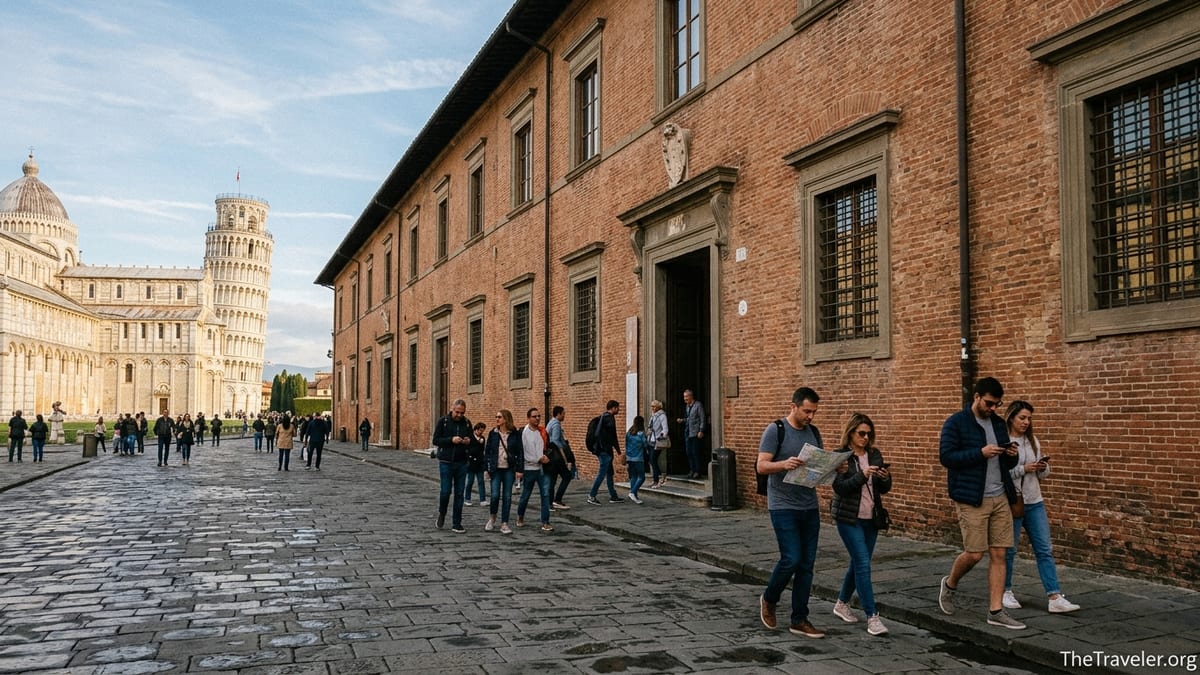
A few steps from Pisa’s Leaning Tower, most visitors rush past an unassuming brick building on the south side of Piazza dei Miracoli. Inside, however, the Sinopie Museum offers something you will not find even in Florence or Rome: the chance to walk inside the creative process of medieval fresco painters. For anyone curious about how monumental religious images were designed, debated and physically made, this quiet museum still matters profoundly.
Get the latest updates straight to your inbox!
What Exactly Is a Sinopia, and Why Should Travelers Care?
The word “sinopia” refers to the red-brown pigment used in Italy for preparatory drawings on wet plaster. Before a medieval fresco was painted in full color on a church or cemetery wall, the artist sketched an underdrawing directly on the fresh plaster using this earthy pigment. These sketches, also called sinopie, mapped out figures, drapery, architecture and even facial expressions. They were never meant to be seen. Once the final paint layer went on, the sinopia disappeared under the finished fresco.
In Pisa, this hidden stage of creativity became visible by accident. During bombing raids in 1944, fire swept through the Camposanto Monumentale, the great cloister-cemetery that closes the north side of Piazza dei Miracoli. The heat shattered the medieval wall paintings. When restorers later detached the surviving fresco fragments, they discovered extensive sinopie underneath, some dating back to the early 1300s. These underdrawings were carefully removed and, in 1979, given their own home in the Sinopie Museum across the square.
For travelers used to looking only at finished masterpieces in places like the Uffizi or the Vatican Museums, the Sinopie Museum is a revelation. Instead of the polished final image, you stand in front of life-size red drawings, full of corrections, erased lines and shifting ideas. It feels like entering the studio of artists such as Buonamico Buffalmacco, Benozzo Gozzoli or Taddeo Gaddi on the very day they laid out a new wall.
This is why the museum still matters. It does not simply preserve rare objects; it preserves a way of seeing medieval art as a living process rather than a frozen, untouchable result. In a period when many visitors move quickly from selfie to selfie, encountering the raw thinking behind those images can fundamentally change how you experience churches and museums across Italy.
A Unique Collection Born from War and Restoration
The Sinopie Museum occupies the former Spedale Nuovo, a medieval hospital that once cared for pilgrims arriving in Pisa. Today, its long, high halls are lined with more than one hundred sinopie transferred from the walls of the Camposanto. You enter on the ground floor to find yourself in a single vast space, where the drawings are arranged roughly according to their original positions in the cemetery’s cloister.
The story behind this collection is inseparable from the wartime damage to the Camposanto. In July 1944, incendiary bombs set the cemetery’s wooden roof ablaze. Burning beams crashed down onto the marble arcades and the frescoes that covered the interior walls. Decades of restoration followed. Conservators used a method called “strappo” to detach the surviving paint layer from the damaged walls. Once that painted skin was removed, the underlying sinopie emerged, often surprisingly intact. The same strappo technique then freed the underdrawings and allowed them to be mounted on canvas and transported to the museum.
Because of this history, walking through the Sinopie Museum feels like reading a second, secret version of the Camposanto’s visual program. Panels bear the titles of the original frescoes that once towered over the cemetery’s burial niches: Crucifixion, The Triumph of Death, Stories of Job, Stories of the Virgin, Stories of the Old Testament. In the cloister today you see the restored fresco fragments in place, many reinstalled over the last twenty years after painstaking conservation campaigns. In the museum you see the nerve system that guided those compositions, like looking at an X-ray alongside the living body.
It is this pairing that has made Pisa a reference point for art historians worldwide. Nowhere else is there such a large, coherent group of medieval sinopie displayed at their original scale. When scholars analyze how religious narratives were planned for a monumental space, when they compare how assistants and masters worked together, they still turn to the Pisa material as a primary case study. As a traveler, you have the rare chance to stand in front of the same evidence.
Drawing Before Painting: How Medieval Fresco Workshops Really Worked
Most guidebooks tell you that fresco is painted on fresh plaster, but they rarely explain how a large cycle actually took shape on the wall. The Sinopie Museum makes that process visible. Look closely at the sinopia for the Crucifixion attributed to Francesco Traini, dated to around 1320–1330. You can see how the artist placed the cross slightly off center, tilted the bodies of the thieves, and adjusted the scale of soldiers in the foreground. Faint erased lines suggest abandoned positions for some figures, while darker contours confirm the final choice.
Elsewhere, in the sinopie related to the famous Triumph of Death cycle attributed to Buonamico Buffalmacco, the red drawings reveal how the painter orchestrated the crowded scene. The central image of Death sweeping across the sky is outlined with quick, sure strokes, but the groups of nobles and the poor below show more reworking. Some heads are shifted higher, horses’ legs are redrawn to improve the sense of motion. You can almost feel the painter pacing along the scaffolding, taking a few steps back to judge the overall rhythm before making another adjustment.
These traces matter because they contradict the old idea of medieval artists as passive craftsmen following rigid iconographic formulas. The sinopie show them as inventive designers, testing and refining their ideas directly on the wall. When you notice a figure’s arm drawn first straight, then bent in a more expressive angle, you are witnessing a creative decision in real time. For students of art history and casual visitors alike, it underscores that the frescoes in the Camposanto, like Giotto’s in Padua or Masaccio’s in Florence, were the result of experimentation, not just repetition.
For travelers, this insight can change how the rest of your trip feels. After visiting the Sinopie Museum, you may look differently at a frescoed chapel in Siena or at the mosaics in Ravenna. Even when the underdrawing is hidden, you will know that beneath every halo and robe lies a dense network of construction lines, corrections and compromises, much like the drafts and revisions behind a great novel.
From Camposanto to Museum: Reading a Lost Medieval World
Many of the sinopie in Pisa belong to narrative cycles designed to surround the dead with a continuous story of salvation, sin and redemption. The Camposanto, whose cloister encircles a central lawn filled with tombs, was conceived as a kind of open-air scripture. The frescoes once unfolded along the walls as a visual guide to the Christian journey from Creation to the Last Judgment. Seen through this lens, the Sinopie Museum becomes an archive of how that story was structured for medieval viewers.
Take the sinopie for the Stories of Job, associated with the Florentine painter Taddeo Gaddi. The red drawings map out scenes of loss, suffering and eventual restoration. Figures appear on different registers, with Job’s body language shifting from despair to renewed strength. Even without the final colors, you can follow the emotional arc. Nearby, the sinopie for Piero di Puccio’s so-called Theological Cosmography and Old Testament episodes show swirling bands of angels, spheres of the cosmos and episodes such as the construction of Noah’s Ark. The underdrawing reveals how the painter balanced text-heavy theological ideas with the need for clear, readable imagery for lay visitors walking the cloister.
Other panels preserve sinopie by Spinello Aretino, who painted the Stories of Saints Efisio and Potito, and by Benozzo Gozzoli, responsible for a long series of Old Testament scenes and an Annunciation along the north gallery. In Gozzoli’s sinopie you can see his characteristic interest in elegant profiles and flowing drapery, even before any blue or gold was applied. Horses and architectural backgrounds are sketched with a light but confident hand, evidence of an artist used to working on a grand scale.
For today’s traveler, these drawings open a window onto the mindset of people who visited the Camposanto around 1400. Imagine a Pisan merchant walking slowly under the arcades, glancing from a funeral monument to an image of Job’s trials, then to a representation of the Final Judgment. The sinopie preserve the skeleton of that visual journey. By seeing them in the museum and then crossing the square to see the restored frescoes back in place, you activate a dialogue between absence and presence, damage and recovery.
Why the Sinopie Matter for Global Medieval Art History
Although the Sinopie Museum is firmly rooted in Pisa’s history, its impact reaches far beyond Tuscany. For art historians, the Camposanto sinopie have become a touchstone in debates about authorship, workshop practice and the evolution of style between the 14th and 15th centuries. Because the underdrawings can sometimes be stylistically distinct from the final painted surface, they help scholars distinguish a master’s hand from that of assistants who might have executed large sections of the color.
This has particular importance for works like the Triumph of Death and related eschatological scenes, where questions of attribution have long been discussed. The red sketches can show whether a single designer conceived the entire composition or whether the project was divided among several painters. Comparing the confident sinopie in some sections with more conservative drawing elsewhere has led to new theories about collaboration in major Tuscan workshops, ideas that in turn affect how we understand frescoes in Bologna, Assisi or Naples.
More broadly, the museum’s holdings help reconstruct painting techniques that were once standard but are now difficult to document. For example, evidence from the sinopie shows how artists sometimes shifted from freehand drawing to using cartoons, full-scale paper models transferred to the wall. You can spot scenes where pounced outlines, made by dusting pigment through pricked paper, overlap with fluid, spontaneous sinopia lines. This coexistence supports the idea that even as technical methods became more formulaic in the 15th century, there was still room for improvisation on the wall.
Finally, the Sinopie Museum is central to conservation history. The damage of 1944 was a catastrophe, but the response helped shape modern standards for saving wall paintings throughout Europe. Techniques developed in Pisa, and the difficult ethical debates surrounding them, continue to influence how institutions from the Louvre to small rural churches approach deteriorating frescoes. Visiting the museum is a reminder that what we see in galleries and basilicas today is not just medieval art, but also the legacy of 20th-century decisions about what to save and how.
Visiting the Sinopie Museum Today: Practical Tips and What to Look For
The Sinopie Museum stands directly opposite the Camposanto on the south side of Piazza dei Miracoli, in the long brick building of the former hospital. For most visitors it fits easily into a half-day visit to the square, alongside the cathedral, baptistery and Leaning Tower. Ticketing for the monuments is usually handled through a combined system managed by the local cathedral works; the Sinopie Museum is generally grouped with sites like the Camposanto and the Opera del Duomo Museum under a multi-monument pass. Prices can change, but in recent seasons a ticket including one monument has been in the single-digit euro range per adult, with options to add more sites at incremental cost.
The museum tends to be quieter than the tower or cathedral, making it an ideal stop in late morning or mid-afternoon when crowds outside are thick and the Tuscan sun is strong. Inside, the lighting is deliberately even and subdued to protect the fragile drawings, so expect a calm, almost study-room atmosphere rather than spectacular spotlighting. Labels are typically in Italian and English, and many panels include simple diagrams showing where the sinopia once appeared in the Camposanto cloister.
When you visit, start by standing back to take in the scale. Each panel is roughly the size of the original wall section, so you quickly sense how overwhelming the imagery must have been when it wrapped around the cemetery. Then move closer and look for the human touch: double lines, quickly sketched hands, lightly indicated faces that were later rethought. You do not need specialist knowledge to see where an artist hesitated and where they were sure of themselves.
For a meaningful circuit, many travelers like to visit the Camposanto first to see the restored fresco fragments and get a sense of the overall narrative, then cross to the Sinopie Museum to study the preparatory drawings. Others do the reverse, using the sinopie as a kind of score and the frescoes as the performance. Either way, allow at least 45 to 60 minutes inside the museum to move beyond a quick glance and let your eyes adjust to the subtle red lines on plaster-colored grounds.
Connecting the Sinopie to the Rest of Your Italian Journey
Seeing the Sinopie Museum early in a trip through Italy can sharpen your eyes for the rest of your route. After Pisa, many travelers head to Florence, Siena or Lucca, all rich in medieval and early Renaissance painting. Once you have walked past panels of giant red drawings in Pisa, you might notice faint underdrawing lines peeking through thin paint in Florentine frescoes, or appreciate more fully the design complexity of a Giottesque crucifix in a side chapel.
The museum also offers a gentle way to introduce children or non-specialists to ideas about how art is made. Parents often find that the graphic, almost comic-strip quality of the sinopie, stripped of gold and bright color, makes it easier to talk about composition, storytelling and artistic choices. You can point to two different outlines for a horse or to a saint whose head was shifted higher and ask which solution seems more dynamic. This kind of conversation can make later visits to more crowded galleries, such as the Uffizi, richer and less overwhelming.
On a practical level, including the Sinopie Museum in your day at Piazza dei Miracoli helps balance your time between iconic and lesser-known sites. You may queue to climb the Leaning Tower at a set time, shuffle with hundreds through the cathedral nave, and then find yourself almost alone among the sinopie, listening to the soft echo of your footsteps. Many visitors report that this quieter space becomes one of the most memorable parts of their Pisa experience, precisely because it feels like discovering a secret beneath the tourist surface.
For travelers interested in slower, more reflective tourism, the museum aligns with a growing preference for depth over checklist sightseeing. Instead of racing from monument to monument, you spend an hour with a single set of works that connect war, faith, craft and restoration across seven centuries. When you step back into the bright marble glare of the square, the Leaning Tower may look the same, but your sense of what medieval Pisa created, lost and saved will have deepened.
The Takeaway
The Sinopie Museum in Pisa still matters because it lets us look through medieval frescoes rather than just at them. By preserving the hidden red underdrawings from the Camposanto, it shows how 14th- and 15th-century painters designed complex narratives, corrected themselves and collaborated in workshops that bridged generations. For scholars, these panels remain a unique archive for understanding technique, authorship and conservation. For travelers, they offer a rare, intimate encounter with the thinking hand behind some of Tuscany’s most significant monuments.
Set within easy reach of the Leaning Tower yet often overlooked, the museum rewards anyone willing to slow down and pay attention to lines rather than colors, to process rather than postcard views. Whether you are an art history student, a curious family or simply a visitor trying to see something in Pisa that most others miss, stepping into the Sinopie Museum can transform not only how you understand medieval art, but how you look at every painted wall you meet afterward.
FAQ
Q1. What is the Sinopie Museum in Pisa?
The Sinopie Museum is a museum on Piazza dei Miracoli that displays the preparatory red-ochre drawings, or sinopie, from the medieval frescoes of the Camposanto cemetery.
Q2. Why are the sinopie from Pisa considered so important?
They form one of the largest and most coherent groups of medieval fresco underdrawings in Europe, revealing in exceptional detail how major Tuscan artists planned large wall cycles.
Q3. How did the sinopie end up in a separate museum from the Camposanto?
After bombing in 1944 damaged the Camposanto, restorers detached surviving fresco fragments and discovered the sinopie beneath, later transferring these drawings to the former hospital building that became the museum.
Q4. Which artists are represented in the Sinopie Museum?
The collection includes sinopie linked to Francesco Traini, Buonamico Buffalmacco, Taddeo Gaddi, Piero di Puccio, Spinello Aretino, Benozzo Gozzoli and other Tuscan painters from the 14th and 15th centuries.
Q5. How much time should I plan for a visit to the Sinopie Museum?
Most visitors find that 45 to 60 minutes is enough to walk through the museum, read the panels carefully and study details in the drawings without rushing.
Q6. Is it better to see the Camposanto or the Sinopie Museum first?
Both orders work. Some people prefer to see the fresco fragments in the Camposanto first, then study the underdrawings; others start with the sinopie and then compare them to the restored paintings.
Q7. Are the explanations in the museum available in English?
Yes. Labels and wall texts are typically provided in Italian and English, giving basic information about each sinopia and its original location in the Camposanto.
Q8. Is the Sinopie Museum suitable for children or non-experts?
It is. The large red drawings are easy to follow visually, and the museum’s quiet atmosphere makes it a good place to explain how artists plan compositions before adding color.
Q9. How does the ticketing for the Sinopie Museum usually work?
The Sinopie Museum is commonly included in multi-site tickets for the Pisa cathedral complex, with prices varying by season. You typically choose a pass that includes one or more monuments and add the museum to your selection.
Q10. What makes the Sinopie Museum different from other art museums in Italy?
Instead of finished masterpieces, it showcases the hidden planning stage of monumental frescoes at full scale, offering a behind-the-scenes view of medieval artistic creativity that is rare elsewhere.