


VistaJet has built one of the most recognizable branded fleets in private aviation, centered on Bombardier Challenger and Global aircraft that all share the same silver-and-red livery and a consistent cabin experience. For travelers, that consistency matters more than the tail number: whether you board in New York, Nice or Nairobi, the cabin layout, service style and amenities will feel reassuringly familiar. This guide walks through every core VistaJet aircraft type, how they are typically used, and what sort of journeys, comfort and pricing travelers can expect in real life.
Get the latest updates straight to your inbox!
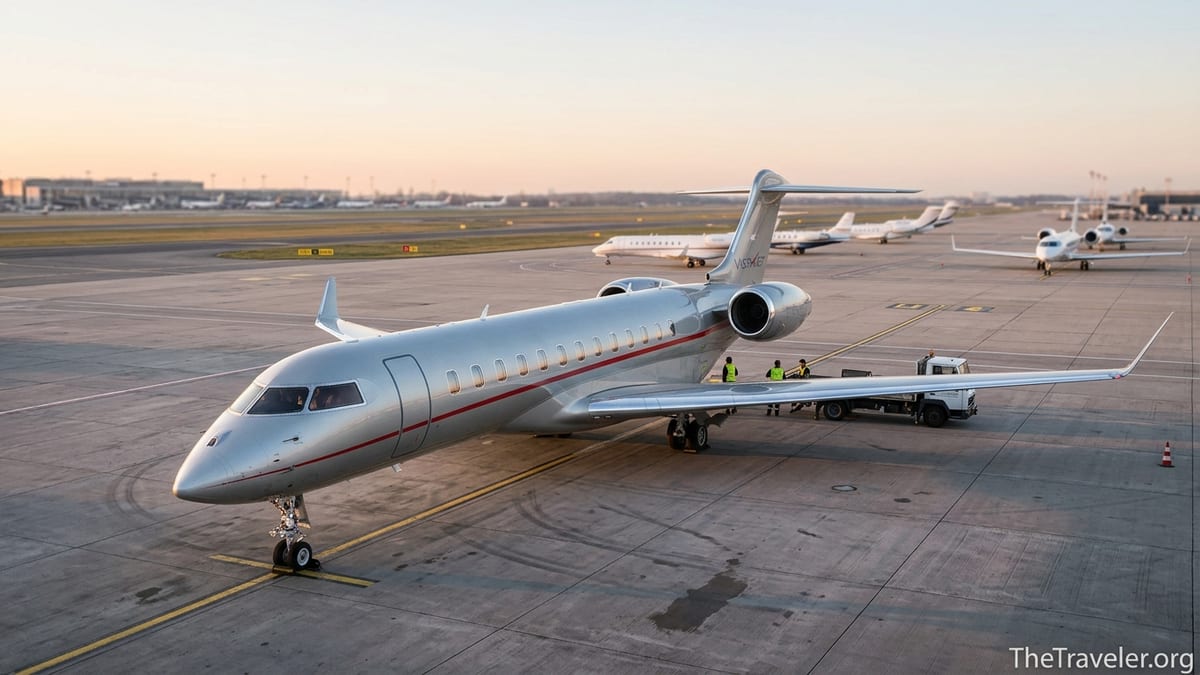
How VistaJet’s Fleet Is Structured
VistaJet operates what it describes as a fully branded, floating fleet of super-midsize, long-range and ultra-long-range jets. Rather than owning a fraction of a specific aircraft, Members buy hours and then access whichever jet best fits their mission on any given day. Behind that promise is a fleet that, as of mid-2026, numbers close to 100 VistaJet-branded aircraft under its own operating certificates, with additional aircraft available through the wider Vista group. The mix is deliberately tight: all are Bombardier types from the Challenger and Global families, which reduces variability for both crews and passengers.
The company transitioned to an all-Challenger-and-Global fleet years ago, retiring earlier aircraft types to focus on a consistent product. Today, that translates into three broad categories. At the super-midsize end sit the Challenger 350 and related variants. In the large-cabin, long-range segment, VistaJet fields the Challenger 605 and 850, along with Global 5000 and 6000. At the top of the range, the Global 7500 and the newest Global 8000, entering the Vista group fleet in 2026, handle nonstop intercontinental and ultra-long routes such as Los Angeles to Hong Kong or London to Singapore.
For travelers, the key takeaway is that almost any VistaJet aircraft you step on board will offer a stand-up cabin, a flat-floor layout and an interior tailored more like a flying living room than a small business jet. Even in the smallest types, you are dealing with super-midsize hardware rather than light jets, which is why VistaJet often appeals to families, small corporate groups and UHNWIs used to widebody comfort on commercial airlines.
Super-Midsize Comfort: Challenger 350 Series
The Challenger 350 and its updated variants form VistaJet’s super-midsize backbone. These aircraft are typically configured for around 8 to 9 passengers, with a flat-floor cabin, fully reclining club seats and a divan that converts to a bed. In range terms, a Challenger 350 can comfortably handle missions such as New York to Miami, Los Angeles to Chicago or London to Marrakech without a fuel stop, typically around 3,200 nautical miles in still-air conditions.
In practice, VistaJet often uses the Challenger 350 family for high-frequency business routes and regional family trips where cabin comfort matters as much as speed. A European client might take a Challenger 350 for a Friday evening hop from London to Mykonos at the start of summer, while a US Member might use it for a same-day Houston to Aspen round-trip during ski season. Flight times on these legs tend to fall in the two to four hour window, which is exactly the sweet spot where a super-midsize jet feels significantly more comfortable than a small light jet but is still more cost-efficient than dispatching a long-range Global.
Pricing reflects that positioning. While exact VistaJet tariffs vary by program and contract, a Challenger 350 flight in the competitive charter market is often quoted in the high single-digit to low five-figure range per flight hour in US dollars, depending on region and demand. That makes it a common choice for companies flying executive teams between regional hubs. The cabin typically includes high-speed connectivity, a full refreshment center and a curated wine and catering offering that mirrors the service found on VistaJet’s larger aircraft.
Large-Cabin Workhorses: Challenger 605 and Challenger 850
Stepping up in size, the Challenger 605 is VistaJet’s classic large-cabin, long-range workhorse. Configured for roughly 10 to 12 passengers, it offers a wider cabin than the Challenger 350 and a typical range of around 4,000 nautical miles. That opens up nonstops such as New York to London in favorable winds or Dubai to Nice without refueling. The 605’s cabin is usually arranged in distinct zones: a forward club-four seating area for meetings, a mid-cabin dining or conference zone and an aft section that converts into a dedicated sleeping area.
In real-world use, this makes the Challenger 605 a favorite for overnight transatlantic trips and longer corporate shuttles. A European private equity firm might use a 605 for a late-afternoon London to New York flight, hold a working dinner at the mid-cabin table, then have senior partners sleep in lie-flat beds in the rear section before landing early the next morning. Similar patterns play out on routes such as Riyadh to Paris or São Paulo to Miami, where clients want a full flat bed on a single overnight leg without stepping up to the very largest jets.
The Challenger 850 occupies an unusual but highly practical niche in the VistaJet fleet. Built on a regional jet platform but configured as a corporate aircraft, it offers a cabin similar in size to a Global 6000 but with a shorter range of about 2,800 nautical miles. That makes it ideal for larger groups flying medium-haul missions, such as a 12 to 14-person delegation traveling from Geneva to Dubai or Moscow to Barcelona. For travelers, the key benefit is sheer cabin volume: the 850 feels more like a small airliner inside, which is appealing for sports teams, touring artists or extended families traveling together on sub-6-hour flights.
Long-Range Globals: Global 5000 and Global 6000
The Global 5000 and Global 6000 form the bridge between VistaJet’s Challenger series and its flagship ultra-long-range jets. Both aircraft offer a true intercontinental cabin experience, with separate living, dining and sleeping zones, high cruise speeds and a gentle cabin altitude designed to reduce fatigue on long legs. Typical VistaJet layouts run to 13 or so passenger seats, with up to five fully flat sleeping positions when the divans and lie-flat seats are converted for overnight use.
On the route map, Global 5000 and 6000 jets frequently operate nonstop services such as London to New York, Paris to Beijing or Dubai to Cape Town. A family based in the Gulf might use a Global 6000 to fly directly from Dubai to the Maldives for a holiday, or to make a same-day return trip to London for a special event without touching commercial terminals. In North America, Globals are often used by corporate clients for coast-to-coast trips that include onward legs to Latin America, such as New York to Los Angeles followed by Los Angeles to Bogotá.
For travelers comparing options, these Globals sit in a sweet spot: they offer most of the cabin comfort and range of the flagship Global 7500 on routes up to around 6,000 nautical miles, but they can be more cost-effective on a per-hour basis. Cabins typically feature full galleys capable of restaurant-style meal service, dedicated cabin crew and connectivity robust enough to run video conferences while crossing the Atlantic. On night flights, it is realistic for three or four passengers to sleep on fully flat beds while others work or relax in a separate zone.
Flagship Ultra-Long-Range: Global 7500 and the New Global 8000
At the top of the VistaJet collection sits the Bombardier Global 7500, widely regarded as one of the most capable purpose-built business jets flying today. The aircraft’s range of around 7,700 nautical miles allows nonstop missions such as New York to Hong Kong or Los Angeles to Sydney in favorable conditions, and its four-zone cabin can be configured with a full bedroom and shower, separate lounge, conference dining area and crew rest. VistaJet has built one of the largest Global 7500 fleets in the world, with more than a dozen in service and additional aircraft being upgraded to the even more capable Global 8000 standard.
For travelers, the Global 7500 is where private aviation truly replaces first-class commercial travel on the longest routes. A typical VistaJet mission might be a westbound nonstop from Paris to São Paulo, with a business leader and their family using the forward lounge for meetings, the mid-cabin table for dinner and the private suite in the rear for a full night’s sleep. Another common scenario is an Asian family chartering a 7500 for a multi-week summer itinerary, for example flying from Singapore to London, then onward to Mediterranean destinations such as Nice, Naples or Ibiza without the hassle of connecting flights or crowded airports.
Pricing on such ultra-long-range flights is commensurately high. Industry commentary and press coverage in Europe have cited hourly rates for Global 7500 operations that can reach into the mid-five figures in euros during peak periods. A single round-trip between Paris and New York on a 7500 can reach the high hundreds of thousands once catering, de-icing and positioning are included, particularly on short-notice bookings. For VistaJet Members with contracted hourly rates and point-to-point pricing, the economics are more predictable, which is one of the reasons the aircraft sees heavy utilization despite its list price rivaling that of a narrowbody airliner.
The next chapter is the Bombardier Global 8000, which the wider Vista group began introducing in 2026. This newest ultra-long-range type offers even higher cruise speeds and a slightly longer range than the 7500, with cabins configured to match VistaJet’s established design language. For travelers who want to minimize time in the air on routes like Dubai to New York or Los Angeles to London, and who often fly into sensitive curfew windows, the extra margin in speed and performance can be more than a technical detail; it can mean arriving in time for a critical morning meeting or clearing weather-related slot restrictions.
Cabin Experience and Service Across the Fleet
Regardless of aircraft type, VistaJet emphasizes that the onboard experience should feel uniform. All jets are painted in the same silver livery with a red stripe, and cabins are refitted over time with a consistent palette of neutral leathers, wood veneers and understated lighting. The idea is that a Member stepping from a Challenger 350 in Geneva onto a Global 7500 in Hong Kong will immediately recognize the environment. This extends to details such as the layout of storage compartments, the placement of power outlets and the design of dining tables.
Service is likewise standardized. Each flight carries at least one dedicated cabin host trained to deliver fine-dining service and manage details such as children’s meals, dietary restrictions and pet care. On the larger Globals, two or more cabin crew may be present on long sectors. Catering is sourced from upscale restaurants and specialist providers in major cities, with menus customized in consultation with clients. For example, a family flying from New York to London with young children might pre-order simple, familiar dishes and snacks, while the adults opt for a multi-course tasting menu paired with wines selected by VistaJet’s partners.
Technologically, the fleet is progressively equipped with high-speed Ku-band or similar connectivity, allowing video calls, VPN connections and streaming entertainment throughout most routes. On overnight flights, crew can transform the cabin from a lounge into a bedroom within minutes: divans become full-length beds with hotel-grade linens, and window shades, lighting and temperature are adjusted to simulate a home bedroom as closely as possible at 41,000 feet. This consistency of cabin environment and service means many travelers choose the smaller Challengers for short trips not because they are willing to compromise on comfort, but because they know the onboard experience will mirror what they find on the flagships.
How Travelers Actually Use the VistaJet Fleet
While aircraft brochures focus on maximum ranges, real-world usage is grounded in practical itineraries. A tech founder based in San Francisco might use a Challenger 350 for frequent trips to Seattle and Los Angeles, then step up to a Global 6000 for quarterly visits to London and Berlin. During summer, the same Member could switch to a Global 7500 for a family holiday itinerary that strings together San Francisco, Honolulu, Tokyo and back home, taking advantage of the jet’s ability to operate long Pacific legs with comfortable margins.
In Europe and the Middle East, VistaJet’s fleet sees intense seasonal patterns. During July and August, Challengers and Globals alike are heavily deployed on Mediterranean leisure routes: London to Nice, Paris to Olbia, Dubai to Mykonos or Riyadh to Bodrum. Clients might originate in one region and land in another, with the aircraft continuing on to its next assignment rather than returning to a fixed base. In winter, the pattern shifts to ski destinations: Globals bring clients from London or New York into hubs like Geneva or Zurich, where smaller aircraft or helicopters may complete the last segment to alpine resorts.
Another frequent use case is time-critical corporate travel, where a leadership team needs to visit several countries in rapid succession. A Global 6000 or 7500 can serve as a flying office for a three-day roadshow across Europe, the Gulf and Asia, enabling meetings on board, confidential discussions between sectors and an overnight rest in a private suite without the disruption of hotel check-ins. In humanitarian or specialist missions, VistaJet aircraft have also been used for medical transport and repatriation, choosing specific aircraft types based on range, cabin layout and the need for medical equipment.
Choosing the Right VistaJet Aircraft for Your Trip
For travelers considering VistaJet for the first time, the question is rarely, “Which tail number do I want?” but rather, “What kind of trip am I planning?” The company’s sales and flight planning teams will typically suggest an aircraft type based on passenger count, route, luggage and any special requirements. As a simple guideline, short regional hops with up to eight passengers often sit comfortably on a Challenger 350, while transatlantic or overnight flights with larger groups gravitate toward the Challenger 605, Challenger 850 or Global 5000 and 6000.
Once flights push beyond the Atlantic into true ultra-long-range territory, the Global 7500 comes into its own. If you are flying a nonstop route such as Los Angeles to Dubai, or you need a full bedroom and shower for privacy, this is where the flagship earns its keep. Meanwhile, travelers who frequently operate from hot-and-high or shorter runways might be advised to choose a specific type that balances field performance with range. The Global 7500, for example, has been optimized to operate from surprisingly constrained runways for its size, which can make it viable into airports that once required a fuel stop or a smaller jet.
Budget is the other consideration. While VistaJet does not publish public rate cards in detail, independent brokers and operators point to an industry pattern where hourly rates climb from the upper mid-range on Challengers to the premium end on Globals, especially the 7500 and 8000. A traveler looking at a New York to London round-trip might find that a Global 5000 or 6000 offers the best balance of comfort and cost if they are traveling with up to eight passengers, whereas a full entourage of a dozen or more with extensive luggage could justify stepping up to the 7500 despite the higher tariff.
The Takeaway
VistaJet’s fleet strategy is built on a simple idea: by standardizing around a handful of large-cabin Bombardier types and painting them all in the same livery, it can deliver a consistent, premium experience anywhere in the world. For travelers, that translates into less time worrying about aircraft specifics and more time focusing on where they need to be and when. A compact selection of super-midsize Challengers, large-cabin workhorses like the 605 and 850, versatile long-range Globals and flagship ultra-long-range 7500 and 8000 jets covers nearly every realistic private aviation mission.
Whether you are planning a quick business day-trip, crossing an ocean overnight or circling the globe on a multi-stop family journey, there is likely a VistaJet aircraft tailored to that profile. Understanding the strengths of each type helps you ask better questions, from cabin layout and sleeping arrangements to range, field performance and budget. In practice, the choice often comes down to how you want to feel during the hours you spend between takeoff and landing: the comfort of a familiar cabin, the privacy of a bedroom at altitude, the reassurance of a crew trained to the same standard, regardless of the tail number painted on the silver fuselage.
FAQ
Q1. Which aircraft types are currently in the VistaJet fleet?
VistaJet focuses on Bombardier aircraft, mainly from the Challenger and Global families. The super-midsize segment is anchored by the Challenger 350 series, the large-cabin category includes the Challenger 605 and Challenger 850, and the long-range and ultra-long-range roles are covered by the Global 5000, Global 6000, Global 7500 and, within the wider Vista group, the new Global 8000.
Q2. What is the flagship jet in the VistaJet collection?
The Bombardier Global 7500 is VistaJet’s flagship ultra-long-range jet, offering a four-zone cabin with options for a full private bedroom and shower, and the ability to fly some of the longest routes in business aviation, such as New York to Hong Kong or Paris to Santiago, under suitable conditions.
Q3. How many passengers can VistaJet aircraft typically carry?
Passenger capacity varies by type. Challenger 350 aircraft usually seat around 8 to 9 passengers, Challenger 605 and 850 jets are commonly configured for about 10 to 14 passengers, while Global 5000 and 6000 aircraft carry roughly 12 to 13. The Global 7500 typically seats up to 16 passengers in VistaJet configurations.
Q4. What kind of routes can VistaJet’s Global 7500 fly nonstop?
In practical operations, the Global 7500 can link many city pairs nonstop that would otherwise require a fuel stop, including routes such as Los Angeles to London, New York to Dubai or Hong Kong to San Francisco, depending on payload, winds and airport restrictions.
Q5. How does the cabin experience differ between Challenger and Global jets?
All VistaJet aircraft offer a consistent design language and high service standards, but Globals provide larger cabins with more distinct zones, longer ranges and additional sleeping capacity. Challengers are ideal for shorter and medium-haul flights, while Globals are optimized for intercontinental and ultra-long-range missions where separate lounge, dining and bedroom spaces matter.
Q6. Does VistaJet publish fixed prices for each aircraft type?
VistaJet typically offers bespoke pricing via membership programs and tailored contracts rather than public rate cards. Hourly costs generally scale with aircraft size and capability, with super-midsize Challengers priced below large-cabin Globals and the ultra-long-range Global 7500 and 8000 at the top end of the range.
Q7. Can I choose a specific aircraft model when I book with VistaJet?
Travelers can request particular aircraft types based on their needs, such as asking for a Global 6000 for a transatlantic flight or a Challenger 350 for a regional hop. Final aircraft assignment depends on availability, routing and operational factors, but VistaJet aims to match or exceed the requested category.
Q8. Are all VistaJet cabins equipped for overnight flights?
Most VistaJet aircraft are configured with seats and divans that convert into fully flat beds, making overnight flights feasible even on smaller Challengers. On larger Globals, cabins typically include dedicated sleeping areas where several passengers can rest on full-length beds while others use separate zones for work or dining.
Q9. How consistent is the service standard across different VistaJet aircraft?
VistaJet trains its cabin crew to a uniform standard and refits interiors over time to maintain a consistent look and feel, so service expectations remain similar whether you are flying on a Challenger 350 or a Global 7500. Differences relate more to space and range than to service quality.
Q10. How do I decide which VistaJet aircraft is right for my trip?
The best choice depends on passenger numbers, route length, luggage, schedule and budget. As a rule of thumb, choose a Challenger 350 for short to medium regional trips with up to eight passengers, move to a Challenger 605, 850 or Global 5000 and 6000 for longer or overnight intercontinental flights, and select the Global 7500 if you need maximum range, a private bedroom or the highest level of onboard space and comfort.