


La Croisette in Cannes is one of those waterfront promenades that lives up to its reputation. Curving gently along the Bay of Cannes for about two kilometers, it concentrates everything people imagine about the French Riviera in a single stroll: legendary hotels, polished beach clubs, designer boutiques and a harbor full of yachts. With so much packed into a relatively short strip, it is easy to drift aimlessly and miss the very things that make La Croisette special. With a bit of planning, you can walk it in a day, hit the classic highlights and still leave time to simply sit, swim and watch the world go by.
Get the latest updates straight to your inbox!
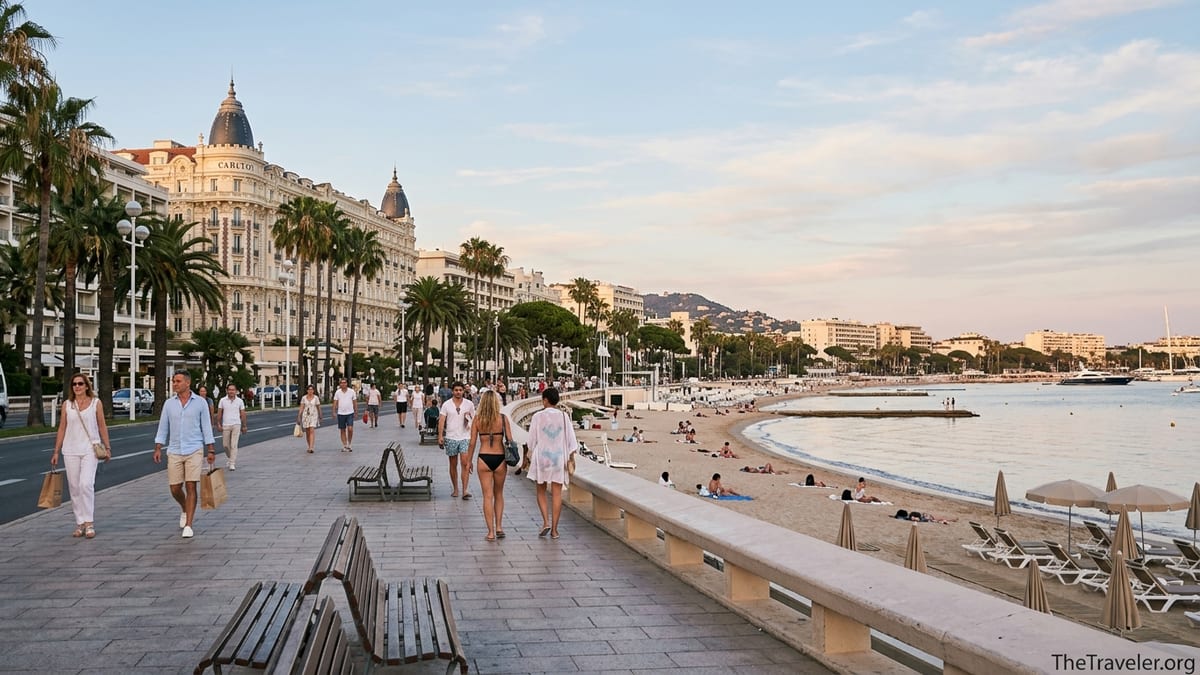
Getting Oriented: How to Reach and Navigate La Croisette
La Croisette begins near the Palais des Festivals et des Congrès, close to Cannes’ main train station, and sweeps east to Port Canto and the Palm Beach area. If you arrive by train to Cannes station on Place de la Gare, you are roughly a seven minute walk from the Palais and the start of La Croisette. From the station, follow signs toward the sea and the Palais; once you see the red carpet steps and the harbor with its forest of masts, you are at the western gateway to the promenade.
The easiest way to experience La Croisette is on foot. The main sidewalk runs parallel to the beach, shaded in parts by palm trees, with a separate lane for cars on the inland side. You can walk the full length from the Palais to Port Canto in about 25 to 30 minutes without stops, but most visitors stretch it into a half day or more with swimming, shopping and café breaks. If walking the entire distance feels daunting in summer heat, local Palm Bus services run along Boulevard de la Croisette, and taxis and ride‑hailing cars are easy to flag near major hotels such as the Carlton or the Majestic.
For many travelers, a practical approach is to break La Croisette into two sections. Start your morning at the western end around the Palais and the Majestic hotel for festival sights and harbor views, then spend midday between the Carlton and the Martinez for beach time. Late afternoon and early evening lend themselves to strolling the quieter stretch from Port Canto to Palm Beach, when the light softens and the crowds thin.
Driving is possible but rarely recommended. During major events such as the Cannes Film Festival in May or Cannes Lions in June, traffic restrictions and road closures around the Palais mean delays and detours, and locals frequently advise avoiding La Croisette by car entirely at these times. If you do arrive by car outside festival dates, look for underground car parks near the Palais or along side streets above La Croisette, then continue the rest of the way on foot.
Iconic Hotels and the Spirit of Old Hollywood Glamour
Even if you never set foot inside, the historic palace hotels that line La Croisette are essential highlights. The most famous is the Carlton Cannes, a Regent Hotel, opened in 1911 and recently renovated. Its white Belle Époque façade, crowned by two domed turrets, has appeared in classic films and celebrity photo calls. An often‑shared story links the hotel to Grace Kelly, who met Prince Rainier of Monaco while staying here during the 1955 Cannes Film Festival, adding to the Carlton’s aura of Riviera romance.
West of the Carlton, the Hotel Barrière Le Majestic Cannes faces the Palais des Festivals and the yacht harbor. Built in the 1920s, it has long hosted film stars and festival juries. Step across La Croisette here and you will notice how close the hotel’s private beach is to the festival red carpet, which explains why so many photo shoots and interviews take place on this stretch of sand. Even if you are not staying at the Majestic, you can book a sun lounger at its beach club or reserve a table at one of its seafront restaurants to soak up the atmosphere.
Further east, near the midpoint of La Croisette, stands the Martinez, now part of the Hyatt family. With its gleaming white Art Deco frontage and long colonnaded terrace, it dominates one of the prime sections of beach. In practical terms, this is a good reference point when you are navigating the promenade: the public Zamenhof beach lies nearby, and many private beach clubs cluster around the Martinez pier. The hotel’s bar and lobby are also popular for an early evening drink, where you can people‑watch under ceiling fans and chandeliers.
You do not need a room key to enjoy the hotel scene along La Croisette. Most of the grandes dames operate street‑level cafés or patio bars open to non‑guests. For example, you might start your day with an espresso and croissant at a sidewalk table near the Majestic, when business visitors hurry past toward the Palais, then pause mid‑afternoon for a citron pressé at the Carlton’s terrace, watching beachgoers cross back and forth to the sea.
Beaches on La Croisette: From Free Sand to Pricey Sunbeds
One of the main reasons to walk La Croisette is the string of beaches that curve along the bay. Visitors are often surprised to discover how much of this shoreline is occupied by private beach clubs attached to hotels and restaurants, interspersed with smaller public sections where anyone can lay down a towel for free. Understanding the difference will help you avoid disappointment and better match the experience to your budget.
At the eastern end of La Croisette, near Port Canto, you will find Plage de la Croisette’s public segments, including the municipally managed Zamenhof beach next to the Martinez hotel. Here the city offers supervised swimming in summer and rents basic sun loungers and umbrellas at controlled prices, typically under 10 euros for a lounger or a little more for a full day set, which is significantly cheaper than many private clubs. Families appreciate this area for its lifeguards, shallow water and the ability to mix paid loungers with free towel space on the same stretch of sand.
Private beach clubs, by contrast, provide padded sunbeds, waiter service and changing cabins, but at a far higher cost. Along the central section of La Croisette, attached to hotels like the Carlton, Majestic and Martinez, a front row lounger in high season can easily run from about 40 to 80 euros for the day, and in some fashionable clubs or during peak events, first‑row prices can exceed that. Many clubs apply a minimum spend on food and drinks per lounger or per table, which might mean committing to 100 euros or more for a couple over the course of the day. If you plan one big “Riviera indulgence” during your trip, booking a day at a well‑reviewed beach club will give you the textbook Cannes experience.
Budget travelers need not feel shut out of the sea. A realistic plan is to mix free and paid days. You could spend your first morning on a free public stretch near the eastern end of La Croisette, bring a simple picnic from a bakery on nearby Rue d’Antibes, and then reserve one splurge day at a private beach further west where you enjoy full service and a leisurely lunch. If a club’s prices feel steep, continue walking; rates vary not only by hotel but also by how close the beds are to the water and whether you choose morning or afternoon sessions.
Luxury Shopping and Window‑Browsing Along the Promenade
Beyond the beaches, La Croisette is one of the most concentrated luxury shopping strips on the Riviera. On the inland side of the street, you will see a near‑continuous line of haute couture and jewelry boutiques. Names such as Chanel, Dior, Louis Vuitton, Gucci, Valentino and Chopard occupy prime corners, often with large glass fronts framing curated window displays designed to stop passersby in their tracks. Even if you never step inside, strolling past these storefronts in late afternoon or early evening is part of the spectacle.
Most flagship boutiques on La Croisette keep hours similar to other French resort towns, often opening late morning and staying open into the early evening, with some closing on Sunday. In summer, when the Mediterranean light softens after 6 pm and the heat eases, visitors and locals alike drift along the promenade in smart casual outfits, ducking into boutiques to browse handbags or watches, then reemerging to continue their walk. If you plan to shop seriously, it can be wise to arrive earlier in the day when staff have more time to assist, particularly in peak months when cruise passengers and festival guests swell the crowds.
If your budget does not stretch to high fashion, treat La Croisette as an open‑air showroom and then head a block inland to Rue d’Antibes for more accessible brands and multi‑label stores. There you will find a broader mix of French and international labels at mid‑range prices, alongside perfumeries and shoe shops. A traveler might, for instance, compare a luxury silk scarf in a La Croisette boutique, then choose a more affordable alternative from a French department store branch on Rue d’Antibes, still returning to the seafront afterward for a celebratory ice cream.
The key to enjoying La Croisette’s shopping without stress is to see it as part of the overall promenade rather than a must‑buy mission. Window‑shop early in your visit, note any standout items or boutiques, and if something still appeals a day later, return at a quieter time to try it on. This approach reduces impulse purchases and lets you appreciate the architecture and displays as part of Cannes’ visual theater.
Palais des Festivals, the Red Carpet and Festival Energy
For many visitors, the Cannes name is inseparable from its famous film festival, and the Palais des Festivals et des Congrès at the western end of La Croisette is the physical anchor of that association. Even outside festival dates, the Palais is worth a stop. On its main exterior staircase, you will often find tourists posing where stars climb the steps each May. Nearby, brass handprints embedded in the pavement pay tribute to actors and directors, a Riviera answer to the Hollywood Walk of Fame.
If you visit during the Cannes Film Festival in May or during major professional events like Cannes Lions or MIPIM, expect this area to feel like a self‑contained village. Temporary structures go up along the waterfront for screenings, parties and brand activations, and access to parts of the Palais is restricted to accredited badge holders. For a casual visitor, the most enjoyable approach is usually to stay slightly back from the densest crowds, find a spot on the harbor wall or a café terrace and watch the elaborate arrivals and camera flashes from a comfortable distance.
Outside those peaks, the Palais acts as a conventional convention center and performance venue. You might find a trade fair or concert underway, with attendees in business dress mingling with beachgoers on La Croisette. Check local listings when you arrive; occasionally, ticketed public events or exhibitions inside the Palais provide a chance to see the interior without a festival badge.
Even if you have only a few hours in Cannes, including the Palais and its immediate surroundings in your La Croisette walk helps you understand why this relatively small city looms so large in global culture. Standing at the harbor rail, with the festival building on one side and the curve of La Croisette stretching toward Port Canto on the other, you get the classic postcard view that links cinema, sea and city in a single frame.
Eating, Drinking and Timing Your La Croisette Experience
Food and drink on La Croisette range from simple takeaway snacks to high‑end tasting menus. Prices tend to climb the closer you sit to the water and the grand hotels, so it pays to think strategically. As a rule of thumb, a coffee at a seafront hotel terrace might cost roughly double what you would pay at a café a few streets inland. That said, many travelers consider one terrace drink a worthwhile splurge for the view and the people‑watching.
One workable strategy is to combine modest meals with one special occasion. For example, you could pick up breakfast pastries and coffee from a bakery on Rue d’Antibes, eat them on a bench overlooking the bay, then book lunch at a beach restaurant attached to a well‑reviewed hotel. Expect to pay in the region of 25 to 35 euros for a main course at many sit‑down spots along La Croisette, with set lunch menus sometimes offering better value. In the evening, you might choose a glass of local rosé at a simpler brasserie on a side street, then return to the promenade for an after‑dinner stroll rather than another expensive round.
Timing also shapes your experience. Mornings on La Croisette, especially before 10 am, are relatively calm, with joggers and dog walkers sharing the promenade and hotel staff setting up rows of sunbeds on the sand. By late morning, day visitors arrive from Nice and Antibes, and beach clubs begin to fill. Midday sun can be intense in summer, particularly between June and August, so plan for shade or indoor breaks then. Late afternoon, from around 5 pm onward, brings a second wave of activity as families finish beach time and people change into smarter clothes for evening aperitifs.
Sunset is one of the most memorable times on La Croisette. While the sun sets behind the Esterel hills to the west rather than directly over the sea, the sky often glows pink and gold, reflecting off hotel windows and the bay. Many visitors choose this hour for a final swim on the public beach near Port Canto, followed by a slow walk back toward the center. If you want a quieter drink with a view, look for simple kiosks or casual bars closer to the eastern end rather than the busiest hotel terraces near the Palais.
Stretching Beyond the Strip: Ports, Islands and Side Streets
It is tempting to spend your entire Cannes visit on La Croisette, but some of the most rewarding experiences lie just off the main strip. At the western end, near the Palais, the Vieux Port houses a mix of fishing boats, local sailing yachts and visiting cruisers. Walking the quays here in the early evening offers more variety than the ultra‑luxury superyacht marina further along, and the atmosphere feels more connected to everyday local life.
At the eastern end of La Croisette, Port Canto marks a natural turning point. This marina, lined with sailboats and motor yachts, is less crowded than the area around the Palais. From here, a short additional walk brings you toward the Palm Beach headland, where you can look back across the full curve of the bay and pick out the silhouettes of the Carlton and the Majestic on the skyline. This vantage point is excellent for photography on clear days, especially when the mountains of the Esterel range stand out in the distance.
From the harbor near the Palais, boats depart to the nearby Lérins Islands, which you can easily fold into a La Croisette‑focused day. A common pattern for time‑pressed travelers is to stroll the western half of La Croisette in the morning, board a late‑morning ferry to Île Sainte‑Marguerite or Île Saint‑Honorat for a few hours of walking and swimming in a quieter setting, then return to Cannes in the late afternoon for a final pass along the eastern promenade and dinner back in town.
Do not overlook the historic center above the western end of La Croisette either. A few minutes uphill from the old harbor, the Le Suquet neighborhood offers narrow lanes, a church and a castle perched above the bay. Climbing to the viewpoint here gives you a different perspective on La Croisette’s arc and helps balance the modern glamour of the beachfront with a sense of Cannes’ longer history.
The Takeaway
La Croisette concentrates much of what visitors expect from the Côte d’Azur into a walkable ribbon of sand, stone and glass. To see it without missing its highlights, think of your visit as a sequence: arrive by train or bus and orient yourself at the Palais des Festivals, admire the classic hotels as you head east, pause at a mix of public and private beaches depending on your budget, weave in some window‑shopping under the shade of palm trees, and finish at Port Canto or Palm Beach as the light softens over the bay.
Along the way, allow yourself at least one indulgence, whether that is a daybed at a well‑placed beach club, a terrace drink at the Carlton or a carefully chosen souvenir from a La Croisette boutique. Balance those splurges with simple pleasures like bakery picnics on the public sand or a quiet bench with a view of the harbor. Combine La Croisette with short detours to the old town or the Lérins Islands and you will leave with a more complete sense of Cannes than the postcard images alone suggest.
Above all, remember that La Croisette is as much about atmosphere as it is about specific sights. The most memorable moments often come not from ticking off landmarks but from unplanned pauses: a jazz trio playing softly at a hotel bar, a sudden burst of applause as a couple poses on the red carpet steps, or a child jumping over small waves on the public beach at sunset. Plan your route, know the key stops, then give yourself permission to slow down and simply watch the Riviera unfold around you.
FAQ
Q1. How much time do I need to see the main highlights of La Croisette?
Most travelers can walk the full length of La Croisette and see its key highlights in half a day, but allowing a full day lets you add beach time, shopping and a relaxed meal.
Q2. Is it possible to enjoy La Croisette on a budget?
Yes. Use the free public beaches at the eastern end, buy picnic supplies on Rue d’Antibes, and limit yourself to one or two splurge moments such as a terrace drink or a single beach club day.
Q3. When is the best time of day to walk La Croisette?
Early morning offers cooler temperatures and fewer crowds, while late afternoon and early evening provide softer light, more activity and pleasant conditions for people‑watching.
Q4. Are there public toilets and changing facilities along La Croisette?
There are municipal facilities near some public beaches and around the Palais area, and private beach clubs offer changing cabins for paying guests. It is wise to plan ahead, especially when traveling with children.
Q5. Do I have to book beach clubs in advance?
In high season and during major events, advance reservations for popular beach clubs attached to hotels like the Carlton, Majestic or Martinez are strongly recommended. Outside peak periods, you can often walk up, especially earlier in the day.
Q6. What should I wear for a day on La Croisette?
Casual but neat clothing works well: light fabrics, comfortable walking shoes or sandals, and swimwear under a cover‑up if you plan to use the beach. In the evening, many people opt for smart casual outfits for drinks or dinner.
Q7. Is La Croisette suitable for families with young children?
Yes. The shallow waters and supervised sections of the public beaches near the eastern end are popular with families, and the promenade is stroller‑friendly, though it can be crowded in peak summer.
Q8. How busy does La Croisette get during the Cannes Film Festival?
During the May festival, the area around the Palais and central La Croisette becomes very crowded, with road closures and heavy security. It is still walkable, but you should expect delays, higher prices and restricted access to some spaces.
Q9. Can I combine La Croisette with a visit to the Lérins Islands in one day?
Yes. Many visitors spend the morning or late afternoon walking La Croisette and use the middle of the day for a boat trip to Île Sainte‑Marguerite or Île Saint‑Honorat, returning in time for an evening stroll and dinner in Cannes.
Q10. Is it safe to walk along La Croisette at night?
La Croisette is generally busy and well lit into the evening, especially in summer, and most visitors feel comfortable walking at night. As in any popular tourist area, keep an eye on your belongings and use common‑sense precautions.