


Few waterfronts capture the spirit of the French Riviera as completely as La Croisette in Cannes. This curving, palm-lined boulevard frames a three-kilometre arc of pale sand, superyachts and Belle Époque facades, concentrating the city’s glamour into a single, walkable strip. Whether you come for sunrise swims, designer shopping or champagne in the shade of striped parasols, La Croisette is where Cannes shows off. This guide focuses on the best walks, beaches and luxury spots so you can plan a day, or an entire stay, around this famous promenade.
Get the latest updates straight to your inbox!
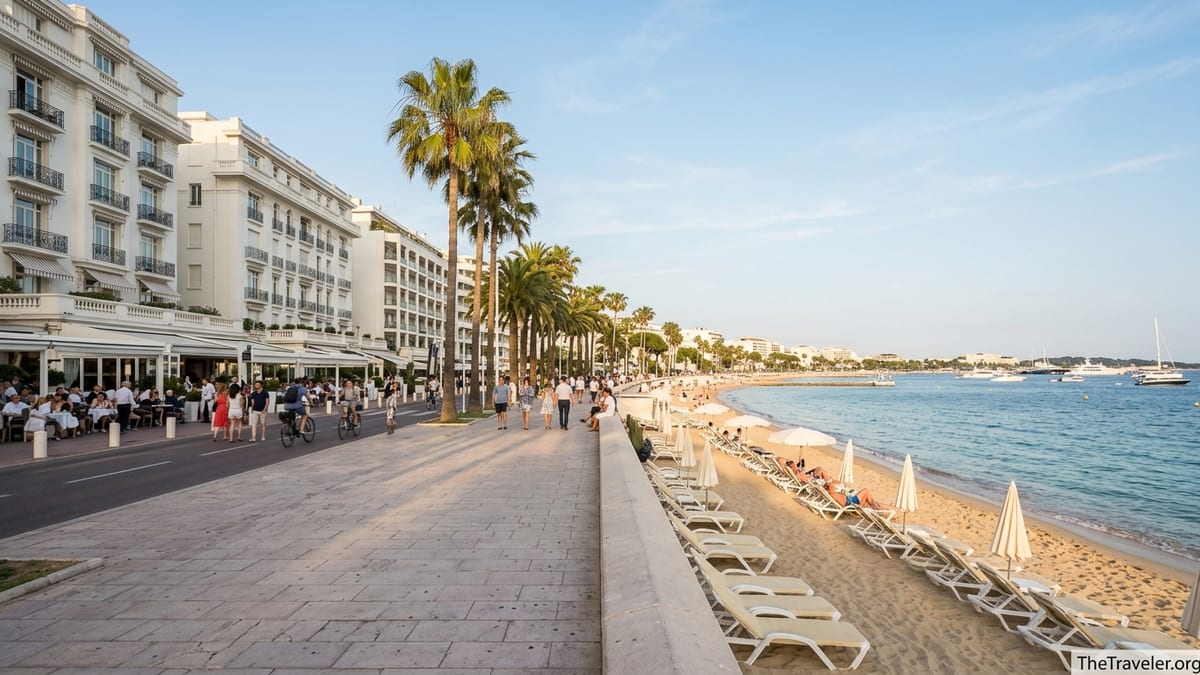
Getting Oriented on La Croisette
La Croisette runs for roughly three kilometres along Cannes Bay, from the Palais des Festivals near the old port in the west to the Pointe Croisette and Palm Beach area in the east. On the inland side, grand hotels, apartment buildings and luxury boutiques form an almost continuous wall of white facades. On the seaward side, the beach alternates between private clubs, municipal stretches and small coves near the eastern tip. It is compact enough that most visitors will explore it entirely on foot at least once.
The central section, between the Palais des Festivals and the Carlton area, is the most intensely developed. Here you find some of the Riviera’s most recognisable hotels, including the Carlton Cannes, Hôtel Martinez and Hôtel Barrière Le Majestic Cannes, each with its own private beach club. This is also where the promenade is widest and most animated, especially during the Cannes Film Festival in May, when red carpets, camera crews and barricades transform it into a live set.
Further east, around Port Canto and the Pointe Croisette, the vibe softens. Yachts line the marina, joggers follow the waterfront path and public beaches like Zamenhof and Bijou Plage offer more space and a mix of locals and visitors. To the west, beyond the Palais, the main seafront becomes Boulevard Jean Hibert and leads to the long public sweep of Plage du Midi, popular with residents and travellers seeking a quieter, less polished side of Cannes.
Most first-time visitors will arrive at La Croisette from Cannes train station, about a 10-minute walk via Rue d’Antibes. If you are staying in town, you will likely cross the boulevard multiple times a day, moving between hotel, beach and the restaurants and shops on the streets behind. It quickly becomes your reference point for the city.
The Best Walks Along the Promenade
The classic walk is the full Croisette promenade, ideally done early in the morning or around sunset. Start near the Palais des Festivals, where the red carpet steps overlook the harbour. From here, walk east with the sea on your right. In the first stretch you pass the Majestic and its beach club, then the Mondrian (formerly the Grand Hôtel) with its deep lawn and gardens, and soon the curved façade of the Carlton Cannes appearing ahead.
Continuing past the Carlton and toward the Martinez, the promenade widens. Benches face the bay, and in the cooler months locals settle with newspapers while dog walkers weave between them. On festival days, this section can feel like a catwalk of black SUVs and evening gowns. Outside peak events, it is surprisingly relaxed, with families on scooters and couples sharing ice creams from kiosks lining the central median.
For a quieter version of La Croisette, push on beyond the Martinez toward Port Canto. The crowds thin, the buildings step down in height and the promenade gains a more residential feel. At Port Canto, detour along the marina edge to admire rows of gleaming yachts and sailing boats, then rejoin the seafront path around the headland. Here you reach the Zamenhof municipal beach and, further on, the sands near Palm Beach, where the city feels far away even though you are still technically on La Croisette’s extension.
If you have half a day and want to see two faces of Cannes, combine La Croisette with a westward stroll to Plage du Midi. Start at the Carlton and walk west past the Palais and old port into the Suquet district, Cannes’ historic hilltop quarter. From there, continue along Boulevard Jean Hibert where the promenade becomes simpler and more residential. The views back to the Croisette skyline, framed by the Esterel hills, give a sense of how compact the bay really is.
Public and Private Beaches: How Access Works
Understanding the beach layout along La Croisette helps you choose where to swim and sunbathe. Much of the central waterfront is taken up by private beach clubs linked to hotels and independent operators. These sections have neat rows of loungers, waiter service, changing cabins and, often, music and dining terraces. Access is by paid day bed or half-day rental, and in high season booking is almost essential.
Prices vary considerably but typical summer rates for a sun lounger with umbrella along central La Croisette range from about 40 to 80 euros per day, rising for front-row spots closest to the water or during peak events like the film festival. Some clubs offer half-day options from late afternoon at slightly lower cost. A beach like Le Benitier, slightly away from the most famous hotel frontages, has been reported with front-row beds around the mid-20 euro range outside major events, illustrating how rates drop as you move from the premium stretch.
Interspersed between these clubs are smaller public sections where you can lay a towel for free. On La Croisette itself, one of the most practical public options is Zamenhof beach, a municipal zone near the eastern end that operates with supervised swimming in summer and the possibility to rent a basic lounger and parasol at controlled city rates. Further along, Bijou Plage combines a public area with an adjacent private club, giving mixed options for groups with different budgets.
If you are staying several days and want to balance indulgence with savings, a common strategy is to choose one or two days at a private club for comfort and service, then use public beaches or the more accessible stretches at Gazagnaire or Plage du Midi on other days. Keep in mind that you can still eat and drink in many beach restaurants without renting a lounger if you are happy to sit at standard tables rather than in the first rows of sunbeds.
Where to Swim for Every Travel Style
For a cinematic Croisette experience, pick a central beach in front of one of the headline hotels. A day at the Carlton’s beach club, for example, might mean paying at the upper end of the price range but you gain spacious loungers, attentive staff, a proper changing area and the chance to lunch on polished Mediterranean dishes while watching tenders shuttle to superyachts anchored offshore. This is where you will likely see festival guests, fashion shoots or business lunches in high season.
Travellers with children often prefer the eastern end of La Croisette and the Pointe Croisette area. Zamenhof beach is municipally managed, with seasonal lifeguards and equipment rentals that are more affordable than private clubs. Nearby, Bijou Plage offers shallow, usually calm water and a mix of free and paying zones, as well as a designated accessible beach area during the main summer months. Continuing beyond towards Gazagnaire beach, you find a string of public coves with soft sand and a family, local feel, plus the advantage of a large parking area near Palm Beach if you arrive by car.
Those seeking a more low-key, local atmosphere often head slightly away from the Croisette core. Plage du Midi to the west is a long ribbon of sand backed by simpler cafés and small apartment blocks, with more modest lounger prices and plenty of space to lay your own towel. It is still within walking distance of the Palais des Festivals, so you can easily split your day between a Midi swim and an evening cocktail back on La Croisette.
For swimmers who care more about water quality and open horizons than about hotel fronts, early morning is ideal. The bay is calmest, jet skis are still quiet, and you can often have large sections of the beach almost to yourself even in August. Practical details like bringing beach shoes for hot sand, a light pareo to meet dress codes in hotel bars, and a small dry bag for your phone and room key will make moving between beach and boulevard almost effortless.
Luxury Hotels, Beach Clubs and Iconic Spots
La Croisette’s reputation is closely tied to its grand hotels. The Carlton Cannes, freshly renovated, combines a curved Belle Époque façade with a private beach club and landscaped courtyard that feels like a film set. A drink on its terrace is a classic Cannes ritual, whether you choose an espresso in the morning or a glass of Provençal rosé as the light softens over the bay. Prices are high but in line with major European luxury hotels in comparable locations.
Further along, the Hôtel Martinez, with its Art Deco architecture and long white frontage, is another benchmark address. Its beach club typically blends pale wood, white cushions and pale-blue accents, with full-service loungers and a restaurant where mains often run from the mid-20 to 40 euro range, more for seafood platters. Even if you are not staying at the hotel, reserving a lunch table gives you a front-row seat on Croisette life.
Opposite the Palais des Festivals, Hôtel Barrière Le Majestic caters strongly to festival and business guests, with suites overlooking the red carpet area and a beach club that feels particularly animated on event nights. Non-residents can book spa treatments, dine at its restaurants or buy a day pass for the beach area when available, which is a way to sample the setting without committing to a multi-night stay.
Beyond the big three, smaller luxury properties like the Mondrian Cannes, JW Marriott Cannes and boutique-style hotels closer to Port Canto also maintain beach arrangements, either with their own concessions or via partnerships with independent clubs. Many travellers choose a hotel one or two streets back from the Croisette, then book beds at a preferred beach club for specific days, achieving a similar beach experience at a slightly lower overall room cost.
Shopping, Dining and Culture Along the Boulevard
Behind the palm trees and parasols, La Croisette doubles as one of the Riviera’s densest concentrations of luxury retail. Along the boulevard itself and on nearby streets you find flagship stores for major fashion, watch and jewellery brands, with seasonal capsule collections timed to coincide with the film festival and summer influx. Window-shopping is a spectator sport here; it is common to see visitors in casual resort wear mixing with tuxedoed festival-goers outside the same storefronts.
For everyday purchases or more accessible fashion, Rue d’Antibes one block inland offers a different commercial profile. International chains, French mid-range brands and local boutiques share space with pharmacies and small food shops. Many travellers adopt a daily pattern of strolling the Croisette in the morning, then dipping into Rue d’Antibes for practical errands before returning to the beach or their hotel.
Dining options along La Croisette range from hotel fine dining to beachside grills. At the highest level, some hotel restaurants hold Michelin distinctions and require advance booking, especially in May and July–August. Expect tasting menus to run into three figures per person before wine. More relaxed options include beach club restaurants offering salads, grilled fish, pasta dishes and shared platters, often with mains in the 20 to 40 euro bracket. Simple snacks, such as panini or ice creams from kiosks, allow you to keep costs down while still enjoying the seafront.
Cultural life on La Croisette is centred in part on La Malmaison, a contemporary art centre housed in a historic villa roughly mid-way along the promenade. It hosts rotating exhibitions of modern and contemporary work, with modest entry fees and regular guided tours. Combined with an hour on the nearby beach and a coffee on a terrace, a visit here rounds out the more commercial, glittering side of the boulevard with a quieter, reflective interlude.
Planning Your Perfect La Croisette Day
A typical day built entirely around La Croisette might start just after sunrise with a walk from the Palais des Festivals to Port Canto and back. The light on the bay is soft, joggers and dog walkers are out, and hotel staff are setting up beach loungers. After a quick coffee at a café terrace, you could move to a reserved sunbed at a beach club, spending the late morning alternating between swims and reading.
Lunchtime is often best taken slightly off-peak, around 1:30 to 2 p.m., when the strongest midday sun has passed. Many beach clubs let you eat in a shaded dining area, then return to your lounger for the rest of the afternoon. If you prefer to manage costs, you might choose a public beach like Zamenhof or Bijou Plage, bring your own towel and umbrella, then step up to the promenade for a sandwich or salad from a café.
Late afternoon and early evening are ideal for exploring the shopping side of the boulevard. Wander past the hotel frontages to see who is arriving in the latest festival-season cars, then browse the boutiques or the more relaxed stores on Rue d’Antibes. As the sun drops, the bay often glows pink and orange, making this a prime time for photographs looking back toward the Esterel hills or out toward the Lérins Islands.
To finish the day, consider an aperitif at one of the hotel bars along La Croisette, followed by dinner either at a beach restaurant or in the streets behind the boulevard where bistros and brasseries cater to both locals and visitors. If you still have energy, a final stroll along the water, with the lights of yachts reflected on the bay, shows La Croisette at its most atmospheric.
The Takeaway
La Croisette condenses the appeal of Cannes into a single curve of coast: beaches where parasols line up in precise formations, hotels whose names have appeared in novels and on film posters, and a promenade that works equally well for early-morning jogs and midnight people-watching. It is both highly managed and genuinely beautiful, a place where even a simple walk can feel like a small event.
For travellers, the key to enjoying La Croisette is matching its many faces to your own style and budget. Public beaches like Zamenhof, Bijou Plage and the sands at Gazagnaire show that you do not need a private club to swim in the same clear water as the superyachts, while a carefully chosen splurge on a beach bed or terrace drink can deliver the full Riviera fantasy. By understanding the layout, planning your walks and being selective about where you spend, you can make this famous promenade feel like your own front yard on the Mediterranean, if only for a few days.
FAQ
Q1. Is La Croisette worth visiting if I am not staying in a luxury hotel?
Yes. The promenade itself is free to enjoy, and there are several public beaches such as Zamenhof and Bijou Plage where you can swim without paying high club prices. You can window-shop, stroll, and stop for a single drink on a terrace to soak up the atmosphere without committing to luxury-level spending.
Q2. How much should I budget for a private sunbed on La Croisette?
In peak summer, expect to pay roughly 40 to 80 euros per day for a lounger and umbrella at a central Croisette beach club, with higher prices for front-row spots or during major events. At the edges of the boulevard or on nearby beaches like Plage du Midi, rates can be lower, and some clubs offer half-day or late-afternoon deals.
Q3. Can I access hotel beach clubs if I am not a guest?
Generally yes, subject to availability. Most hotel beach clubs along La Croisette sell day passes for sunbeds and accept external reservations for their restaurants. During the Cannes Film Festival or busy August weekends, priority often goes to in-house guests, so advance booking and flexibility on timings help.
Q4. Where is the best place to swim with children near La Croisette?
Families often choose the eastern end of the promenade, especially Zamenhof beach and Bijou Plage, which offer relatively shallow, calm water and supervised swimming in high season. Further along near Gazagnaire, public beaches have a relaxed, local feel and are well suited to children who like to paddle and play at the water’s edge.
Q5. What is the best time of day to walk La Croisette?
Early morning and sunset are the most comfortable and atmospheric times. Mornings offer cooler temperatures and a calm bay for swimming or jogging, while evenings bring softer light, busier terraces and the sight of the bay and the Esterel hills glowing in the sunset.
Q6. Are there affordable food options around La Croisette?
Yes. While many hotel restaurants and beach clubs are expensive, you will find more moderately priced cafés, bakeries and snack bars on side streets and along Rue d’Antibes one block inland. A common approach is to enjoy the Croisette for walking and views, then step back a street or two for lunch or dinner to keep your budget under control.
Q7. How do I get to La Croisette from Cannes train station?
It is about a 10-minute walk. From the station, head down Rue d’Antibes or a parallel street toward the sea and continue until you reach the promenade. Taxis and rideshares are available but often unnecessary unless you have heavy luggage or mobility issues.
Q8. Is La Croisette crowded all year round?
Crowds peak during the Cannes Film Festival in May and in July and August. Outside these periods, especially from late September to April, the promenade is far quieter and feels more like an elegant local seafront, though weekends and sunny days can still be lively.
Q9. Can I swim in Cannes outside the summer months?
Yes, many locals swim from late spring through autumn, and some hardy residents bathe year-round when the weather is calm. Water temperatures are coolest in winter, so if you plan to swim between November and March, consider a light wetsuit and always check conditions before entering the sea.
Q10. Is La Croisette suitable for people with limited mobility?
The main promenade is flat, paved and generally accessible, with benches at regular intervals. Some public and municipal beaches, such as the accessible area near Bijou Plage, offer adapted facilities in season. When booking a beach club or hotel, it is wise to ask specifically about step-free access and any assistance available for reaching the sand.