


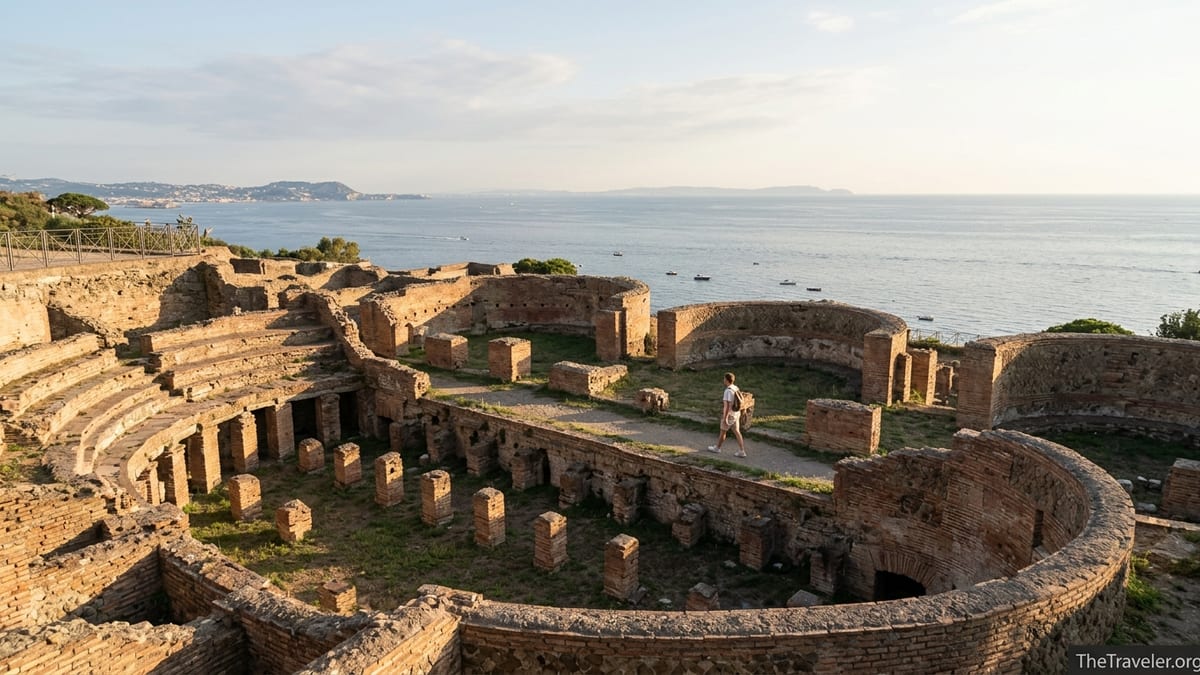
The first time I climbed the terraces of Baiae Archaeological Park, it felt less like visiting a ruin and more like sneaking into the backstage of Rome’s most exclusive resort. Terracotta brick walls still curve around sunken pools, marble fragments lie where aristocrats once lounged, and the Bay of Naples glitters below almost exactly as it did when emperors came here to unwind. Walking these slopes, with the fumaroles of Campi Flegrei in the distance and the sea pushing gently at the shore, makes ancient Roman luxury feel far less abstract and far more like a lifestyle you can almost step back into.
Get the latest updates straight to your inbox!
Where Rome Came to Relax: Setting the Scene in Baiae
Baiae sits on the northwestern edge of the Bay of Naples, folded into the volcanic landscape of the Campi Flegrei, a short commuter-train ride from central Naples and a taxi hop from Pozzuoli. In Roman times this was not a sleepy suburb but the resort of choice for the richest citizens of the empire. Senators, generals, and emperors built sprawling villas here, connected to the sea by private harbors and fed by natural hot springs that rose through the porous volcanic rock. When writers like Seneca and Pliny described Baiae as a place of excess and pleasure, they were talking about this very hillside and shoreline.
Today the modern town of Baia and nearby Bacoli wrap around the same curved bay, but the real star is the Archaeological Park of Baiae, administered as part of the Parco Archeologico dei Campi Flegrei. On land, the park climbs in a series of terraces above the water, dominated by massive domes and brick exedras that locals long misnamed “temples.” Just offshore, part of the ancient resort lies underwater, protected as a separate submerged archaeological park. Together, they preserve one of the clearest windows into how Roman elites turned natural scenery and geothermal power into a highly polished version of everyday luxury.
What makes Baiae particularly compelling is scale. At many Roman sites you admire a single bath complex or villa. Here, you walk through level after level of baths, courtyards, and reception spaces, then look out to sea knowing that whole villa districts lie just under the surface. It is not a single house but an entire landscape reimagined for pleasure.
Climbing Through Terraces of Pleasure: First Impressions on Foot
Most visits to the terrestrial park begin at the ticket office off Via Sella di Baia, where a combined ticket for the Phlegraean Fields sites typically costs in the range of 7 to 10 euros per adult, with reduced and free options for many EU visitors. After a brief climb you step into the first terrace, and the impression is immediate: this is not a modest provincial ruin. Barrel vaults loom above you, brickwork forms long curving corridors, and glimpses of the sea appear through arches that once framed carefully composed views for elite guests.
One of the early surprises is how three dimensional the site feels underfoot. Paths zigzag up and down between terraces, sometimes leading you across the tops of ancient rooms, sometimes dropping you to floor level where mosaic fragments still cling to thresholds. In one corner, a set of shallow steps descends into a circular basin that archaeologists identify as part of a bath or pool. It takes little imagination to picture bath attendants circulating with oils and towels, the air heavy with steam from the nearby geothermal vents.
There is also a strong domestic feel to parts of Baiae. In the so called “sector of the small baths,” modest sized rooms open one into another, with low benches and wall niches that would have held lamps or small statues. Standing in these spaces at mid morning, when groups from Naples have not yet arrived, you can hear the wind off the bay and the buzz of scooters from the modern road below. It feels surprisingly intimate, as if the owners have just stepped out to deal with an issue in the harbor.
The So Called Temples: Domes, Light, and Private Spa Design
Baiae is famous for its so called “temples,” a set of impressive domed structures long thought to be religious buildings but now understood as components of sophisticated thermal complexes and possibly imperial palaces. One of the most striking is the so called Temple of Diana, a massive rotunda that once formed part of a bath suite. When you walk inside, the first thing that hits you is scale: the dome soars overhead, broken in places but still powerful enough to create an echo when tour guides speak.
Instead of a bare shell, though, fragments tell a more extravagant story. Along the base of the walls you can see traces of marble revetment, thin slabs that once covered the brick in patterns of colored stone. The remains of niches hint at where statues of gods, nymphs, or emperors stood, watching over bathers. Light filters through gaps in the dome in irregular shafts, a reminder that in its prime the interior would have been carefully lit by small windows and flickering oil lamps, catching steam rising off the hot pools.
A short walk away, the so called Temple of Mercury contains what may be one of the largest surviving Roman domes, rivaling early experiments that would eventually culminate in the Pantheon. Step to the center of the space and clap your hands; the acoustics send the sound skating along the curvature, a reminder that this was as much a performance space as a place to wash. Imagine an aristocrat guiding a guest through the baths, their voices reflecting and amplifying in a way that underscored the architecture’s power.
By the time you reach the sector associated with the so called Temple of Venus, perched higher on the slope with expansive sea views, the pattern is clear. These were not anonymous public facilities like a modern municipal pool. They were part of vast private or semi private spa complexes, where controlled views, precise water temperatures, and impressive engineering all supported a carefully curated experience of comfort and status.
Thermal Baths and Roman Wellness: Luxury with a Practical Side
Baiae’s prosperity rested largely on hot water. The Campi Flegrei are an active volcanic region, and the same forces that worry modern volcanologists once supplied Romans with a network of natural springs. At Baiae, engineers channeled this resource into an intricate system of baths, pipes, and heating rooms that turned wellness into an art form. Walking the park today, you can still see the stubby brick pillars of hypocausts, the underfloor heating systems that allowed hot air to circulate beneath bath halls and private rooms.
On one terrace, sections of floor have collapsed or been removed to reveal these hypocaust supports, creating a kind of cutaway view of Roman engineering. Guides often stop here to explain how slaves would have tended furnaces below, feeding them with wood to keep room temperatures at exact degrees. In practice, this meant that a wealthy patron could move through a carefully sequenced ritual: starting in a warm tepidarium, progressing to a hot caldarium, then returning to a cooler frigidarium or plunge pool, all while attendants offered massages, perfumes, and refreshments. For a modern visitor used to quick showers and crowded gyms, the idea of spending hours in such a circuit gives Roman leisure a more tangible, almost enviable rhythm.
The medical side of this regimen is still visible in the nearby modern spa town of Agnano and the various terme facilities around the Bay of Naples, where locals soak in mineral rich water for skin, respiratory, and joint conditions. In Baiae’s time, a senator with arthritis or a general recovering from campaign injuries might have been prescribed a stay here for therapeutic bathing. As you trace the lines of water channels and stand on the edges of old pools, it becomes easier to see these baths not simply as decadent spas but as a high status version of healthcare, where the line between treatment and indulgence was pleasantly blurred.
Looking Out to a Drowned Resort: Villas Beneath the Waves
One of Baiae’s most haunting qualities is that part of the ancient city has literally slipped under the sea. Ongoing subsidence, caused by the slow rise and fall of magma chambers under Campi Flegrei, gradually lowered sections of the shoreline over many centuries. The result is the Submerged Archaeological Park of Baia, a protected marine area where divers and glass bottom boat passengers can view streets, mosaics, and villa foundations now resting several meters below the surface.
From the upper terraces of the terrestrial park, you can look down toward the modern marina and know that some of Rome’s most opulent seaside villas once extended into what is now open water. Archaeologists have identified structures belonging to vast residential complexes, including peristyle courtyards, harbor installations, and richly decorated rooms. In 2023, underwater researchers reported the discovery of an ornate mosaic floor and extensive marble paving associated with a high status villa, a reminder that much of Baiae’s best decoration remains in situ offshore, only partially explored.
On a practical level, visiting this underwater section adds a visceral layer to the experience of Roman luxury. Local dive centers in the Bacoli and Baia area organize guided dives for certified divers, typically pricing a two dive half day outing in the range of 80 to 120 euros including basic equipment. For non divers, glass bottom boat tours leave from the small harbor in Baia itself, often charging around 20 to 30 euros for a one to two hour trip, depending on season and group size. Watching mosaic floors and column bases slide beneath the viewing windows while small fish dart in and out makes the idea of a vanished resort feel intimately real.
Operators usually anchor above specific highlights such as the submerged Nymphaeum of Punta Epitaffio, where copies of statues stand in their original positions, the originals now protected in the local museum. The combination of ancient columns, seagrass, and flickering light creates a strange continuity. Roman luxury has not disappeared; it has been folded into a new ecosystem where crabs explore what were once banquet halls.
Connecting the Dots: The Museum in the Aragonese Castle of Baia
To fully understand Baiae’s brand of luxury, it helps to pair the archaeological park with a visit to the Museo Archeologico dei Campi Flegrei, housed in the Aragonese Castle of Baia that overlooks the bay. The castle itself, a fortress perched dramatically on a promontory, occupies the site of a former Roman villa complex. Inside, carefully arranged galleries display artifacts from Baiae and other Phlegraean sites, including statues recovered from the submerged nymphaeum and decorative elements that once adorned the bath complexes you have just walked through.
Seeing a marble Aphrodite or an emperor’s portrait in the controlled light of a museum after glimpsing their replicas or empty niches on site makes the difference between textbook history and lived culture. You start to appreciate how color and texture saturated these spaces. Fragments of wall painting, sections of patterned marble floors, and finely carved capitals demonstrate that even utilitarian elements like column bases or door frames were opportunities for display.
In practical terms, the castle museum is reachable by the same local buses and taxis that serve the park, and combination tickets or integrated passes are sometimes available, particularly during cultural initiatives promoted by the Italian Ministry of Culture. For travelers based in Naples, weaving Baiae and the museum into a single day trip, possibly combined with nearby sites such as the Flavian Amphitheater in Pozzuoli, creates a thematic journey through how Romans sculpted land, sea, and stone into a comprehensive vision of status.
Planning Your Visit: Practical Tips That Shape the Experience
Experiencing Baiae as the Romans did starts with timing. The terrestrial archaeological park follows hours typical of Italian state sites, usually opening around 9 in the morning and closing roughly an hour before sunset, with Monday closures common. In practice, this means a summer day visit will offer more time and harsher light, while winter afternoons can be short but atmospheric. Arriving early, ideally right at opening time on a weekday, often means cooler temperatures on the steep terraces and quieter paths, which makes it easier to imagine the site in its ancient, less crowded prime.
Transport from Naples is straightforward but benefits from planning. Many visitors take the Cumana or regional trains toward Torregaveta, disembarking at stations such as Fusaro or Baia and then walking or taking a short taxi ride uphill. Others join small group tours that combine Baiae with Cuma or the Piscina Mirabilis, trading some flexibility for simplified logistics. If you are planning to pair the terrestrial park with the underwater section, keep in mind that dive centers typically run morning and early afternoon departures, and glass bottom boat tours depend heavily on calm seas and good visibility. Calling ahead or asking local accommodation hosts to confirm departures a day or two in advance can prevent disappointment.
Budget wise, Baiae is relatively gentle compared to marquee sites like Pompeii. Entrance to the terrestrial park sits in the lower single digits of euros for many visitors when part of combined tickets, although prices evolve and concessions vary. The real cost variables are transport from Naples, guided tours, and underwater activities. A realistic day budget for a couple, including train fares, park entrances, a simple seafood lunch near the marina, and a glass bottom boat excursion, can remain under 150 euros if you avoid private transfers and high end restaurants. That said, one of the pleasures of Baiae is lingering over a plate of local mussels or spaghetti alle vongole while looking back at the terraces where Roman elites once staged their own seaside feasts.
Making Roman Luxury Feel Real: Walking as Time Travel
What distinguishes Baiae from other Roman sites is not just its architecture but the way the landscape forces you to move through space. Climbing from terrace to terrace, feeling your legs work on steep ramps, you begin to understand that for ancient elites, luxury was not about static possessions but about orchestrated sequences of sensations. A host might lead guests from a shaded grove to a heated bath, then out to a belvedere for sea views and finally down to a private harbor where a boat waited. As a modern visitor following roughly similar paths, you temporarily step into that choreography.
Real world details drive this home. The rough texture of brick under your hand as you steady yourself on a sloping passage, the lingering scent of vegetation reclaiming collapsed rooms, the way sound changes when you step under a dome, or the sudden coolness of a shaded exedra after a sunbaked stairway all create a physical, sensory connection with people who lived here two millennia ago. Instead of abstract notions of “Roman opulence,” you encounter specific comforts: heated floors, framed sea views, protected courtyards where wind does not howl off the bay.
Pairing the on land visit with a dive or boat trip in the submerged park intensifies that feeling. Watching a guide gesture at a submerged street line while you float above, or seeing a reconstructed statue in a nymphaeum niche underwater, makes the concept of a lost resort viscerally clear. This was not a mythic Atlantis but a functioning, meticulously engineered seaside district that succumbed slowly to geological forces. Roman luxury here is not frozen in an instant like Pompeii under ash; it has sagged, slid, and settled in ways that you can trace with your own body as you walk or swim.
The Takeaway
Baiae Archaeological Park is not the most famous site in Italy, but for travelers interested in how ancient people actually lived, it may be one of the most revealing. The combination of terraced bath complexes, looming domes, and a partially drowned shoreline transforms Roman luxury from a concept into something granular and tactile. You see where bathers sat, where hosts staged conversations, where ships docked beneath villa terraces, and where geology eventually reclaimed prime waterfront real estate.
Walking through Baiae, especially if you take the time to layer in the castle museum and the underwater park, offers a kind of slow time travel. Each step on the brick pavements and each glance at the shifting shoreline helps bridge the gap between the empire’s grand narratives and the everyday pleasures of its elite. In a region filled with iconic ruins, Baiae stands out as a place where you are not just looking at the past, but briefly moving through it, tracing the outlines of a lifestyle that feels far closer than the centuries suggest.
FAQ
Q1. Where exactly is Baiae Archaeological Park, and how do I get there from Naples?
Baiae Archaeological Park lies in the Campi Flegrei area west of Naples, near the towns of Baia and Bacoli. From Naples, many visitors take regional trains toward Torregaveta and get off at stations such as Fusaro or Baia, then continue by local bus or taxi. Alternatively, you can book an organized tour or hire a private driver for door to door transport.
Q2. How much time should I plan to visit the terrestrial park at Baiae?
Most travelers find that two to three hours is enough to explore the main terraces at a comfortable pace, with time for photographs and short rest stops on the climbs. If you also want to visit the Aragonese Castle museum on the same hill or combine Baiae with nearby sites like Pozzuoli, plan for most of a day in the area.
Q3. What are the typical opening hours and weekly closure days?
The terrestrial archaeological park usually opens around 9 in the morning and closes roughly an hour before sunset, with seasonal variations. Like many Italian state sites, it is commonly closed on Mondays. Because hours can change for maintenance or special events, it is wise to confirm current times shortly before your trip.
Q4. Do I need to book tickets in advance, or can I just show up?
For the terrestrial park, many visitors simply arrive and buy tickets at the entrance, especially outside peak summer weekends. During holidays or when special events are running across the Campi Flegrei sites, pre booking through official channels or reputable ticketing services can shorten waits and guarantee entry at busy times.
Q5. How much does it cost to visit, and are there combined tickets?
Standard adult tickets for Baiae Archaeological Park are typically in the lower single digits of euros, often around the 7 to 10 euro range when part of broader Campi Flegrei passes. Discounts and free entry apply to various age groups and categories, especially European Union residents. Combined or multi site tickets are sometimes offered, so asking at the ticket office or checking official information can help you save money if you plan to see several sites.
Q6. What should I wear and bring, especially in summer?
Wear sturdy walking shoes with good grip, as paths between terraces can be uneven and occasionally steep. In warmer months, lightweight clothing, a sun hat, and sunscreen are essential, since many areas are exposed. Bringing a refillable water bottle is wise, as shade and refreshment points inside the archaeological area are limited, and you can top up in the nearby town before or after your visit.
Q7. Can I visit the underwater archaeological park if I am not a certified diver?
Yes, you can. While certified divers can book guided dives with local centers to explore submerged streets and mosaics, non divers can join glass bottom boat tours that depart from the harbor in Baia. These trips usually last one to two hours and allow you to see villa remains and parts of the underwater landscape without entering the water.
Q8. Is Baiae a good alternative or complement to Pompeii and Herculaneum?
Baiae is an ideal complement rather than a replacement. Pompeii and Herculaneum offer broad snapshots of urban life, while Baiae focuses on elite leisure and spa culture in a resort setting. Visiting Baiae after Pompeii can make the contrast between everyday town life and high end vacation living in the Roman world especially vivid.
Q9. Is the site suitable for children and travelers with limited mobility?
Children who enjoy climbing and exploring ruins often find Baiae exciting, especially when stories of emperors and submerged villas are woven into the visit. However, the steep terraces and uneven paths can be challenging for strollers and visitors with limited mobility. Some upper or lower sections may be hard to access without negotiating stairs, so checking in advance and planning for a slower pace is advisable.
Q10. Are there places nearby to eat or stay if I want to linger in the area?
The modern towns of Baia and Bacoli offer a range of small hotels, guesthouses, and seaside restaurants, many specializing in local seafood. Travelers often combine a park visit with lunch overlooking the marina or an overnight stay that allows time for the castle museum and a sunset stroll along the waterfront. If you prefer a city base, Naples is close enough that you can comfortably visit Baiae on a day trip and return there for evening dining and nightlife.