


On a clear day just west of Naples, it takes a moment to understand what you are looking at in Baiae. Tiered brick ruins step down a hillside, thermal pools sit silent under the sun, and just offshore boat captains point to pale shapes beneath the waves. Here, at Baiae Archaeological Park and its submerged twin under the sea, you are standing in what was once the most exclusive resort of the Roman world and today one of Italy’s most unusual archaeological experiences.
Get the latest updates straight to your inbox!
What and Where Is Baiae Archaeological Park?
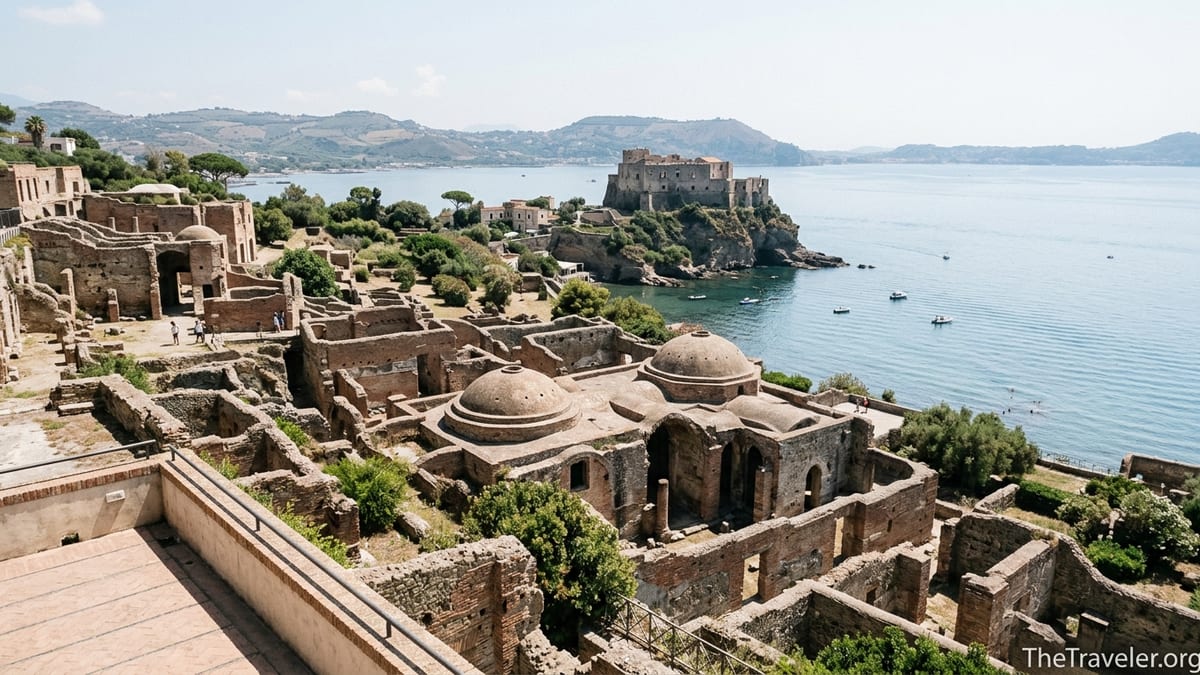
Baiae Archaeological Park, officially Parco Archeologico delle Terme di Baia, is a vast complex of Roman ruins on the northwestern shore of the Bay of Naples, around 25 kilometers from central Naples in the modern town of Bacoli. The site spreads over a steep hillside facing the water, with terraces of brick-built halls, baths, and courtyards that once formed monumental thermal complexes commissioned by Rome’s elite. Just offshore lies the separate but closely related Submerged Archaeological Park of Baiae, where entire villa districts are now under several meters of water.
In Roman times, Baiae was part spa town, part playground of emperors. Ancient writers compared it to a mix of modern-day Monaco, a luxury wellness resort, and a political backroom. From roughly the 1st century BC to the 3rd century AD, this was where senators, generals, and emperors such as Augustus and Nero came to soak in volcanic hot springs, host lavish banquets, and quietly negotiate alliances far from the formal atmosphere of Rome.
Today, visitors encounter Baiae in two main ways. On land, you walk the terraces of the archaeological park, entering huge domed halls that once echoed with steam and conversation. On the water, glass-bottom boat rides and guided dives glide above mosaic floors, street fragments, and statues in the underwater section sometimes nicknamed the “Sunken Pompeii of the Bay.” Together, these twin parks offer a rare chance to see how a single ancient landscape can exist both on a hillside and beneath the sea.
Because Baiae sits within the wider Campi Flegrei (Phlegraean Fields) volcanic area, the entire setting feels different from the better-known ruins of Pompeii. You can see fumaroles and volcanic cones on nearby headlands, and from the terraces the view takes in the naval base of Misenum, Pozzuoli, and, in the distance, Vesuvius. It is a compact but intense archaeological zone, easily visited as a half- or full-day trip from Naples.
A Roman Playground for Emperors and Elites
Baiae’s importance in antiquity came from its unusual mix of geology, location, and politics. Natural hot springs bubbled from the volcanic ground, and Roman engineers amplified them into elaborate spa complexes. The hillside location allowed architects to stack buildings on several levels, connected by staircases and ramps, creating a dense resort where sea views and private corners were both easy to find. The nearby naval harbor at Misenum made the area strategically significant and ensured a constant flow of high-ranking visitors.
Ancient sources describe Baiae as a place of endless parties, political gossip, and luxury. The Roman poet Propertius condemned it as a “harbor of vice,” while others joked that serious statesmen seemed to lose their discipline as soon as they arrived. In modern terms, it was something like a combination of a high-end spa town and a political conference resort, where deals could be struck in the privacy of a steam room rather than a public forum.
Concrete examples of this elite presence show up in the archaeology. The sprawling bath complexes in today’s park are believed to be linked to imperial estates established under Augustus. Archaeologists have identified wealthy residential quarters with elaborate layouts, private bathing pools, and direct sea access. The famous Nymphaeum of Emperor Claudius, now underwater, includes statues of gods and members of the imperial family that once surrounded a luxurious seaside dining grotto, the Roman equivalent of a private beach club restaurant reserved for the inner circle.
For modern visitors, walking through the park gives a sense of just how concentrated that ancient luxury once was. You might climb a staircase and emerge into a circular hall nearly 30 meters across, imagine it filled with marble, colored plaster, and heated pools, then step onto a terrace where, 2,000 years ago, senators looked out over the same curve of bay you see today. The political intrigues have vanished, but the stage where they played out is still remarkably intact.
Why Part of Baiae Is Underwater
One of the most striking facts about Baiae is that a large portion of the ancient town, including seafront villas and roads, now lies several meters below sea level. This is not due to a sudden tsunami or dramatic earthquake alone but to a slower geological process called bradyseism, where volcanic areas like the Phlegraean Fields rise and fall over centuries. In Baiae’s case, the land gradually sank relative to the sea, submerging lower-lying neighborhoods while upper terraces remained dry.
The result is a rare underwater archaeological landscape. What used to be seafront promenades and courtyard gardens are now snorkeling and diving routes. In places, you can still see the tops of ancient columns and wall lines on sonar imagery. Glass-bottom tour boats today trace a route above what was once the Roman Via Herculanea, a coastal road lined with elite properties. Instead of chariots and litters, visitors look down on it from boat benches, watching fish flicker above black-and-white mosaic pavements.
The gradual nature of the submergence has had an unexpected benefit for archaeology. Without the intense later construction that affected many coastal towns, some villa foundations, baths, and decorative floorings ended up sealed in relatively stable marine conditions. Divers and underwater archaeologists working in the Submerged Archaeological Park of Baiae have documented whole residential blocks, complete with peristyle courtyards, thermal rooms, and service corridors. For travelers, this means that a glass-bottom tour or guided dive here can feel like flying over a three-dimensional blueprint of a Roman seaside neighborhood.
The underwater setting does present conservation challenges. Marine organisms slowly colonize stone and mosaic tesserae, and wave action can disturb loose material. Italian authorities created the official underwater park to control access, manage boat traffic, and support research. When you book a glass-bottom boat tour, snorkeling trip, or dive, you are not simply signing up for a fun activity; you are entering a tightly managed heritage zone that balances visitor access with the long-term survival of an irreplaceable site.
Exploring the Hillside Ruins: What You See on Land
Most visitors begin their experience at Baiae in the hillside archaeological park. The entrance leads into a sequence of terraces, each containing monumental structures that were once part of the vast imperial thermal complexes. One of the most memorable features is the series of large domed halls popularly but somewhat inaccurately called “temples.” From the outside they resemble enormous brick drums emerging from the slope; inside, they open into soaring spaces that once held hot or cold plunge pools, steam rooms, and ceremonial baths.
At the top of the site, you can walk through areas often described as the “Temple of Venus” and “Temple of Diana,” though modern scholars see them as parts of grand bath complexes rather than actual temples. Their engineering is impressive: thick brick walls, concrete domes, and clever use of the hillside to channel spring water. Travelers who have previously visited Roman sites like the Baths of Caracalla in Rome often comment that Baiae feels more intimate and vertical, with surprising views at the end of nearly every staircase.
Lower down, terraces include colonnaded courtyards, fragments of marble pavements, and remains of hypocaust systems, the underfloor heating networks that distributed hot air from furnaces. In several rooms you can see the short brick pillars that once supported raised floors, a visual reminder that Romans experienced a kind of “underfloor central heating” two millennia ago. Guides sometimes point out how soot marks, stone channels, and brick repairs reveal busy maintenance teams who kept these baths running for elite clientele.
Because the park is relatively compact, many visitors choose to explore it without a guide, following interpretive panels that explain key structures in Italian and English. A typical visit to the hillside zone takes about 90 minutes to two hours at a moderate pace, including time to pause for photos of the bay and the Aragonese Castle of Baia, a later medieval fortress that now houses the Archaeological Museum of the Phlegraean Fields. Some independent travelers pair the park with a short taxi ride or walk up to the castle afterward to see statues and artifacts from Baiae in the museum galleries before returning to Naples in the late afternoon.
The Underwater Park: Glass-Bottom Boats, Snorkeling, and Dives
For many, the highlight of Baiae is the chance to see the submerged ruins from the water. Several authorized operators based in Bacoli and Baia’s small harbor run glass-bottom or semi-submarine boat tours. A typical outing lasts around 45 to 60 minutes, during which the captain maneuvers along marked routes above key underwater zones such as the Nymphaeum of Claudius, stretches of the ancient Via Herculanea, and villa districts with visible mosaics.
Onboard commentary, often in Italian and English, explains what you are seeing through the glass panels: geometric black-and-white floor designs, low walls defining rooms, and in some cases modern replica statues placed where ancient originals once stood. Prices for glass-bottom boat trips generally start from the equivalent of around 25 to 35 US dollars per adult, depending on operator and season, making them accessible to families and casual visitors who prefer to stay dry while still experiencing the underwater site.
More adventurous travelers can join snorkeling or scuba diving excursions run in cooperation with the Submerged Archaeological Park authority. Local dive centers based around the harbor offer half-day tours that include equipment, a briefing on both safety and history, and guided exploration of specific archaeologically rich zones. As of recent seasons, introductory snorkeling experiences with a guide typically begin around the equivalent of 40 to 50 US dollars per person, while full scuba dives with equipment rental often range upwards from roughly 80 to 120 US dollars, varying by provider and group size.
These underwater visits are more tightly regulated than many recreational dives. Group sizes are kept small, and routes follow established paths to avoid damaging fragile remains. Divers are usually required to have at least basic certification for deeper routes, while try-dives for beginners stay in shallower, more controlled areas. Many visitors who dive here report that seeing Roman walls and mosaics at eye level adds an emotional dimension that is hard to capture from a boat alone, particularly when shafts of light cut through the water and highlight patterns on the ancient floors.
Practical Information: Tickets, Hours, and How to Get There
Baiae Archaeological Park is managed as part of the wider Parco Archeologico dei Campi Flegrei, which also includes sites such as Cuma and the Flavian Amphitheater in Pozzuoli. Standard entry tickets to the hillside Terme di Baia site are modestly priced; recent published rates have been around 5 euros per adult, with reduced and free entries available for eligible visitors according to Italian heritage rules. Combination tickets and regional passes such as the Campania Artecard may include Baiae among multiple archaeological sites, making it economical for travelers planning several visits over a few days.
Opening hours typically follow a pattern common to many Italian archaeological parks: open from Tuesday to Sunday, starting at 9:00 in the morning, and closing about one hour before sunset, with last admission some time before the posted closing time. The park is usually closed on Mondays and on certain national holidays. Because hours can shift seasonally, particularly in winter when daylight is shorter, it is wise to confirm the latest schedule through official Italian cultural heritage channels or by checking locally in Naples before setting out.
Reaching Baiae from Naples is straightforward but involves at least one change of transport. Many independent travelers take a regional train toward the Phlegraean Fields area, getting off at stations such as Fusaro, which lies roughly 800 meters from the archaeological park, then continue on foot or by local bus. Others prefer to ride a suburban train or metro to Pozzuoli and then switch to a local bus or taxi for the last leg along the coast. Travel time from central Naples generally ranges between 45 and 70 minutes depending on connections. In recent years, boat shuttles and organized van tours from Naples have also appeared, appealing to visitors who prefer door-to-door transport.
For the underwater park, departure points are typically from the harbor area near Baia. Glass-bottom boat operators often run multiple trips per day in high season, especially on weekends, but may require advance booking for morning or late-afternoon slots that are popular with tour groups. If you are planning both the hillside park and a glass-bottom boat tour in a single day, it is practical to visit the land site in the cooler morning hours, break for lunch at a nearby seafront café, and then join a mid-afternoon boat trip when the sun angle can make underwater visibility especially atmospheric.
Why Baiae Matters: Cultural, Scientific, and Experiential Value
Baiae’s importance extends far beyond its immediate scenic appeal. Culturally, it offers a rare, concentrated glimpse into the lifestyle of Rome’s ruling classes away from the capital. While sites such as the Palatine Hill in Rome and the villas around the Bay of Naples show how emperors lived, Baiae reveals where they relaxed, schemed, and socialized. The combination of monumental baths, elite villas, and a resort-town atmosphere makes it invaluable for historians trying to reconstruct how power and pleasure intersected in the Roman world.
Scientifically, Baiae is a living laboratory for both archaeology and geology. Underwater excavation and documentation here have driven innovation in marine survey techniques, 3D imaging, and digital reconstruction. Research teams have used multi-beam sonar, photogrammetry, and even experimental underwater augmented reality to map and interpret the submerged quarters. Geologists studying bradyseism use Baiae, along with nearby Pozzuoli, as a long-term case study of how volcanic regions rise and fall. The partially flooded ruins serve as markers of past sea levels and land movements, helping scientists refine models that are relevant to coastal communities worldwide.
From a conservation perspective, Baiae has pushed Italian and international heritage bodies to grapple with questions that will become more urgent as sea levels change globally. How do you protect ancient stonework underwater? How do you manage visitor impact when access requires boats and specialized gear? Initiatives at Baiae, such as strict mooring systems, guided-only underwater access, and ongoing monitoring of biological growth on surfaces, are watched closely by managers of other coastal sites in the Mediterranean and beyond.
For travelers, perhaps the most compelling reason Baiae matters is experiential. Few places allow you to connect with the ancient world in such a multi-sensory way: feeling rough brick under your hands on a hillside terrace, smelling the sea and volcanic air, then looking down through boat windows at the ghostly geometry of submerged mosaics. As interest in more immersive, slower forms of tourism grows, Baiae offers an alternative to crowded, heavily trafficked sites like central Pompeii, while still fitting easily into a wider Naples and Campania itinerary.
Planning Your Visit: What to Expect on the Ground
Planning a day at Baiae is relatively simple, but a few real-world details can make the experience smoother. The hillside park includes many staircases and uneven surfaces, so comfortable walking shoes are essential. In summer the stone terraces can become very hot, with limited shade, so sun protection and water are important even for a two-hour visit. There are basic facilities near the entrance, but services inside the archaeological zone itself are minimal, which gives the ruins a quiet, contemplative feel compared to busier sites.
Food options cluster around the harbor and the main road between Baiae and Bacoli, where travelers find casual pizzerias, seafood trattorias, and cafés. Many visitors combine their archaeological visit with a leisurely seafood lunch overlooking the bay, sampling dishes such as spaghetti alle vongole or fried local fish. Prices in this area are generally lower than in the historic center of Naples; a typical sit-down lunch with pasta, a shared appetizer, and soft drinks or house wine might fall in the range of 20 to 30 euros per person, though upscale options exist as well.
Because Baiae is part of the wider Campi Flegrei region, some travelers opt for a full-day circuit that includes another nearby site. A popular combination is Baiae plus the Flavian Amphitheater in Pozzuoli, one of the largest Roman amphitheaters in Italy, or Baiae plus the ancient city of Cuma with its famous cave associated with the Sibyl of Roman legend. Several local tour companies and licensed guides based in Naples and Pozzuoli offer private or small-group itineraries that link these places, sometimes with hotel pickup, which can be efficient for visitors with limited time or those uncomfortable navigating local transport.
Seasonal timing also shapes the experience. Spring and early autumn are often ideal for comfortable temperatures on land and decent underwater visibility. In high summer, heat on the hillside terraces can be intense by midday, but the breeze on boat tours offers some relief. Winter visits are entirely possible and tend to be very quiet, though glass-bottom operations may be less frequent and sea conditions more variable. Checking the latest schedules for both the archaeological park and boat operators in the days before your visit helps avoid disappointment, especially if you have your heart set on the underwater component.
FAQ
Q1. What exactly is Baiae Archaeological Park?
Baiae Archaeological Park is a hillside complex of Roman thermal baths and related structures near Naples, together with a protected underwater area where parts of the ancient resort town now lie submerged.
Q2. How is Baiae different from Pompeii?
Pompeii was a bustling regional city buried suddenly by volcanic ash, while Baiae was an elite spa and resort for Rome’s ruling classes, with much of its seafront quarter gradually sunk underwater rather than covered in ash.
Q3. Can I visit Baiae from Naples as a day trip?
Yes. Most travelers reach Baiae from Naples in under 1.5 hours using a mix of regional trains and local buses or taxis, allowing enough time in one day to explore both the hillside ruins and, with planning, an underwater boat tour.
Q4. Do I need to book a guided tour to see the archaeological park on land?
No. You can visit the hillside park independently by purchasing a standard ticket at the entrance, although many visitors choose to hire a local guide or join a small group to better understand the complex bath structures and history.
Q5. How much does it cost to visit Baiae?
The hillside archaeological park ticket is relatively inexpensive, typically a few euros per adult, while optional extras such as glass-bottom boat rides, snorkeling, or scuba dives have separate prices that are higher and vary by provider and season.
Q6. Is the underwater archaeological park suitable for non-divers?
Yes. Glass-bottom and semi-submarine boat tours are designed for non-divers and families, allowing you to see key underwater ruins from the surface, with commentary explaining the villa layouts, roads, and mosaics below.
Q7. What level of fitness is required to visit Baiae?
On land, expect numerous stairs and uneven paths, so a basic level of mobility and balance is needed. Underwater activities such as snorkeling or diving require normal swimming ability and, for scuba, appropriate certification or participation in supervised beginner programs.
Q8. When is the best time of year to visit Baiae?
Spring and early autumn usually offer comfortable temperatures for walking the terraces and relatively good sea conditions for boat tours, while summer brings hotter weather but more frequent departures and longer opening hours.
Q9. Are there museums connected to Baiae?
Yes. The nearby Archaeological Museum of the Phlegraean Fields, housed in the Aragonese Castle of Baia overlooking the park, displays statues, inscriptions, and artifacts found in Baiae and other sites in the region.
Q10. Is Baiae Archaeological Park suitable for children and families?
Many families enjoy Baiae, especially the combination of exploring ruins and taking a glass-bottom boat tour. However, parents should be prepared for stairs, sun exposure, and the need to supervise children closely around drop-offs and water.