


On a quiet stretch of the Bay of Naples, just 30 minutes from central Naples by car, lies one of the strangest archaeological sites in Italy. Baiae Archaeological Park is at once a clifftop maze of ruined Roman baths and a surreal underwater city where mosaicked villa floors lie a few meters below the waves. Two thousand years ago this was the most fashionable resort in the Roman world, a place of pleasure palaces, experimental architecture and whispered scandals involving emperors and senators. Today, visitors can wander its terraced ruins and even snorkel or dive above its sunken streets to understand how Rome’s elite really vacationed at the empire’s most exclusive retreat.
Get the latest updates straight to your inbox!
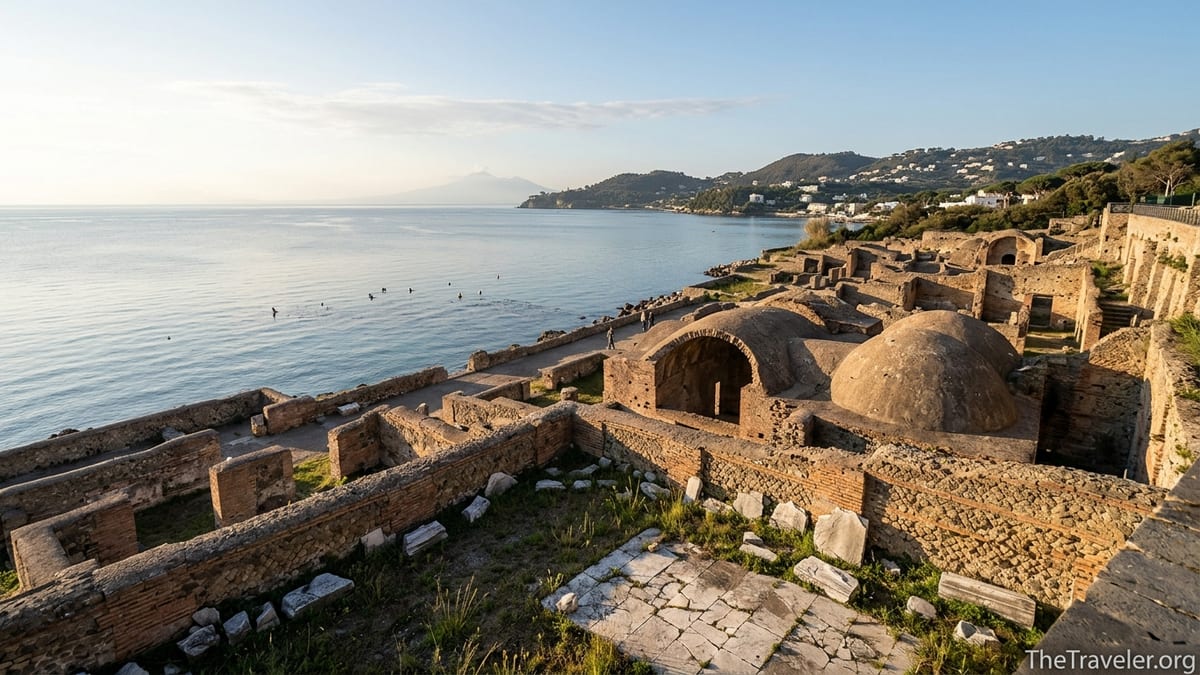
From Volcanic Bay to Imperial Playground
Baiae grew up on the northwestern shore of the Gulf of Naples, inside the geologically active Campi Flegrei, or Phlegraean Fields. This volcanic landscape gave the area its defining attractions: naturally heated mineral springs and pools of steaming water that the Romans quickly learned to harness. By the late Republic, around the 1st century BC, Baiae had transformed from a small coastal settlement into a fully fledged spa town, its hillsides progressively carved into terraces supporting grand residences and bath complexes.
For the Roman elite, Baiae combined health, luxury and proximity. It sat only about 200 kilometers south of Rome, close to the major naval base at Misenum and within a short sail of other resort towns like Puteoli and Capri. Statesmen such as Julius Caesar and Cicero kept villas here, alongside generals, bankers and literary celebrities. Ancient writers described Baiae as a place where powerful Romans escaped the formalities of the capital in favor of hot-water cures, late-night banquets and discreet affairs far from the Senate’s gaze.
The atmosphere was so hedonistic that philosophers used Baiae as shorthand for moral decline. Seneca called it a vortex of luxury and a harbor of vice, and moralists complained that people came more for the parties than the therapeutic waters. Yet that reputation only helped the town’s appeal. What Las Vegas and Saint Tropez represent to modern travelers, Baiae represented to the Romans: a waterfront escape where money, status and pleasure came together in spectacular fashion.
By the 1st century AD, the shoreline was crowded with villae maritimae, maritime villas whose private piers, fish ponds and bath suites stretched right into the sea. The landscape became an almost continuous ribbon of architecture, with individual properties blending into one another. What is now Baiae Archaeological Park preserves a large slice of that world, both on the slopes above the bay and on the seabed just offshore.
Why So Many Emperors Chose Baiae
Baiae’s guest list reads like a roll call of Roman power. Julius Caesar and his rival Pompey the Great vacationed here; later, emperors including Augustus, Tiberius, Nero, Hadrian and Claudius all maintained residences along this coast. The emperor Hadrian is believed to have spent his final days at a villa in Baiae before his death in AD 138, while Caligula famously ordered a temporary bridge of boats across the bay, turning the water between Baiae and Puteoli into a floating roadway for a theatrical military parade.
These imperial villas were not modest retreats. Archaeologists have uncovered evidence of vast peristyle courtyards, private bath suites, colonnaded sea pools and ornate dining rooms with views across the bay to Capri and Vesuvius. The so-called Villa of the Pisoni, now part of the underwater archaeological park, shows just how elaborate these residences could be, with symmetrical courtyards, columned porticoes and decorative marble floors preserved beneath a few meters of seawater.
Baiae also played a backstage role in political drama. Ancient sources hint that Marcus Antonius and Cleopatra stayed nearby, and that secret negotiations, alliances and betrayals were often sealed in its luxurious triclinium dining rooms rather than in Rome itself. For travelers today, standing on the terraces that once formed the upper floors of such villas, it is easy to imagine senators pacing colonnades while plotting careers that would shape the empire.
The same geography that made Baiae attractive also made it precarious. Being ringed by volcanic craters meant easy access to thermal springs but also exposure to subtle shifts in the earth’s crust. Over centuries, those shifts slowly altered the coastline and prepared the way for one of the most remarkable transformations of any ancient resort: Baiae’s partial descent beneath the sea.
How a Luxury Resort Slipped Underwater
Unlike Pompeii, which disappeared abruptly under volcanic ash, Baiae sank slowly. The culprit is bradyseism, a term geologists use for the gradual rising and falling of the ground in volcanic regions as magma and gases move beneath the surface. Around Baiae and the wider Phlegraean Fields, this vertical motion has been observed for centuries, with medieval observers recording churches and marketplaces alternately dipping below and reemerging from the sea.
At Baiae, the lower seafront terraces suffered the most. Over the late Roman and medieval periods the land subsided by several meters, allowing seawater to advance inland. Porticoes, fish ponds, mosaic floors and entire bath complexes that once sat at or just above the waterline ended up under several meters of water. Today, estimates suggest roughly one third to almost half of the ancient town lies submerged offshore, within what is now the Underwater Archaeological Park of Baia, part of a protected marine area.
Modern divers see this slow-motion disaster frozen in place: column bases still in situ, marble thresholds on the seabed, and courtyard layouts preserved as if merely flooded. In some areas, wave action and marine life have softened marble edges and colonized stone surfaces, but the general street plan of the waterfront quarter is still legible. Because the water depth is often in the range of 3 to 6 meters, even snorkelers peering from the surface can pick out black and white mosaics framing what were once indoor pools.
The bradyseism that once submerged Baiae has not stopped. Over the last few decades, instruments at nearby Pozzuoli have recorded periods where the coast has risen by more than a meter, lifting the seabed and slightly decreasing the depth of some underwater ruins. Authorities monitor this activity both for civil protection and to understand how changing sea levels and ground motion might affect the archaeological layers. For visitors, it lends an added sense of drama: Baiae is not only a window into Roman luxury, but an active geological laboratory where the coastline is still shifting.
Inside the Terraced Ruins: The Land Section of the Park
Most visitors begin their exploration at the Parco Archeologico delle Terme di Baia, the land-based part of the site spread over the hillside above the modern town of Baia. The ruins here represent the upper levels of sprawling ancient villa and bath complexes, arranged on a series of massive terraces cut into the slope. Instead of a single coherent plan, archaeologists have identified at least seven major sectors, each likely built at different times by different elite owners and later absorbed into large thermal establishments in the imperial period.
One of the most striking structures is the so-called Temple of Diana, not a temple in the strict sense but a colossal domed hall that was probably part of an elite bath complex. Its drum-like brick walls, pierced by large windows, once supported a concrete dome that rivaled early experiments in vaulted construction elsewhere in the empire. Standing beneath its open oculus today, travelers can imagine the space filled with steam and the echo of voices as bathers moved between hot and cold pools.
Nearby stands the so-called Temple of Mercury, another misnamed bath hall whose circular plan and central pool create remarkable acoustics. Modern visitors stepping inside often notice that a quiet conversation at one side of the room can be heard clearly on the other. Archaeologists believe the room once functioned as a natatio, a large indoor swimming pool, with warm vapors rising from the depth and light filtering down from above. The third great hall, the so-called Temple of Venus, occupies an upper terrace and likely belonged to yet another private or semi-public bath suite offering visitors a panoramic view over the bay.
Walking paths weave between these monuments and smaller rooms that once housed changing areas, massage rooms and heated chambers. Informational panels in Italian and English help visitors visualize missing upper stories and decorative finishes. Travelers often compare the experience to ascending a multi-level spa carved directly into the hillside, with each terrace revealing a new perspective over the sea and the islands beyond. Practical details matter here: the site is largely outdoors and involves considerable stair climbing, so comfortable shoes, water and sun protection are essential, especially in the summer months.
Baiae Beneath the Waves: Visiting the Underwater Archaeological Park
The other half of Baiae’s story unfolds underwater in the Parco Archeologico Sommerso di Baia, a protected marine zone off the modern harbor. Access is strictly regulated to protect the ruins, so travelers can only visit on organized boat excursions, snorkeling tours or guided dives run by licensed local operators. Many of these tours depart from small marinas in Baia or nearby Pozzuoli and can be booked in advance through dive centers or local agencies.
For non-divers, glass bottom boat trips and snorkeling excursions are the easiest way to see the submerged city. A typical boat and snorkel tour lasting about two hours might cost in the region of 35 to 60 euros per person, often including mask, snorkel and a guide who points out key features on the seabed. From the surface on a calm day, visitors can clearly see geometric mosaic patterns, column drums and the outlines of courtyards like the so-called Villa a Protiro, famous for its preserved entrance framed by columns.
Certified divers can explore designated routes at depths usually between 4 and 12 meters, following underwater trails laid out around notable structures such as the Terme del Lacus, a bath complex with a central pool, or the Pisoni villa, with its seafront peristyles. Dive centers typically offer half-day packages that include equipment, guide and boat transfers, with prices commonly falling between 70 and 110 euros depending on the number of dives and gear rental. Water temperatures vary seasonally, so a thicker wetsuit is recommended in spring and autumn when the temperature can dip below 20 degrees Celsius.
Underwater, the impression is unlike any other Roman site. Fish dart between column bases; seagrass ripples over ancient pavements; and in some areas replicas of statues stand where the originals were found, giving visitors a sense of the decorative schemes without exposing priceless artifacts to ongoing marine erosion. Visibility can change with weather and currents, so operators often schedule departures for morning hours when the water is calmer and the angle of the sun enhances contrast on the seabed.
Life, Leisure and Scandal in Rome’s Most Exclusive Resort
Behind the impressive architecture at Baiae lies a very human story of how the Romans understood leisure. The concept they used was otium, a cultivated form of free time that combined intellectual pursuits, socializing and physical relaxation. Villas at Baiae were designed to embody this ideal. Libraries and covered porticoes allowed for reading and conversation; gardens and dining rooms staged banquets; and bath suites offered an orchestrated journey through hot, warm and cold water designed to refresh body and mind.
At the same time, Baiae was famous for excess. Ancient satirists wrote about endless drinking parties, lavish feasts and romantic intrigue. The resort’s reputation was so charged that some conservative writers advised respectable Romans to avoid it. In practice, that moral criticism may have only made Baiae more alluring to the upper classes, who valued it precisely as a place where the rigid hierarchies and decorum of Rome loosened for a few days or weeks each year.
Many of the site’s surviving features speak directly to this culture of pleasure. Seaside dining rooms were oriented to catch sunsets over the bay. Private harbors allowed guests to arrive in style by boat, bypassing public roads. Fish ponds, or piscinae, made it possible to serve freshly caught seafood at short notice. Even some of the more experimental architecture, like the vast domed halls on the hillside, can be read as status symbols: their daring engineering advertised the wealth and connections of the patrons who built them.
Today, travelers can easily combine a visit to Baiae with stops at other ancient leisure spots along the Bay of Naples, such as the villas at Oplontis or the theater district of Naples itself. This broader circuit helps place Baiae within a network of elite retreats that ringed the bay, the so-called Campanian Riviera of the Roman world. Seen together, they show that the desire to escape city life in favor of sea views, spa treatments and good wine is anything but new.
Planning Your Visit: Practical Tips and Realistic Expectations
Reaching Baiae is straightforward from Naples. Many travelers choose to stay in Naples’ historic center and take a regional train toward Pozzuoli, then continue by local bus or taxi to Baia and Bacoli. Others rent a car, which offers more flexibility for combining Baiae with nearby sites like Cumae and the Flavian Amphitheater in Pozzuoli. Parking is available near the entrance to the land park and at marinas along the waterfront, though in peak summer weekends spaces can fill quickly.
The land-based Parco Archeologico delle Terme di Baia usually operates with daytime opening hours that vary slightly between winter and summer seasons. Ticket prices are modest by European standards, typically in the range of 5 to 8 euros for a standard adult entry, with reductions or combined tickets sometimes available that cover multiple Phlegraean Fields sites. Travelers using regional museum passes or cards should check valid inclusions and reservation rules, as some passes require booking a free timed ticket through official museum apps before arrival.
To see the underwater park, plan ahead. Only authorized operators can bring visitors into the marine protected area, and daily capacity is limited. In high season, especially from June through September, popular morning slots for boat and snorkel tours often sell out several days in advance. It is wise to contact a dive center or tour operator before your trip, sharing your swimming ability or dive certification level so they can recommend the right excursion. Weather can also affect departures, so keeping a flexible day in your itinerary for Baiae reduces the risk of disappointment.
Conditions on site reward travelers who come prepared. Summer heat on the hillside terraces can be intense, with limited shade. A reusable water bottle, hat and light clothing make for a more comfortable visit. The archaeological paths include uneven stone surfaces and steps, so sturdy footwear is helpful and very young children or travelers with limited mobility may find certain sections challenging. In the underwater park, wetsuit thickness and footwear suitable for boat decks matter more than fashion; many operators provide full gear, but it is worth confirming in advance what is included in your tour price.
The Takeaway
Baiae Archaeological Park is more than a picturesque ruin. It is one of the few places in the Mediterranean where travelers can move in a single morning from terraced Roman bath halls high on a volcanic hillside to the mosaicked floors of submerged villas visible just below the waves. That combination of geological drama, imperial history and experimental tourism infrastructure makes Baiae a compelling complement to better known sites like Pompeii and Herculaneum.
For visitors interested in how the Roman elite really lived, Baiae offers an unusually intimate perspective. Standing under the open sky in the so-called Temple of Mercury or floating above a sunken courtyard in the underwater park, it is possible to reconstruct the rhythms of ancient vacation life with surprising clarity: the early morning dip, the leisurely lunch overlooking the bay, the political gossip traded in steam-filled rooms. Rather than a static museum, Baiae feels like a resort paused mid-season, its architecture waiting for guests who will never return.
At the same time, Baiae’s story is a reminder of how fragile coastal landscapes can be. The same volcanic forces that created its hot springs ultimately pulled part of the town beneath the sea, leaving modern visitors to piece together its history between land and water. Experiencing both halves of the park in a single visit makes that lesson tangible. You can trace the line where ancient promenades once met the shore and then sail over their drowned remains a short while later.
For travelers willing to venture just beyond the standard Naples and Pompeii circuit, Baiae rewards curiosity with a layered, atmospheric encounter with the ancient world. It is a place where geology, politics and pleasure intersect in concrete, visible ways, and where the grandeur of Rome’s past feels unusually close, whether you are standing on a sun-baked terrace or looking down through clear water at a marble threshold that once welcomed emperors.
FAQ
Q1. What exactly is Baiae Archaeological Park today?
The park is a combined land and underwater heritage site near Naples that preserves the ruins of Baiae, a Roman luxury resort with vast bath complexes and seafront villas.
Q2. How is Baiae different from sites like Pompeii or Herculaneum?
Pomerii and Herculaneum were buried by volcanic eruptions, while Baiae sank slowly due to ground subsidence, leaving part of the town underwater and part on a terraced hillside.
Q3. Do I need to be a certified diver to see the underwater ruins?
No. Non-divers can join glass bottom boat or snorkeling tours that visit the underwater park, allowing you to view mosaics and walls from the surface with a mask.
Q4. How much time should I plan for a visit to Baiae?
Most travelers spend half a day on the hillside ruins and another half day on a boat or snorkeling tour, so a full day is ideal if you want to see both sections.
Q5. Is it realistic to visit Baiae as a day trip from Naples?
Yes. With an early start, you can travel from central Naples to Baiae by car or public transport, explore the land park and join an afternoon boat tour before returning.
Q6. What is the best season to visit Baiae Archaeological Park?
Late spring and early autumn often balance pleasant air temperatures, manageable crowds and reasonable water conditions, though underwater tours usually operate through the warmer months.
Q7. Are there English explanations at the site?
Yes. The land park offers interpretive panels in Italian and English, and many dive centers and tour operators provide English-speaking guides for excursions.
Q8. Can children visit the underwater archaeological park?
Many boat and glass bottom tours accept children, and some operators offer family-friendly snorkeling trips, but minimum age and swimming ability requirements vary by company.
Q9. How much do underwater tours at Baiae typically cost?
Prices vary by season and operator, but snorkeling or glass bottom boat excursions often fall between roughly 35 and 60 euros, while guided dives usually cost more.
Q10. Do I need to book tickets or tours in advance?
Advance booking is strongly recommended in high season for both the underwater excursions and, where required, time slots for the land park, to avoid limited availability on the day.