


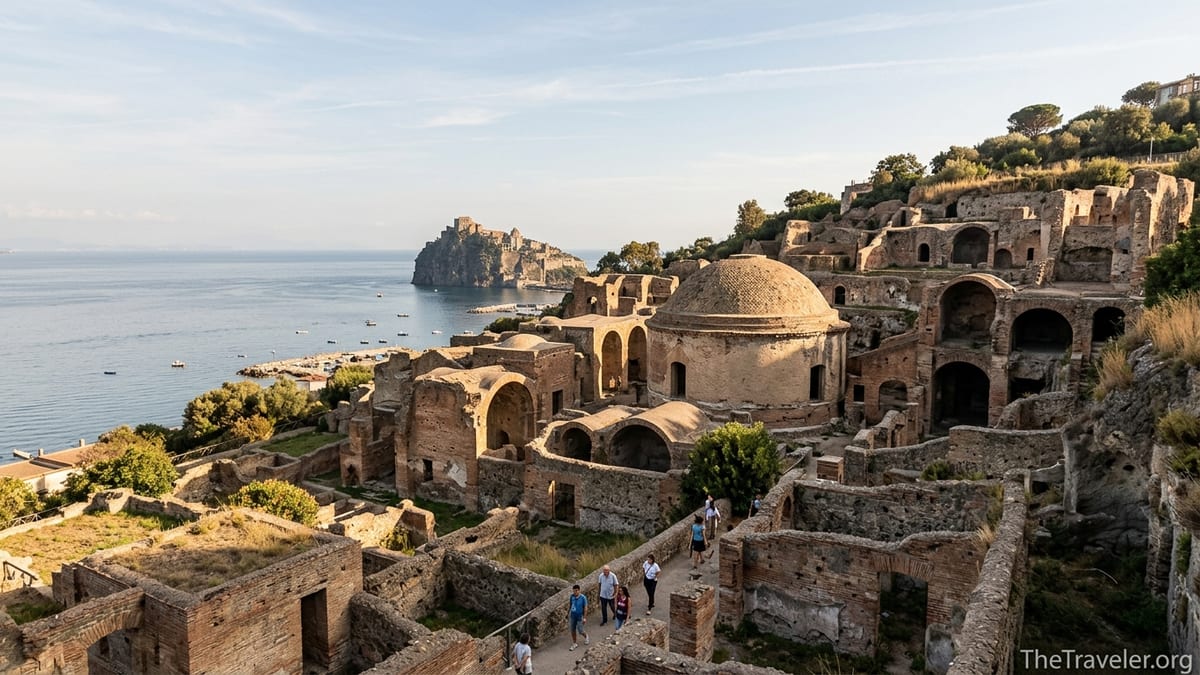
On the volcanic coast west of Naples, the Baiae Archaeological Park looks, at first glance, like a jumble of brick walls, terraces and overgrown arches. Step closer, and you realise you are standing in what was once the most exclusive resort of the Roman world, a place where emperors built sprawling villas and where the sea now covers marble mosaics and statue-lined dining rooms. For anyone curious about how Rome’s elite actually lived, schemed and relaxed, Baiae still matters in a way few sites can match.
Get the latest updates straight to your inbox!
From Imperial Playground to Archaeological Park
In antiquity, Baiae was the symbol of luxury. Perched along the Phlegraean Fields coastline between Pozzuoli and Cape Misenum, it combined thermal springs, sheltered bays and a mild climate. Ancient authors describe it as a pleasure resort filled with villas owned by the richest Romans, including Julius Caesar and later emperors. Modern research confirms that the core of today’s Parco archeologico delle Terme di Baia preserves only a slice of a much larger residential and spa complex that once extended down to the shoreline and beyond it, now under water.
For visitors today, the park is divided between the hillside thermal terraces and the Submerged Archaeological Park just offshore. On land, you walk through monumental bath complexes layered on different levels of the slope, often referred to as the “Temple of Venus,” “Temple of Diana” and “Temple of Mercury,” although archaeologists now see them as parts of elaborate private and semi-public baths rather than actual temples. Offshore, in the protected marine area at depths of roughly 5 to 13 metres, lie streets, porticoes and villa sectors preserved by the slow subsidence of the coastline caused by volcanic bradyseism.
That combination of on-land ruins and an underwater city makes Baiae a uniquely rich laboratory for understanding elite Roman life. The hilltop terraces show how the upper classes used architecture and landscape to impress guests, while the submerged quarter preserves floor mosaics, fountains and street fronts that would otherwise have been lost to modern development. Recent mapping projects using ultra-high-resolution bathymetry and 3D modelling have revealed whole villa plans, such as the grand Villa dei Pisoni and the so-called Villa con ingresso a protiro with its columned entrance and patterned floors, allowing archaeologists to reconstruct how these estates functioned day to day.
For travellers, this means that a short train ride from central Naples followed by a local bus or taxi brings you to a site where a glass-bottom boat can glide over a Roman nymphaeum while, later the same afternoon, you drift through echoing brick halls on the hillside. Few destinations compress so much of Rome’s social history into such a compact, and still relatively uncrowded, space.
What Baiae Reveals About Roman Status and Showmanship
Roman elites did not simply own villas at Baiae for peace and quiet. They built here to be seen. The terraces of the archaeological park are stacked one above another, creating sweeping views over the bay. In the Roman period, these levels would have been faced in marble, decorated with colonnades and gardens, and connected to private harbours and fish ponds on the shore. To invite a guest to Baiae was to stage a carefully choreographed experience of ascent, views, scented baths and dramatic vistas of the sea.
Concrete domes like the great circular hall of the so-called Temple of Mercury speak to this desire to impress. At over 20 metres in diameter, it is one of the largest surviving Roman domed spaces, predating the Pantheon’s famous dome in Rome. When you walk inside today, your voice bounces off the walls; imagine this space lined with coloured marble, steam curling from hot-water pools and flickering oil lamps throwing reflections onto the curved ceiling. For senators, courtiers and imperial favourites, this was a world designed to make them feel simultaneously powerful and dazzled by the architectural prowess of their hosts.
The underwater park preserves more intimate, but no less revealing, evidence. At Punta Epitaffio, the remains of a Claudian-era nymphaeum show niches arranged around a banqueting space where water once flowed from statues into channels. The original statues, now displayed at the Archaeological Museum of the Phlegraean Fields in the Aragonese Castle above Baiae, include figures such as Antonia Minor, mother of Emperor Claudius. On site, divers now swim past carefully placed replicas in the original positions, a reminder that elite dining here was framed by imperial imagery, mythological scenes and the constant sound of running water.
Booking a guided dive or snorkelling tour through a local operator in Baia or Bacoli, which as of 2026 typically costs from around 40 to 80 euros depending on whether you are snorkelling or scuba diving with full equipment rental, puts you face to face with this social choreography. You literally float along mosaic corridors where clients once approached their patrons, glide over geometric floor patterns where toasts were raised, and see how architecture channeled guests through a sequence of experiences that broadcast wealth and cultural sophistication.
Everyday Luxury: Baths, Water and Wellness Culture
Baiae was famous not just for villas but for water. The whole landscape is riddled with hot springs fed by volcanic activity, and the park’s preserved structures are essentially a hillside of baths. Walking through the complex today, you trace a path from cold rooms to warm and hot chambers, from open terraces with sea breezes to enclosed domes that trapped heat. This sequence mirrors the Roman approach to wellness, where bathing was as much about ritual, sociability and display as about hygiene.
In the so-called Temple of Venus area, large semicircular rooms with radiating niches suggest elaborate bathing suites. Hypocaust pillars, small brick stacks that once supported floors, are visible in several halls, showing how hot air from furnaces circulated beneath the marble pavement. In some sectors, you can see channels cut into walls and basins lined with waterproof mortar, physical details that ground the literary descriptions of Baiae as a spa town in real engineering solutions. Modern studies of the Villa con ingresso a protiro’s fountain and hydraulic systems in the submerged park have revealed sophisticated water-pressure management, with lead pipes feeding jets and cascades that would have dazzled bathers and dinner guests alike.
The elite Roman approach to wellness extended beyond the baths themselves. Seaside villas here often had private fish ponds, or piscinae, for breeding fish and shellfish that could be served fresh at banquets. Divers in the underwater park can see the low walls and sluice gates of these structures. On land, you can still trace channels that once brought seawater into terraced pools. When you sit at a modern café in nearby Bacoli eating seafood pasta, you are effectively consuming the same combination of hot springs, salt water and marine resources that drew Roman elites to Baiae two thousand years ago.
For modern travellers, practical wellness experiences echo this ancient culture. Many visitors pair a tour of the archaeological park with a soak at nearby modern thermal facilities in the Phlegraean Fields area, where spa centres tap similar geothermal sources. While these are contemporary, not archaeological, they give a visceral sense of why warm mineral waters remained attractive from Roman times through the modern era, and why Baiae’s hot springs were at the heart of its elite identity.
Power, Politics and Scandal on the Bay of Naples
Understanding elite Roman life is impossible without grappling with its politics, and Baiae was one of the empire’s most political landscapes. Ancient writers portray it as a place of intrigue, where alliances were made and broken far from the formal settings of the Senate and Forum. Its secluded coves, private dining rooms and lavish entertainments provided the perfect backdrop for both discreet negotiations and very public displays of influence.
Although specific stories often blur into legend, the pattern is clear: emperors and power brokers used Baiae as a safe, and pleasurable, distance from Rome. Estates like the Villa dei Pisoni, named for the powerful Piso family implicated in conspiracies under Nero, illustrate how closely villas and politics intertwined. Archaeological surveys show that this villa stretched across large terraces with direct access to the sea, a perfect setting for private gatherings out of public view. Today, the outline of the complex is partly visible on bathymetric maps and through guided snorkel routes, where you can follow the line of collapsed walls and porticoes under the waves.
The recent discovery and ongoing study of a submerged bathhouse complex that some researchers tentatively associate with Cicero’s circle adds another layer to this political geography. The structure, with its preserved mosaic floor and wall decorations, lies in shallow water and has attracted media attention for its potential link to one of Rome’s most famous orators. Whether or not that attribution proves correct, the building itself is a reminder that even intellectuals and statesmen invested in luxurious waterfront retreats where they could combine work, leisure and networking.
Standing on the park’s uppermost terrace today, looking across the bay to the headlands of Cape Miseno, it is easy to picture imperial entourages arriving by ship, guarded by the fleet once stationed nearby. Modern tour boats, many of which depart from the small harbour of Baia and sell combined tickets for land and sea visits, follow similar routes. The continuity of movement along this shoreline highlights Baiae’s long role as a space where power played out in semi-private settings. For travellers interested in the human side of empire, this context makes the archaeological remains feel less like isolated ruins and more like the backdrop for very real decisions and rivalries.
Underwater City: How Submerged Baiae Preserves Elite Spaces
The partial submergence of Baiae, caused by centuries of gradual ground sinking in the Phlegraean Fields, might seem like a tragedy for archaeology. In practice, it has preserved street fronts, mosaics and architectural details with a completeness rarely seen in coastal resorts that stayed above sea level. The underwater archaeological park, legally protected as a marine area, now covers around 177 hectares of seabed, with visible remains at depths shallow enough for guided tours.
On a typical glass-bottom boat excursion, which usually lasts around an hour and costs in the region of 25 to 35 euros per person depending on the operator and season, you drift above sections of paved road flanked by tabernae, or shops, and the entrance to villas with columned porticoes. The “Villa con ingresso a protiro,” for example, is instantly recognisable by its two-column entrance framing a doorway, and by its black-and-white geometric mosaics. Archaeologists have digitally reconstructed this residence, showing how its atrium, fountain and surrounding rooms formed a compact but highly refined household space, probably belonging to a wealthy but not necessarily senatorial family.
Divers experience a different perspective, swimming within arm’s length of floor mosaics, marble fragments and statue bases. In the Nymphaeum of Punta Epitaffio, they see replicas of statues placed exactly where the originals stood when the room was an elite banqueting space dedicated to the emperor Claudius. In other sectors, like the so-called “Portus Julius” area, submerged quays and basin walls speak to the maritime infrastructure that supported elite villas and the fleet alike. Conservation projects over the past decade have focused on stabilising mosaics and controlling biological growth on stone surfaces, so that visitors can still recognise patterns even in low-visibility conditions.
For researchers, the underwater city offers a rare opportunity to study the full relationship between shoreline villas, infrastructure and the sea. High-resolution sonar and photogrammetry have mapped not only the visible walls but also subtle features such as garden layouts and staircases leading to now-vanished upper floors. This work feeds into broader studies of Roman coastal development, including how elites balanced the desire for sea views and private harbours with the risks of erosion and seismic instability. For visitors, these same reconstructions appear in on-site panels and museum displays, helping you visualise the original grandeur of the underwater remains as you peer through a viewing window or a dive mask.
Landscape, Volcanic Forces and the Fragility of Luxury
Baiae’s setting in the Campi Flegrei, a vast volcanic caldera, is not just a dramatic backdrop; it is central to understanding why this elite landscape looked the way it did, and why so much of it ended up under water. The same geothermal forces that heated the baths gradually caused sections of the coastline to sink, a phenomenon known as bradyseism. Archaeological layers show that parts of Roman Baiae were already coping with changing sea levels in late antiquity, raising quays and walls even as the ground continued to subside.
Walking through the on-land park, you will notice how terraces are cut directly into volcanic tuff, and how the layout exploits natural ridges and bowl-shaped depressions. The great domed halls of the baths take advantage of this geology, with walls keyed into the bedrock. At the same time, the very solidity of these constructions could not save them from long-term geological change. The fact that a mosaic-lined dining room that once hosted imperial banquets now lies several metres below sea level is a powerful reminder of the fragility of even the most opulent lifestyles when set against deep-time natural processes.
Modern geological monitoring in the Phlegraean Fields, widely covered by Italian civil protection authorities and research institutes, keeps close watch on current episodes of uplift and subsidence. While these concern contemporary residents more than tourists, they also frame the visitor experience at Baiae. Interpretive panels in the park explain how the landscape has risen and fallen over millennia, inviting you to think about Roman elites investing heavily in a coastline that was never truly stable. For travellers today, it is a chance to reflect on how modern coastal luxury developments face parallel long-term challenges from sea-level change and seismic risk.
In practical terms, the volcanic context shapes your visit. Many travellers combine Baiae with nearby sites such as the Solfatara crater (when open) or Lake Avernus, both part of the same volcanic system and closely linked to Roman myth and elite villa culture. Local guides often offer full-day tours that include transport from Naples, a guided walk through the Baiae thermal park, a glass-bottom boat excursion over the submerged ruins and a stop at panoramic viewpoints where you can see how the caldera embraces the entire gulf.
Visiting Baiae Today: How Travellers Experience Elite Rome
Although Baiae is increasingly featured in travel media as an “underwater Pompeii,” it remains far less crowded than the better-known ruins around Vesuvius. From central Naples, you can reach the area by taking a regional train toward Pozzuoli or Fusaro and then a local bus or taxi to Baia or Bacoli. Many visitors opt for organised tours run by local companies, which bundle transport, archaeological park entry and boat or dive excursions into a single price, often starting around 80 to 120 euros per person for a half-day or full-day experience.
On land, the Parco archeologico delle Terme di Baia typically requires an admission ticket that can be combined with other Phlegraean Fields sites. Once inside, paths and staircases lead you through the main sectors: the great domed hall of the so-called Temple of Mercury, the terraced baths attributed to Venus, and the more secluded areas associated with Diana. Information boards in Italian and English help orient you, but hiring a licensed local guide, often available at the entrance or bookable through tour operators, adds context on how each space functioned in Roman times, who might have used it and what decorative schemes once covered the plain brickwork.
For the underwater component, you have choices. Non-divers can join glass-bottom boat or semi-submersible tours that depart from Baia’s small harbour. These boats have underwater viewing galleries or glass panels that let you look sideways at walls and floors instead of just down at them. Snorkellers and divers book through operators such as dive centres in Baia, Bacoli or Pozzuoli, which provide gear, guides and briefings on both safety and heritage protection. As of 2026, it is standard to require advance reservations in high season, especially for weekend dives, because the marine park strictly limits visitor numbers on each site to reduce environmental impact.
Staying nearby deepens the experience. Small hotels and guesthouses in Bacoli and Baia overlook the harbour and the castle that now houses the Archaeological Museum of the Phlegraean Fields. Spending a night here rather than rushing back to Naples allows you to visit the hillside park in the cooler morning, take an afternoon boat tour over the submerged city and then wander up to the castle museum before sunset. Exhibits there include the original statues from Punta Epitaffio and other finds from submerged villas, letting you see masterpieces in a controlled environment and then mentally slot them back into the spaces you have just explored in person.
FAQ
Q1. Where exactly is Baiae Archaeological Park, and how do I get there from Naples?
Baiae Archaeological Park is in the Phlegraean Fields area, near the town of Bacoli west of Naples. From central Naples you can take a regional train toward Pozzuoli or Fusaro, then continue by local bus or taxi to Baia. Many travellers also book organised tours that include direct minivan transport from Naples hotels.
Q2. What is the difference between the hillside park and the submerged archaeological park?
The hillside Parco archeologico delle Terme di Baia preserves terraced bath complexes and villa structures above ground, while the Submerged Archaeological Park of Baiae protects the parts of the ancient city that sank below sea level. On land you walk through vaulted halls and domes; offshore you view streets, mosaics and villa sectors by glass-bottom boat, snorkelling or scuba diving.
Q3. Do I need to be a certified diver to see the underwater ruins at Baiae?
No. Certified divers can book guided dives, but non-divers can still experience the underwater city via glass-bottom boats, semi-submersible tours or guided snorkelling in shallow areas. These options are designed for visitors with little or no previous experience and include life jackets and briefings.
Q4. What kind of remains from elite Roman life can I actually see with my own eyes?
Visitors can see monumental domed bath halls, terraced pools, hypocaust heating systems, mosaics with geometric patterns, entrances framed by columns, nymphaea with statue niches and the outlines of private fish ponds. In the museum at the Aragonese Castle above Baiae you can view original marble statues and decorative pieces recovered from submerged villas.
Q5. How much time should I plan for a visit to Baiae Archaeological Park?
If you only visit the hillside thermal park, two to three hours is usually enough. To combine the land site with a glass-bottom boat tour or a dive in the submerged park, plan at least a half day. Many travellers allocate a full day to include the castle museum and a relaxed meal by the harbour.
Q6. Is Baiae suitable for travellers who are not very mobile or who travel with children?
The hillside ruins involve many stairs and uneven paths, which can be challenging for visitors with limited mobility. However, glass-bottom boat tours are generally accessible and popular with families, as children can see mosaics and walls under water without swimming. It is best to check accessibility details with operators and the park in advance.
Q7. When is the best time of year to visit Baiae for good visibility and comfortable weather?
Spring and early autumn often offer a good balance of mild air temperatures, lighter crowds and decent water clarity. In high summer, heat on the terraces can be intense but sea conditions are usually calm. Winter visits are possible on land but some boat and dive operations may reduce schedules depending on weather.
Q8. Do I need to book tours for the submerged park in advance?
Advance booking is strongly recommended, especially from late spring through early autumn and on weekends. The marine protected area limits the number of boats and divers at each site, so operators often fill time slots several days ahead in high season.
Q9. What can Baiae tell me that places like Pompeii or Herculaneum do not?
While Pompeii and Herculaneum show everyday urban life frozen by a sudden eruption, Baiae focuses on elite leisure and power at a coastal resort. Its combination of vast bath complexes, luxury villas and underwater remains offers a detailed look at how the richest Romans used architecture, water and landscape to signal status and conduct politics away from the capital.
Q10. Is it possible to visit Baiae and the wider Phlegraean Fields as a day trip from Naples?
Yes. Many visitors come on a day trip, especially by organised tour that combines transport, a guided walk through the thermal park and a boat excursion. However, staying overnight in Bacoli or Baia lets you explore at a slower pace, visit the castle museum and enjoy the evening views over the bay.