


The first time I walked through Rione Terra in Pozzuoli, I expected another quiet historic quarter on a hill above the sea. Instead, I found myself inside a living cross-section of Campania’s past: a Roman port city frozen beneath my feet, a Renaissance acropolis above my head, and the restless ground of the Campi Flegrei caldera always subtly shaping the story. More than Pompeii or Herculaneum, this compact headland made ancient Campania feel disarmingly real, layered and still very much part of everyday life.
Get the latest updates straight to your inbox!
From Modern Pozzuoli to the Ancient Acropolis
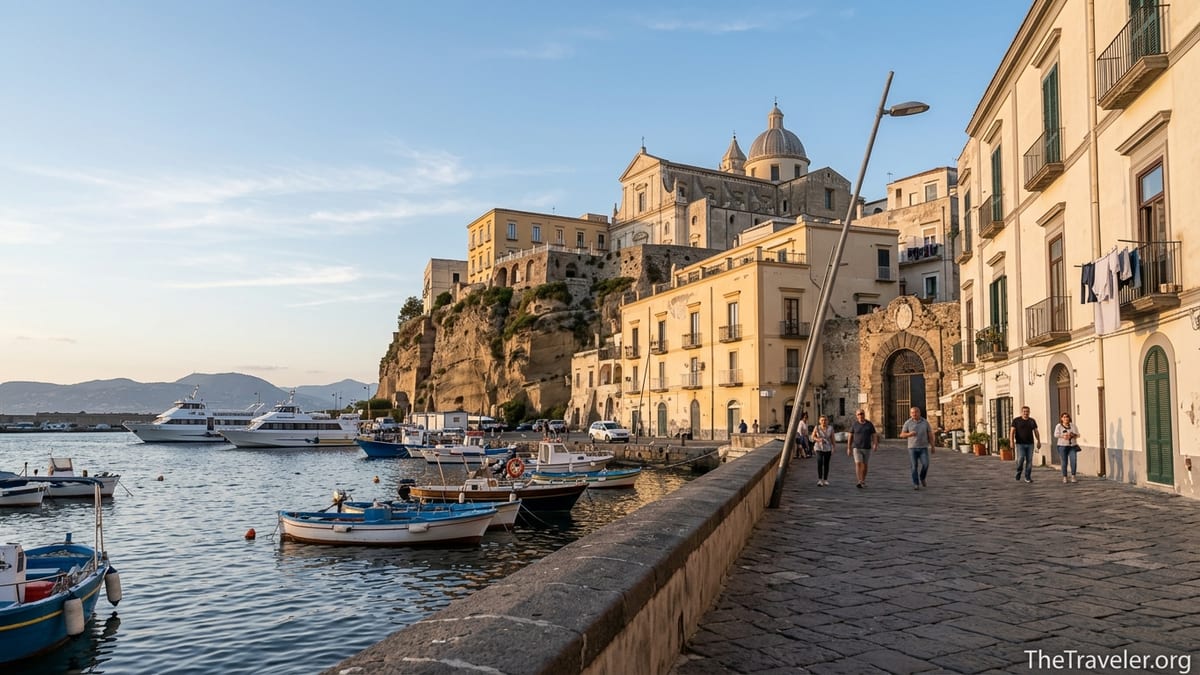
The approach to Rione Terra begins down at the working port of Pozzuoli, where hydrofoils to Ischia and Procida share the quay with fishing boats unloading plastic crates of cuttlefish and anchovies. From Piazza della Repubblica, the ochre-colored rock of the Rione Terra headland rises abruptly, crowned by the cathedral that today dominates the skyline. It is a short walk, ten minutes at most, but it feels like a small pilgrimage from the contemporary city into its oldest core.
Today, visitors usually reach the top via a gently sloping road or the recently installed elevator that links the modern seafront with the historic acropolis above. The lift, inaugurated only in the last few years, turns what was once a steep climb into an easy transition, especially welcome in the heat of a Campanian afternoon. Stepping out, you arrive in a restored piazza edged with palazzi that still bear the coats of arms of local noble families, their stucco facades hiding a much older skeleton of Roman stone.
What makes this first view striking is the silence. Unlike the constant murmur at Naples’ historic sites, Rione Terra remains relatively uncrowded. On a late spring morning, I shared the streets mainly with local residents heading to the port, a pair of archaeology students carrying tripods, and a guide unlocking the door of the small infopoint in the former Sedile dei Nobili. The scale is intimate enough that you can immediately imagine this as a self-contained town, perched above the sea, layered with almost three millennia of occupation.
Before you even descend underground, there are clear traces of that long continuity. A few steps from the main square, fragments of earlier city walls and tufa blocks emerge between later masonry. A balcony on Palazzo Migliaresi overlooks the entire Bay of Pozzuoli, from the hulking outline of the Solfatara crater to the distant curve of Capo Miseno, making it easy to understand why the Greeks first chose this headland in the sixth century BC and why the Romans later turned Puteoli into the principal commercial port of Campania.
Descending Into the Underground Roman City
The real revelation of Rione Terra begins when you join the guided tour of the underground archaeological route, accessed through a door that feels almost too modest for what lies behind it. Visits are organized in small groups with timed entries, typically clustered on weekends and holidays, and must be accompanied by an official guide. Before entering, the staff briefly explains the rules: no wandering off, watch your head at low arches, and expect some uneven floors and cool temperatures even in the height of summer.
Almost immediately, you leave the modern world behind. A short staircase leads down into a grid of Roman streets preserved beneath the later buildings. What appears above ground as a compact Renaissance quarter is, below, an entire slice of the ancient colony of Puteoli: narrow decumani paved with worn stone slabs, shop fronts with thresholds still intact, and storage rooms whose amphorae impressions remain visible in the mortar floors. The overhead lighting is kept deliberately soft, enough to see by but never harsh, so that your eyes adjust slowly to the underground twilight.
One of the most evocative stretches passes former tabernae, the Roman shops that once lined a busy commercial street. In one, the outlines of grinding stones for grain are still clearly visible, giving a sense of the daily rhythm of bakers preparing bread for dockworkers above. Another space shows traces of counters and built-in dolia, those large earthenware jars that would have stored oil or wine. Listening to the guide explain how merchants from across the Mediterranean unloaded amphorae into these rooms, it is easy to picture longshoremen climbing up from the harbor while you now walk where their cellars once stood.
Elsewhere, a series of vaulted corridors and cryptoporticoes reveal how the Romans tamed the tufa rock to create level terraces for the acropolis. Some sections are still blackened by ancient smoke or stained with the mineral traces of centuries of slow water seepage. Unlike the open-air ruins of Pompeii, this underground city feels almost continuous, more akin to slipping behind the scenes of a functioning town. Above your head, the modern palazzi and the cathedral rest directly on the Roman fabric, a literal layering that the guides are quick to point out with laser pens on exposed cross-sections of masonry.
Living on a Restless Volcano: Bradyseism Made Visible
Walking through Rione Terra is also walking on the edge of an active volcanic system. Pozzuoli lies at the heart of the Campi Flegrei caldera, where the ground itself slowly rises and falls in cycles of bradyseism. You can read scientific papers about this phenomenon, but it is another thing to see how it has shaped an entire city. Guides often gesture seaward toward the Macellum, the so-called Temple of Serapis near the modern harbor, whose marble columns carry visible borings from marine molluscs several meters above today’s waterline, tangible proof of centuries of subsidence and uplift.
Inside the underground route, bradyseism becomes a practical subject as well as a geological one. Passages are regularly monitored, and recent reinforcement work and careful routing of visitor paths reflect an awareness that this is not a static ruin. In a few spots, explanatory panels mention the twentieth-century episodes when Pozzuoli rose by more than a meter in a matter of years, cracking buildings and ultimately pushing authorities to evacuate the entire Rione Terra in 1970. It is impossible to linger in a cool, vaulted Roman alley without thinking about how the very ground has flexed beneath it over two thousand years.
Outside, evidence of this dynamic landscape is woven into the everyday urban fabric. Looking back from the parapet near the cathedral, you can see the stepped alignment of modern waterfront buildings adjusted to shifting ground levels, and slightly tilted doorways on older structures closer to the port. Locals talk about the latest small tremors the way others might discuss the weather, a quiet but constant reminder that this headland is a vantage point into both deep time and very current geological change.
For travelers used to associating ancient Campania solely with the explosive drama of Vesuvius and Pompeii, Rione Terra offers a slower, more intimate narrative of earth processes. Here, the story is not a single catastrophic eruption freezing a city in time, but rather the patient oscillation of land and sea, alternately drowning and exposing harbors, damaging houses, and forcing communities to adapt, move, and eventually return.
The Human Story of Evacuation, Abandonment and Return
One of the most striking aspects of Rione Terra is that its modern history is as dramatic as its ancient past. On 2 March 1970, as bradyseismic uplift accelerated and fear of a potential eruption grew, authorities ordered the evacuation of the entire quarter. Roughly five thousand residents were removed in a matter of days, many escorted by soldiers, leaving furniture, family photographs and everyday objects behind. Within weeks, what had been a dense, working-class neighborhood became a silent acropolis, its windows shuttered and streets empty.
Stories from that period still circulate in Pozzuoli. Elderly locals recall watching convoys of trucks carrying household goods toward temporary housing blocks on the outskirts of Naples. Some remember sneaking back toward the Rione in the years that followed, hoping to retrieve possessions, only to find doors sealed and guards posted. While the feared eruption never came, the district remained off-limits for decades, damaged further by the 1980 Irpinia earthquake and later bradyseismic episodes. It effectively became an urban ghost town perched above an active harbor.
Paradoxically, that abandonment created the opportunity for the extensive archaeological investigations that underpin today’s visitor experience. With residents gone, archaeologists were able to explore under palazzi and courtyards, gradually uncovering the buried Roman city that had always supported the later layers. The underground route that now feels so coherent was pieced together room by room and tunnel by tunnel. It opened to the public in the early 2000s and has continued to expand as new sections are stabilized and interpreted.
Walking those streets now, with audio explanations describing bakeries, workshops and storage rooms, it is hard not to think about the families who lived directly above them in the twentieth century. Rione Terra becomes less an abstract archaeological site and more a palimpsest of real lives: Roman merchants handling grain contracts for Rome, medieval clergy crossing between episcopal buildings, seventeenth-century noble families overseeing their estates, and modern dockworkers heading down toward the ferries. For a traveler, that continuity makes ancient Campania feel vivid and inhabited rather than distant and museum-like.
Architecture Above: Cathedral, Palazzi and Sea Views
Emerging from the underground city, the upper Rione Terra feels both familiar and slightly re-enchanted. At the highest point stands the cathedral, a building that encapsulates the district’s layered identity. The church incorporates the remains of a Roman temple dedicated to Augustus, and within its restored interior you can see fluted columns and fragments of ancient entablature side by side with Baroque and contemporary interventions. For those who join combined tours run through local cultural associations, visits often include the cathedral, diocesan museum spaces, and additional underground chambers beneath episcopal buildings.
The streets around the cathedral are lined with palazzi that once belonged to noble families such as the de Fraja-Frangipane and the Russo, many of them carefully restored after decades of neglect. Their portals display carved stone coats of arms; in some courtyards, you can still make out the outlines of wells and cisterns that served the households when the Rione functioned as a self-contained civic and religious center. A section of the Sedile dei Nobili has been repurposed as an infopoint where visitors can book guided visits or ask about temporary art events and concerts sometimes held in Palazzo Migliaresi.
One of the great pleasures of visiting Rione Terra is simply standing at its lookout points. From the terraces near Palazzo Migliaresi, the view sweeps across the entire bay: ferries tracing white wakes toward the islands, the circular form of the Flavian Amphitheater inland, and the volcanic cones that mark the Campi Flegrei landscape. On clear winter days, the air is sharp enough that you can distinguish individual stairways on the far cliffs, while in summer an evening haze softens the outlines into pastel bands of blue and gold.
Despite the ongoing restoration, the quarter retains a sense of quiet. A few small bars and cafes on the edge of the headland cater mainly to locals who come up for the views at sunset or after Mass. Prices for an espresso or a glass of house wine are usually comparable to what you would pay in central Pozzuoli, making it easy to linger without feeling you have entered a tourist enclave. The combination of monumental setting and everyday informality reinforces the feeling that this is still part of a living city, not a detached open-air museum.
Practical Tips: How to Visit Rione Terra Today
For travelers based in Naples, Rione Terra is one of the easiest deep-time excursions you can make without a car. Frequent suburban trains connect the city to Pozzuoli in roughly 30 minutes, and from the station it is a short walk through the modern center to the port and then up toward the headland. Some visitors combine the Rione with the nearby Flavian Amphitheater and the Macellum on a relaxed day trip, allowing time for a seafood lunch at one of the trattorie along the waterfront.
The underground archaeological route operates on scheduled, guided tours, typically on weekends and public holidays with fixed entry times spread across the morning and afternoon. Because arrangements and opening days can change due to ongoing restoration or seismic monitoring, it is important to check the latest information on official regional culture or municipal tourism channels shortly before your visit. Many travelers choose to reserve in advance through local booking platforms or by contacting the infopoint, especially during spring and autumn when school groups and Italian visitors are frequent.
Tour prices are generally modest compared with the major Campanian sites. Entry for the underground route tends to be in the low two-digit euro range per adult, with concessions for students and seniors and sometimes combined tickets available that include the cathedral and related sites under the umbrella of cultural projects often branded locally as Puteoli Sacra. English-language tours are not guaranteed at every time slot, so if language is important, it is worth specifying your preference when reserving or opting for a private guide.
Conditions in the underground section are cool and slightly damp throughout the year, with uneven paving in places. Closed shoes with good grip are advisable, and travelers with limited mobility should check access conditions in advance, since some staircases are narrow and there may be step-free alternatives only on certain sections. Above ground, the new elevator eases the climb, but the historic streets themselves still involve cobblestones and gentle slopes, typical of a compact Italian acropolis.
Rione Terra in the Wider Landscape of Ancient Campania
Experiencing Rione Terra changes the way you see other sites in Campania. After walking its underground streets, a visit to Pompeii or Herculaneum feels less like stepping into an isolated tragedy and more like visiting different neighborhoods of a single, sprawling ancient world. Puteoli was once Rome’s principal gateway to the Mediterranean, a commercial hub that handled grain shipments from Egypt and goods from across the empire. Standing in a Roman storage room beneath Pozzuoli’s cathedral, you can imagine the same cargoes that passed through the warehouses excavated today near the Bay of Naples and the Tiber mouth at Ostia.
It also reframes the modern suburbs and port infrastructure you see from the train windows between Naples and Pozzuoli. Industrial silos, shipyards and apartment blocks sit on land that has been rising and falling for millennia, reshaping shorelines and redirecting trade. When you later stroll the seafront at Baia or gaze toward Capo Miseno, the volcanic silhouettes around you read less like picturesque hills and more like the rims of ancient craters, each with its own impact on how people settled, built and worshipped.
For travelers planning a longer stay in the region, Rione Terra can be a pivot point for exploring the wider Campi Flegrei area. From Pozzuoli you can reach the Archaeological Museum of the Phlegraean Fields in Baia, where statues and inscriptions found beneath Rione Terra are displayed in a former Renaissance fortress. You can continue to the submerged ruins of Baiae, the dramatic caldera wall near Monte di Procida, or the acropolis of Cumae. In each of these places, echoes of what you saw under Rione Terra reappear: similar paving stones, comparable shop layouts, and the same uneasy coexistence between human architecture and restless ground.
In that sense, walking through Rione Terra is less a stand-alone sightseeing stop and more an introduction to how ancient Campania actually worked. It shows a port city not at the moment of catastrophic destruction but in the middle of a very long, ongoing conversation with its landscape, one that continues to this day as scientists monitor seismic swarms and urban planners debate how best to protect residents while preserving irreplaceable heritage.
The Takeaway
Leaving Rione Terra, I found it hard to shake the feeling that I had not just visited a historic site but stepped briefly into a cross-section of Campania’s entire story. Few places compress so much into such a small area: a Greek acropolis, a thriving Roman port, a medieval bishop’s seat, a seventeenth-century noble quarter, a twentieth-century disaster zone, and a carefully managed archaeological project, all occupying the same tufa headland above the bay.
What makes it memorable is how tangible that layering becomes underfoot. In the underground streets, wheel ruts and shop thresholds are close enough to touch. Above, palazzi that once housed local elites stand over the voids of Roman warehouses, and the cathedral fuses an imperial temple with centuries of Christian devotion. Even the slow heaving of the caldera, expressed in cracks, tilted doorways and seawalls repaired again and again, becomes part of the narrative.
For travelers who want ancient Campania to feel less like a series of postcard ruins and more like a lived-in landscape, Rione Terra is worth weaving into any itinerary around Naples. It is intimate where larger sites can feel overwhelming, and it offers something rarer than spectacular collapse: the chance to see how a city negotiates with deep time, not just once, but over and over again.
FAQ
Q1. Where exactly is Rione Terra and how do I get there from Naples?
Rione Terra is the historic headland above the port of Pozzuoli, west of Naples. From central Naples you can take a suburban train to Pozzuoli in about half an hour, then walk ten to fifteen minutes through the modern town to the base of the hill and either follow the sloping road or use the elevator to reach the top.
Q2. Do I need to book a tour in advance to visit the underground archaeological route?
The underground route is only accessible on guided tours with fixed entry times, and visitor numbers are limited, especially on weekends and holidays. While same-day spots are sometimes available, it is wise to reserve in advance through official culture or tourism channels or by contacting the local infopoint, particularly in spring and autumn.
Q3. How long does a typical visit to Rione Terra take?
The underground tour generally lasts around one to one and a half hours, depending on the route and language. If you add time to explore the upper streets, visit the cathedral and enjoy the viewpoints, plan for at least half a day in Pozzuoli, which also leaves space for a relaxed meal along the waterfront.
Q4. What should I wear and bring for the visit?
Wear comfortable, closed shoes with good grip because the underground paving is uneven and can be slightly slippery. The temperature below ground is cool even in summer, so a light layer is useful, and a small bottle of water and compact camera are practical; large backpacks may need to be left or carried carefully in narrow passages.
Q5. Is Rione Terra suitable for children and less-experienced travelers?
Yes, provided everyone is comfortable with dimly lit spaces and a few staircases. Children often enjoy the “hidden city” feel of the underground route, and guides are used to adapting explanations. For very young children or anyone with mobility or balance issues, it is best to inquire in advance about current access arrangements and possible limitations.
Q6. How does Rione Terra compare with better-known sites like Pompeii?
Rione Terra is far smaller and quieter than Pompeii, with visits focused on one compact acropolis rather than a sprawling city. Instead of open-air streets frozen by a single eruption, you explore an underground section of a port that evolved for centuries and was later buried under later buildings, which gives a strong sense of continuity between ancient and modern Campania.
Q7. Can I visit the cathedral and museum spaces as part of the same trip?
In many cases, yes. Local cultural initiatives often offer combined visits that include the underground route, the cathedral built around the ancient temple of Augustus and adjoining museum or diocesan spaces. Availability and formats can change, so it is advisable to check current offerings and book the combination that best fits your interests and time.
Q8. Are there places to eat or have a drink near Rione Terra?
Immediately around the headland you will find a handful of small bars and cafes where locals stop for coffee or an aperitivo while enjoying the view. Just below, around the port and Piazza della Repubblica, there is a wider choice of trattorie and pizzerie serving seafood, classic Neapolitan dishes and simple snacks at prices comparable to the rest of Pozzuoli.
Q9. Is it safe to visit given the volcanic activity at Campi Flegrei?
Rione Terra operates under continuous monitoring by Italian civil protection and scientific agencies, and public access reflects the current safety assessments. While Campi Flegrei is an active caldera and minor tremors are not unusual, tours and opening times are managed with caution; if conditions change, authorities can temporarily adjust or suspend visits.
Q10. When is the best time of year and day to explore Rione Terra?
Spring and autumn offer comfortable temperatures, clearer views and generally fewer crowds than peak summer, making them ideal for combining the underground route with walks around the headland. Within a day, early morning and late afternoon tend to be quieter for tours, and sunset from the upper terraces is particularly atmospheric when the bay and surrounding volcanoes are gently backlit.