


Perched on a tufa cliff above the Bay of Pozzuoli, Rione Terra looks timeless at first glance: a compact maze of pastel facades, a cathedral crowning its crest, fishing boats gliding below. Yet this small district west of Naples is one of Italy’s most dramatic stories of abandonment and rebirth. Over the past half century, Rione Terra has transformed from a crumbling, evacuated quarter into a meticulously restored acropolis and archaeological site that lets visitors walk through three millennia of urban life layered one above the other.
Get the latest updates straight to your inbox!
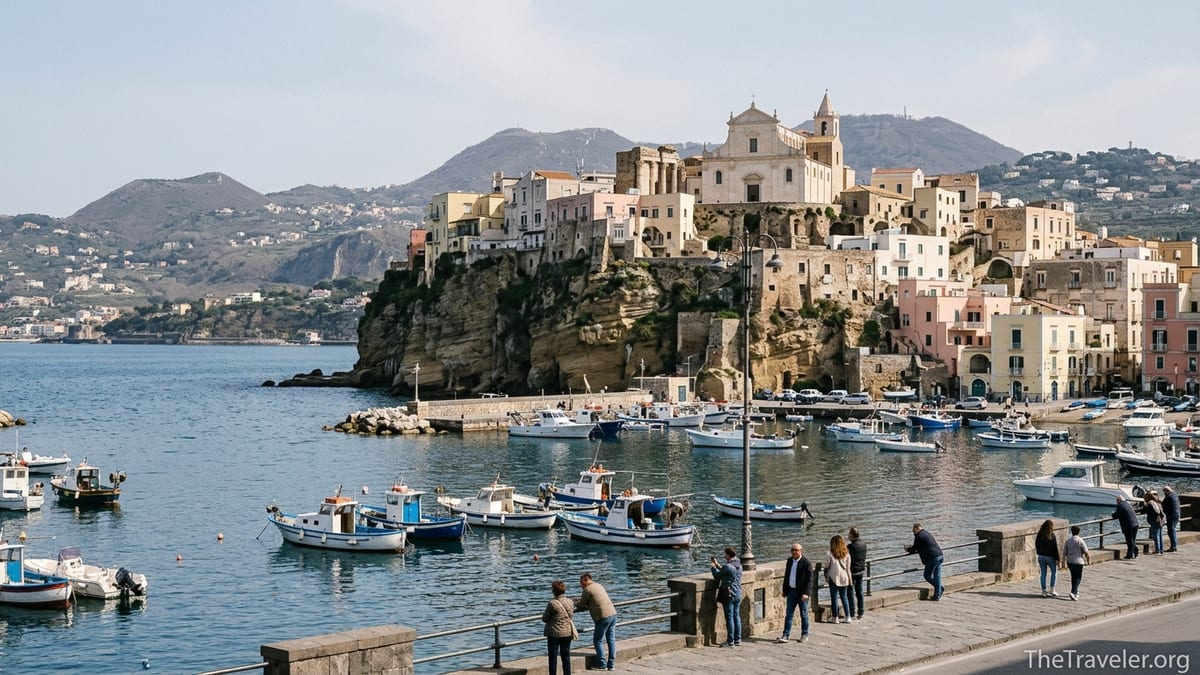
From Greek Outpost to Roman Powerhouse on the Bay
Long before the word “Rione” appeared on maps, this rocky headland was the heart of a bustling port. The Greeks likely founded a settlement here in the 6th or 5th century BC, choosing the cliff for its natural defense and easy access to the sheltered bay. Later, under Roman rule, the town became Puteoli, a key commercial gateway for goods flowing into imperial Rome. When you stand on today’s panoramic terrace and look down towards the harbor, it takes little imagination to picture Roman ships crowding the waterfront, their cargoes of grain, wine, and luxury goods bound for the capital.
The Romans reshaped the headland into a proper acropolis. Beneath today’s streets runs a grid of ancient decumani and cardines, lined with shops, warehouses, and workshops. Archaeological excavations have revealed tabernae with counters still in place, storage rooms for amphorae, and paved lanes where cart ruts remain visible. On a guided visit to the underground percorso archeologico, travelers walk eye-level with these remains, almost as if they had stepped out of modern Pozzuoli and dropped four meters down into 1st-century Puteoli.
At the summit, where the Cathedral of San Procolo now stands, the Romans built a grand temple dedicated to Augustus. Centuries later, this temple was converted into a Christian basilica. Inside the cathedral today, visitors can see how baroque chapels and marble altars were woven into the ancient colonnade, a rare place where imperial cult and Counter-Reformation piety still share the same walls. The layering of functions on this small promontory is the essence of Rione Terra’s story: every era reused what came before rather than starting afresh.
Through the Middle Ages and the early modern period, the acropolis remained the city’s core. Narrow lanes wound between modest houses and noble palazzi; the Bishop’s Palace and civic buildings occupied the cliff’s edge. Fishermen, craftsmen, and merchants lived within the walls, climbing up and down the steep alleys that connected the upper town with the port. Until the late 20th century, Rione Terra was not a museum piece but a densely inhabited neighborhood, its buildings patched and repatched over earlier Roman and medieval fabric.
The Day the Ground Rose: Bradyseism and the 1970 Evacuation
Rione Terra’s modern history cannot be understood without bradyseism, the slow rise and fall of the ground caused by volcanic activity in the Campi Flegrei caldera. Pozzuoli sits inside this restless landscape. Around the harbor, the famous Roman Macellum, often called the Temple of Serapis, bears deep borings from marine mollusks several meters up its marble columns, clear evidence that the land has sunk below sea level and risen again more than once.
In the late 1960s, the ground in Pozzuoli began to lift once more. Small earthquakes multiplied, cracks opened in buildings, and pavements buckled. Between 1969 and 1972, the town rose by well over a meter in places, with the most pronounced movement beneath the historic center and the port. Civil protection authorities watched Rione Terra with particular concern: many houses were already fragile, with centuries of ad hoc alterations and limited maintenance, and their foundations rested on ancient structures not designed for modern loads.
On 3 March 1970, the government ordered the complete evacuation of Rione Terra as part of a broader emergency plan for the lower parts of Pozzuoli. Nearly three thousand residents were moved out in a matter of days, some bussed inland under military supervision, others resettled in new apartment blocks in the Toiano district above town. Many had lived in the same narrow streets for generations. Oral histories recall families given little time to pack, elderly residents bewildered at being told they could not return, and shopkeepers locking their doors without knowing if or when they would reopen.
The evacuation saved lives in a zone at real geological risk, but it also tore the social fabric. For years afterward, Pozzuoli’s new housing estates were filled with former Rione Terra families trying to adapt to high-rise life. Down on the headland, shutters remained closed, plaster peeled, and vegetation pushed through cracked masonry. The citadel that had once been the beating heart of the town now stood empty, scarred by bradyseism and abruptly cut off from everyday life.
Decades of Silence and the Slow Start of a Comeback
After the evacuation, Rione Terra entered a long limbo. In 1964, a devastating fire had already damaged the cathedral and nearby buildings; the bradyseismic crisis compounded that destruction and halted restoration. A second intense episode of ground uplift in the early 1980s, which triggered the temporary evacuation of tens of thousands more residents in greater Pozzuoli, kept authorities cautious about investing heavily in the abandoned acropolis. For much of the late 20th century, Rione Terra remained off-limits, visible from the seafront promenade yet largely inaccessible.
Behind the scenes, though, archaeologists and engineers were slowly reassessing the site. Surveys documented not only structural damage but also the extraordinary preservation of the Roman city locked below. Where modern houses had been removed or were too damaged to salvage, excavations revealed entire stretches of ancient street under later flooring. In some cellars, workmen broke through to barrel-vaulted corridors whose last inhabitants had been Roman shopkeepers nearly two thousand years earlier.
In the 1990s and early 2000s, a comprehensive program of consolidation began. Because bradyseism can cause both uplift and subsidence over time, engineers opted for flexible solutions: deep foundations where possible, lightweight materials in reconstructions, and careful monitoring of deformation. Funding came in stages, often tied to broader initiatives to revitalize the Campi Flegrei area. Progress felt slow on the ground; locals could see scaffolding and cranes, yet the gates to the citadel remained mostly closed.
A turning point for public perception came with the opening of the underground archaeological route in the early 2000s. For the first time, small groups of visitors could book guided tours that led them into the heart of Roman Puteoli beneath the evacuated quarter. Reviews from early travelers describe a sense of astonishment: after years of hearing Rione Terra spoken of only in terms of risk and decay, they discovered a remarkably intact ancient city, cool and quiet under the restored streets where no one yet lived.
A Layered City Revealed: Walking the Underground Archaeological Route
Today, the percorso archeologico del Rione Terra is one of Campania’s most atmospheric archaeological experiences. Access is typically by guided tour at set times, often on weekends and public holidays, with small groups escorted by licensed guides. Prices fluctuate but are generally in line with other regional sites: travelers can expect to pay a modest ticket comparable to a mid-range museum in Naples, with discounts for children and students. Because schedules change in response to ongoing monitoring of seismic activity, it is wise to confirm hours locally a few days before visiting.
The route winds through a honeycomb of vaulted corridors and rooms that formed the commercial and service core of Roman Puteoli. Visitors pass tabernae whose countertops still bear circular cuts where large jars once sat, traces of painted wall decoration, and drainage channels running along basalt paving. In some stretches, modern walkways are elevated above the ancient street so you can clearly see the stratigraphy: heavy Roman foundations at the bottom, medieval rebuilds above, and 19th-century brickwork closest to the surface.
Guides often pause at a crossroads where the light filters down through small openings, explaining how the modern houses that once rose above were essentially perched on a Roman skeleton. This explains both the vulnerability of the quarter during bradyseismic crises and its scientific value today. For archaeologists, Rione Terra offers a rare three-dimensional section through an uninterrupted urban history. For travelers, it is a tangible lesson in how cities grow layer by layer and how geological forces can abruptly expose what time had concealed.
An especially evocative section runs under the former Palazzo Migliaresi, once the town hall and now a venue for cultural events. Here, barrel vaults and storerooms illustrate the logistics that kept the port economy turning: amphorae stacked in rows, goods moved in and out of warehouses carved into the cliff. Standing there, with the distant sound of waves and the muffled echo of your own footsteps, it is easy to imagine the clatter of carts and the shouted orders of dockworkers coming up from the harbor two millennia ago.
The Reborn Citadel: Cathedral, Palazzi, and Panoramic Piazzas
While the underground tells the story of ancient Puteoli, the surface of Rione Terra today showcases a careful, often understated restoration of the post-Roman town. The goal has not been to recreate a picturesque theme park but to stabilize and revive the acropolis as a civic and cultural space. Visitors arriving from the modern city climb through a controlled entrance, emerging onto a network of clean, largely car-free lanes lined with pastel buildings whose facades have been repaired yet still show the irregularities of centuries of adaptation.
At the highest point stands the Cathedral of San Procolo Martire, reopened after extensive restoration that followed both the 1964 fire and decades of bradyseismic uncertainty. Inside, the integration of the ancient Augustan temple is immediately visible: huge marble columns frame the nave, and the restored spaces allow glimpses down to earlier levels. For architecture and art history enthusiasts, the cathedral is a rare chance to see Roman, baroque, and contemporary conservation techniques in direct dialogue under one roof.
Nearby, Palazzo Migliaresi has been converted into a cultural venue and viewpoint. Its terraces look straight over the harbor, across the bay to the islands of Ischia and Procida, and back toward the smoking cone of Vesuvius on clear days. Travelers often time their visit to coincide with late afternoon, when the sun drops behind the Campi Flegrei hills and the façades of Pozzuoli’s seafront glow soft orange. Compared with the bustle of central Naples, the atmosphere up here is remarkably tranquil, especially outside of peak summer weekends.
Not every building has been fully reoccupied, and some areas remain under controlled access, a reminder that Rione Terra is a work in progress. Yet cafés and wine bars are slowly reappearing around the base of the acropolis and along the modern waterfront below. It is increasingly common to combine a late-morning underground tour with a long seafood lunch in the port district, where restaurants serve the catch landed just meters away: grilled local fish, pasta with clams from the bay, and house wines from the volcanic slopes inland.
Living with a Supervolcano: Risk, Memory, and Everyday Life
Rione Terra’s transformation is as much social and psychological as it is architectural. The evacuation of 1970 and the broader displacements of the 1980s remain vivid in local memory. Many Pozzuolesi can point to a balcony or doorway in the citadel and tell you which relative once lived there before moving to Toiano or other modern districts. Guided tours sometimes touch on these stories, not only as background but as part of the ongoing conversation about what it means to live above an active caldera.
The Campi Flegrei system has entered renewed phases of uplift and seismic unrest multiple times since the early 2000s. Recent scientific studies note ground rise in and around Rione Terra measured in tens of centimeters over the last two decades, leading authorities to keep strict building codes and real-time monitoring in place. For visitors, this means occasional closures or adjusted visiting hours when seismic swarms occur, as safety protocols take priority. For residents of greater Pozzuoli, it is a reminder that the city’s prosperity and risks are forever linked to the restless ground beneath their feet.
Yet everyday life continues around these concerns. Families stroll the waterfront promenade in the evening, children fish off the quay, and commuters ride the metropolitan train line into Naples. The restored acropolis has given Pozzuoli a powerful symbol of resilience: a place where the community can showcase its history rather than be defined only by hazard maps and emergency drills. Local festivals and cultural events increasingly use Rione Terra as a stage, projecting light installations onto its façades or hosting open-air concerts in its courtyards.
For travelers, visiting Rione Terra offers a window into this coexistence with risk. Unlike the frozen tragedy of Pompeii, where time stopped in a single eruption, Pozzuoli’s story is ongoing. The people you meet in cafés or on the pier are not distant descendants but often the very individuals who lived through evacuation and return. As you stand on the panoramic terrace and feel a sea breeze off the bay, it is striking to realize that this seemingly solid cliff is, geologically speaking, a moving platform.
Planning a Visit: Practical Tips for Today’s Traveler
Rione Terra sits a short walk uphill from the modern port of Pozzuoli, reachable from central Naples in under an hour by regional train or metropolitan line. Many independent travelers arrive on a morning train, visit the Macellum (Temple of Serapis) ruins near the station, then continue on foot through the waterfront quarter to the base of the acropolis. The climb to the entrance is steep but relatively short; comfortable shoes and water are advisable, especially in the summer months when shade is limited on some stretches.
Because visitor access is closely managed, advance planning pays off. Guided tours of the underground archaeological route typically operate in specific time slots, more frequently on weekends and Italian public holidays. It is common for departures to be grouped by language, with Italian and English the most widely available. As schedules and booking procedures can change in response to seismic monitoring and staffing, travelers should check the latest information from local tourism offices or on-site infopoints in Pozzuoli shortly before their trip, rather than relying on years-old brochures or third-party websites.
Ticket prices for the underground route are usually modest compared with major sites like Pompeii and can represent good value given the small-group format and specialist guiding. Combined tickets with other Campi Flegrei attractions, such as the archaeological park at Baia or the Flavian Amphitheatre in Pozzuoli, are sometimes available through regional cultural passes. Many visitors find that half a day is enough for the underground tour and a slow wander around the restored streets and cathedral, though photography enthusiasts and history buffs may want longer to explore angles, details, and viewpoints.
Facilities around Rione Terra are steadily improving. Restrooms are available at the entrance and in some restored buildings, and simple cafés can be found both atop the acropolis and along the harbor below. For lunch, restaurants in the port district serve everything from quick fried seafood cones to leisurely multi-course meals with outdoor seating overlooking the water. Pairing a visit to Rione Terra with an evening ferry ride to nearby Procida or Ischia, or with a wider day trip through the volcanic landscapes of the Campi Flegrei, creates a full and varied itinerary within easy reach of Naples.
The Takeaway
The story of Rione Terra is one of layered resilience. From Greek outpost to Roman trading hub, from medieval citadel to evacuated hazard zone and finally to carefully restored acropolis, this small headland above the Bay of Pozzuoli condenses centuries of urban evolution into a walkable stage. Its most recent chapter, written in the language of bradyseism, emergency planning, and heritage conservation, has turned a symbol of displacement into a powerful example of how a community can reclaim and reinterpret its most fragile places.
For travelers, Rione Terra offers more than scenic views and evocative ruins. It offers a rare chance to stand inside a city that is both ancient and actively negotiating its future with the forces of nature beneath it. The underground streets of Roman Puteoli, the reborn Cathedral of San Procolo, and the quiet lanes where residents once locked their doors and left in haste all invite reflection on how we inhabit risky landscapes and what remains when we are forced to leave. Visiting Pozzuoli today, you encounter not just traces of past lives but a community still writing the next chapter of its remarkable transformation.
FAQ
Q1. What exactly is bradyseism, and how did it affect Rione Terra?
Bradyseism is the slow rise or fall of the ground caused by movements of magma and fluids beneath a volcanic area. In Pozzuoli, repeated episodes of uplift opened cracks in buildings and deformed streets, particularly in the historic center. Concern that fragile structures in Rione Terra could fail during stronger shaking led authorities to evacuate the entire district in 1970, leaving it uninhabited for decades while restoration and monitoring plans were developed.
Q2. Is Rione Terra currently safe to visit given the Campi Flegrei activity?
Authorities allow visits only when monitoring data indicate that risk is at acceptable levels, and they can temporarily close access if seismic activity increases. The district is equipped with modern safety measures, and visitor numbers are controlled through guided tours and limited opening hours. While the broader Campi Flegrei area is an active volcanic system, sightseeing in Rione Terra is managed with caution, similar to visiting other monitored volcanic regions such as parts of Iceland or the Aeolian Islands.
Q3. Can people live in Rione Terra again, or is it only an archaeological site?
Rione Terra today functions primarily as an archaeological and cultural complex, with institutional and cultural uses in many restored buildings rather than full residential occupation. Some structures host exhibitions, events, or administrative offices, while others remain under study or consolidation. The long-term vision focuses on making the acropolis a shared civic and heritage space for Pozzuoli, rather than repopulating it as a dense residential quarter as it was before 1970.
Q4. How does a visit to Rione Terra compare with a trip to Pompeii?
Pompeii is a sprawling open-air city frozen by a sudden eruption, best explored over many hours or a full day. Rione Terra is smaller and more vertical, with a strong focus on the relationship between the ancient underground city and the later town above. A typical visit includes a guided tour through enclosed underground spaces and a walk around the restored acropolis, often completed in half a day. Many travelers who have seen Pompeii appreciate Rione Terra for its intimate scale and for showing how a historic center can be adapted, rather than abandoned, in the face of ongoing geological risk.
Q5. Do I need to book a guided tour in advance to see the underground route?
Because access to the underground archaeological route is limited and guided, advance booking is strongly recommended, especially on weekends, holidays, and in high season. Some same-day slots may be available at local infopoints, but they can fill quickly. Schedules and procedures can change in response to seismic monitoring or staffing, so it is wise to confirm details with Pozzuoli tourism offices or on-site information desks shortly before your desired date.
Q6. What should I wear and bring when visiting Rione Terra?
Comfortable walking shoes with good grip are important, as the approach involves uphill streets and the underground route includes uneven surfaces. Temperatures below ground are generally cooler than outside, so a light layer can be useful even in summer. Bringing water, especially on hot days, is advisable, though you will find cafés and bars nearby for refreshments. Photography is usually allowed, but tripods or bulky equipment may be restricted inside the underground sections and cathedral.
Q7. Is Rione Terra suitable for children and less mobile travelers?
The surface streets of Rione Terra are relatively easy to navigate, with some ramps and level areas, though gradients can still be challenging for visitors with limited mobility. The underground route involves stairs and uneven floors and may not be fully accessible to wheelchair users or those with significant mobility issues. Families with children often find the visit engaging, but very young children may tire quickly in the confined underground spaces, so planning a shorter tour or combining it with time at the nearby waterfront can help balance the day.
Q8. How can I combine a visit to Rione Terra with other sights in the area?
Rione Terra pairs naturally with other Campi Flegrei attractions such as the Flavian Amphitheatre in Pozzuoli, the Macellum near the port, and the archaeological sites and seaside vistas around Baia and Bacoli. Many travelers make a day of it by spending the morning in Pozzuoli, taking the underground tour and exploring the acropolis, then continuing by regional train or local bus to the baths and harbor at Baia in the afternoon. Others link a visit to Rione Terra with an evening ferry to Procida or Ischia, taking advantage of the port’s connections to the islands.
Q9. When is the best time of year and day to visit Rione Terra?
Spring and autumn often provide the most pleasant combination of mild temperatures and manageable visitor numbers. In summer, midday heat on the exposed streets can be intense, so many travelers prefer morning or late-afternoon tours, enjoying the golden light for photography from the panoramic terraces. Winter can be atmospheric and quieter, though some services and tour frequencies may be reduced. Because opening hours can adjust seasonally and in response to seismic monitoring, checking current schedules shortly before your trip is recommended.
Q10. Why is Rione Terra considered a model for transforming risky historic districts?
Rione Terra shows how a historic center exposed to geological hazards can be stabilized and reimagined rather than simply abandoned or rebuilt from scratch. Engineers and conservators have strengthened structures while preserving visible traces of the past, and planners have favored cultural and civic uses that keep visitor numbers manageable. The result is a place where archaeological research, risk management, and local identity intersect, offering other cities in challenging environments a real-world example of how to balance safety, memory, and sustainable tourism.