


Perched on a rocky spur above the Bay of Pozzuoli, Rione Terra looks at first like a compact Italian hill town. In reality, it is one of the most extraordinary archaeological and historical palimpsests in southern Italy, a place where Greek colonists, Roman merchants, medieval bishops and modern volcanologists have all left their mark. For travelers interested in the deep story of the Bay of Naples beyond Pompeii, understanding what Rione Terra is and why it is so historically important can completely reframe a visit to this coast.
Get the latest updates straight to your inbox!
Where and What Exactly Is Rione Terra
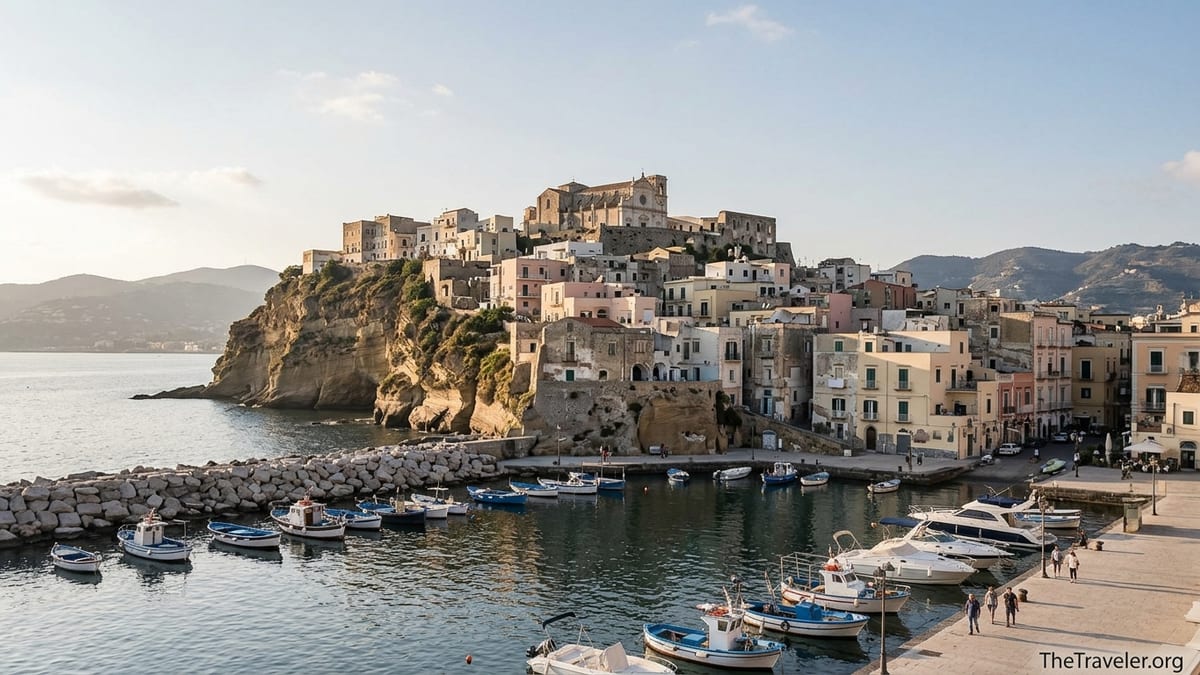
Rione Terra is the ancient fortified quarter of Pozzuoli, a city set in the volcanic Campi Flegrei just west of Naples. The district occupies a small headland that projects into the bay, forming a natural acropolis above the harbor. Today you see pastel facades, a Baroque cathedral and narrow lanes. Beneath and behind that surface lies the skeleton of a much older city, with Roman streets, warehouses and houses preserved under the modern buildings.
In practical terms for visitors, Rione Terra is a walled precinct at the northern end of Pozzuoli’s seafront. Modern Pozzuoli spreads out around it, but the rione itself is a distinct enclave, accessed through controlled entry points and usually visited on guided tours. Standing on its ramparts you can look east toward the skyline of Naples and Vesuvius, south to Capri on a clear day, and directly down onto the busy marina where fishing boats unload their catch each morning.
Unlike many old quarters in Italy that have evolved continuously, Rione Terra was abruptly emptied in the 1970s because of volcanic ground movement, then left largely frozen for decades. That evacuation unintentionally turned the neighborhood into an enormous time capsule. When you walk here today you are not just wandering through a picturesque centro storico. You are moving across a multi-layered archaeological site that captures two and a half millennia of history in a few city blocks.
For many travelers based in Naples, Rione Terra is still off the usual circuit that includes Pompeii, Herculaneum and the Amalfi Coast. Yet it is barely thirty minutes away by commuter train and offers an intimate, three-dimensional view of an ancient port that once rivaled Rome itself for commercial importance.
From Greek Dicearkia to Roman Puteoli
The story of Rione Terra begins in the sixth century BCE, when Greek settlers from the island of Samos founded a colony called Dicearkia on this rocky headland. The promontory provided a defensible acropolis and a vantage point over maritime traffic entering the bay. Traces of this early Greek phase survive in fragments of walls and in the layout of the substructures that later Romans and medieval builders reused rather than demolish.
In 194 BCE the Romans established a colony here and called it Puteoli. Thanks to its deep, sheltered harbor and position on the Tyrrhenian routes, Puteoli quickly grew into one of the key ports of the Roman world. Grain ships from Alexandria, marble from the eastern Mediterranean and luxury goods from across the empire passed through its quays. The hill of Rione Terra became the civic acropolis, crowned with temples and public buildings that proclaimed the city’s wealth and loyalty to Rome.
One emblem of this Roman prosperity is the Temple of Augustus that once dominated the crest of the promontory. Built by a wealthy merchant in honor of the emperor, the temple later became the core of Pozzuoli’s cathedral, with Corinthian columns and marble elements still visible behind the Baroque interior. Nearby, under today’s houses, archaeologists have uncovered a grid of Roman streets, taverns, workshops and storage rooms that formed the bustling urban fabric of Puteoli’s upper town.
Walking the underground itinerary today, you pass doorways whose thresholds are deeply worn by ancient foot traffic and see ruts from wagon wheels cut into basalt paving stones. In one vaulted space, traces of painted plaster cling to the walls of what was probably a modest apartment; in another, amphorae were stored neck down in the floor for bulk goods. These tangible details give a sense of how densely occupied the acropolis was when Puteoli served as Rome’s western maritime gateway.
Medieval Stronghold and Seaside Quarter
With the decline of the Roman Empire and the silting and subsidence of the harbor, much of the low-lying port area fell into disuse. The population retreated to the defensible rock of Rione Terra, which shrank from a cosmopolitan Roman district to a compact medieval rocca. New fortifications wrapped around the headland and surviving Roman walls were incorporated into ramparts and houses. Over time, the ancient temple on the summit was fully Christianized and expanded as the cathedral of San Procolo, symbolizing the continuity of sacred space even as empires fell.
By the early modern period, Rione Terra functioned as Pozzuoli’s walled historic core. Narrow alleys ran between tall, crowded buildings. Many families lived above small workshops or storerooms cut into ancient masonry. Visitors who saw Pozzuoli in the 18th and 19th centuries often described the rione as picturesque but dilapidated, with laundry strung between balconies and the cathedral towering over a tight maze of lanes.
This layering of time is still visible. On a current visit you might see a Renaissance doorway grafted onto a wall that hides a Roman barrel vault, or a Baroque window frame set above blocks cut in the Republican period. From the sea, the profile of Rione Terra resembles a small island of stone, rising sheer from the water and topped by the cathedral. For medieval sailors, this was both a landmark and a refuge, and for centuries the rione remained the beating heart of civic and religious life in Pozzuoli.
Crucially, that continuity existed despite the restless geology underfoot. Ground here has been rising and falling by several meters over the centuries, a slow vertical movement known as bradyseism. Medieval chroniclers noted episodes when the shoreline advanced or retreated, and fishermen adjusted moorings as ancient quays dipped below or rose above the tide. Yet until the 20th century, these changes did not empty the acropolis itself.
Bradyseism, Evacuation and a Frozen-in-Time Neighborhood
The turning point came between 1969 and 1972, when the Campi Flegrei caldera entered a strong phase of uplift. In just a few years the ground around Pozzuoli rose by well over a meter. Cracks opened in houses in Rione Terra, doors jammed in their frames and residents felt frequent small earthquakes. With scientists and civil protection officials worried that the unrest might precede an eruption, authorities ordered a rapid evacuation of the historic quarter in March 1970.
Approximately a few thousand inhabitants were moved in a matter of days to new public housing complexes built inland, in districts such as Rione Toiano and later Monterusciello. The operation removed the population from immediate risk but had a profound human and cultural cost. Families who had lived on the acropolis for generations suddenly found themselves in modern apartment blocks on the volcanic plain, far from the sea and the tightly knit social fabric of their old lanes.
Once the residents were gone, large parts of Rione Terra were walled off to prevent looting and vandalism. For decades the quarter remained largely abandoned, with collapsed roofs, bricked-up doorways and vegetation creeping over centuries-old walls. The bradyseismic crisis eventually eased without a major eruption, but the neighborhood’s fate was sealed. No one moved back in, and Pozzuoli’s day-to-day life shifted to the surrounding districts on more stable ground.
From a traveler’s perspective, this painful chapter is exactly what allowed Rione Terra to become such an exceptional archaeological site. Because the old houses were never modernized or rebuilt after the evacuation, archaeologists in the late 20th century could strip away damaged floors and walls and discover Roman Puteoli preserved like a buried under-city beneath the abandoned apartments. The result is a place that feels suspended in time, where traces of 20th-century life sit directly above the stonework of antiquity.
The Archaeological Itinerary: Walking Through Two Cities at Once
Today, the main way to experience Rione Terra is via a structured archaeological itinerary that leads you beneath the surface of the modern quarter. Visitors are typically accompanied by a guide through a sequence of tunnels, vaulted rooms and open stretches of Roman street that run under the present-day grid. Tours are usually limited in group size and operate on set schedules, so advance reservations through local operators or tourist offices are strongly recommended, especially in high season.
One of the most striking moments comes early on, when you emerge onto a Roman decumanus, a main east-west street, preserved at its original level several meters below the current ground. The paving stones are intact, and the facades of ancient tabernae stall fronts still define the corridor. Here, a guide might point to a blackened area on the wall interpreted as a kitchen corner, or to a series of niches that probably held household shrines. These specific details transform the abstract idea of a “Roman port” into an environment you can touch and inhabit.
Further along the route, you pass through spaces that evidence suggests were used for storage and small-scale production. In one room, rows of low brick piers would once have supported raised floors for keeping goods dry. In another, the remains of channels and basins hint at water management in an area where cisterns and wells were essential. Occasionally, shafts of daylight filter down from openings above, reminding you that there is still a living (or once-living) town on top of this buried level.
Guides often frame the experience as a dialogue between the two cities: Roman Puteoli below and the evacuated Rione Terra above. You may see where later builders pierced Roman vaults to install staircases, or where a medieval wall cuts bluntly across an earlier alignment. For travelers who have visited Pompeii, the contrast is instructive. Pompeii feels like a city arrested by sudden catastrophe. Rione Terra, by contrast, reveals slow transformation and reuse, culminating in a 20th-century evacuation that inadvertently safeguarded the deep past.
The Tempio Duomo and the Sacred Heart of the Acropolis
At the very summit of Rione Terra stands the cathedral of Pozzuoli, often called the Tempio Duomo because it incorporates the Roman Temple of Augustus into its structure. From the outside, visitors see a largely Baroque church with an elegant facade and a staircase leading up from a small square. Step inside, however, and you can recognize unmistakable classical elements: towering columns, a rectangular cella and the proportions of a Roman temple repurposed for Christian worship.
This fusion of sacred architectures illustrates how Rione Terra has continually reinterpreted its most prestigious space. In the imperial period, the temple signaled the loyalty of Puteoli’s merchant elite to the emperor and the gods of Rome. After late antiquity, the same podium and colonnade provided the bones for a cathedral dedicated to a local Christian martyr, San Procolo. Earthquakes and a major fire in the 1960s damaged the building, and for many years after the bradyseismic evacuation it stood closed and scaffolded.
Recent restorations have aimed to reveal both layers at once. In some parts of the interior, Baroque decorative schemes have been cleaned and conserved. In others, efforts have highlighted the underlying Roman stonework, allowing visitors to see how columns were re-cut, how walls were thickened and where ancient doorways were blocked or reopened. When you attend a service or concert here today, you are participating in a living religious tradition set inside a monument that originally honored Augustus two thousand years ago.
From the terrace around the cathedral, there are sweeping views over the Bay of Pozzuoli and the broader Campi Flegrei. On clear evenings, the light from the western sun catches the curve of the coastline and the silhouettes of distant islands. It is an atmospheric place to reflect on how a single building can embody the religious, political and artistic history of an entire region, and how the acropolis of Rione Terra has remained sacred ground across wildly different eras.
Rione Terra, Campi Flegrei and Living with a Restless Volcano
Rione Terra is not only important for its archaeological treasures. It also sits at the approximate center of the Campi Flegrei volcanic caldera, a vast, partially submerged system whose slow ground movements continue to affect modern life around the bay. Over the last several decades, instruments have measured repeated phases of uplift and subsidence focused in a zone only a few kilometers wide around the old acropolis and harbor. Earthquake swarms occasionally rattle Pozzuoli and nearby suburbs, and local authorities regularly update emergency plans and risk communication.
For travelers, this means that visiting Rione Terra offers an unusual chance to observe how a community lives with long-term natural hazard. Information panels in and around the site explain bradyseism in accessible language, noting how the famous Roman market building by the harbor shows rings of marine mollusk holes on its columns where the sea level once stood. Guides often point out that streets you walk today were under water centuries ago, or that a given quay has been alternately submerged and dry several times since antiquity.
The evacuation of Rione Terra in 1970 and the larger relocations in the early 1980s are still part of the collective memory in Pozzuoli. Older residents may recall when the alleys on the acropolis were full of shops and children, and how overnight the neighborhood went silent. Some tours explicitly incorporate this human dimension, describing the difficult choices families faced and how urban planners created entirely new suburbs to house the displaced. This intertwining of geoscience, urban policy and personal memory makes Rione Terra an important case study for how societies adapt to slow-onset disasters.
While current monitoring shows episodes of uplift and seismicity, daily life in Pozzuoli proceeds much like in any other small Italian coastal city, with cafes lining the seafront and ferries shuttling to nearby islands. When planning a visit, it is sensible to check local civil protection advice and be aware that occasional small earthquakes are part of the background of life here. For most travelers, however, these phenomena remain an intriguing topic of conversation with guides rather than an immediate concern.
Planning Your Visit: What Travelers Actually Experience
For a typical traveler based in Naples, reaching Rione Terra is straightforward. Commuter trains on the coastal line connect central Naples to Pozzuoli in roughly half an hour, and from Pozzuoli station the walk to the old acropolis takes about ten to fifteen minutes downhill through the modern town. Taxis and local buses are also available, and some private tour companies bundle Rione Terra with nearby sights such as the Flavian Amphitheater and the Solfatara fumarole field when access conditions allow.
As of recent seasons, access inside Rione Terra itself is generally through organized visits, often branded locally under combined cultural initiatives that also include the cathedral and other heritage sites. These visits are usually scheduled in blocks, for example morning and early afternoon, with closures on certain weekdays or holidays. Because the situation can change in response to conservation work or volcanic monitoring updates, it is wise to confirm current opening times with Pozzuoli’s tourist information offices or reputable tour operators shortly before you go.
Prices for guided tours tend to be modest compared with headline sites such as Pompeii, typically in the range that a mid-range traveler would spend on a restaurant meal in central Naples. Family tickets and reduced rates for students or seniors are often available. Many tours are conducted in Italian, but operators increasingly offer English-language options, especially on weekends and in the spring and autumn high seasons. If language is a concern, arranging a private guide or joining a small-group tour through a specialist agency can ensure more detailed explanations of the archaeology and risk context.
On the day of your visit, wear comfortable shoes suitable for uneven stone surfaces and prepare for a mix of indoor and outdoor environments. Underground sections can feel cool and damp even in summer, while the exposed streets and terraces above can be hot under the midday sun. Combining Rione Terra with a walk along the waterfront, a stop at the nearby Roman amphitheater and a seafood lunch at one of the harborside trattorias makes for a full, rewarding day that blends deep history with contemporary local life.
The Takeaway
Rione Terra is much more than a pretty historic quarter on a Neapolitan bay. It is the original nucleus of Pozzuoli, an acropolis first chosen by Greek settlers, transformed into the commercial heart of Roman Puteoli and later compressed into a medieval stronghold. Its narrow lanes and cathedral-topped skyline tell a story of continuity across political and religious change, while its evacuation in the 20th century turned the district into an accidental time capsule of urban archaeology.
For travelers, the site’s importance lies in this rare combination of qualities. Beneath your feet lie remarkably intact Roman streets and houses that capture everyday life in one of antiquity’s busiest ports. Above them rise the shells of abandoned modern homes and a cathedral that began life as a temple to Augustus. All of it stands at the restless center of the Campi Flegrei, where slow ground movements and careful monitoring remind visitors that history here is still being shaped by geology.
Visiting Rione Terra adds a powerful dimension to any exploration of the Bay of Naples. It connects the dots between textbook images of Pompeii, the living city of Naples and the quieter, more reflective landscapes of the Phlegraean Fields. For those willing to venture just beyond the standard itineraries, this compact headland offers one of the most layered and thought-provoking historical experiences in southern Italy.
FAQ
Q1. What is Rione Terra in simple terms?
Rione Terra is the ancient fortified quarter of Pozzuoli, a compact hilltop district above the harbor where Greek, Roman, medieval and modern layers of the city overlap.
Q2. Why is Rione Terra considered so historically important?
It preserves the original core of Roman Puteoli, once a major port of the empire, and shows continuous reuse of the same acropolis from antiquity through the Middle Ages into the 20th century.
Q3. How is Rione Terra different from Pompeii or Herculaneum?
Pompeii and Herculaneum were buried suddenly by volcanic eruptions, while Rione Terra evolved over centuries and was evacuated only recently, leaving a layered mix of Roman, medieval and modern structures.
Q4. Is it safe to visit Rione Terra given the Campi Flegrei volcano?
Authorities closely monitor volcanic activity and adjust access if needed. Under normal conditions, visiting Rione Terra is considered safe, though occasional small earthquakes are part of local life.
Q5. Can I walk freely in Rione Terra or do I need a guided tour?
Access to the main archaeological areas is usually through guided or structured visits, while some exterior streets and viewpoints may be accessible more freely, depending on current regulations.
Q6. What are the highlights I should not miss inside Rione Terra?
The underground Roman streets, the storerooms and houses of ancient Puteoli, and the Tempio Duomo cathedral that incorporates the Temple of Augustus are key highlights for most visitors.
Q7. How long should I plan for a visit?
Allow at least one and a half to two hours for the guided archaeological itinerary and cathedral, and longer if you want to explore the seafront and nearby Roman amphitheater.
Q8. Do I need to book in advance?
Advance reservations are strongly recommended, especially in high season or on weekends, because group sizes and visiting hours are limited and can change with conservation or monitoring needs.
Q9. Is Rione Terra suitable for children and less mobile travelers?
Children often enjoy the underground passages, but there are steps, uneven pavements and confined spaces, which can be challenging for visitors with limited mobility; check current access details before going.
Q10. What other sights pair well with Rione Terra in a day trip?
Many travelers combine Rione Terra with Pozzuoli’s Flavian Amphitheater, the ancient market building by the harbor and a seafood meal along the waterfront before returning to Naples.