


High above the busy waterfront of Pozzuoli, the rocky spur of Rione Terra looks compact and self-contained, a small walled citadel pressed between sky and sea. Yet this headland, evacuated in the 1970s because of volcanic ground movements, is one of the most revealing places in Campania for understanding how the region’s culture has grown, endured, and adapted over more than two millennia. To walk its narrow lanes and underground streets today is to see Greek foundations, Roman ambition, medieval resilience, and modern risk management layered in stone.
Get the latest updates straight to your inbox!
A Citadel on a Volcano: Why Rione Terra Is Unique in Campania
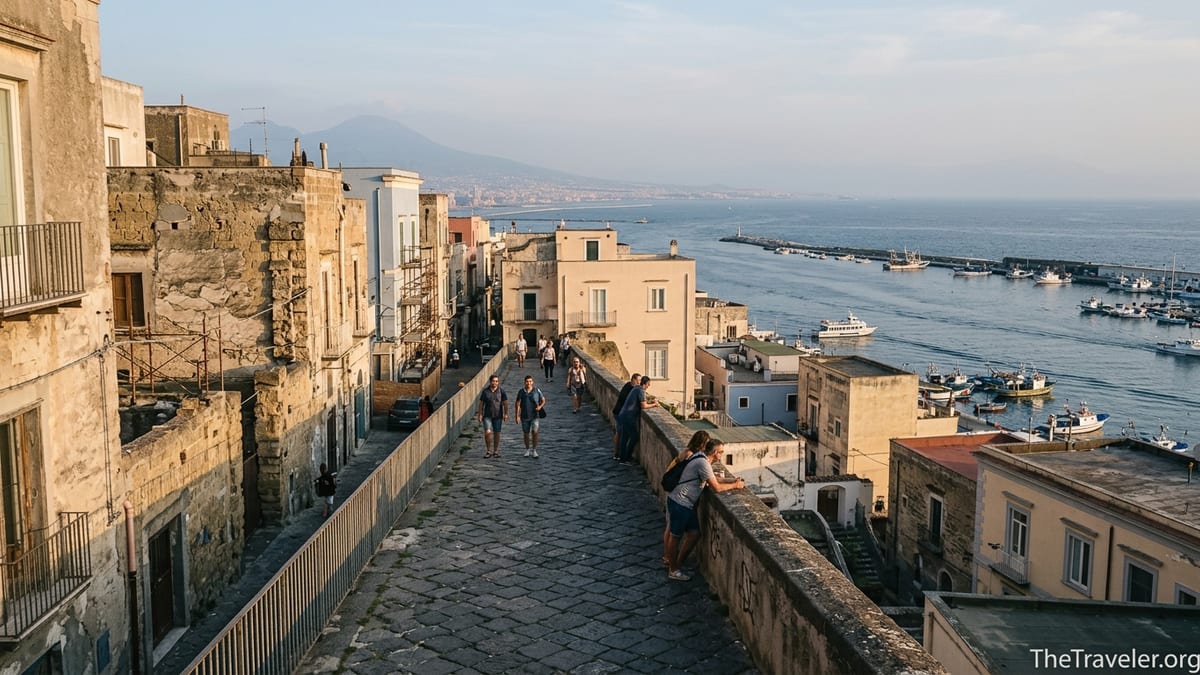
Rione Terra occupies the ancient acropolis of Puteoli, the Roman harbor that once rivaled Ostia for control of Mediterranean trade. From its bastions you can see the curve of the Bay of Pozzuoli, the faint profile of Vesuvius to the east, and the low hills of the Campi Flegrei caldera all around. Few places in Campania make the region’s defining realities so visible in one sweep: volcanic power, maritime commerce, and dense urban life pressed into a fragile landscape.
Unlike nearby postcard icons such as Positano or Capri, this headland has been continuously reused and rebuilt since the Greek colony of Dicearchia was founded here. Greek street grids sit beneath Roman warehouses and shops, which in turn support medieval and early modern houses. For travelers used to the “frozen in time” narrative at Pompeii, Rione Terra offers a contrasting story: a city that never stopped changing, but carried its past forward as structural foundations and cultural memory.
The district’s survival at the center of one of Europe’s most monitored volcanic systems gives it added weight. Ground here has risen and fallen several meters over the centuries because of bradyseism, the slow swelling and sinking linked to the Campi Flegrei magma and hydrothermal system. In the 20th century that movement forced the evacuation of the entire neighborhood, turning Rione Terra into a ghost citadel for decades and underscoring how cultural heritage in Campania exists in constant negotiation with geology.
Today, when you enter through the controlled access gates, you walk into a kind of open-air archive. Every vaulted passage, every consciously restored façade, and every exposed stretch of Roman pavement is part of a deliberate regional effort to treat heritage, urban life, and volcanic risk as one intertwined story rather than separate issues.
From Greek Dicearchia to Roman Puteoli: The Commercial Heart of Campania
Long before Naples became a grand Bourbon capital, Puteoli was the workhorse port of the region. The Greeks chose this headland and its natural harbor in the 4th century BCE for its strategic location along maritime routes heading west, then the Romans developed it into a key customs and trade hub linking Rome to Spain, North Africa, and the eastern Mediterranean. Rione Terra, perched directly above the quays, was the administrative and religious core of this operation.
Walking the underground archaeological itinerary today, you see how thoroughly commerce shaped the space. The route threads past the remains of tabernae, the small barrel-vaulted shops that once sold fish, wine, and imported goods brought in on freighters anchored just below. Excavated dolia, huge ceramic jars sunk into the floor, recall the days when grain and oil moved through Puteoli in quantities large enough to feed Rome’s population. Plaques along the path explain that these were not secondary facilities: Puteoli was a first-stop port for cargo, a place where contracts were signed and goods transshipped inland.
Rione Terra’s role in Campania’s cultural history is tied to this constant flow. The streets were crowded not just with local fishermen and artisans but with Greek merchants, African ship captains, and officials from Rome’s bureaucracy. In practice that meant languages and religious traditions overlapped: a traveler today can see evidence of eastern cults, Roman imperial worship, and local practices converging within a few meters of each other. This cosmopolitan environment helps explain why Campania later developed such a layered identity, comfortable with outside influences yet fiercely attached to local customs.
For modern visitors, this ancient commercial past is still legible in the city beyond the site gates. A short walk from Rione Terra, the Macellum of Pozzuoli, with its famous columns marked by marine mollusc holes, tells another chapter of the trade story: how the port infrastructure repeatedly sank and rose with bradyseism, yet remained in use because the economic stakes were too high to abandon it fully. Seen together, these sites show that Campania’s prosperity has always come with a price: the need to inhabit, and repeatedly rebuild, a restless coastline.
The Temple-Cathedral: A Monument to Campania’s Layered Faith
At the crown of Rione Terra stands one of Campania’s most unusual religious monuments: a baroque cathedral literally wrapped around the skeleton of a Roman temple. In Roman times this was a grand temple, traditionally attributed to Augustus, whose marble fragments and decorative corbels are now displayed both on site and at the Archaeological Museum of the Phlegraean Fields in Baia. In late antiquity and the Middle Ages, the structure was transformed into a Christian church, dedicating imperial architecture to a new faith without erasing its classical core.
This fusion is not unique in Italy, but the way it is handled at Rione Terra makes it a textbook example for cultural historians. Step inside the Tempio-Duomo and you see baroque stuccoes and chapels, then, in strategic cuts along the walls and pavement, the fluted Roman columns and original cella alignments emerge. Guides often emphasize how local bishops in the 17th century consciously chose to preserve, rather than demolish, these pagan elements, anticipating later ideas about heritage conservation.
The church’s more recent story anchors it even more firmly in Campania’s modern cultural imagination. During the evacuation of the 1970s, when residents were forced to leave their homes because of accelerating ground uplift, the bishop of Pozzuoli remained in Rione Terra for years as one of its last official inhabitants. He supervised the gradual removal of paintings, sculptures, and liturgical objects, including works by artists such as Artemisia Gentileschi that were sent for safekeeping. For local people, that act turned the cathedral into a symbol of both loss and guardianship.
When the building reopened after an extensive restoration campaign, many Puteolani described attending mass there as “returning home,” even if they now lived in neighborhoods such as Monterusciello built to house evacuees. Travelers who visit today, by reserving a guided tour through the local information point, are stepping into a space that still carries a living emotional charge, not just an aesthetic one. That makes the cathedral an essential stop for understanding how Campania’s religious life adapts to crisis without severing its roots.
Bradyseism and the 1970s Evacuation: A Modern Turning Point
In the late 1960s and early 1970s, Pozzuoli entered a new phase of bradyseism. The ground beneath the town rose roughly a meter and a half in a few years, cracking buildings and warping streets. Rione Terra, sitting directly on the uplifted rock, suffered significant structural damage. In 1970 authorities ordered a complete evacuation of the neighborhood. Residents were relocated to new housing estates inland, and the headland’s gates were shut.
For Campania, the spectacle of an entire historic quarter being abandoned for geological reasons was shocking. Newspapers at the time portrayed Rione Terra as a symbol of the state’s struggle to manage life above an active caldera. The episode influenced how Italian civil protection agencies later approached volcanic risk, not only at Campi Flegrei but also around Vesuvius and Stromboli. In practical terms it led to the creation of new building codes, hazard maps, and relocation policies that still shape development choices in Campania today.
On the ground, the consequences for the neighborhood were harsh. Without daily life to anchor it, the citadel fell into disrepair. Windows were bricked up to keep looters out; graffiti and informal dumping scarred the lanes. For nearly thirty years, travelers arriving in Pozzuoli saw Rione Terra as a silent, dark mass above the port, a daily reminder that in this region heritage is never completely safe from the forces beneath it.
Yet the evacuation also set the stage for one of Italy’s most ambitious long-term heritage rescue projects. Because the buildings were emptied but not demolished, archaeologists could explore beneath them with an intensity that would have been impossible in a functioning residential quarter. Engineers and planners, backed by regional and national funds, began the slow work of consolidating walls, installing modern monitoring systems, and designing an access route that could both welcome visitors and serve as an educational tool about bradyseism. In this sense, the crisis of the 1970s turned Rione Terra into a laboratory for thinking about how to preserve living cities in hazardous landscapes.
The Underground City: Archaeology as Living Urban Memory
The most striking experience for many visitors to Rione Terra today is the underground itinerary, a guided walk through the Roman city preserved beneath later structures. You descend from a modern entry pavilion into a network of streets aligned with the original decumanus, passing shopfronts, storage rooms, and fragments of frescoed walls left in situ. The ceiling arches are often the cellars of buildings you have just walked past above, collapsing two thousand years of urban history into a single vertical glance.
Unlike the wide-open ruins of Pompeii, where volcanic ash froze a single moment in time, the Rione Terra tunnels show how a city was continuously reused. Medieval and early modern builders cut new doorways into Roman walls, repurposed marble blocks for staircases, and laid new brick vaults over ancient foundations. Guides point out where a wine cellar from the 18th century rests directly on a Roman shop floor, or where drainage channels have been adapted again and again to shifting street levels. The effect is like reading palimpsest pages, with each era scratching its notes over those that came before.
For Campania’s cultural history, this physical layering matters as much as the individual artifacts extracted from the ground. It illustrates how communities here have long preferred adaptation to erasure. When economic or geological pressures forced change, the instinct was to reconfigure the existing city rather than abandon it entirely. That mindset helps explain why, even after the traumatic evacuation of the 1970s, local officials and residents pushed for decades to bring Rione Terra back into public use instead of relegating it to permanent ruin.
From a traveler’s perspective, the underground itinerary also connects Rione Terra to the broader Campi Flegrei network of sites. A morning spent navigating its dim Roman streets pairs naturally with an afternoon at the Flavian Amphitheater in central Pozzuoli or the bath complexes of Baiae. Taken together, these visits allow you to trace how elites, merchants, and ordinary townspeople once moved through a landscape dense with both opportunity and risk, much as commuters and tourists do today along the Circumflegrea railway or the coastal road.
Revival and Community: Rione Terra in Contemporary Campania
The gradual reopening of Rione Terra in the 21st century has been more than a conservation success story. It has become a touchstone for local identity in a region where many residents live with daily reminders of economic precarity and seismic risk. Weekend visitors from Naples stroll its belvederes, while school groups from nearby towns line up at the ticket office to follow guides through the underground circuit. For many families, these trips double as personal pilgrimages to the neighborhood where grandparents or great-grandparents once lived.
Economically, the site’s revival is part of a broader push to diversify Campania’s tourism beyond the saturated Amalfi Coast. Pozzuoli’s restaurants and bars, many clustered just below Rione Terra along the port, now market themselves as gateways to the Phlegraean Fields experience. A traveler might book a late-morning tour of the archaeological itinerary, stop for a seafood lunch featuring local mussels or spaghetti alle vongole on the waterfront, then return to the headland at sunset for views across the bay. That pattern has helped support small hospitality businesses in a city that historically relied more on industry and commuting than on visitors.
At the same time, the restored district serves as a forum for public conversations about risk and memory. Civil protection drills, cultural festivals, art installations, and open-air concerts regularly use the headland as a stage, pairing performances with information stands about volcanic monitoring or urban planning. When tremor swarms or uplift measurements make national news, Rione Terra appears in television footage as shorthand for the tension between everyday life and potential emergency. In this way, the neighborhood continues to shape how Campania imagines its own future.
Crucially, the revival has not tried to erase the scars of abandonment. Certain façades still show patched cracks from past ground movements; some alleys remain closed, marked with signs explaining ongoing consolidation work. Rather than presenting an idealized historic village, Rione Terra invites visitors to see heritage as a work in progress, subject to the same uncertainties that have always defined the Campi Flegrei region.
Rione Terra in the Wider Story of Campi Flegrei
To understand why Rione Terra matters beyond Pozzuoli, it helps to place it within the wider Campi Flegrei system. This volcanic field includes Solfatara’s steaming crater, the submerged ruins of Baiae, and the great cistern of the Piscina Mirabilis at Bacoli, among other sites. All of them illustrate how ancient societies turned volcanic features into assets. Thermal waters powered bath complexes, porous volcanic stone became a prized building material, and sheltered bays created by past eruptions offered excellent harbors.
Rione Terra occupies a privileged point in this constellation. From its terraces you can trace visual lines to many of these landmarks, turning an abstract hazard map into a tangible panorama. The headland shows how a community not only endured bradyseism but also used it, at times, to its advantage; for instance, uplift episodes in Roman times temporarily raised quays above damaging storm surges, even as they created long-term engineering challenges. This dynamic relationship between geology and daily life is a central theme in Campania’s cultural history.
For contemporary planners and scientists, the neighborhood functions as a reference case. Engineers studying how to retrofit historic buildings in seismically and volcanically active zones often cite Rione Terra’s consolidation works, from reinforced vaulted ceilings to discreet monitoring sensors embedded in ancient masonry. Urbanists working on evacuation scenarios look at how the 1970s relocation shaped modern suburbs such as Toiano and Monterusciello, and how the gradual reactivation of the old center affects patterns of commuting and tourism.
Travelers who include Rione Terra in an itinerary that also takes in Naples, Pompeii, and the Amalfi Coast gain a more nuanced picture of Campania. Instead of seeing the region solely as a succession of monuments and scenic views, they encounter a living laboratory where questions about where to build, what to preserve, and how to live with natural hazards are actively negotiated. That is one of the reasons many heritage professionals argue that the Phlegraean Fields, with Rione Terra as a key node, deserve more international attention as a cultural landscape of global significance.
The Takeaway
Rione Terra may occupy only a few compact hectares above Pozzuoli’s harbor, but its significance for Campania’s cultural history is out of all proportion to its size. Here, within a short walk, you can move from Greek foundations to Roman streets, from a temple-turned-cathedral to bricked-up façades that still tell of 20th-century evacuation and return. The neighborhood condenses the region’s defining themes: maritime trade, layered faith, creative reuse of urban space, and the constant negotiation with volcanic risk.
For travelers willing to step slightly off the standard Naples-and-Pompeii circuit, a half day in Rione Terra offers a powerful counterpoint to more familiar sites. It shows Campania not just as the land of spectacular ruins and sunlit coastlines, but as a place where communities keep reinventing their relationship with a challenging environment. In the rising and falling ground, the patched masonry, and the carefully lit underground streets, you can read an ongoing story of adaptation that helps explain why this corner of the Phlegraean Fields still matters so deeply, both to local residents and to anyone interested in how cultures endure.
FAQ
Q1. Where exactly is Rione Terra, and how do I get there from central Naples?
Rione Terra is the historic acropolis of Pozzuoli, about 15 kilometers west of central Naples. From Naples you can take a regional Trenitalia train from Napoli Campi Flegrei or Montesanto stations to Pozzuoli Solfatara or Pozzuoli station, then walk about 10 to 15 minutes downhill toward the port to reach the headland.
Q2. Is Rione Terra still affected by volcanic activity and bradyseism today?
Yes, the wider Campi Flegrei area remains an active volcanic system, and slow ground movement known as bradyseism is still monitored closely. However, access to Rione Terra is managed in coordination with Italy’s civil protection authorities, and visits are allowed only when conditions are considered safe, with real-time monitoring supporting those decisions.
Q3. Do I need to book a tour to visit Rione Terra, or can I explore on my own?
The surface streets of Rione Terra may be accessible during opening hours without a guide, subject to local rules in force at the time of your visit. To enter the underground archaeological itinerary and see the Roman streets and structures beneath the modern buildings, you generally need to join a guided tour organized through the local visitor information point or authorized operators.
Q4. How long should I plan for a visit, and what else pairs well with Rione Terra in a day?
A typical underground tour takes around 60 to 90 minutes, and wandering the surface lanes and viewpoints adds another hour. Many travelers pair Rione Terra with the nearby Flavian Amphitheater in Pozzuoli, a seafood lunch on the waterfront, or an afternoon visit to other Campi Flegrei sites such as the ruins at Baiae or the Piscina Mirabilis cistern in Bacoli.
Q5. What makes Rione Terra different from visiting Pompeii or Herculaneum?
Pompeii and Herculaneum are open archaeological parks that preserve towns abruptly buried by eruptions, essentially frozen in time. Rione Terra, by contrast, shows a city that was continuously inhabited, rebuilt, and adapted from Greek to modern times, then temporarily evacuated and carefully reactivated. It is more compact, more vertically layered, and closely integrated with today’s working city of Pozzuoli.
Q6. Is Rione Terra suitable for children and travelers with limited mobility?
The surface of Rione Terra includes some uneven pavements and moderate slopes but can be manageable for many visitors. The underground itinerary involves stairs, changes in level, and confined spaces, which can be challenging for people with limited mobility or claustrophobia. It is best to check current access information and discuss specific needs with the ticket office or tour organizer before booking.
Q7. When is the best time of day or year to visit Rione Terra?
Mornings and late afternoons often offer softer light and cooler temperatures, which make the exposed headland more comfortable and photogenic. Spring and autumn are generally pleasant seasons in Campania, with milder weather and fewer heatwaves than midsummer, while winter visits can be atmospheric but may be affected by rain and shorter daylight hours.
Q8. Are there places to eat or have a coffee near Rione Terra?
Yes, just below the headland the port area of Pozzuoli has numerous cafés, gelaterie, and seafood trattorie that draw both locals and visitors. Many travelers plan a visit so they can enjoy an espresso or an aperitivo with views of the bay before or after their tour, or sit down to a meal featuring local fish and shellfish.
Q9. How does visiting Rione Terra help me understand Campi Flegrei and its risks?
Rione Terra offers a concentrated example of how people have lived with, and responded to, the Campi Flegrei volcanic system over centuries, from Roman adaptations to ground movement to the 1970s evacuation. Interpretive panels and guides explain bradyseism and modern monitoring, so by the time you leave you have a clearer sense of why the region is closely watched and how communities balance everyday life with potential hazards.
Q10. Is Rione Terra a good base for exploring other parts of Campania?
While most visitors treat Rione Terra and Pozzuoli as a day trip from Naples, staying overnight in Pozzuoli can be a pleasant alternative to the city center. From there you can use local trains, buses, and ferries to explore Campi Flegrei sites, reach central Naples, or connect to longer-distance trains and hydrofoils that serve the rest of Campania, including the Amalfi Coast and the islands.