


More news on this day
Thousands of passengers across Australia and New Zealand faced extensive disruption today as 308 flights were delayed and six cancelled at major hubs including Adelaide, Auckland, Brisbane, Christchurch, Gold Coast, Melbourne, Perth and Sydney, tangling schedules for Qantas, Air New Zealand, Jetstar, Virgin Australia and several smaller carriers.
Get the latest news straight to your inbox!
Major Hubs Struggle To Keep Schedules On Track
Operational data compiled from airport boards and aviation tracking services indicates that disruption has been concentrated at the region’s largest gateways, with Sydney, Melbourne, Brisbane, Perth and Auckland accounting for a significant share of the 308 delays recorded today. Adelaide, Christchurch, Gold Coast and other secondary hubs have also reported elevated levels of knock on disruption as aircraft and crews fell out of position.
Published coverage over recent weeks has already highlighted how quickly single runway operations or low visibility can cascade through national networks in Australia and New Zealand. When departure banks in Sydney or Auckland are slowed, the impact is often felt within hours in Melbourne, Brisbane, Perth and Christchurch, with once punctual services forced into rolling delays throughout the day.
Qantas, Air New Zealand, Jetstar and Virgin Australia have all featured prominently in today’s disruption figures. Publicly available information shows that their combined presence on busy domestic and trans Tasman routes magnifies the scale of any operational stumble, as a single delayed aircraft or crew rotation can affect several consecutive flights in different cities.
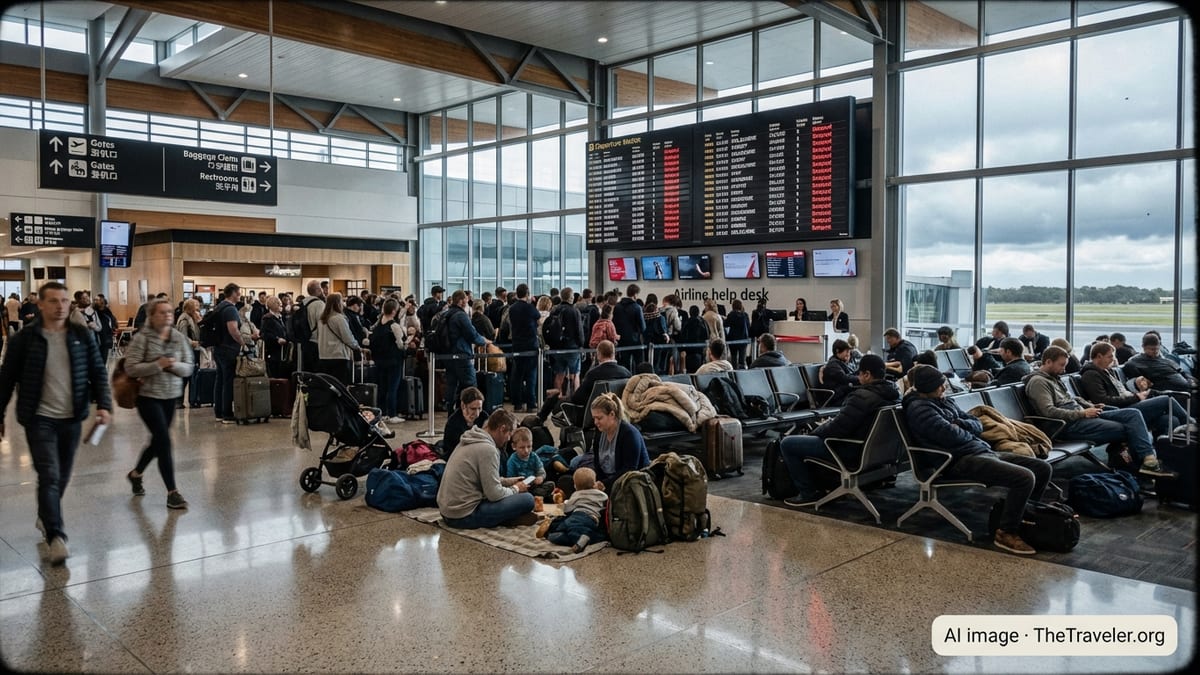
While today’s tally of six cancellations is modest compared with some previous episodes, the volume of delayed services has still been enough to overwhelm airport seating, strain baggage systems and force many travellers to miss connections, particularly at Sydney and Melbourne where tight turnarounds are common.
Weather, Staffing And Tight Rosters Combine Again
Reports from recent weeks indicate that the current disruption fits a now familiar pattern, where adverse weather and tightly stretched staffing levels collide with ambitious scheduling. Forecasts for strong winds, low cloud and patchy fog around key coastal airports have periodically forced traffic management measures, including single runway operations at Sydney, which slow arrivals and departures even when visibility later improves.
Industry analysis published in April and early May has noted that both Australian and New Zealand carriers are still running networks that leave limited room for recovery when a storm band or ground handling shortfall hits. Aircraft utilization remains high, and crew rosters are often built around minimal downtime between sectors. When the first wave of morning flights runs late, delays ripple through the day, which appears to have been the case again across trans Tasman and domestic corridors today.
Public commentary has also pointed to ongoing skill shortages in specialist roles such as licensed engineers, air traffic controllers and security screeners. Even small gaps in these areas can lead to gate holds or last minute aircraft swaps, which propagate further delays. Airlines across the region have been recruiting aggressively, but training pipelines take time to restore the depth of experience that existed before the pandemic.
Observers note that the combination of busy leisure demand, corporate travel recovery and the approach of the Southern Hemisphere winter has created a challenging operating environment. When seasonal weather systems arrive, as they have periodically this month, the thin margin for error vanishes quickly.
Qantas, Air New Zealand, Jetstar And Virgin Passengers Hit Hard
Today’s figures show that passengers booked on Qantas, Air New Zealand, Jetstar and Virgin Australia have borne the brunt of the disruption, reflecting their dominant market share on both domestic and trans Tasman routes. Publicly available route maps and schedules underline how closely intertwined these airlines are at major hubs such as Sydney, Melbourne, Brisbane, Perth, Auckland and Christchurch.
Travelers connecting between Australia and New Zealand have faced particular challenges. Recent severe weather events demonstrated how fog in Auckland and high winds in Sydney can simultaneously slow arrivals and departures, forcing airlines to hold or divert trans Tasman services. Similar patterns are evident today, with late inbound aircraft from one side of the Tasman arriving well behind schedule and missing their planned departure windows for the return leg.
Published analysis of earlier disruption waves in 2026 has also emphasized the role of codeshare and alliance arrangements. Flights marketed under one airline’s code but operated by a partner can create confusion when delays mount, as travelers attempt to navigate which carrier’s policies apply for rebooking and care. With multiple alliances and joint venture partnerships active on the Tasman, today’s network wide delays are likely to have produced a complex web of knock on effects across several brands.
For frequent flyers, today’s events may feel like a continuation of a difficult year. Consumer reports and on time performance statistics released over recent months show that reliability concerns have become one of the most common complaints in both countries, even as traffic volumes return to or exceed pre pandemic levels on some routes.
Trans Tasman Corridors Under Sustained Pressure
The trans Tasman market linking Australian cities with Auckland, Wellington, Christchurch and other New Zealand gateways has been a particular focus of scrutiny in 2026. Recent reporting shows that the route family is both strategically important and operationally fragile, with high utilization of aircraft, peak time clustering of flights and exposure to volatile coastal weather systems on both sides of the Tasman Sea.
According to publicly available government data, on time performance for some Tasman city pairs has been under pressure since late 2025, with average delay minutes creeping higher during periods of bad weather. Air New Zealand, Qantas and Jetstar have all added or adjusted frequencies as demand has rebounded, while Virgin Australia has strengthened selected Auckland, Christchurch and Queenstown links in partnership with alliance carriers.
Today’s 308 delays and six cancellations have once again highlighted how disruption on these corridors does not stay contained. Late arriving Tasman flights feed into domestic connections at Sydney, Melbourne, Brisbane, Perth and Adelaide, pushing back departure times for services that might otherwise have operated on time. Christchurch and Auckland, in turn, feel the knock on impact from delayed Australian departures arriving hours behind schedule.
Analysts suggest that without additional slack in aircraft rotations or more conservative scheduling in the shoulder seasons, episodes like today’s are likely to recur. The combination of strong passenger demand and weather exposed routings continues to test the resilience of both airline and airport operations across the Tasman network.
What Today’s Chaos Means For Future Travel
While daily disruption figures fluctuate, the pattern emerging across early 2026 suggests structural challenges for air travel in Australia and New Zealand. Airlines have restored capacity quickly to meet resurgent demand, but infrastructure, staffing and air traffic management systems remain finely balanced. Today’s groundings across Adelaide, Auckland, Brisbane, Christchurch, Gold Coast, Melbourne, Perth and Sydney reinforce that even routine bouts of poor weather can create outsized impacts when networks are this tightly run.
Consumer advocates and travel analysts have increasingly urged passengers to build greater flexibility into their plans. Recommendations in recent public guidance include avoiding the last flight of the day when a same day arrival is essential, allowing longer connection windows at major hubs and considering travel insurance products that address missed connections and extended delays.
Regulators in both countries are also examining reliability trends. Publicly accessible reports from transport agencies have started to track on time performance and cancellation rates in more detail, providing a clearer picture of how often passengers are affected. Although today’s tally of six cancellations is lower than in some previous disruption events, the sheer number of delayed flights underlines that punctuality, rather than outright cancellation, may be the more persistent frustration.
For now, travelers across the region are once again spending unplanned hours in terminals from Perth to Auckland, watching departure boards shift as airlines work to recover their operations. With the busy winter holiday period approaching, the pressure will remain on carriers and airports to find ways to keep similar episodes from becoming a defining feature of flying in Australasia.