


More news on this day
Beijing Daxing International Airport is contending with a fresh bout of operational turbulence, as Chinese carriers report a cluster of grounded aircraft and more than 100 delayed services disrupting domestic routes and at least one connection involving Saudi Arabia.
Get the latest news straight to your inbox!
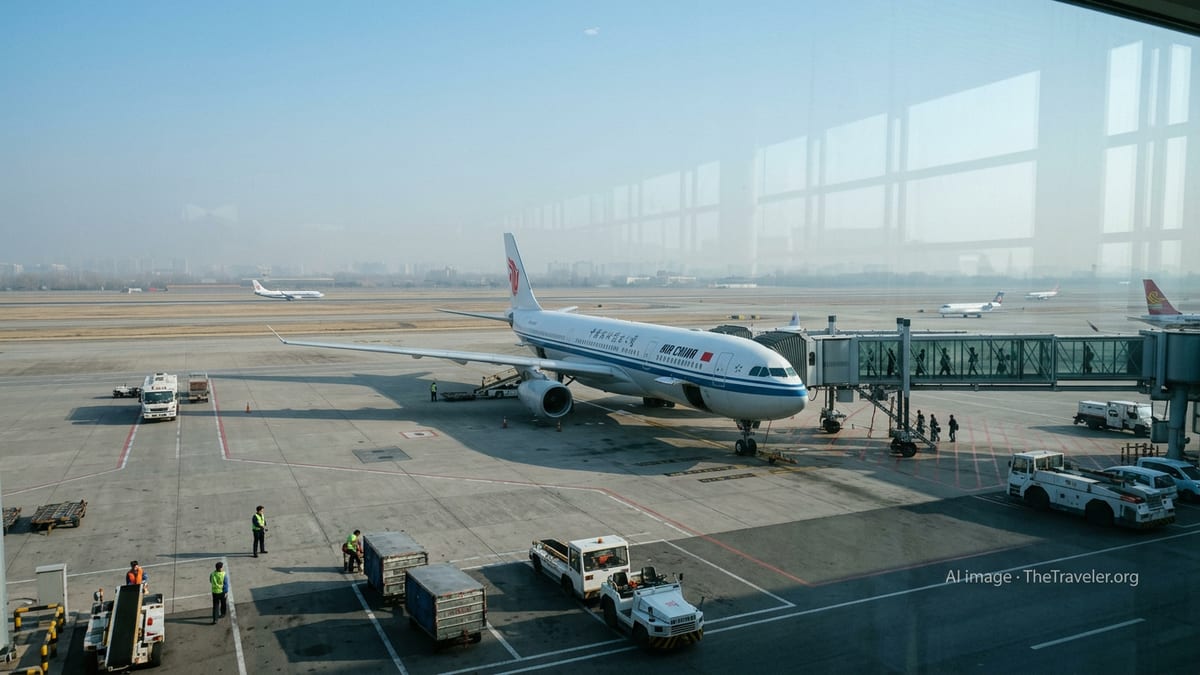
Grounded Aircraft and 107 Delays Hit Key Chinese Carriers
Publicly available flight-tracking and schedule data for June 22 indicate that operations at Beijing Daxing International Airport have been under pressure, with a total of nine grounded aircraft and 107 delayed flights reported across a group of major Chinese airlines. The disruptions have been concentrated among China Eastern Airlines, Air China, China Southern Airlines, China United Airlines and XiamenAir, all of which maintain dense domestic networks and, in some cases, routes linking China with the Middle East.
The grounded aircraft tally reflects flights that were either cancelled shortly before departure or removed from the day’s active schedule, leaving aircraft out of rotation. The delays span a broad range of domestic services, particularly on trunk routes connecting Beijing with coastal and central Chinese cities, where even short hold-ups can quickly ripple through the network.
The situation has highlighted how tightly scheduled Beijing’s newer hub operates. Beijing Daxing has become a core base for China Southern and China Eastern, while continuing to share regional traffic with Beijing Capital International Airport. When a group of carriers serving overlapping markets encounter the same disruption window, knock-on effects can spread quickly across the country’s domestic system.
The overall pattern at Daxing on June 22 mirrors a broader rise in schedule volatility at Chinese hubs since spring, with local and international aviation data providers recording elevated levels of last-minute adjustments, short-notice cancellations and rolling departure delays on domestic routes.
Severe Weather Over North China Compounds Operational Strain
Meteorological alerts issued on June 22 for North and Northeast China point to a significant spell of convective weather, including forecasts of strong thunderstorms, squall lines and hail in parts of the Beijing region. These alerts, circulated by national weather services early in the day, warned that winds associated with the storms could exceed gale force in localized cells.
Such conditions present a particular challenge for an airport serving as a primary hub for heavily utilized narrowbody fleets. Even when airports remain technically open, thunderstorm cells in arrival and departure corridors frequently require air traffic controllers to impose flow restrictions, increase separation between aircraft or suspend movements in certain directions for short periods. In practice, this can cause departure queues to build rapidly and arrival banks to be stretched out over longer time windows.
Operational data show that flights associated with the affected carriers at Beijing Daxing experienced clusters of delays concentrated around the most intense forecast periods. In some cases, short-haul services that might otherwise have absorbed minor schedule slippage became substantially late, particularly where aircraft were due to operate multiple domestic segments in succession.
Weather-related constraints have periodically tested the resilience of China’s domestic aviation network in recent years, but the current episode underscores the continuing sensitivity of high-frequency hubs to sudden changes in local conditions. Once delays push a portion of the fleet beyond turnaround buffers, airlines can be forced into a mix of tactical cancellations and rolling delays to restore order to the schedule.
Domestic Chinese Routes and a Saudi Connection Affected
The disruption at Beijing Daxing has been felt most acutely on domestic Chinese routes, particularly high-demand links between the capital region and major provincial cities. China Eastern, China Southern, China United and XiamenAir all operate dense webs of flights from Daxing to destinations such as Shanghai, Guangzhou, Xiamen and inland provincial capitals, meaning that even a modest cluster of affected flights can impact large numbers of passengers.
According to published schedules and same-day status feeds, the delays and groundings have also intersected with at least one connection involving Saudi Arabia. In recent seasons, Chinese carriers and their partners have expanded links between China and the Gulf region, with routes allowing passengers to connect between Chinese domestic services and flights serving Saudi cities via major hubs.
Where domestic feeder flights into Beijing Daxing run late, travellers aiming to connect to long-haul or medium-haul services onward to the Middle East face heightened risk of missed connections and unplanned overnight stays. Although specific rebooking and care arrangements vary by airline and ticket type, the day’s disruption at Daxing appears to have raised the stakes for itineraries that rely on tight transfer windows.
This latest round of irregular operations comes at a time when China’s aviation sector is positioning for continued growth in both domestic and international travel, including renewed emphasis on tourism and business ties with the Gulf. Any hint of fragility in the reliability of feeder services into key hubs can therefore have a disproportionate effect on routes that airlines are actively trying to promote.
Pressure on On-time Performance and Passenger Experience
Beijing Daxing has been promoted as a next-generation hub intended to ease congestion at Beijing Capital and improve the passenger experience. However, recent operational patterns suggest that on-time performance remains vulnerable to a combination of weather, airspace constraints and tightly packed timetables across multiple carriers.
Industry punctuality reports and anecdotal passenger accounts have, in recent months, drawn attention to uneven reliability on some mainland Chinese domestic routes. Instances of missed connections, gate changes close to departure and extended waits on board aircraft have all featured in traveller reports related to services operated by large Chinese network airlines, including those with a presence at Daxing.
The June 22 disruption, with nine grounded flights and more than one hundred delays, adds to this picture by illustrating how quickly a busy hub can shift from routine operations to strain once external conditions deteriorate. Even when average delay durations remain moderate, the cumulative impact on thousands of passengers can be substantial, especially where travel plans involve onward connections or tightly timed ground arrangements.
For Beijing Daxing, the challenge lies in balancing growth ambitions with operational resilience. Airlines operating from the airport have been adding routes and frequencies, including new international services, while contending with the realities of regional weather and shared airspace. The latest disruptions suggest that additional buffers, contingency planning and clearer passenger communication may be required during periods of heightened meteorological risk.
What Travelers Using Beijing Daxing Should Expect Next
Looking ahead, reports from aviation data providers and meteorological services indicate that intermittent convective weather is likely to persist in parts of North China through the early summer period. For passengers using Beijing Daxing International Airport, particularly those flying with China Eastern, Air China, China Southern, China United Airlines or XiamenAir, this raises the prospect of further localized disruptions on busy travel days.
Travel industry guidance generally recommends that passengers build extra time into itineraries involving connections at major hubs that have experienced elevated delay levels. For those pairing domestic China flights with longer-haul services to regions such as the Middle East, opting for longer transfer windows can provide a margin of safety if departure or arrival times shift on the day of travel.
At the same time, the scale of Beijing’s aviation market means that airlines and the airport operator have strong incentives to limit the duration and severity of any disruption. Schedule adjustments, temporary capacity measures and fine-tuning of peak-hour traffic flows are among the tools that carriers and air traffic managers can deploy to restore stability once adverse weather passes.
The June 22 turbulence at Beijing Daxing illustrates both the growing importance of the airport in China’s domestic and international networks and the operational challenges that accompany that role. As the country’s airlines continue to rebuild and expand their route maps, the performance of key hubs such as Daxing will remain a critical factor shaping passenger confidence and the overall competitiveness of China’s aviation sector.