


Sibiu rewards careful planners. Two full days are enough to explore its cobbled Old Town and the remarkable ASTRA open air museum in nearby Dumbrava Forest. Add a third day and you gain the freedom to ride into the mountains at Păltiniș or wander to Saxon villages such as Rășinari or Biertan without rushing. This guide uses current transport, opening hours and prices to outline a realistic weekend that balances architecture, museums and nature rather than cramming everything into one frantic checklist.
Get the latest updates straight to your inbox!
How long to stay in Sibiu and when to come
If you have only a weekend, plan on at least two nights in Sibiu. One full day can be devoted to the compact historic center, where the Upper Town and Lower Town are easily explored on foot, and a second day to the ASTRA Museum of Traditional Folk Civilization in Dumbrava Forest. That second day can comfortably include a relaxed dinner back in Piața Mare rather than a sprint between multiple attractions.
With a third day, you can add a mountain or village excursion such as Păltiniș, Rășinari or Cisnădioara without feeling pressed for time. Public transport to Păltiniș currently runs only three times per day each way on Tursib route 22, so it works far better as a dedicated day than as a quick side trip. In winter, the limited daylight and slow, sometimes icy roads into the Carpathians mean that three days is a practical minimum if you want both culture and mountains.
Spring and early autumn often give the best balance of clear views and manageable crowds. Summer weekends coincide with festivals in Piața Mare and late opening hours at some museums, yet also the strongest heat on the exposed squares and in the open air sections of ASTRA. Winter brings Christmas markets and snow in Păltiniș but surfaces in the Old Town can be very slippery, especially the steep stairways between the Upper and Lower Towns.
In short, two solid days are enough to understand the city and its open air museum. A third day lets you slow down: take a forest walk at Păltiniș, linger over panoramic photos from the Council Tower, or sit with coffee under Sibiu’s distinctive rooftop “eyes” rather than treating them as a quick photo stop.
Arriving in Sibiu by train, bus and air
Sibiu sits on Romania’s main railway line 200 between Brașov and Arad, with additional lines north toward Mediaș. Direct trains link Sibiu with Brașov, Bucharest and Cluj-Napoca, though journey times are slower than motorway driving. On a typical weekday timetable in late 2026, Sibiu railway station sees around 36 departures, including several daily InterRegio and Regio services toward Brașov and two or more toward Bucharest and Cluj-Napoca. Exact timings change each year, so it is wise to check the national timetable platform or an up to date app shortly before travel.
As a rough planning guide, Brașov to Sibiu by direct train generally takes about 3 hours, with at least three departures most days. Bucharest to Sibiu often involves a change at Brașov and takes around 5 to 6 hours in total, although occasional through services may shorten that. Cluj-Napoca to Sibiu can take 5 hours or more, sometimes with a change at Mediaș. Private operators as well as the national railway run on some of these routes, so comparing departure times and on board comfort is worthwhile when booking.
Intercity and regional coach companies also connect Sibiu with Brașov, Bucharest, Cluj-Napoca and many smaller Transylvanian towns. These services depart from locations around the train station and major roads at the edge of the center rather than a single central bus terminal. Buses can be faster than trains on some segments, especially Bucharest to Brașov, but tickets often need to be booked directly with individual operators rather than a single national platform.
Sibiu International Airport, a few kilometers west of the center, has grown into a useful regional hub. Regular flights connect Sibiu to cities such as Vienna, Munich and several German destinations. Low cost carrier services link Sibiu with Hamburg, Frankfurt area airports, Basel, Dortmund, Nuremberg, Karlsruhe / Baden-Baden, Memmingen and other western European cities, along with seasonal holiday routes announced each January for the upcoming summer. Taxis and rideshares connect the airport with Piața Mare in around 15 to 20 minutes, and some local buses stop outside or near the terminal; always verify the current bus line numbers and timetables on arrival because local routes are periodically adjusted.
Walking Sibiu’s Old Town: a one day route
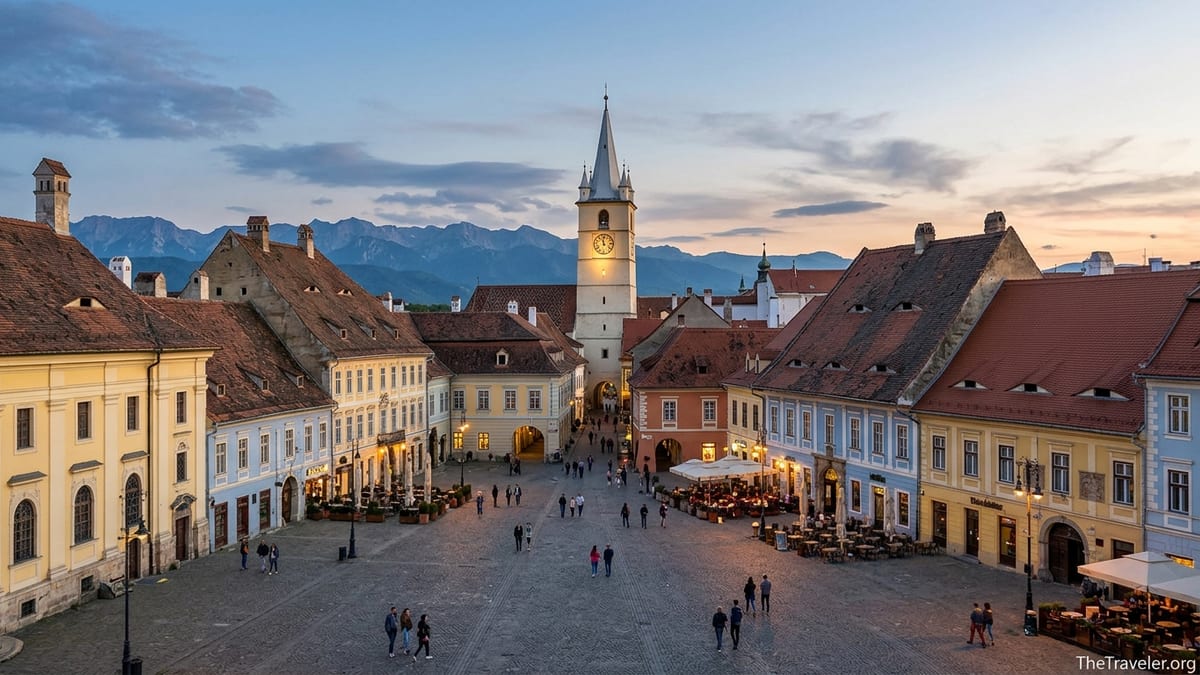
Sibiu’s historic center is compact enough to explore entirely on foot in one day. A logical start is Piața Mare, the “Big Square,” ringed by pastel facades and the Brukenthal National Museum complex. From here, you can climb the Council Tower for one of the city’s finest panoramas. The tower usually opens daily in the late morning through late afternoon, with last entry in the early evening and a modest admission of a few lei. Exact hours vary by season, so it is sensible to confirm at the base on arrival in the square.
From Piața Mare, slip through the passage toward Piața Mică, the “Little Square.” Here you start to notice Sibiu’s famous “eyes of the city” roof windows: narrow arched openings built into the steep tiled roofs of merchants’ houses. Historically these were functional ventilation openings for attics and granaries, but from street level they resemble watchful eyes peering over the square. Many visiting photographers like to shoot from the middle of the square using a wide angle lens to capture both the cobbled surface and the line of “eyes” above the arcades.
Continue across the cast iron Bridge of Lies, dating from the mid 19th century, whose legends range from oath breaking lovers to feuding traders. From its balustrade you have atmospheric views down into the Lower Town’s narrow streets. A short climb leads back up toward the Evangelical Cathedral and Huet Square, where you can appreciate some of the oldest Gothic architecture in the city. The Evangelical Cathedral often charges a small entrance fee to visit its interior and the tower; opening hours are generally from late morning to late afternoon, though in winter or during services access can be restricted.
After Huet Square, descend via the historic stairways or cobbled ramps to the Lower Town. Here the atmosphere feels quieter and more residential, with long rows of stepped gables and sections of the old fortifications such as Strada Cetății, where preserved towers and bastions flank a tree lined promenade. You can walk this route back toward the upper level near Piața Unirii, then curve around to finish once more at Piața Mare for dinner. The entire loop, including breaks for coffee and a mid day lunch, usually fits comfortably into a full day without rushing.
Museums and culture: Brukenthal, churches and living history
The Brukenthal National Museum is among Romania’s oldest art museums and still one of its most prestigious. Its collection is spread over several buildings, including the Brukenthal Palace on Piața Mare, the Museum of Contemporary Art on Strada Tribunei and the History Museum in the Old Town. In 2026, parts of the complex are undergoing phased renovations, so certain exhibition halls or auxiliary buildings may be temporarily closed at any given time. The main palace galleries, however, remain the centerpiece with European painting, Transylvanian art and period interiors.
Standard adult tickets for the Brukenthal Palace are typically priced in the tens of lei rather than hundreds, with separate or combined tickets available if you want to visit multiple sections in one day. Discounts apply for students, seniors and children. A focused visit to the palace galleries alone takes around 1.5 to 2 hours, while adding specialist museums like the Pharmacy Museum or the contemporary art wing can easily fill half a day, especially for art enthusiasts who read interpretive labels closely.
Beyond Brukenthal, the Evangelical Cathedral of Saint Mary at Huet Square, the Orthodox Holy Trinity Cathedral near the upper ring of boulevards and various Roman Catholic churches all contribute to Sibiu’s layered religious history. Many allow visitors inside outside of service times, often free or for a small fee to access towers or crypts. For travelers with a strong interest in history and architecture, combining Brukenthal, the Evangelical Cathedral interior and a walk along the old fortifications creates a rich cultural day without leaving the center.
Those seeking more contemporary culture should look for events at the city’s theatres and cultural centers. On summer weekends, you might find open air film screenings, classical concerts or theater performances in courtyards and squares. While specific programs change year by year, Sibiu’s role as former European Capital of Culture continues to influence its calendar, so checking the tourist office on Piața Mare for current exhibitions and performances is worthwhile if you plan your weekend around the arts.
ASTRA Museum and Tursib 13: planning a full day in Dumbrava Forest
The ASTRA Museum of Traditional Folk Civilization, a few kilometers south of the center in Dumbrava Forest, is one of Romania’s most impressive open air museums. Its extensive grounds ring a small lake and hold hundreds of traditional houses, farmsteads, watermills and wooden churches relocated from different regions of the country. Even a brisk circuit with only brief stops takes several hours; most visitors who want to go inside multiple houses, linger at craft demonstrations and enjoy a meal on site should allocate at least four to five hours.
In late 2026, standard adult admission to ASTRA is typically in the range of a few dozen lei, with reduced prices for children, students and seniors and free or discounted entry on certain official days. Opening hours are usually from morning to early evening, with extended summer hours when daylight is long. The museum is open year round, although in deep winter some outdoor exhibits may close temporarily during heavy snow, and walking between scattered homesteads can take longer on icy paths.
Getting there without a car is straightforward on Tursib bus 13, which runs from Sibiu railway station and central stops such as those near the old fortifications along Calea Dumbrăvii to the Muzeul ASTRA terminus. As of updates in September and April 2026, line 13 serves the stop Dumbrava 2 and continues to Muzeul ASTRA with frequent departures roughly every 15 to 20 minutes during the day, starting before 06:00 and running until nearly midnight. A single urban ticket is priced at the standard Sibiu city fare, and you can pay by contactless card on board or purchase tickets at Tursib agencies, vending machines or via the SibiuBus app.
Because ASTRA’s grounds are so large, trying to combine a meaningful visit there with other major attractions in the same afternoon is unrealistic. For example, arriving at the museum after lunch and leaving around closing time leaves only three to four hours, barely enough to walk the main loop, much less listen to guides, attend craft workshops or pause at the lakeside terraces. A better plan is to dedicate most of one day to ASTRA: catch bus 13 from the station or center mid morning, spend the bulk of your daylight hours exploring the site and have a late afternoon return to enjoy an early dinner back in the Old Town.
Păltiniș and the mountains: Tursib 22 and realistic excursions
Păltiniș is Romania’s highest permanent mountain resort, set amid forests and meadows south of Sibiu. It is accessible without a car using Tursib route 22, which in 2026 operates a limited but reliable timetable. Recent schedules and local reporting indicate three daily departures from Sibiu railway station at around 07:00, 11:00 and 16:00, with return services from Păltiniș at approximately 09:00, 13:30 and 17:30. The timetable published for April 2026 and later confirmed by local travel guides describes these same patterns.
On 2 November 2026, Tursib published updated fares indicating that a single ticket on line 22 costs 12 lei, while a two trip ticket costs 21 lei. Tickets are sold at Tursib agencies, vending machines, online, in the SibiuBus app and even at a ticket machine on the coach itself, and payments by contactless card are accepted. The bus route runs from Sibiu Gară through neighborhoods on the south side of the city, then passes through the traditional village of Rășinari and continues via mountain road curves to Păltiniș, with the full journey taking roughly one hour each way.
Given these timings, a realistic day trip might use the 07:00 departure, arrive in Păltiniș around 08:00, enjoy several hours of walking on forest paths or ski runs, then return on the 13:30 bus to be back in Sibiu mid afternoon. Alternatively, catching the 11:00 bus up and the 17:30 bus down allows a full afternoon on the plateau. In winter, the early bus is particularly useful for skiers headed to the Arena Platoș slopes near Păltiniș, while in summer it suits hikers who want cooler morning temperatures for climbs and ridge walks.
Travelers should be realistic about mountain weather. In winter, snow and ice are common from late November into March, and even in April pockets of snow may linger on shaded trails. The bus still runs, but paths can be slippery and windchill on the open meadows can be severe; proper boots and layered clothing are essential. In summer, afternoon thunderstorms can build quickly, so plan walks that allow you to be back near the resort or bus stop before late afternoon storms. For those without a car, Păltiniș is still a feasible excursion, but the fixed bus times and potential for sudden weather changes mean it fits best as a full third day rather than a rushed half day add on.
Village and countryside day trips: Rășinari, Cisnădioara, Biertan and the Transfăgărășan
Not every rural excursion requires a mountain road. The pastoral village of Rășinari lies directly on the route of Tursib 22, which means you can ride the same bus used for Păltiniș and simply get off earlier. Rășinari is known for its Orthodox churches, traditional houses and cheese production. Walking the main street and side alleys gives a feeling of old rural Transylvania while remaining well connected to Sibiu. As with Păltiniș, the limited number of daily buses means you need to build your schedule around the line 22 timetable.
Cisnădioara, a short distance southeast of Sibiu, crowns a hill with an 800 year old Romanesque fortified church and offers fine views toward the Cindrel Mountains. While some Tursib routes and metropolitan buses serve neighboring Cisnădie, reaching Cisnădioara itself usually involves a combination of public transport plus a substantial uphill walk or a short taxi or rideshare from Sibiu. Visitors describe combining Cisnădioara and nearby Cisnădie in a single day, stopping at cafes such as Agora in Cisnădioara’s gardens, but this works best with a car or prearranged driver because local bus timings can be sparse outside commuter hours.
Biertan, with its UNESCO listed fortified church and atmospheric Saxon layout, makes for a memorable day trip from Sibiu but is not easy by public transport alone. Getting there often involves first reaching Mediaș or Sighișoara by train or bus, then using local buses or prebooked transfers to the village. As a result, many travelers choose organized tours or private drivers that combine Biertan with other fortified churches such as Alma Vii or villages in the Târnava Valley. For visitors using Sibiu as a base for southern Transylvania, Biertan is one of the most rewarding but logistically demanding side trips.
The Transfăgărășan mountain road, often named among the world’s most dramatic drives, lies further to the east and south across the Făgăraș range. It is effectively impossible to experience the high alpine stretch near Bâlea Lake by public bus alone. No regular Tursib city route crosses the ridge, and the road itself typically opens only in summer months, often from late June through October, depending on snow conditions. Reaching it from Sibiu usually means hiring a car, joining an organized tour or arranging a private driver. For first time visitors limited to a car free weekend, Păltiniș and the accessible villages offer more realistic mountain experiences.
Two or three day itineraries with budget examples
A practical two day plan for Sibiu centers on the historic core and ASTRA. On Day 1, walk the Old Town route: start in Piața Mare, visit the Brukenthal Palace galleries, climb the Council Tower, continue through Piața Mică and across the Bridge of Lies, explore the Evangelical Cathedral and Huet Square, then descend to the Lower Town and follow the old fortifications back toward the upper boulevards. Allow time for coffee breaks in Piața Mică or along Strada Cetății and dinner back in Piața Mare or the Lower Town, where traditional restaurants serve local dishes such as ciorbă and Transylvanian stews.
On Day 2, dedicate your time to the ASTRA Museum. Take Tursib 13 from the railway station or a central stop mid morning, arriving at Dumbrava Forest around opening time. Spend four to six hours walking through regional farmsteads and craft workshops, pause for lunch at one of the on site restaurants or terraces, then return to the city in late afternoon. If energy allows, an evening stroll back through the Old Town squares or along the fortifications provides a different nighttime atmosphere and photo opportunities.
For a third day in fair weather, choose either Păltiniș or a village combination. In summer, a Păltiniș day might follow the 07:00 or 11:00 Tursib 22 bus up and the 13:30 or 17:30 return, with a couple of easy forest walks and a lunch stop at a mountain guesthouse. In shoulder seasons, or for travelers who prefer history to hiking, a village loop with a rented car or private driver to Cisnădioara and Cisnădie, or a longer tour that includes Biertan, can be more rewarding.
Accommodation prices fluctuate with season and events, but a mid range double room around Piața Mare or on quiet central streets might be in the region of 300 to 450 lei per night, with breakfast often included. Guesthouses in the Lower Town or slightly outside the core may drop to 220 to 300 lei for a double, while budget hostels and simple pensions can sometimes undercut 200 lei for solo travelers. A city bus ticket currently costs about the standard local fare for urban lines and 12 lei for the long distance Păltiniș route; museum tickets for Brukenthal and ASTRA together for one adult generally add up to under 100 lei.
Putting this together, a solo traveler staying two nights in a central guesthouse at 280 lei per night might spend roughly 560 lei on accommodation, 80 to 100 lei on museum entries, about 40 lei on local buses including one round trip on line 13, and perhaps 150 to 220 lei per day on meals, coffee and occasional drinks. That yields a rough two day budget in the vicinity of 1,200 to 1,400 lei. A couple sharing a 360 lei double room for two nights (720 lei total) might together spend 160 to 200 lei on museums, 80 to 100 lei on buses including two single Păltiniș tickets if they add a mountain day, and 250 to 350 lei per day on food, giving a three day estimate around 2,000 to 2,400 lei depending on dining choices.
Where to stay and practicalities of walking, weather and accessibility
Staying directly around Piața Mare offers unbeatable proximity to the main sights and an atmospheric view of the square’s roofs and towers. Hotels and apartments here are usually in historic buildings, often with thick walls, original beams and the signature roof “eyes.” You can walk to Brukenthal, the Council Tower, Evangelical Cathedral and most restaurants in five minutes or less. The trade offs include higher prices, limited on street parking and some late night noise during festivals or weekend evenings.
The Lower Town and streets descending from Piața Mică offer a slightly quieter ambience, with cobbled lanes, traffic calming and a mix of residential houses and guesthouses. Walking back up to Piața Mare involves climbing one of the stairways or sloped streets, which can be steep for those with limited mobility but remain short in distance. Here, prices for accommodation can be a bit lower than on the main square, and access by car is somewhat easier, although historic restrictions mean parking may still be a few minutes’ walk from your door.
Quieter central streets just outside the densest historic core, such as those near the upper ring boulevards, balance walkability with easier driving and often better access to parking. From these areas you can still reach Piața Mare in 10 to 15 minutes on foot, yet you might gain a modern lift, smoother pavements and proximity to supermarkets. For travelers arriving by car and planning day trips into the countryside, these districts can be particularly practical.
Cobbled streets and stairways are part of Sibiu’s charm but can present challenges. In dry conditions, walking around the Old Town poses few issues beyond the need for comfortable, supportive shoes. In winter, ice patches often form on the shaded stairways between the Upper and Lower Towns and on sections of the old fortifications. People with reduced mobility may find the irregular surfaces tiring, and some historic buildings lack lifts. When booking, it is worth asking hotels explicitly about elevator access and step free routes, especially if you rely on a wheelchair or have joint problems. Using buses to reach ASTRA and Păltiniș reduces driving stress, but boarding involves a step up to the coach, and the long open air paths at ASTRA and forest tracks at Păltiniș are not fully accessible.
Who will enjoy Sibiu: families, history lovers, photographers and explorers
Sibiu works especially well for families. The walkable Old Town keeps distances manageable for children, and the squares provide open space to run while parents sit at cafe terraces. The ASTRA open air museum adds interactive learning: many children enjoy entering wooden houses, watching craftspeople at work and playing near the lakeside. A family using public buses can visit both the Old Town and ASTRA over two days without needing a car, and older children may appreciate a third day’s bus trip to Păltiniș for forest walks or summer tubing runs at nearby slopes.
History enthusiasts will find layers of narrative in Sibiu’s architecture. The Lutheran heritage in the Evangelical Cathedral, the Orthodox presence in its grand cathedral on the ring boulevard, and the Baroque elegance of Brukenthal Palace trace the city’s multicultural past. Day trips to nearby fortified churches such as Cisnădioara or farther afield to Biertan deepen this picture of Transylvanian Saxon settlement and defense. Travelers who plan ahead with train timetables and driver bookings can use Sibiu as a base to explore southern Transylvania’s castles, churches and palaces over several days.
Photographers benefit from Sibiu’s shifting light. Early morning views across Piața Mare, when delivery vans still share the cobbles with a few locals, reveal muted pastel facades and crisp “eye” windows under slanting sun. Late afternoon sees warm light on the Evangelical Cathedral tower and the roofs of the Lower Town from vantage points on the fortification walls. The Council Tower, Huet Square and the Bridge of Lies all offer classic shots, while ASTRA’s wooden churches and lakeside reflections reward slower, more contemplative photography. In winter, snow on Păltiniș’s spruces and ski slopes contrasts with ochre buildings and black church roofs back in Sibiu.
For travelers using Sibiu as a gateway to southern Transylvania, the city offers a balanced base. You can arrive by train or plane, settle into a central guesthouse, and over two or three days combine Old Town walks, major museums and accessible excursions into the countryside. With accurate knowledge of current Tursib routes 13 and 22, realistic expectations about mountain weather and an honest appraisal of walking comfort on cobbles and ice, Sibiu becomes not just a beautiful postcard destination but a practical, enjoyable hub for exploring one of Romania’s most compelling regions.