


More news on this day
An Air Canada itinerary expected to take roughly 11 hours to Europe reportedly stretched into about 40 hours of cascading delays and rebookings, capped by a 15-euro airport food voucher that has fueled renewed debate over what stranded passengers should receive when trips unravel.
Get the latest news straight to your inbox!
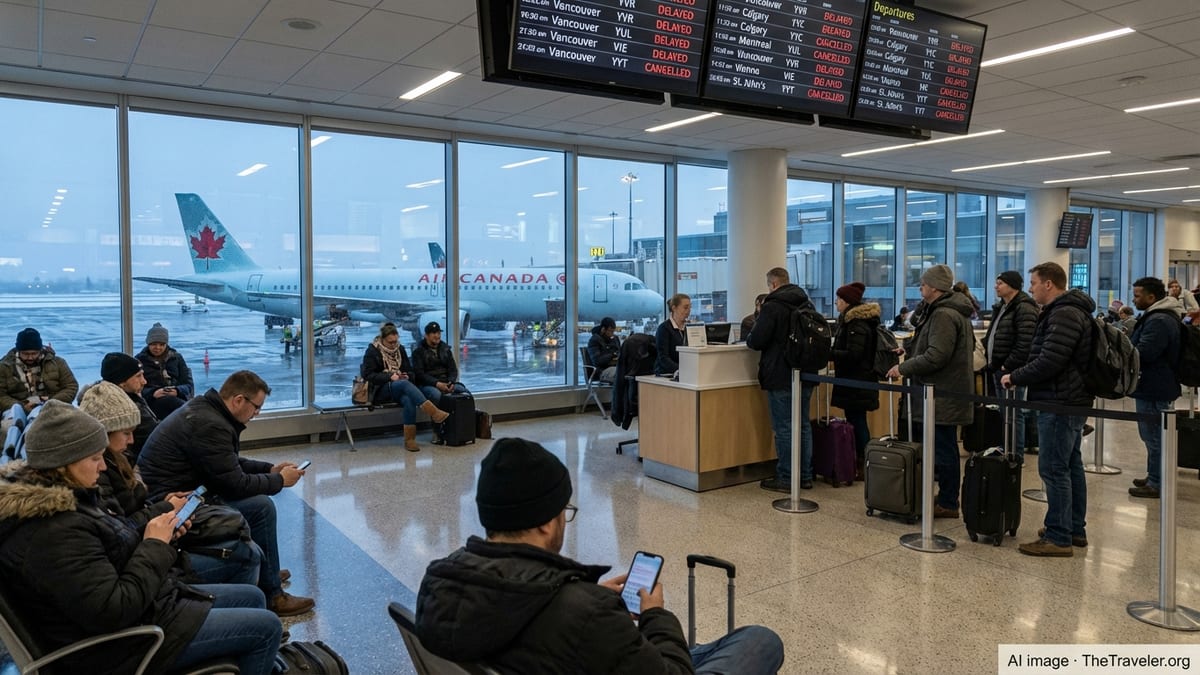
What reports say happened, and why the voucher drew attention
Published coverage describes a routine transatlantic itinerary that ballooned into a multi-stop grind after flight delays rippled through the passenger’s connections. As the wait lengthened, the reported assistance offered at the airport included a 15-euro food voucher, a figure that struck many readers as disconnected from the cost of meals in major European hubs and the scale of time lost.
While the details of any disruption can turn on a flight’s routing, the timing of gate changes, and whether the airline classified the cause as controllable, the story resonated because it reflects a common pattern in irregular operations: once a first leg slips, rebooking options narrow, seats disappear, and what began as a same-day arrival can turn into an overnight or multi-day sequence.
The sharpest point of scrutiny is not only the delay itself but the mismatch between passenger expectations and what airlines provide at the airport in real time. Meal vouchers are often presented as a quick fix, but they can be limited by value, by where they can be redeemed, and by how quickly restaurants can serve crowds when multiple flights are disrupted at once.
How Air Canada’s obligations can vary by where the disruption occurs
For travelers on a Canadian carrier, rights and remedies are not governed by a single global rulebook. Instead, obligations can depend on where the disruption happens, whether the trip is international or domestic, and which legal regime applies to the affected segment of travel.
In Canada, the Air Passenger Protection Regulations set out required standards that can include assistance such as food and drink and, when an overnight stay is necessary, hotel accommodation and transport. These duties generally hinge on the cause of the disruption and whether it is within the airline’s control, within its control but required for safety, or outside its control.
Compensation for delays under Canada’s APPR is also cause-dependent. Where a delay is within the airline’s control and not required for safety, the framework sets fixed amounts based on arrival delay at the final destination, including C$400 for 3 to under 6 hours late, C$700 for 6 to under 9 hours, and C$1,000 for 9 hours or more for large carriers.
For travelers touching the European Union, EU passenger-rights rules can come into play on certain itineraries, particularly for flights departing from an EU airport. EU rules are also known for a distinct concept of “right to care,” which can require meals and refreshments in proportion to waiting time, communication access, and accommodation when needed, alongside separate compensation rules tied to distance and length of delay in qualifying scenarios.
EU “right to care” vs. cash compensation: two different questions
One source of confusion during high-profile delay stories is that meal vouchers and hotel rooms are typically part of “care” obligations, while cash compensation is a separate track with separate eligibility tests. A small voucher may be frustrating, but it does not by itself answer whether a passenger is owed compensation, reimbursement of expenses, or a refund.
Under EU rules summarized in European Commission and EU public guidance, passengers facing long delays can be entitled to meals and refreshments in reasonable relation to the waiting time, plus communication options. Compensation can be owed in some cases when arrival delay exceeds three hours, though airlines can contest compensation if they can show “extraordinary circumstances” under the regulation’s framework.
EU guidance also emphasizes that when airlines fail to provide required care, travelers may be able to claim reimbursement of reasonable and necessary expenses, which is why passengers often keep receipts for meals, local transport, or hotels when assistance is not provided or is inadequate.
At the practical level, travelers can end up dealing with multiple systems on a single journey: a Canada-based carrier operating a transatlantic itinerary, a delay that occurs at an EU airport or outside it, and onward connections that may be on different operating carriers. In those cases, the best path to relief may depend on the disrupted segment, the operating airline for each leg, and the documented reason given for the delay.
What stranded passengers can document immediately during a long delay
When a trip begins to spiral, travelers often have only minutes to make decisions that affect refunds, rerouting, and later claims. Publicly available guidance from Canadian and EU passenger-rights sources consistently points to documentation as the difference between a clean claim and a dead end.
Passengers typically keep boarding passes, booking confirmations that show the final destination and scheduled arrival time, and screenshots of delay notifications. If an airline provides a meal voucher, travelers often save the voucher details and any written terms that limit where it can be used.
If care is not offered or is inadequate, keeping itemized receipts becomes essential. Canadian APPR guidance notes that receipts may be needed when filing a claim with the airline or escalating a complaint to the Canadian Transportation Agency, and EU guidance similarly supports reimbursement of necessary, reasonable expenses when required care was not provided.
Travelers also benefit from separating three requests that can get mixed together at the counter: rerouting to the final destination, a refund if travel no longer serves a purpose, and compensation for inconvenience where a regime provides it. Mixing these up can lead to inconsistent outcomes, especially when the airline’s system automatically closes options once one is selected.
Why these stories keep surfacing as rules evolve
High-frustration delay stories continue to circulate because the passenger experience is shaped by both law and logistics. Even when rules require “reasonable” meals or hotel accommodation, the on-the-ground reality can be long lines, limited inventory at airport hotels, and voucher systems that lag behind fast-moving rebookings.
At the same time, passenger-rights policy is not static. In Europe, institutions have been discussing updates intended to clarify obligations like care, communication, and rerouting. Separately, Canada’s APPR framework has been under ongoing public scrutiny as travelers and airlines debate how causes are categorized and how quickly claims are processed.
For consumers, the practical takeaway is that the value of a single meal voucher is only one piece of a larger question: whether the airline met its obligations to rebook promptly, provide appropriate care during the wait, and pay compensation when the rules apply. For airlines, the reputational risk can be amplified when a widely shared voucher amount appears out of step with the duration of disruption and the cost of food in the terminals where stranded passengers are told to wait.