


For many travelers, Western Union is as familiar as airport check-in and passport control. It is one of the oldest names in global money transfers and still the default option in bus stations and high streets from Mexico City to Manila. Yet in 2026, digital challengers have changed the landscape. If you are planning a trip or a long stint abroad, it is worth asking whether Western Union still makes sense compared with newer services like Wise, Revolut, Remitly, or PayPal’s Xoom. This review looks at Western Union through a traveler’s lens, using current examples to show where it performs well, where it is expensive, and how it stacks up against the competition.
Get the latest updates straight to your inbox!
Western Union at a Glance in 2026
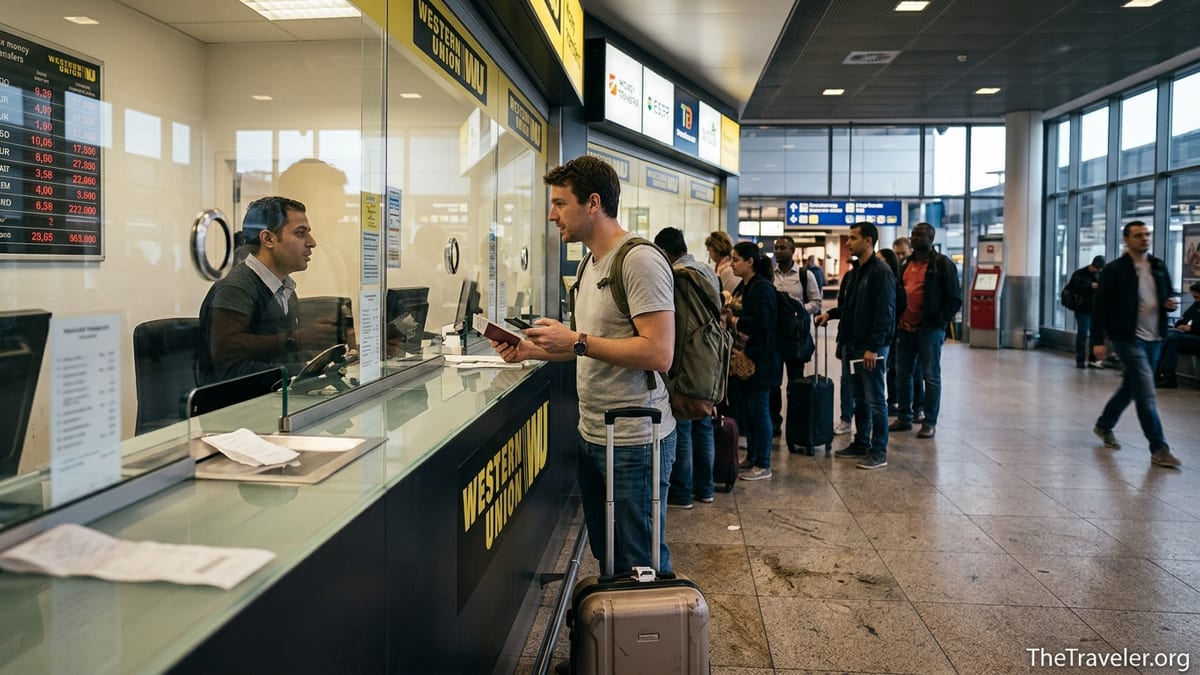
Western Union remains one of the largest money transfer companies in the world, moving tens of billions of dollars a year and serving more than 200 countries and territories. It combines a huge physical agent network, which includes banks, post offices, supermarkets, and corner shops, with a website and mobile app that let you send money from your phone or laptop. For travelers, the most visible side of Western Union is still cash pickup: the ability to send or receive currency in person, often within minutes, in places where traditional banking infrastructure is thin.
In practice, this means that a backpacker stuck in rural Peru, a digital nomad in Morocco, or a student in the Philippines can often find a Western Union counter within a short ride and collect cash in local currency with a passport and a transaction number. That physical footprint is Western Union’s core strength and a key reason it remains relevant even as digital alternatives grow.
At the same time, Western Union has pushed further into online transfers. From the United States, you can typically fund a transfer by bank account, debit card, or credit card through the app, and choose how the recipient gets the money: bank deposit, cash pickup, or in some countries mobile wallet. In major travel corridors such as the United States to Mexico or the eurozone to North Africa, transfers can arrive in minutes to a cash desk or within hours to a bank account, depending on cut-offs and local banking systems.
The trade-off for this reach and speed is price. Western Union’s total cost usually combines a visible transfer fee plus a less obvious exchange rate margin. On many popular routes this makes it more expensive than specialist online competitors, especially if you pay by card or send from a retail agent instead of using the app.
Fees and Exchange Rates: What Travelers Really Pay
When you use Western Union, you normally pay in two ways. The first is an upfront fee shown before you confirm the transfer. The second is a margin built into the exchange rate. In 2026, typical Western Union exchange rate margins for consumer transfers sit roughly in the low single digits over the mid-market rate on many main corridors, and can be higher on more exotic routes. Independent fee trackers note that Western Union often adds around 1 to 3 percent, sometimes more, to the real market rate offered between banks, and that this margin can equal or exceed the visible fee on some transfers.
To see how this looks in real life, consider a U.S. traveler sending 500 dollars to a friend in Mexico for shared accommodation costs. In June 2026, mid-market rates have often hovered around a certain level, but Western Union might quote a rate that is approximately 2 percent worse than that real rate for an online bank-funded transfer to a Mexican bank account. On top of that, a typical online fee for this sort of transfer may be around single-digit dollars. The overall cost, combining the fee and the weaker rate, can end up in the range of roughly 3 to 4 percent of the total amount. If you walk into a supermarket agent and pay with a credit card for instant cash pickup, the fee and margin can rise further.
Contrast that with a corridor where Western Union is relatively competitive. For example, some recent comparisons show that for smaller online transfers funded by bank account from the United States to India, Western Union’s fee and rate can be close to digital rivals. In certain cases, Western Union may offer promotional rates that narrow the gap, especially for new customers or specific destinations. This underlines that actual costs can vary significantly by route, amount, funding method, and payout option. The key for travelers is not to rely on assumptions but to check the live quote in the app and compare it with at least one competitor before confirming.
It is also important to understand that paying with a credit card typically increases cost. Card-funded Western Union transfers often attract higher fees, and your card issuer may treat the transaction as a cash advance, adding its own fees and interest from day one. Travelers who send money regularly while abroad are generally better off funding transfers from a bank account or debit card, even if that means planning a day or two ahead.
Speed, Convenience, and Network Coverage When You Are Abroad
One of Western Union’s enduring strengths is how quickly it can move money where traditional banking is slow. For many payouts to cash, Western Union still offers near real-time availability, sometimes within minutes, once the sender has paid for the transfer and it has been approved. This can be a genuine lifeline if your card stops working overseas or you lose your wallet and need someone at home to send emergency funds.
Imagine you are in Tirana on a Balkans trip and your main card is declined repeatedly. A friend in New York can use the Western Union app, pay from their bank account or card, choose cash pickup, and send money in dollars or euros to a local agent. Within a short time, you can walk to a branded counter in a busy commercial street, show your passport, provide the transfer number, and walk out with local currency. This sort of real-world safety net is not yet matched in every corner of the world by app-only fintechs.
Network size also matters in rural or less-developed regions. In parts of West Africa, Central Asia, and Latin America, Western Union agents are present in towns that have few bank branches and unreliable ATM networks. For overlanders driving across borders or volunteers working in remote communities, knowing there is a Western Union sign in the nearest market town can significantly reduce stress around access to funds.
On the convenience front, Western Union has made its app and website more traveler-friendly over the past few years. You can store frequent recipients, scan ID details, and track transfers in real time. Many travelers use the app to send money to themselves for pickup in local currency when they do not trust local ATMs or want to avoid carrying large amounts of cash between borders. However, account verification and compliance checks can still slow things down, especially if your profile or transfer triggers additional security reviews, so it is wise not to wait until the last minute for large or unusual amounts.
How Western Union Compares with Wise, Revolut, and Other Digital Players
For travelers comfortable with apps and online banking, the main question is how Western Union stacks up against digital-first services such as Wise, Revolut, Remitly, WorldRemit, PayPal and Xoom, or region-specific players. In most cases, these challengers target bank-to-bank or card-to-bank transfers, and sometimes multi-currency accounts, rather than cash payout. That focus often allows them to undercut Western Union on price when the recipient has a bank account or mobile wallet.
Wise, for example, typically uses the mid-market exchange rate and charges a clear fee that is a small percentage of the amount plus a fixed component. Independent comparisons in 2026 often show Wise’s total cost for bank transfers under or around one percent on many major routes, significantly below Western Union’s combined fee and rate margin on the same corridors when sending from the United States or the eurozone. Revolut, which offers multi-currency accounts and in-app transfers, can also be cheaper for weekday transfers within its fair usage tiers, though weekend markups, card top-up fees, and ATM withdrawal limits mean it is not always the lowest cost option for every traveler in every scenario.
Consider a remote worker in Lisbon paying rent to a landlord with a bank account in Brazil. With Western Union, a 1,000 euro transfer to Brazilian real funded by card could involve a visible fee and an exchange rate slightly below the market rate, leading to a total cost that can run into several percentage points. Using a service like Wise or Remitly for a bank-to-bank transfer might reduce the total cost by tens of euros on a single payment, with the exchange rate much closer to the mid-market level.
However, when the recipient needs cash or lacks access to a bank account, many of these digital competitors fall short. Some, like Remitly or WorldRemit, offer cash pickup in selected countries through local partners, but the coverage is not as universal as Western Union’s network. A traveler sending money to a trekking guide in rural Nepal, or to a family member in a village in Senegal, may find that only Western Union or a handful of traditional remittance brands operate locally. In those cases, the higher price is less about poor value and more about the cost of sustaining a physical network where few others operate.
Practical Use Cases: When Western Union Makes Sense for Travelers
For short city breaks between developed countries, Western Union is rarely the cheapest or most convenient way to move money. If you are flying from the United States to France for a week, using a fee-free travel credit card for spending and a low-fee ATM withdrawal card for cash will almost always beat the cost of sending yourself money through Western Union. Similarly, paying accommodation or tours by card or bank transfer through a low-cost provider usually works out better than wiring funds to a cash counter.
Where Western Union starts to make sense is at the edges: emergencies, cash-only economies, and situations where the person on the other end does not have reliable banking access. A common example is a parent in Chicago supporting a student volunteering in rural Guatemala. Local host families may prefer to be paid in cash, and banks may be a two-hour bus ride away. Western Union’s ability to deliver cash to a nearby town within minutes, even on a weekend, can outweigh the extra percentage point or two in cost, particularly if the amounts are modest and the support is occasional.
Another frequent use case is bill settlement or rent payment where the recipient insists on cash. In parts of Eastern Europe or North Africa, some landlords and small businesses still avoid bank transfers for tax or practical reasons. A long-stay traveler might send funds from their home-country bank through Western Union to themselves and collect local currency in person to pay in cash. The fees add up over time, but for those without a local bank account or residence permit, it can be simpler than navigating domestic banking bureaucracies in a foreign language.
Western Union is also a fall-back option for multi-country trips where card acceptance is patchy. Overlanders driving from Europe through Central Asia, or backpackers crossing multiple borders in Southeast Asia, often use a mix of local ATMs, travel cards, and occasional Western Union pickups to manage funds. Knowing you can ask a trusted contact at home to send a transfer that will be ready for pickup in a day or less in most countries is comforting when your itinerary includes regions where card terminals and ATMs are sparse.
Strategies to Reduce Costs if You Choose Western Union
If Western Union fits your travel scenario, there are several ways to keep costs under control. The most effective is to use the website or app rather than walk into an agent location. Recent comparisons indicate that online transfers funded from a bank account or debit card almost always attract lower fees than cashier-assisted transfers, and sometimes slightly better exchange rates. In a U.S. to Mexico example, an online bank-funded transfer for deposit to a bank account might cost a relatively modest fixed fee plus a moderate rate margin, while the same amount sent for cash pickup and funded by credit card at a supermarket counter can cost significantly more.
Next, avoid unnecessary credit card funding. If you can, plan ahead and use a bank transfer or debit card to fund your Western Union transfer. This not only reduces Western Union’s own fees but also avoids your card issuer levying cash-advance fees and immediate interest. For frequent travelers, pairing a low- or no-fee online bank account with the Western Union app can create a flexible emergency channel without relying on expensive credit.
It also pays to play with combinations of amount, funding, and payout in the app before you travel. Western Union’s quote tool lets you see the total fee and the rate for different scenarios without committing. You might find, for instance, that sending one larger transfer per month and withdrawing cash locally results in a lower percentage cost than several small payments. Or you might discover that bank deposit to your own local account is noticeably cheaper than repeated cash pickups, making it worthwhile to open a basic domestic account when staying several months in one country.
Finally, always compare Western Union with at least one competitor and with your travel card’s ATM withdrawal terms. Many modern debit cards now charge modest or no fees on foreign ATM withdrawals up to a monthly limit, using close-to-market exchange rates. If your destination has a solid ATM network, that often beats sending money to yourself. Reserve Western Union for the situations where ATMs do not work, local banks are unreliable, or the recipient needs cash in a different region.
The Takeaway
In 2026, Western Union is no longer the obvious first choice for every international traveler, but it remains highly relevant. Its global footprint, fast cash availability, and ability to serve people without bank accounts give it a role that slimmer, cheaper digital services cannot always fill. For emergencies, remote destinations, and cash-only situations, Western Union still provides a degree of security that many travelers value.
At the same time, the cost gap compared with modern online money transfer companies can be significant, especially for larger or regular transfers between bank accounts. Once you factor in both the visible fee and the exchange rate margin, Western Union will often cost a few percentage points more than a low-cost rival for the same route. Over a long trip or a year abroad, those differences can add up to hundreds of dollars.
If you are planning travel, the most sensible approach is to treat Western Union as one tool in your kit rather than a default solution. Use cheaper bank-to-bank services or multi-currency travel accounts where those fit, rely on low-fee cards for everyday spending and ATM withdrawals, and keep Western Union in mind for edge cases where its physical network and speed justify the extra cost. With that mindset, you can benefit from Western Union’s strengths without overpaying for the convenience it offers.
FAQ
Q1. Is Western Union still a good option for travelers in 2026?
Western Union can be a good option for emergencies, cash-only destinations, or when the recipient has no bank account. For routine bank-to-bank transfers between well-connected countries, specialist online services usually offer lower overall costs.
Q2. How expensive is Western Union compared with services like Wise or Revolut?
Western Union often charges both a visible fee and a hidden exchange rate margin, which together can add up to several percent of the transfer amount. Wise, Revolut and similar services typically use a more transparent fee structure and rates closer to the mid-market level, so they are usually cheaper for bank transfers.
Q3. When does Western Union offer the best value for travelers?
Western Union offers the best value when you or your recipient need fast access to cash in a place where banking infrastructure is weak, ATMs are unreliable, or digital transfer options do not operate. In those cases, the cost premium can be justified by the security and convenience of its agent network.
Q4. Is it cheaper to use the Western Union app than an in-store agent?
In most cases, yes. Transfers started online or in the app, especially when funded with a bank account or debit card, tend to have lower fees than those initiated in person at an agent and paid for with cash or credit card.
Q5. How can I reduce fees if I have to use Western Union while traveling?
You can usually reduce fees by funding transfers from a bank account or debit card instead of a credit card, sending through the app rather than in-store, choosing bank deposit over cash pickup where possible, and consolidating small transfers into fewer larger ones.
Q6. Is Western Union safe to use for international travel money transfers?
Western Union is heavily regulated in the United States and many other countries and uses standard security measures to protect transfers. The main risk for travelers is not safety but cost, so it is important to verify recipient details carefully and compare prices before sending.
Q7. How fast are Western Union transfers for common travel routes?
Cash pickup transfers can arrive within minutes on many routes once approved and paid for, while bank deposits may take from a few minutes to one or two business days, depending on the country, payout bank, and local clearing systems.
Q8. Can I send money to myself with Western Union while abroad?
Yes. Many travelers send money from their home-country account to themselves for pickup in local currency at a Western Union agent. This can be useful when ATM networks are unreliable or when you want to control how much cash you carry at any one time.
Q9. Are credit card funded transfers with Western Union a bad idea?
They are usually more expensive. Western Union may charge higher fees for card-funded transfers, and many card issuers treat them as cash advances with extra fees and interest. It is generally better to fund transfers from a bank account or debit card if you can.
Q10. Should I choose Western Union or a multi-currency travel card for a long trip?
A multi-currency travel card or online account paired with low-fee ATM withdrawals is usually more cost-effective for ongoing spending on a long trip. Western Union is best kept as a backup solution for emergencies or situations where you or your recipient need cash in areas with limited banking access.