


For many travelers, Western Union sits somewhere between a lifeline and a mystery. You see the yellow logo on the window of a tiny minimart in Bangkok, at the post office in a French village, or inside a supermarket in Mexico City, but what the service actually does, what it costs, and when you should use it are not always obvious. This guide breaks Western Union down in plain language, with real-world travel examples so you can decide when it is a smart tool and when you might be better off with something else.
Get the latest updates straight to your inbox!
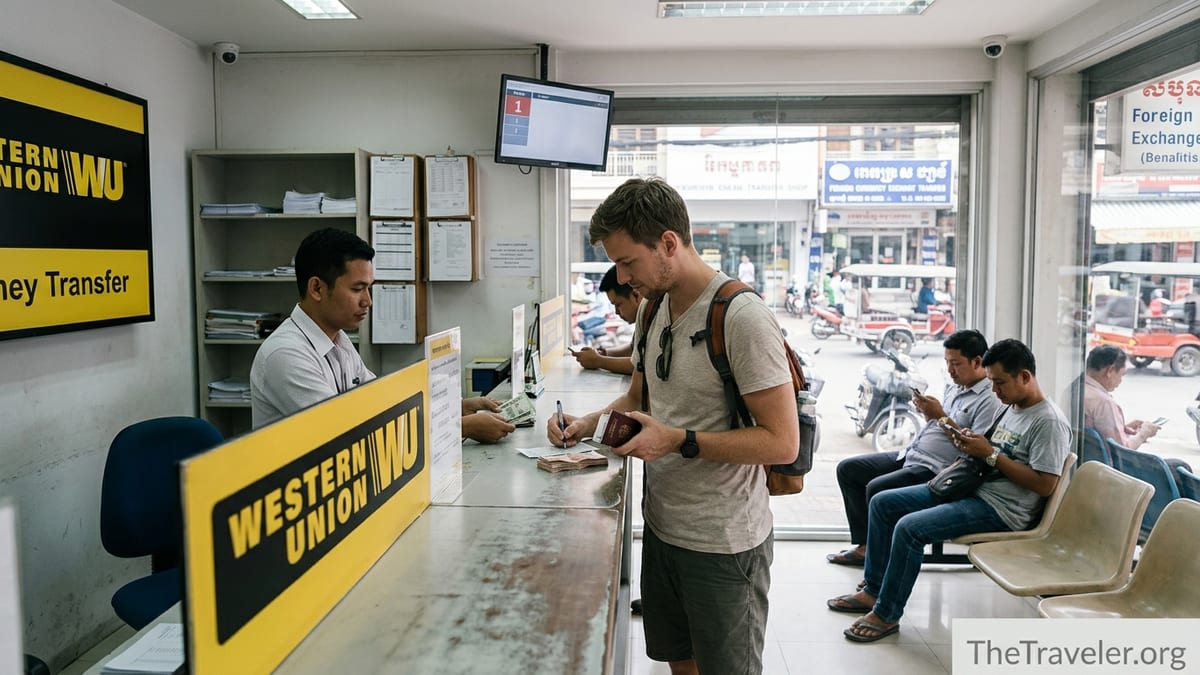
What Western Union Actually Is in 2026
Western Union is one of the world’s largest money transfer networks, best known for letting people send cash almost anywhere and have it collected in person within minutes. Instead of being a bank, Western Union operates a private network that connects hundreds of thousands of partner locations worldwide, from bank branches and post offices to grocery stores and corner shops. When you send money, the funds move within Western Union’s system rather than through a traditional bank wire, which is why cash pickup can be so fast.
From a traveler’s point of view, Western Union is mainly a way to move money across borders in three forms: cash pickup, bank deposit and mobile wallet deposit. You can pay for the transfer with a debit or credit card, a linked bank account, or with cash at an agent location, depending on the country you are sending from. Your recipient might be a friend, a guesthouse owner, or simply yourself in another country.
In practice, many people associate Western Union with emergency situations: a lost card in Peru, a stolen wallet in Thailand, or a landlord abroad who will only accept cash. It is still used heavily by migrant workers sending remittances home, but for travelers it has become a flexible backup option that works in places and situations where your bank card or usual money app does not.
Western Union has modernized in recent years. You can now set up transfers through a website or mobile app in many send countries, see an upfront estimate of fees and exchange rates before you confirm, and track your transfer with a Money Transfer Control Number, often called an MTCN. Underneath, though, the core idea remains what it has been for decades: you put money in at one point in the network, and someone else can take it out almost instantly at another point, usually in local currency.
How a Western Union Transfer Works, Step by Step
Every Western Union transaction has three main parts: how you pay, how the money is delivered, and how much it costs. Suppose you are in New York and need your sister to have 300 euros in Paris today to pay a hostel deposit. You open the Western Union app, choose France as the destination and 300 EUR as the amount for your recipient. The app shows you the equivalent amount in dollars that will be charged to you, the fee for the chosen delivery method, and the exchange rate Western Union will use to convert your dollars into euros.
You then select the payout method. If your sister wants cash pickup near her hostel, you choose cash pickup and enter her full name as it appears on her passport. If she would rather receive the funds directly into her French bank account, you choose bank deposit and enter her IBAN. To fund the transfer, you might use a US debit card or link your US checking account. Once you confirm, Western Union processes the payment and creates an MTCN. You send your sister the MTCN and, if it is cash pickup, she goes to a nearby agent with her passport, provides the MTCN and walks out with cash in euros.
Timing depends on the route and method. A cash pickup transfer from the United States to a major city in Mexico or the Philippines, paid for with a debit card, can often be ready in minutes. A bank deposit from Germany to a bank account in India might show as “within a few hours” or “by the next business day,” similar to a fast international transfer. If you schedule a transfer from your bank account on a Friday night in the United States, you should expect potential delays until Monday, just as with any financial transaction tied to banking hours.
The key detail travelers often miss is that Western Union shows you the total cost upfront, but that cost is split between the visible transfer fee and the exchange rate. You might see a low fee for a bank deposit to Europe but a less favorable exchange rate compared with the mid-market rate you would find on a currency converter. Understanding this split is crucial to deciding when Western Union is good value and when you are paying extra for speed or convenience.
Common Travel Scenarios Where Western Union Is Useful
Western Union is rarely a daily spending tool for travelers, but it becomes very useful in specific situations. One classic example is the lost-card emergency. Imagine you are backpacking in Thailand, your debit card is eaten by an ATM in Chiang Mai, and your bank can only send a replacement card to your home address in the United States. A family member back home can walk into a Western Union agent or use the app to send you the equivalent of 500 dollars for cash pickup in Thai baht. Within minutes, you can collect the cash from a Western Union counter in a 7‑Eleven or bank branch and continue your trip.
Another scenario is getting local cash in a country where ATM fees and exchange rates are particularly painful. Some long-term travelers in Argentina, for example, have used Western Union transfers to themselves because the effective exchange rate after Western Union’s conversion has, at times, been significantly better than the official bank rate. A traveler in Canada or Europe might send 300 US dollars equivalent to an agent in Buenos Aires for cash pickup, find that the pesos they receive are worth more than what they would get from a standard ATM withdrawal, and pay only a modest fee on top.
Western Union can also bridge gaps where your usual digital tools do not work. A guesthouse in rural Morocco might not accept card payments or international bank transfers, but there could be a Western Union counter at the nearest town’s post office. In that case, you can send the owner a cash pickup transfer with their full name and town, they collect the funds, and your booking is secured. Similarly, if you are volunteering in a remote part of the Philippines and need to pay a local supplier in cash, a friend in your home country can send a transfer directly in Philippine pesos for pickup in the nearest market town.
Finally, some frequent travelers use Western Union as a controlled way to budget. Instead of carrying several thousand dollars in cash for a two-month trip through Central America, they might leave the money in their home bank account and send themselves 300 or 400 dollars worth at a time for pickup in Guatemala, Honduras or Costa Rica. This reduces the risk of losing all their cash at once and lets them adapt to changing plans, though it requires discipline to compare total costs with simpler ATM withdrawals.
What It Really Costs: Fees, Exchange Rates and Example Transfers
The true cost of using Western Union has two parts. First is the explicit transfer fee, which might be a few dollars for a bank-to-bank transfer or more for cash pickup funded by a credit card. Second is the exchange rate margin, which is the difference between the rate Western Union gives you and the mid-market rate you would see on a currency converter. Even if the fee looks low, the exchange rate can add a significant hidden cost, especially on larger amounts.
For example, imagine you are in the United States and want to send 500 dollars to a friend in Spain as euros. On a typical day in mid‑2026, the real mid-market rate might be around 1.05 dollars to 1 euro. If Western Union offers you 1.02 dollars per euro, that implies roughly a 3 percent margin built into the rate. On 500 dollars, that margin alone could cost about 15 dollars in addition to any transfer fee. If the visible fee for a bank deposit is 4.99 dollars, your total cost is closer to 20 dollars, not just the fee shown on the receipt.
Costs vary by route, method and funding source. Online transfers from a US bank account to a bank account in Western Europe can sometimes have a low or even zero transfer fee but a modest exchange rate margin of around 2 percent. By contrast, a debit- or credit-card funded cash pickup from the United States to a remote town in West Africa may have a higher stated fee and a larger margin, reflecting both card processing costs and the extra work of maintaining cash availability at distant agents. Reviews in 2026 often find that in-person agent transfers are more expensive than online transfers for the same route and amount.
On smaller sums, the convenience can justify the cost. If you need an urgent 100‑dollar equivalent in Thai baht and a Western Union cash pickup costs you a total of 10 to 15 dollars in combined fees and rate margin, that may be acceptable to get you out of trouble. On repeated, larger transfers, though, the extra cost adds up quickly. Sending 1,000 dollars each month to yourself in another country via Western Union could cost hundreds of dollars a year more than using a low-cost international bank transfer app, especially when both sender and recipient have access to bank accounts and stable internet.
How Western Union Compares with Cards, ATMs and New Money Apps
To decide whether Western Union makes sense on a trip, it helps to compare it with the main alternatives: using your debit or credit card at ATMs, paying directly by card, or using specialized money transfer apps that send funds to local bank accounts. Each method has its own mix of cost, speed, and reliability, and the best choice depends on where you are and what problem you are trying to solve.
A travel debit card linked to an account that refunds ATM fees is often the cheapest everyday solution. You simply withdraw local currency at ATMs as needed, typically at or near the mid-market exchange rate set by the card network, paying only the local ATM fee if it is not refunded. For a slow, multi-country trip through Europe, this approach is usually more economical than repeatedly sending yourself money through Western Union, particularly when card acceptance is widespread.
However, ATMs and card payments break down when you do not have your card, when local ATMs are unreliable, or when merchants operate on cash only. In parts of Southeast Asia or Latin America, a hotel or landlord might only accept local cash for longer-term stays, or a local ATM network might impose strict daily limits or high fixed fees. In those cases, Western Union and similar services can be a faster or more flexible option, especially for urgent one-off transfers or in regions where modern money transfer apps do not yet cover local banks.
Modern fintech platforms that focus on international transfers, such as low-cost online remittance services and multi-currency accounts, often undercut Western Union on bank-to-bank transfers in major currencies. They usually publish transparent fees and use exchange rates much closer to the mid-market rate. If you are paying a landlord’s bank account in Berlin from a US or UK account, one of these services is likely to be cheaper than a Western Union bank deposit. Where Western Union still holds an advantage is its enormous network of cash pickup locations, including small towns and rural areas where banking infrastructure is thin and where newer apps do not yet offer coverage.
Sending Money to Yourself While Traveling
One of the most practical but least understood uses of Western Union for travelers is sending money to yourself. The mechanics are simple: you create a transfer from your home-country profile, set the recipient’s name as your own, and choose a pickup location in your destination country. When you arrive, you go to a Western Union agent with your passport and MTCN, and pick up your own money in local currency.
Consider a traveler from Chicago planning a month in Vietnam. Instead of carrying 2,000 dollars in cash, they leave most of the funds in their US bank account. Before the trip, they schedule a 500‑dollar Western Union transfer to themselves, to be picked up in Hanoi. After a week of travel, they see their initial cash run low and, from a cafe with Wi‑Fi, they initiate another 400‑dollar transfer to themselves in Da Nang, funded by their US debit card. Within minutes, the money is ready for pickup at a local bank that partners with Western Union, and the traveler never has more than a few hundred dollars equivalent in their wallet at once.
This approach can be particularly attractive in destinations where the local cash economy is dominant and card acceptance is thin, or where ATMs have low withdrawal limits. Some travelers in parts of South America have used Western Union self-transfers to bypass bank-set ATM limits of the equivalent of 50 or 100 dollars per day. By consolidating their withdrawals into fewer, larger Western Union pickups, they reduce per-transaction fees, though this must be weighed against Western Union’s own charges and rate margins.
There are catches. You must use your full legal name as shown on your passport and be prepared for local agents to request additional identification or ask simple verification questions. Some countries cap how much money you can receive per transfer or per day before extra checks are triggered. In a few destinations, foreign travelers cannot pick up money at all Western Union counters, only at certain banks or official agents. And if a transfer is flagged for compliance review, it can be delayed or canceled, which is stressful if you are counting on the cash for same-day expenses.
Risks, Scams and Safety Tips for Travelers
Because Western Union lets cash move quickly across borders, it has long been a favorite tool for scammers. The company has tightened controls in recent years, but the basic rule for travelers remains simple: only send money to people you know and trust, and never to strangers you have met solely online. Any arrangement where someone you do not know personally asks you to pay a deposit, fine or fee via Western Union should be treated with high suspicion.
A common pattern involves bogus apartment rentals or vehicle purchases in another country. A scammer will ask you to send a Western Union transfer in your own name, then send them a photo of the receipt and tell you that this “proves” you have the money. They may claim they cannot collect it because it is in your name, but if they can persuade a friendly or corrupt agent to bend the rules, or if they learn enough of your personal details, they might be able to withdraw the cash. To stay safe, never share full screenshots of a transfer receipt or your MTCN with anyone who does not actually need to pick up the money.
On the physical side, cash pickups should be treated like ATM withdrawals. Choose agents in well-lit, busy locations whenever possible, such as bank branches or major supermarkets, especially if you are collecting a large amount. Avoid counting cash in the street or just outside the agent’s door. If you are picking up the equivalent of several hundred dollars in a country where that is a lot of money locally, consider going with a trusted friend or asking a reputable taxi to wait for you just outside the main entrance.
If something goes wrong, such as a transfer not arriving or an agent refusing to pay out, you should contact Western Union support and keep all documentation. Refunds are possible when funds have not yet been collected, though they can take time to process, especially across time zones and public holidays. In disputed cases, having a clear record of what you sent, when, and to whom will help you argue your case, whether you are dealing with Western Union directly or with your bank or card provider.
The Takeaway
Western Union is neither a relic of the pre-internet age nor the ideal everyday payment method for modern travel. It sits in a middle space: a powerful, sometimes expensive, sometimes lifesaving tool that makes most sense when other options fail or do not fit your situation. Understanding how it splits costs between fees and exchange rates, how timing and limits work, and where its global network is strongest can turn it from a confusing logo into a practical part of your backup plan.
For ordinary day-to-day spending on the road, a good travel debit card and, where available, a low-cost international transfer app will usually be cheaper and simpler. But when you are in a cash-only guesthouse in a rural town, when your wallet has been stolen, or when you need to get money to or from a country with fragile banking infrastructure, Western Union’s combination of online setup and physical cash pickup remains hard to replace. Used thoughtfully, with eyes open to the real costs and common scams, it can be one of the more reliable safety nets in a traveler’s financial toolkit.
FAQ
Q1. Can I use Western Union if I do not have a bank account while traveling?
You can. In many countries you can walk into an agent location with cash, pay for the transfer on the spot, and have your recipient collect cash at another Western Union location abroad.
Q2. How fast does a Western Union transfer arrive for cash pickup?
For popular routes and when funded by card or cash, cash pickup transfers often arrive within minutes, provided both the sending and receiving locations are open and there are no extra compliance checks.
Q3. Is Western Union cheaper than using a travel debit card and ATMs?
Usually not for everyday use. Once you factor in both the transfer fee and the exchange rate margin, Western Union usually costs more than withdrawing cash from ATMs with a good travel card.
Q4. Can I send money to myself with Western Union while abroad?
Yes. You can create a transfer in your home country profile using your own full name as the recipient, then pick up the money at a Western Union agent in your destination with your passport.
Q5. What information does my recipient need to pick up cash?
They typically need the MTCN, the exact sender name, the amount expected and a valid government-issued photo ID. Local rules can require additional details depending on the country.
Q6. Are there limits on how much I can send or receive through Western Union?
Yes. Limits vary by country, route and how you pay. Online transfers can be capped in the low thousands of dollars per day, and agents may impose their own lower limits for cash pickup.
Q7. What happens if a Western Union transfer is not picked up?
If the recipient does not collect the money, you can usually request a refund from Western Union, though it may take several business days to return funds to your card or bank account.
Q8. How do I know what exchange rate Western Union is giving me?
When you set up a transfer, Western Union shows you the rate it will apply and how much the recipient will receive. Comparing this to an independent mid-market rate gives you a sense of the margin.
Q9. Is it safe to pick up large amounts of cash from a Western Union agent?
Safety is similar to making a large ATM withdrawal. Choose busy, reputable locations, avoid displaying cash in public and, for sizeable sums, consider going with a trusted companion.
Q10. When should I consider alternatives instead of Western Union?
Consider alternatives when both you and your recipient have bank accounts, the payment is not urgent, or you are sending regular amounts. In those cases, low-cost online transfer services are often cheaper.