


In the middle of the North Atlantic, the nine islands of the Azores rise from the Mid-Atlantic Ridge where the North American, Eurasian and African plates meet. This tectonic crossroads creates steep underwater canyons, deep oceanic waters close to shore and a string of young volcanic islands. For travelers, that geology translates directly into world-class whale watching, unusually rich marine life and an island landscape shaped by craters, lava flows and caves. Planning a trip here means understanding how the Mid-Atlantic Ridge underpins both the wildlife offshore and the volcanic experiences on land.
Get the latest updates straight to your inbox!
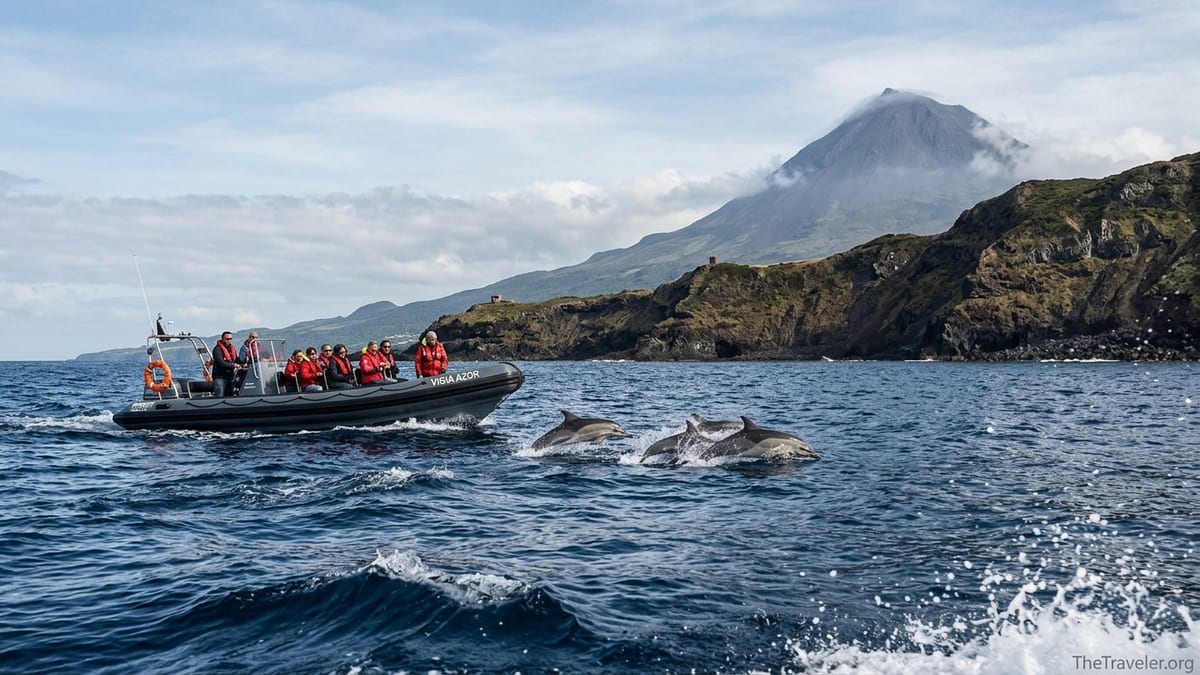
The Mid-Atlantic Ridge Beneath Your Boat
The Azores archipelago sits astride the Mid-Atlantic Ridge and associated fault systems, near a complex triple junction where the North American, Eurasian and African plates interact. The islands are the exposed peaks of massive volcanoes that rise thousands of meters from the abyssal plain. This tectonic context creates a very steep submarine topography, so deep ocean waters suitable for large whales begin just a short distance from the coast instead of hundreds of kilometers offshore as in many regions.
For whale watchers, this means that sperm whales, baleen whales and a variety of dolphins can be observed relatively close to the islands, often within a one to two hour ride from harbor. Oceanographic studies and tourism authorities note that productive upwelling zones and mixing along the ridge and nearby seamounts support dense plankton and squid, which in turn attract cetaceans throughout the year. The same processes that built the islands and their calderas therefore also sustain the marine wildlife that visitors come to see.
The ridge’s presence is also felt in the patterns of species you are likely to encounter. Deep diving sperm whales favor the abrupt drop-offs around islands such as Pico and Faial, while migratory blue and fin whales follow spring blooms associated with Atlantic frontal systems intersecting the archipelago. Understanding this link between tectonics, ocean productivity and whale movements helps set expectations for what each season can offer.
Main Whale-Watching Hubs in the Azores
Whale-watching operations are now present on most Azorean islands, but a few ports stand out as established hubs with a concentration of licensed companies and interpretation facilities. São Miguel, especially Ponta Delgada and Vila Franca do Campo, hosts some of the longest-running operators and offers daily trips for much of the year. Regional and national tourism portals highlight São Miguel as a primary gateway for first-time visitors because of its larger airport, broad accommodation base and a compact mix of marine and volcanic attractions.
Pico Island, particularly the ports of Lajes do Pico and Madalena, is another major center. Several specialist operators here focus heavily on cetacean research and naturalist-led tours, often marketing Pico as a base for intensive whale watching. Nearby Faial, using the harbor of Horta, shares the same rich channel between the two islands and also supports multiple companies. Official whale-watching directories from Azorean authorities and national tourism bodies consistently list São Miguel, Pico and Faial as the islands with the strongest infrastructure for marine excursions, including interpretation centers and experienced guides.
Other islands such as Terceira and São Jorge also offer whale watching, typically at a smaller scale. Terceira’s Angra do Heroísmo and Praia da Vitória host a handful of operators and can be attractive for travelers already based there for cultural or hiking experiences. However, if whale watching is your main goal, concentrating your limited days on São Miguel or the Pico–Faial pair generally gives you more departure options and greater flexibility to reschedule in case of bad weather.
Seasons, Species and What to Expect
The Azores are unusual in offering cetacean sightings year-round, although the mix of species changes with the seasons. According to the International Whaling Commission’s country profile for Portugal and regional tourism sources, sperm whales are recorded around the Azores in every month and tend to be more frequently observed in the warmer months from roughly late spring through early autumn. Resident dolphin species such as common, bottlenose and Risso’s dolphins also occur year-round.
Migratory baleen whales, especially blue, fin and sei whales, are most strongly associated with spring. Scientific field studies and tour operators that cooperate in research indicate that peak abundance for these large baleen whales typically occurs between about March and May, sometimes extending into early June depending on ocean conditions in a given year. Visitors focused on seeing the largest whales should therefore aim for that broad window, while remembering that migration timing can vary and no responsible company will guarantee particular species on a given day.
Summer, from roughly June to September, is characterized by generally calmer seas and warmer air and water temperatures, which can make boat trips more comfortable and increase the frequency of departures. During this period, sightings tend to be dominated by sperm whales and several dolphin species, along with occasional fin or sei whales and other seasonal visitors such as Atlantic spotted dolphins. Autumn and winter see fewer scheduled trips because of more frequent storms and swell, but some operators, particularly on São Miguel, continue running tours whenever conditions allow, with resident species still possible.
Writers should avoid inventing specific probabilities of sightings. Instead, rely on ranges and patterns described by reputable sources such as the International Whaling Commission’s whale watching handbook, official national and regional tourism portals, and established Azorean research-oriented operators. When preparing a final piece, it is advisable to include a note stating the month and year when seasonal information and species records were last verified.
How Whale-Watching Tours Operate
Most whale-watching excursions in the Azores use either rigid-inflatable boats or larger, more conventional vessels. Rigid-inflatable boats, often with powerful outboard engines, are fast and maneuverable, allowing guides to respond quickly when land-based lookouts report animals at the surface. They typically offer open-air seating with riders straddling or sitting astride padded benches, and passengers are provided with flotation jackets and sometimes waterproof outer layers.
Larger catamarans or displacement vessels, available from ports like Ponta Delgada and Horta, trade some speed for greater stability, shelter and onboard facilities such as toilets. These boats are generally a better option for families with young children, older travelers or anyone prone to seasickness. Typical excursions last around two to three hours, although some springtime trips targeting migratory baleen whales, or combined whale-and-dolphin and coastal sightseeing tours, may run longer.
Before departure, companies usually deliver a safety briefing that covers lifejacket use, seating positions, how to move safely on deck and what to do in case of seasickness. Naturalist guides or marine biologists then explain which species might be encountered, the basics of whale behavior and how local whale watching evolved from a whaling tradition. A distinctive feature of the Azorean approach is the continued use of land-based lookout posts, known as vigias. These posts, staffed by trained spotters with powerful binoculars, scan the horizon and radio boat skippers with positions, a practice rooted in the old whaling industry and now repurposed for conservation-focused tourism.
Half-day excursions typically depart once or twice daily in high season, with some operators offering a morning and an afternoon sailing to give flexibility around weather and sea conditions. When planning, travelers should allow buffer days, especially in spring and autumn, as departures can be cancelled at short notice for safety reasons. It is common to book whale watching early in a multi-day stay so that any cancellations can be rebooked later in the visit.
Responsible Whale-Watching Regulations
The Azores have a regional legal framework for whale watching that dates back to the late 1990s, refined over time to address animal welfare and visitor safety. A set of guidelines and regulations for whale watching, summarized by conservation organizations and the Regional Government, specify how vessels may approach cetaceans. These rules define parameters such as minimum approach distances, limits on the number of boats near a group of animals and maximum time spent with a particular group.
While exact numbers can change with regulatory updates, current documents indicate that vessels must reduce speed as they approach and avoid cutting across the path of animals or positioning directly in front of or behind them. There are additional restrictions around mothers with calves, including keeping greater distances and prohibiting attempts to approach very young animals alone at the surface. Boats are also required to avoid sudden changes in speed and direction that could disturb cetaceans and to leave the area if animals show signs of avoidance or stress, such as repeated long dives or abrupt changes in swimming direction.
The licensing regime places caps on the number of commercial whale-watching operators and boats in different zones of the archipelago, intended to prevent overcrowding and cumulative pressure on resident populations. Regional authorities and the coastguard monitor compliance and may inspect vessels or sanction operators that breach the rules. When preparing a final article, writers should check the latest official regulations from the Azorean Regional Government so that any mention of distances, angles or license caps reflects the most recent legal text, and should indicate the verification date in a short note.
For travelers, this regulatory framework means it is worth choosing companies that explicitly advertise adherence to responsible whale-watching guidelines, work with scientists or citizen science projects and prioritize animal welfare over chasing every possible sighting. It also means that there may be occasions when skippers decide not to approach particular animals or to leave an encounter sooner than guests expect, a decision grounded in both law and best practice.
Volcanic Landscapes: Meeting the Ridge on Land
The same Mid-Atlantic Ridge volcanism that shapes Azorean waters is written clearly across the islands’ surfaces. One of the most striking sites is the Capelinhos volcano on Faial. This flank eruption, which took place between 1957 and 1958, added new land to the island and left behind a stark, ash-covered cone beside the sea. Today the Capelinhos Volcano Interpretation Centre operates within a partially buried lighthouse building, with exhibits on the eruption sequence, local impacts and the geology of the Azores. Official natural park information confirms that the center is open to visitors with posted hours and entry fees, and that access is controlled for safety in the surrounding protected landscape.
On São Miguel, visitors can explore lava tubes such as Gruta do Carvão on the outskirts of Ponta Delgada. Regional natural monument documentation notes that only a portion of this several-kilometre-long tube is open to the public via guided tours, with fixed opening hours and specific safety rules. These include mandatory guide accompaniment, limitations for visitors with reduced mobility due to stairways and uneven ground, and restrictions on group size. Helmets are typically provided, and visitors are expected to follow instructions closely to protect both themselves and delicate cave formations.
Terceira offers further insight into the islands’ volcanic interior. Algar do Carvão, a volcanic vent in the island’s central area, allows visitors to descend along stairways into a former magma conduit now lined with basalt and trachyte, often dripping with groundwater. The managing association has announced that, after a closure linked to visitor center construction, access reopened on a limited basis in March 2026, with visits structured around set schedules and local priorities. Because operating conditions here have changed over the last few years, writers should double-check current opening times, reservation requirements and any temporary restrictions directly with managing bodies close to publication.
Several viewpoints across the islands include interpretive signage that explains the Mid-Atlantic Ridge and the Azores triple-junction setting in accessible terms. On São Miguel, viewpoints around Furnas and Sete Cidades calderas highlight volcanic origins, while on Pico and Faial, panels near coastal cliffs and lava fields often reference historic eruptions and the submarine structure of the ridge. These stops work well as land-based complements to a day on the water, helping travelers connect the tectonic story they hear on whale-watching boats with the landscapes under their feet.
Logistics, Access and Typical Costs
The Azores are connected to mainland Europe and North America by direct flights, with São Miguel’s Ponta Delgada airport serving as the main international gateway. Airlines based in Portugal and several European carriers operate regular services from cities such as Lisbon and Porto, and seasonal or year-round links from locations including London and certain North American hubs. Inter-island travel is provided by domestic flights and seasonal ferries, the latter particularly important for moving between Pico, Faial and São Jorge.
Seasonality in flight schedules overlaps with peak whale-watching periods. Spring and summer generally see the highest frequency of flights, aligning with the March-to-May window for migratory baleen whales and the June-to-September period favored by many visitors for calmer seas and warmer weather. Autumn and winter bring reduced air and ferry schedules, which can complicate island-hopping even though year-round cetacean sightings are possible. When integrating both whale watching and volcanic sightseeing, travelers should consider not only local weather but also the practicality of reaching multiple islands within their available time.
For a combined itinerary that includes at least one whale-watching outing and key volcanic sites on a single island, a realistic minimum stay is around four to five full days. This allows buffer time for tour cancellations and space for land excursions around calderas, geothermal areas or lava tubes. Travelers hoping to visit two main hubs such as São Miguel and Pico or Faial should plan on roughly a week or more, recognizing that inter-island travel can easily occupy half a day at each transfer.
Prices vary by island, operator, season and boat type, but current examples from Azorean whale-watching companies and cave attractions suggest broad ranges. As of late 2026, a standard half-day whale-watching trip on a shared rigid-inflatable or mid-size vessel commonly falls in an approximate range from the upper tens to low hundreds of euros per adult, with child discounts and higher prices for small-group or research-oriented outings. Guided visits to lava tubes or volcanic vents such as Gruta do Carvão or Algar do Carvão are typically priced in the lower tens of euros per adult. Writers should treat these as indicative examples only and clearly state that exact rates must be rechecked with operators or managing bodies near publication, noting the month and year when prices were last reviewed.
Suggested Island Combinations for Different Travelers
Because the Azores cover a wide area and inter-island travel takes time, choosing a focused combination of islands is important. For travelers primarily interested in whale watching and geology, a Pico and Faial pairing works particularly well. Pico’s ports, with their concentration of research-oriented whale-watching companies, offer multiple daily departures in season and intimate access to the deep channel that draws sperm and baleen whales. Faial, just across the water, adds the Capelinhos eruption landscape, viewpoints over the central caldera and Horta’s maritime atmosphere. With about a week, visitors can base themselves on one island and use ferries for day trips to the other, blending boat excursions with hikes on volcanic terrain.
First-time visitors who want an easier mix of marine experiences, volcanic scenery and general sightseeing often gravitate towards São Miguel. From Ponta Delgada or Vila Franca do Campo, travelers can join whale- and dolphin-watching trips, then spend other days exploring crater lakes, geothermal bathing pools and accessible lava tubes without changing islands. São Miguel’s larger infrastructure also means more accommodation, dining and rental car options, which can simplify logistics for shorter stays or family trips.
Those keen on combining whale watching with classic caldera and lava-cave experiences in a slightly quieter setting might consider pairing São Miguel or Pico with Terceira. Terceira’s Algar do Carvão and related caves offer a direct look into the archipelago’s volcanic heart, while small-scale whale watching out of Angra do Heroísmo can complement trips taken from the larger hubs. Because cave access and schedules have been subject to change in recent years, it is essential to confirm operating status and any reservation requirements when planning.
Whichever combination travelers choose, the key is to remember that every element of an Azores itinerary is shaped by the same tectonic forces. The whales offshore follow food webs nurtured by Mid-Atlantic Ridge upwellings, and the cliffs, cones and caves ashore are the visible edges of submarine volcanoes. By aligning travel plans with seasons, regulations and local logistics, visitors can experience both the marine and volcanic faces of this remarkable mid-ocean archipelago in a way that respects its wildlife and landscapes.