


On paper, Hilton Grand Vacations Club Tuscany Village in Orlando looks like an easy win: spacious villa-style suites, a pretty lakeside setting, and a location minutes from Walt Disney World and Universal Orlando. But the reality on the ground is more nuanced. Many first-timers arrive assuming it functions like a regular Hilton hotel, only to discover a timeshare-focused resort with its own rhythm, quirks, and unadvertised costs. Understanding those differences before you book can mean the difference between a relaxed Orlando base and a stay filled with small surprises.
Get the latest updates straight to your inbox!
It Feels Like a Resort, But Operates Like a Timeshare
The biggest surprise for many guests is that Tuscany Village is not a traditional Hilton hotel. It is a vacation ownership resort managed by Hilton Grand Vacations, which means a large share of people on property are owners using points, not nightly hotel guests. That shapes everything from the pace of housekeeping to the tone of interactions at check-in. You still earn Hilton Honors points and see the familiar Hilton branding, but day-to-day operations are driven by the timeshare model rather than typical hotel standards.
In practice, this can show up as fewer full-service touches than you might expect from a similarly priced Hilton resort. Daily housekeeping is not standard in the way it would be at a city Hilton; villa stays are set up more like self-catering condos, with midweek tidy service or paid daily cleaning options. Guests used to a Hilton in downtown Chicago or a flagship resort like Hilton Orlando may find Tuscany Village feels more like a condo community, with staff around but not constantly present.
Because many guests are owners returning year after year, there is also a “neighborhood” feel that can be either charming or disorienting, depending on your expectations. Pool conversations often revolve around points charts and exchange strategies. Sales representatives move around the property, greeting long-time owners by name. For a first-time visitor who simply booked a good rate on a one-bedroom suite, that culture can come as a surprise.
The ownership focus also means policies are set with long stays in mind. Check-in and checkout days tend to be busy on Fridays and Sundays, and popular room locations can be hard to secure for short stays. If you arrive expecting the flexibility of a standard hotel, you may be frustrated that certain buildings are consistently blocked by owners who reserve a year or more in advance.
Location Is Excellent, But Transportation Is Not What Many Expect
Most guests choose Tuscany Village for its location. The resort sits just off Vineland Avenue near the southern end of International Drive, directly adjacent to the Orlando Premium Outlets Vineland. You can walk from your villa to brand-name factory stores in a few minutes, and it is roughly 3 miles to Walt Disney World’s main entrance, about 4 miles to SeaWorld, and approximately 7 miles to Universal Orlando. Driving times in light traffic can be under 15 minutes to most major parks, which sounds perfect on paper.
What many first-timers do not realize is that “near Disney” does not mean “on the Disney transportation grid.” Tuscany Village is not an official Disney or Universal hotel and does not offer the kind of frequent, complimentary park transportation you find at on-site resorts. The resort has at times partnered with third-party shuttles that run fixed schedules to Disney, Universal and SeaWorld for a per-person fee, often around 10 dollars per person for Disney and Universal and slightly less for SeaWorld. These services typically require advance reservations, operate at limited departure and return times, and can fill up during busy school holiday periods.
Guests who assume they can simply hop on a free bus every 20 minutes are often disappointed. A family of four relying on paid shuttles for a week’s stay can easily add over 150 dollars to their transportation budget, especially if they want midday returns for naps. Ride-share services such as Uber and Lyft are widely available, and a typical morning ride from Tuscany Village to the Magic Kingdom area might run 12 to 20 dollars before surge pricing, but that cost doubles for round-trips and climbs rapidly during peak fireworks hours or summer storms.
For many visitors, renting a car remains the most practical choice. However, even that comes with trade-offs: congested I‑4 traffic at rope-drop and park closing, toll roads if you use certain routes from Orlando International Airport, and the need to pay parking not only at the theme parks but also back at the resort. Understanding these layers in advance helps you decide whether the convenience of having a kitchen and laundry outweighs the extra logistics compared with staying on-site at a Disney Skyliner hotel or Universal’s Endless Summer Resort.
Fees, Parking and “Value” Are More Complicated Than Advertised Rates
Hilton markets Tuscany Village as a high-value way to enjoy villa living near the parks, and nightly rates can look quite competitive compared with two standard rooms at a full-service resort. A one-bedroom suite with a full kitchen and washer-dryer can sometimes price out in the 180 to 260 dollars per night range in shoulder seasons, particularly for Hilton Honors members booking in advance. However, nightly costs do not tell the full story, and many first-time guests are caught off guard by additional fees and charges.
Self-parking at Tuscany Village currently runs around 10 dollars per night plus tax. For a week-long stay, that means roughly 75 dollars added to your bill before you even factor in park parking, which for Disney and Universal can each run more than 30 dollars per day for standard parking. If you drive to the parks every day, it is easy to spend 300 to 400 dollars on combined parking over the course of a typical family vacation, a figure many travelers fail to include when comparing resorts.
On top of parking, guests should expect the usual resort-style extras. While Tuscany Village has sometimes advertised waived resort fees under certain promotional offers, many standard bookings still include a daily resort charge that can be around 30 dollars plus tax. That fee typically covers amenities like Wi‑Fi, use of pools and fitness centers, and some scheduled activities. For a 6‑night stay, that can add approximately 200 dollars to your total. Families enticed by a low nightly rate may be surprised when the final folio reflects several hundred dollars more once taxes, resort fees, and parking are included.
There are also on-site spending temptations that add up quickly. The poolside bar and grill, coffee shop, and small marketplace offer convenience, but prices are resort-level. A couple of frozen cocktails around the main pool can easily run 30 dollars before tip, and a basic breakfast of pastries, coffee, and juice for four might edge past 40 dollars. Savvy guests use the resort’s proximity to big-box grocers and the nearby outlet’s food court to keep food costs under control, but that requires planning and at least one grocery run early in the stay.
Room Layouts Are Generous, But Views and Noise Vary Dramatically
When guests praise Tuscany Village, they often talk about the space. Even the one-bedroom suites tend to feel more like apartments than hotel rooms, with full kitchens, dining tables, living areas, washer-dryers, and screened balconies. Two-bedroom lockoff configurations allow multi-generational families to spread out, and many units come with soaking tubs in the primary bathroom and separate walk-in showers. Compared to a standard 300-square-foot hotel room, these villas can easily double or triple your living area.
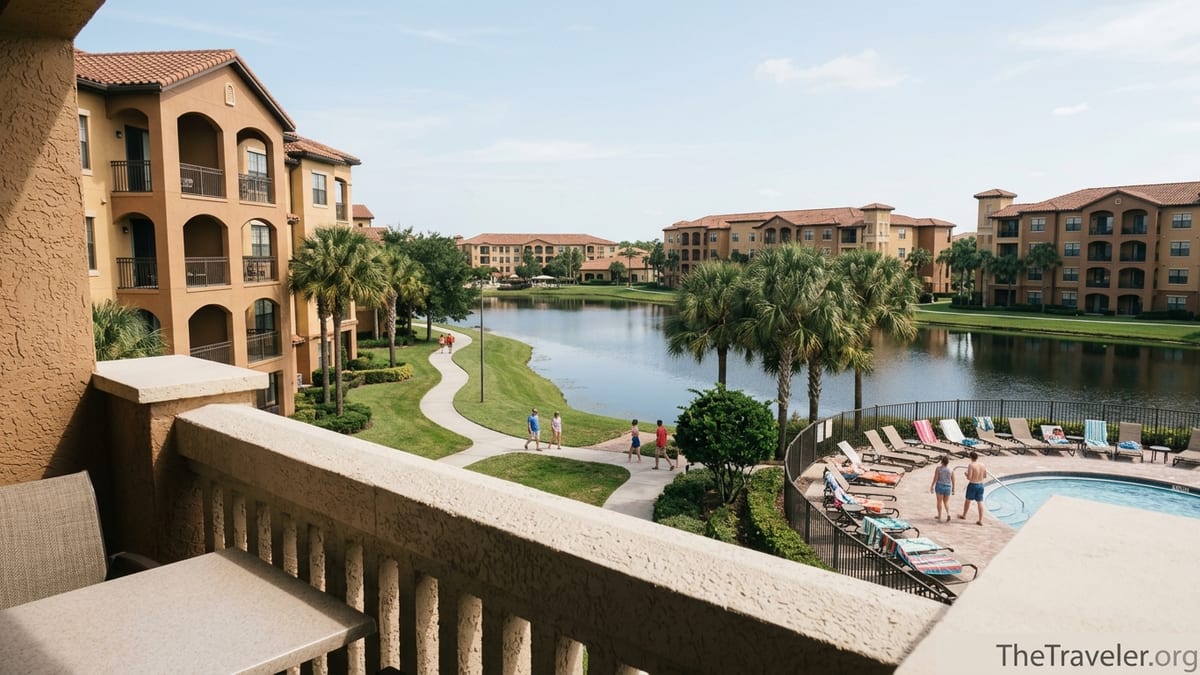
What does not always come across in glossy photos is how inconsistent room positioning can be. Some buildings have lovely views over the central lake or quiet interior courtyards, while others look toward the adjacent outlet mall or the highway. Ground-floor units near high-traffic paths can experience early morning noise from rolling suitcases and late-night chatter from returning parkgoers. Guests who expect a tranquil Tuscan escape sometimes find themselves falling asleep to the hum of nearby I‑4 rather than the sound of fountains.
Noise around the pools is another recurring theme in guest feedback. The main pool area often hosts music, organized games, and activities for children throughout the day. That energetic atmosphere suits many families perfectly, but those who envision a quiet resort pool for reading may be bothered by the constant soundtrack. Units that overlook this pool can hear afternoon activity even with balcony doors closed, while buildings farther back feel noticeably calmer but may require a longer walk to amenities.
Renovation cycles also matter. Over time, different buildings have been refreshed at different moments, so some villas feature newer flooring, updated cabinetry, and fresher furniture while others retain slightly dated decor. Reviews in recent years suggest that while overall cleanliness remains a strong point, a minority of guests encounter worn carpets, older appliances, or cosmetic wear. If you have strong preferences, consider requesting a recently updated building and a lake or interior garden view well before arrival, and follow up again a few days before check-in. Requests are never guaranteed, but polite persistence often helps.
Housekeeping, Maintenance and Amenities Are Not “Hotel Standard” Daily
Another common point of confusion involves housekeeping. Many guests arrive expecting daily full-service cleaning included in their nightly rate, as they would receive at a typical Hilton-branded hotel. At Tuscany Village, stays are generally structured as vacation rentals: you receive a full turnover clean before arrival and after departure, with a limited number of refreshes during longer stays. Shorter visits might not include automatic daily cleaning, although you can usually arrange extra service for an added fee per day.
This means you should be prepared to take on small tasks yourself, such as running the dishwasher, emptying trash into hallway chutes or designated areas, and managing towels between any scheduled towel exchanges. For families, this can be a positive, since it allows predictable nap times without housekeeping interruptions. However, guests expecting turndown chocolates and fresh linens daily may interpret the lighter-touch approach as a lack of service rather than a design feature of the vacation ownership model.
Maintenance response times can also feel different than at a pure hotel. Overall feedback suggests Tuscany Village maintains its grounds well, with manicured landscaping, clean pools, and tidy common areas. But inside the villas, a malfunctioning garbage disposal, slow-draining shower, or thermostat issue may not always be resolved within an hour, especially on high-occupancy weekends when engineering teams are stretched across hundreds of units. Guests who treat the space as a condo, report issues early, and allow flexible time windows for service generally fare better.
On the upside, the resort’s shared amenities are extensive for a property at this price point. Two main pool complexes, a children’s splash area, a fitness center, sports courts, a small arcade or activity center, and walking paths around the lake give families plenty to do on non-park days. The trade-off is that these spaces are shared across a large guest population, so pool chairs can be scarce during spring break afternoons and the fitness center may be packed before breakfast on peak dates.
The Timeshare Sales Pitch Is Real, Even If You Just Booked a Room
Perhaps the single most consistent surprise for first-time guests at Tuscany Village is the prominence of timeshare sales activity. Because Hilton Grand Vacations uses the property as both an owner resort and a sales showcase, there is a constant flow of marketing tied to vacation ownership. Guests who bought a discounted three- or four-night promotional package through Hilton or a partner brand are usually required to attend a 90-minute presentation in exchange for that low rate.
Even travelers who booked a standard nightly rate sometimes report receiving phone calls to their villa inviting them to a “member update,” “owner orientation,” or complimentary breakfast session that is, in reality, a sales pitch. Staff at the check-in desk may remind you of gift card incentives, dining vouchers, or extra Hilton Honors points if you agree to schedule a meeting. For some guests, this is a mild annoyance that they decline once and move on from. Others who attend report feeling pressured by aggressive closing tactics or uncomfortable with the high-pressure environment.
The key is to understand in advance that this is part of Hilton Grand Vacations’ business model and to decide, as a travel party, how you will handle it. If you have booked a discounted package that requires a presentation, be clear on the commitment: it usually means both adults in the room must attend together and you may spend closer to two hours in total once check-in, waiting, and follow-up conversations are included. Guests who arrive with realistic expectations, a firm budget, and a willingness to say “no” repeatedly tend to emerge with their incentives intact and minimal frustration.
If you are not on a promotional offer and prefer to avoid sales conversations entirely, you can politely decline invitations at check-in and over the phone. Being direct helps: a simple “We are not interested in vacation ownership and won’t be attending any presentations” is more effective than vague hesitations. Many frequent travelers choose Tuscany Village for the spacious villas and accept the sales presence as background noise, but it can be jarring for guests who assumed it operates identically to a standard Hilton hotel.
Planning Tricks That Make Tuscany Village Work Better
Despite its quirks, Tuscany Village can be an excellent Orlando base if you know how to work with its strengths. The full kitchens are a major asset. Stocking the fridge with breakfast ingredients and simple dinners on your first day can save a family hundreds of dollars over the course of a week. Because there are major grocery chains and warehouse clubs within a 10 to 15 minute drive, many guests schedule a quick shopping run right after check-in. Simple routines like cereal and fruit before rope-drop, or pasta and salad at night after a park day, turn the villa into a genuine home base rather than just a place to sleep.
Another practical strategy involves scheduling non-park days to enjoy the resort itself. On-site pools, the small activity center, and walking paths around the lake can easily fill a full day, especially for younger children who appreciate a break from lines and crowds. By alternating busy days at Magic Kingdom or Islands of Adventure with slower days at the resort, you make better use of the amenities your nightly rate is funding and reduce the chance that kids feel the resort is merely a crash pad.
Transportation planning is equally crucial. Before you arrive, map out your likely park days and decide whether paid shuttles, ride-share, or a rental car makes the most sense. For example, a couple visiting for three days of Universal-only touring may find ride-shares cheaper and less stressful than renting a car and paying for both resort and park parking. A family of five doing a full week of split Disney and Universal days will almost always come out ahead with a vehicle, even after stacking up gas and parking costs, simply because of the flexibility it provides for midday breaks and grocery runs.
Lastly, communication matters. Use the pre-arrival email or app messaging to request your preferred building type, floor, and view. If a balcony overlooking water or interior gardens is important, say so. If mobility issues make long walks difficult, request a building near the main pool or lobby. While no request is guaranteed, staff are far more likely to accommodate needs that have been clearly stated well ahead of time than last-minute pleas at a busy Friday check-in line.
The Takeaway
Hilton Grand Vacations Tuscany Village Orlando offers a very different experience from a conventional hotel stay, even though it shares the Hilton name and many familiar design cues. Its strengths are clear: spacious villa-style accommodations with full kitchens and laundry, an attractive lakeside setting near the outlet mall, and relatively quick access by car to Walt Disney World, SeaWorld, and Universal Orlando. For families who value space and the ability to self-cater, these advantages can more than justify the nightly rate.
At the same time, the resort’s timeshare DNA shapes nearly every aspect of the stay. Limited daily housekeeping, added parking and resort fees, paid or infrequent theme park transportation, variable room views, and the ever-present possibility of a sales pitch catch many first-time guests off guard. Those misaligned expectations are often the difference between glowing reviews and disappointed ones. Understanding the model in advance and planning around it is essential.
If you approach Tuscany Village as a condo-style resort with hotel branding, rather than as a traditional full-service Hilton, you are more likely to appreciate what it does well. Treat the kitchen and laundry as core amenities, build transportation and fee costs into your budget, and set firm boundaries around any timeshare discussions. Do that, and this sprawling Tuscan-themed property can serve as a comfortable, cost-effective launchpad for an Orlando vacation, rather than a source of unwelcome surprises.
FAQ
Q1. Is Hilton Grand Vacations Tuscany Village a regular Hilton hotel?
It operates more like a condo-style timeshare resort than a traditional hotel, with many owners staying on points and fewer automatic daily services.
Q2. Does Tuscany Village offer free shuttles to Disney and Universal parks?
The resort is near the parks but does not typically provide frequent, complimentary shuttles like on-site hotels; third-party paid shuttles or ride-shares are more common.
Q3. Is there a resort fee or extra charge beyond the nightly rate?
Many stays include a daily resort charge plus nightly self-parking, which can add hundreds of dollars over a week, so it is wise to confirm costs before booking.
Q4. How often do they clean the rooms during a stay?
Daily full housekeeping is not standard. You receive a thorough clean at check-in and check-out, with limited refreshes or extra cleaning available for a fee.
Q5. Are the villas really larger than typical hotel rooms?
Yes. Even one-bedroom suites usually feature a separate living area, full kitchen, dining space, washer-dryer, and a screened balcony, offering significantly more space than a standard room.
Q6. Is the resort noisy, especially around the pools?
The main pool can be lively with music and activities during the day, and some units near high-traffic areas may hear noise; buildings farther from pools are generally quieter.
Q7. Will I be pressured to attend a timeshare presentation?
Guests on promotional packages are required to attend, and others may be invited, but you can decline if your booking does not obligate you to participate.
Q8. Is a rental car necessary if I stay at Tuscany Village?
A car is not mandatory, but many guests find it practical for park visits, grocery runs, and flexibility, especially once they factor in shuttle costs and schedules.
Q9. Are there grocery stores and dining options nearby?
Yes. There are several supermarkets, big-box stores, and casual restaurants within a short drive, and the adjacent outlet mall’s food court offers additional quick options.
Q10. How far in advance should I request a specific building or view?
Submit preferences as early as possible, ideally when booking and again a few days before arrival; while nothing is guaranteed, early clear requests have a better chance of being honored.