


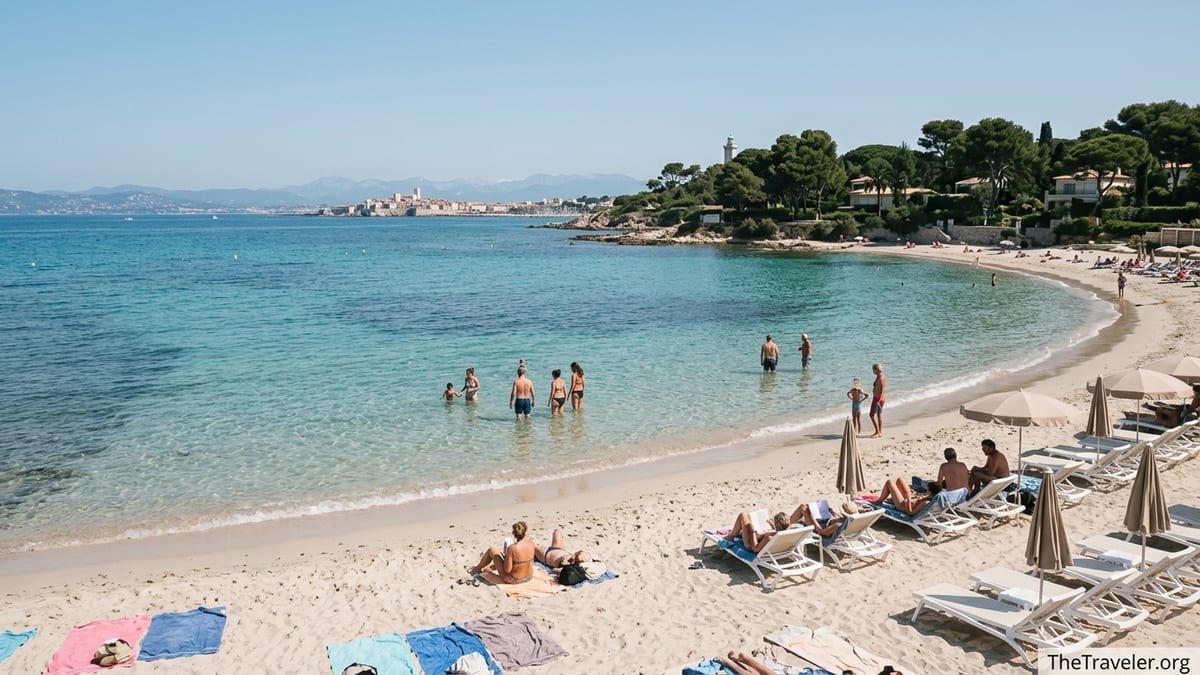
Cap d’Antibes is hardly short on beautiful places to lay a towel, from tiny rocky coves to polished hotel beaches that feel like private clubs. Yet ask people who know the peninsula well to name its most emblematic stretch of sand, and Plage de la Garoupe comes up again and again. Curved like a shallow shell on the eastern side of the cape, with pale sand, turquoise shallows and a backdrop of pines, it manages to feel both thoroughly Riviera and surprisingly intimate. What sets it apart from the other beaches along Cap d’Antibes is not just the view, but the way landscape, history and daily life all converge here.
Get the latest updates straight to your inbox!
A Rare Sandy Crescent in a Mostly Rocky Cape
One of the first things that makes Plage de la Garoupe different from other beaches on Cap d’Antibes is the sand itself. Much of the peninsula’s shoreline is rugged and rocky, with concrete platforms cut into the stone at spots like the small coves off the coastal path or the tiny swimming areas near Port de l’Olivette. By contrast, Garoupe forms a natural-looking sandy crescent, shallow and sheltered, which is relatively uncommon along this particular stretch of the Côte d’Azur.
For practical purposes, that means Garoupe works especially well for visitors who prefer sand underfoot rather than pebbles or rocks. Families often base themselves here because children can wade into the sea gradually, instead of clambering down ladders fixed to rock slabs as they might at wilder spots along the cape. The slope into the water is gentle enough that you will see toddlers playing at the edge while their parents sit just a few metres back, something less feasible on steeper or rockier coves.
The water quality is another point in Garoupe’s favour. The bay is relatively enclosed and protected from strong swell by the curve of the cape, so the sea is often calm and clear. On many summer mornings, visibility is good enough to see small fish darting around the ankles of swimmers standing waist-deep. Snorkellers who are used to rougher seas on the exposed southern side of Cap d’Antibes, particularly around the Tire-Poil path, often comment on how pleasantly tranquil Garoupe feels by comparison.
Visually, the setting is striking in a way that many nearby beaches cannot quite match. Looking out from the sand, you see the old town of Antibes to the north and, on clear days, the white peaks of the southern Alps behind it. Turn inland and the backdrop becomes a wall of umbrella pines and cypress trees, with glimpses of grand private villas set back from the road. The composition of sand, sea, mountains and greenery is quintessential Riviera and helps explain why so many postcards of Cap d’Antibes are shot here rather than on its rockier shores.
Where Public Beach Meets Iconic Beach Clubs
While Cap d’Antibes has several coastal access points, Plage de la Garoupe is unusual in how it mixes a public beach with a cluster of long-established private beach clubs in a relatively small area. The public section occupies part of the central stretch of sand, free to access for anyone willing to bring their own towel. Either side of it sit private concessions such as Plage Keller and Plage Joseph, with neat rows of sun loungers, waiter service and dedicated changing facilities.
This close coexistence creates a range of experiences in one bay. A couple on a tighter budget might settle on the public sand with a supermarket picnic, while a few metres away, guests at Plage Keller are ordering grilled fish and rosé to their loungers. Recent reviews note that a day bed with mattress and umbrella at one of the clubs typically starts around 40 euros in high season and rises for front-row places by the water, in line with other upscale Riviera beach clubs. Lunch at Keller’s restaurant, Le César, commonly runs to 40 to 60 euros per person for a main course, dessert and a glass of wine, depending on choices.
Compared with more urban beaches in Antibes or Juan-les-Pins, this patchwork layout feels particularly pronounced. La Salis Beach, nearer the town, for instance, has some private areas but is mostly open public sand, with snack kiosks and casual pedalos for rent. At Garoupe, the transition from public to private is much sharper. Wooden decks, uniform parasols and linen-clad servers at the clubs give the scene a distinctly polished look, which contrasts with the do-it-yourself feel of the towel area. For many visitors this provides a useful choice within a few steps: splurge on comfort for a day or keep costs down while still enjoying the same sea.
Another difference is service culture. The beach clubs at Garoupe tend to be significantly more low-key than the thumping DJ-led venues you might find in parts of Cannes or Saint-Tropez, yet more refined than the modest beach bars in nearby residential coves. Dress codes are relaxed but smart, and staff are used to hosting both hotel guests from luxury properties on the cape and day trippers. In high season it is common to see a mix of local residents, international visitors who return every summer and couples who have come specifically after reading about Garoupe’s reputation as one of the prettiest bays in the area.
Gateway to the Sentier du Littoral Coastal Path
Another element that sets Plage de la Garoupe apart is its role as the main gateway to the Sentier du Littoral, also called the Tire-Poil coastal path. This walking trail hugs the rocky edge of Cap d’Antibes for roughly 3 to 5 kilometres, depending on how far you go, eventually reaching the grounds near Villa Eilenroc. Many hiking guides describe Garoupe’s car park and beachfront as the natural starting point for the loop around the peninsula.
For visitors, this means Garoupe can easily anchor a full day that combines both hiking and swimming without any need for a car once you arrive. A typical itinerary might involve taking the morning bus or taxi from Antibes to the Garoupe area, grabbing a coffee from the simple café behind the beach, then setting off along the coastal path before the sun is at its strongest. The trail runs past jagged limestone, low stone walls and occasional glimpses of grand villas, with metal railings in places where the path narrows above the water. By late morning, walkers often circle back to Garoupe to cool off with a swim and a late lunch at one of the beach clubs.
Few other beaches on Cap d’Antibes offer such a straightforward link between a protected swimming area and a well-maintained coastal trail. Some coves along the path can be reached via steps from the rocks, but these are more about brief dips than settled beach days, with limited or no facilities. Starting at Garoupe, you have public parking, bus stops, restaurants and lifeguard supervision in high season, all within a few hundred metres of the trailhead. That combination of convenience and natural drama gives Garoupe a practical advantage over lonelier but less accessible spots.
For people who enjoy photography, this dual identity is particularly appealing. You can capture classic Riviera beach scenes in the morning and more rugged seascapes along the Tire-Poil route a short time later, without needing to change locations. The contrast between the manicured sand of Garoupe and the wild cliffs further south on the cape underlines just how varied this small peninsula can be.
A Strong Sense of History and Local Identity
Plage de la Garoupe is also deeply woven into the cultural and spiritual history of Cap d’Antibes. Just above the bay, up a steep path through pines and scrubby undergrowth, stands the Garoupe lighthouse and the chapel of Notre Dame de la Garoupe. The chapel has long been associated with the protection of sailors, and over time it has accumulated offerings and plaques from seafarers and families giving thanks for safe returns. From the beach, you can often see the white lighthouse tower on the hill, a reminder that this has always been a working maritime landscape as well as a leisure destination.
Visitors who walk up to the plateau are rewarded with expansive views that put Garoupe in context. Looking down, you can trace the curve of the bay, the line of the coastal path and, beyond, the outline of Antibes and the broader Mediterranean. In practical terms the climb is only about a kilometre from the beach, but with a noticeable incline, so it is advisable to tackle it in the cooler hours of early morning or late afternoon. At the top there is usually a small café or kiosk operating in season, where hikers pause before heading back down to the water.
This overlay of spiritual heritage and modern beach life gives Garoupe a character that is harder to sense from some of the newer, more hotel-centric beaches elsewhere on the cape. While Plage des Ondes, for example, is beloved for its small stone tower and west-facing sunset views, it does not have the same immediate connection to a centuries-old pilgrimage site just above it. For travellers who appreciate destinations with layers of story rather than just picture-perfect views, Garoupe’s link to the chapel and lighthouse can be a quiet but meaningful draw.
Even in everyday rituals, this history shows through. On early summer mornings, you will often see local residents walking their dogs along the shore, then heading up the Calvaire path with a rosary or simply enjoying the quiet. In July, traditional processions still connect the chapel with Antibes below. Most casual beachgoers will not time their visit around these events, but knowing that such customs are alive adds depth to what might otherwise feel like just another beautiful stretch of sand.
Atmosphere: Intimate Yet International
Although Plage de la Garoupe is among the most photographed beaches on Cap d’Antibes, it retains a more intimate feel than you might expect. The bay is relatively small compared with the long, sweeping sands of Juan-les-Pins or the larger municipal beaches closer to Antibes town. In high summer, this means it can feel crowded at midday, but it also means you are never far from the water, the shade or the exit. The compactness tends to encourage a slower, more local rhythm rather than a festival-like atmosphere.
The crowd here is distinct from some of the livelier nearby resorts. You will see families with young children in the public zone, older local couples who have been coming for decades and a steady stream of visitors from across Europe and beyond. Because the beach clubs are relatively refined, Garoupe tends to attract those looking for comfort and scenery over nightlife. By early evening, the atmosphere often softens into something close to serene, particularly outside the peak of July and August.
Language-wise, it is common to hear French, English and Italian within a few metres. Staff in the beach clubs are generally used to international clients and can switch between languages with ease, while the public area has more of a neighbourhood feel, with groups chatting among themselves and children playing in French. Compared to, say, the very cosmopolitan promenade of Cannes where English often dominates in season, Garoupe still feels rooted in its local community.
The daily rhythm reflects this blend. Mornings are busy with walkers starting the coastal path, local swimmers doing laps in the calm bay and café regulars reading newspapers on the terrace. Midday belongs to families and day trippers who arrive after a late breakfast in Antibes or Nice. Late afternoon sees a second wave of visitors who show up specifically for the softer light, looking to swim when the sun is lower and the heat less intense. This shared pattern is part of what makes Garoupe stand out: over the course of a single day you feel the beach change mood several times, yet it never quite loses its underlying calm.
Practicalities: Access, Pricing and Seasonal Nuances
From a logistical standpoint, Plage de la Garoupe can feel more manageable than some other spots on Cap d’Antibes, though there are still things to keep in mind. The beach sits roughly midway along the peninsula, a short drive from both Antibes and Juan-les-Pins. In high season, visitors staying in Antibes often take a local bus or taxi to avoid the challenge of parking along the narrow roads of the cape. There is a car park close to the beach, but spaces can fill quickly on sunny weekends from late June through August.
Costs vary significantly depending on how you choose to experience the beach. For the public section, there is no entry fee, meaning you can enjoy the same views and water as the guests in the clubs at no charge. Bringing your own towels, umbrellas, drinks and simple picnic supplies from town keeps the budget reasonable, especially for families. Ice creams and basic snacks from cafés behind the beach are priced comparably to other Riviera resorts, typically a few euros for a soft drink or a scoop of gelato.
Opting for one of the private beach clubs, however, shifts the cost profile closer to that of high-end Riviera destinations. Recent accounts from travellers describe sunbed rentals starting from around 35 to 40 euros per person for back rows, rising in price for rows closer to the sea. Beachfront loungers in August can cost more, reflecting demand. Lunch in the associated restaurants is similarly positioned: a grilled fish dish or a plate of fresh pasta with seafood might be in the 30 to 40 euro range, with starters and desserts adding to the bill. For many visitors, the premium feels justified by the quality of the setting and service, but it is worth reserving in advance by phone, especially at the height of summer.
Seasonality also affects the beach more noticeably than some of the larger urban stretches. Lifeguard presence, rental facilities and the full range of restaurant services typically operate from roughly May to late September, though exact dates can shift slightly each year. Outside these months, the beach remains accessible, but you will find fewer amenities open and the sea temperature cooler. For travellers who prefer quieter experiences and do not mind brisker water, late September and early October can be particularly pleasant, with warm days, softer light and more space on the sand.
The Takeaway
On a peninsula lined with both glamorous resorts and hidden rocky inlets, Plage de la Garoupe manages to feel like the essence of Cap d’Antibes distilled into one small bay. Its rare combination of fine sand, sheltered turquoise water and mountain-framed views would already make it special. Add to that the mix of public access and polished beach clubs, the direct connection to one of the Riviera’s most scenic coastal paths and the presence of the historic chapel and lighthouse above, and you have a place where the strands of natural beauty, history and everyday life tie together.
Compared with other beaches on the cape, Garoupe is neither the wildest nor the most overtly luxurious, but it bridges those worlds in a way few others do. Travellers can choose to experience it as a simple, no-cost beach day on the public sand, an indulgent escape with sunbed service and leisurely lunches, or the starting point for a day of hiking and exploration. Each choice reveals a slightly different side of the same landscape.
For visitors deciding how to spend limited time on Cap d’Antibes, this versatility is a strong argument for making Garoupe a priority stop. Even a short visit, perhaps timed for an early-morning swim before walking the Sentier du Littoral or for a late-afternoon dip beneath the lighthouse, can give a clear sense of what makes this corner of the Riviera unique. In a region full of celebrated beaches, Plage de la Garoupe stands out not by trying to be something it is not, but by quietly embodying everything that makes Cap d’Antibes so compelling.
FAQ
Q1. Where exactly is Plage de la Garoupe on Cap d’Antibes?
Plage de la Garoupe sits on the eastern side of Cap d’Antibes, roughly midway along the peninsula between Antibes and Juan-les-Pins, in a small sheltered bay below the Garoupe lighthouse and chapel.
Q2. How is Plage de la Garoupe different from other nearby beaches?
Unlike many rocky coves on Cap d’Antibes, Garoupe offers a sandy, gently sloping bay, a mix of free public beach and established private clubs, and direct access to the coastal hiking path.
Q3. Is there a public section, or is it all private beach clubs?
There is a clearly defined public section of sand at Plage de la Garoupe where you can lay a towel for free, alongside several private beach clubs that rent sun loungers and provide restaurant service.
Q4. How much does it cost to rent a sunbed at Plage de la Garoupe?
Prices vary by club and season, but in summer you can expect to pay in the region of 35 to 40 euros or more per person for a sunbed with umbrella, with higher rates for front-row spots by the water.
Q5. Is Plage de la Garoupe suitable for children and non-swimmers?
Yes, the sand and shallow, sheltered water make it particularly suitable for families and less confident swimmers, though normal precautions are still important and children should always be supervised.
Q6. Can I walk the Sentier du Littoral coastal path from Plage de la Garoupe?
Yes, Plage de la Garoupe is the main starting point for the Sentier du Littoral around Cap d’Antibes, allowing you to combine a coastal hike with a swim or beach day before or after.
Q7. How do I get to Plage de la Garoupe without a car?
You can reach Plage de la Garoupe by local bus or taxi from Antibes or Juan-les-Pins, then walk a short distance from the nearest stop, which is often easier than finding parking in peak season.
Q8. When is the best time of year to visit Plage de la Garoupe?
The main season runs from roughly May to late September, when lifeguards and beach clubs operate, but many visitors enjoy the quieter shoulder months of June and late September for fewer crowds.
Q9. Are there restaurants or cafés directly on the beach?
Yes, several beach clubs at Plage de la Garoupe include full-service restaurants and bars, and there are also cafés just behind the beach where you can buy drinks, snacks and simple meals.
Q10. Can I visit the lighthouse and chapel above Plage de la Garoupe?
Yes, a steep but short walk from the beach leads up to the Garoupe plateau, where you can see the lighthouse, visit the chapel and enjoy panoramic views of the bay and surrounding coastline.