


Most travelers arrive at Plage de la Garoupe with one plan in mind: claim a lounger, order a cold drink and admire the turquoise water of Cap d’Antibes. It is an easy place to be lazy. Yet wrapped around this celebrated cove is a web of stories, small rituals and overlooked corners that can turn a standard beach day into one of the most memorable stops on the French Riviera. Slow down, step away from the row of parasols and Plage de la Garoupe reveals another side of itself.
Get the latest updates straight to your inbox!
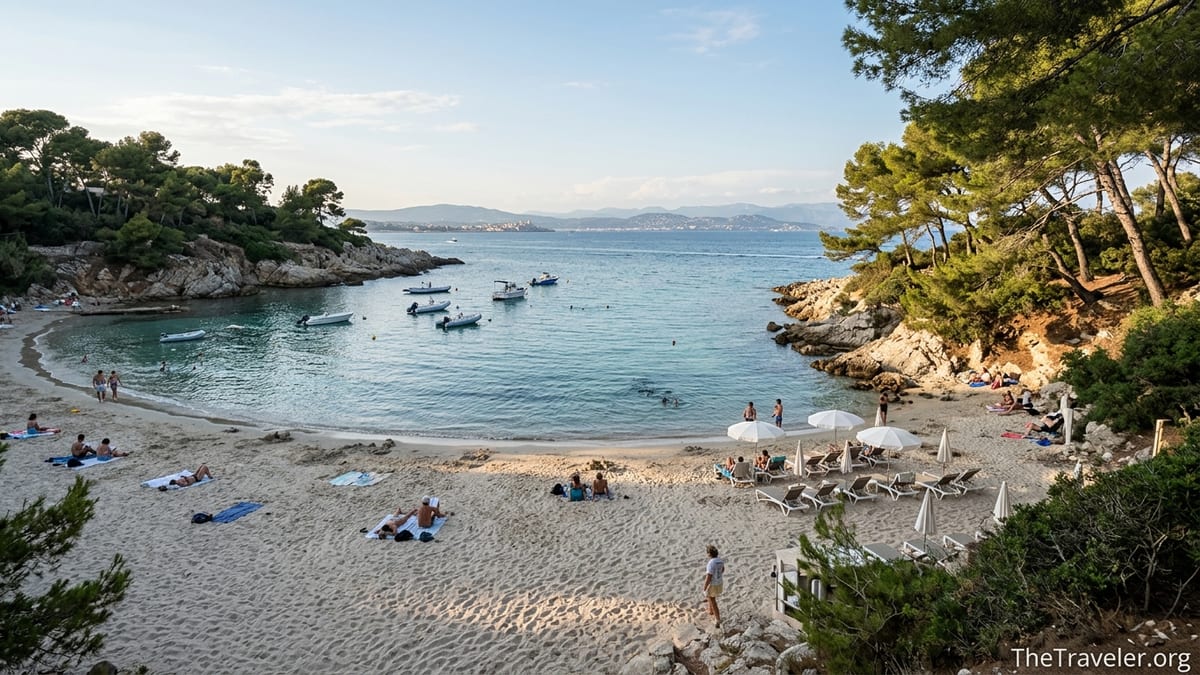
The Beach Behind the Glamour: Traces of a Literary Past
Most people who rent a sunbed at Plage Keller or Plage Joseph have no idea they are lying on the sand that helped reinvent the French Riviera. In the 1920s, American couple Gerald and Sara Murphy persuaded the Hotel du Cap to stay open in summer and spent weeks clearing Garoupe’s shoreline of old nets and seaweed to create a beach worthy of their friends. Among the guests they attracted were F. Scott and Zelda Fitzgerald, Ernest Hemingway and Pablo Picasso, who came to this very cove for long lunches, sea swims and late-night parties. You can still picture that scene if you arrive early, before the first service at the beach restaurants, when the bay is quiet and only a few boats rock at anchor.
Look closely at the curve of the bay and you will notice why the Murphys chose this exact spot. The beach sits in a small, sheltered indentation on the eastern side of Cap d’Antibes. In the calm of the morning, the sea here often looks like polished glass and the sand is unusually soft for this rocky stretch of coast. To the west, beyond the headland, you can make out the old town walls of Antibes; to the east, the skyline of Nice and, on exceptionally clear winter days, the pale outline of the Alps. Locals know that if you come just after sunrise in January or February, when the air is cold and dry, the mountains can appear startlingly sharp behind the bay.
What most visitors miss is how little of that long history is signposted on the beach itself. There are no large plaques about the Murphys or their literary circle, and if you walk straight from the car park to the nearest free stretch of sand you may never sense it. To feel the past of Plage de la Garoupe, walk the full curve of the cove at low tide. Notice the small stone slipways where fishermen once dragged up their boats, and the older villas peeking through the pines behind the beach clubs. It is in these quiet, unremarkable details that the beach’s glamorous story still lingers.
Reading the Shoreline: Public vs Private Without the Guesswork
One of the most confusing aspects of Plage de la Garoupe, especially in summer, is understanding exactly what is public and what is reserved for beach clubs. From June through September, most of the sand is taken up by neat rows of loungers belonging to a handful of private operators. Many first-time visitors assume that the entire bay is off-limits unless they pay, turn around in frustration and drive on to another beach. In reality, there is always a free public section, but it takes a little observation to find it.
As you arrive along Chemin de la Garoupe, look for the central staircase and the main access from the small parking area. From the top step you can see the division of the beach: private clubs occupying the flattest central portions, with public areas tucked to the sides and between the terraces. The simplest approach is to walk calmly along the waterline; you are allowed to cross in front of the clubs, and you will quickly see where the loungers end and the open sand begins. In high season the public strip can be only a few metres deep, but it shares the same clear water and views as the paid sections.
Costs are another detail many visitors do not anticipate. On a typical July day, a front-row sunbed at a club like Plage Keller can easily run from the equivalent of a modest hotel night elsewhere in France once you add an umbrella and a couple of drinks. By contrast, the public area often fills with local families who roll out simple straw mats bought in Antibes markets and bring cool bags from home. If you are prepared with your own lightweight umbrella and a pair of sandals sturdy enough for the hot sand and occasional pebbles, you can enjoy much the same setting at a fraction of the cost.
Hidden in plain sight is a second, more relaxed option: the rocky edges of the bay. On either side of the main sandy arc, flat rocks provide impromptu sunbathing platforms where locals spread towels in the shoulder seasons, particularly in May and late September when the sea is still warm but the beach clubs are quieter. There is no rental service here, just the slap of the waves and the cicadas in the pines. A small dry bag and swim shoes make these natural ledges surprisingly comfortable, and you gain an entirely different, less crowded perspective on the beach.
Snorkel-Friendly Corners and the Underwater Meadow
From the sunbeds, the water off Plage de la Garoupe looks like one uniform sheet of turquoise. Step into the sea and you quickly realise the seabed is a patchwork of sand, rock and seagrass, each of which attracts different marine life. The majority of swimmers tend to stay directly in front of the central sand, where the bottom is mostly clear and shallow. Snorkellers in the know wander instead towards the rocky headlands that frame the bay, especially the eastern side, which offers more texture and shelter for fish.
Follow the line of buoys that marks the swimming perimeter and you will soon see dark patches on the sea floor. These are beds of Posidonia oceanica, a protected seagrass native to the Mediterranean. To casual bathers, they can look like unattractive seaweed, and in late summer dried tufts sometimes wash ashore in thick banks that visitors complain about. Yet these meadows are crucial nurseries for fish and help keep the water at Garoupe so crystal clear. Local environmental groups regularly explain that leaving natural accumulations in place through much of the year helps combat erosion and maintain the beach’s shape.
For a more rewarding snorkel, pack a simple mask and snorkel rather than relying on hotel beach toys. Enter the water from the public side and swim slowly along the edge where sand meets rock. Even without diving deep you are likely to spot small wrasse, bream and sea urchins clinging to crevices. On calm mornings, when boat traffic in the bay is minimal, the visibility can be surprisingly good. A lightweight rash vest is useful protection against the southern sun, as very few people think to reapply sunscreen once they are happily floating on the surface.
One more detail that many people overlook is the rhythm of the day underwater. At midday in August, the shallow areas can feel crowded and noisy, with children playing and paddleboards gliding back and forth. If you wait until the final hour before sunset, the water often empties out, the heat softens and both the fish and the colours become more vivid. Locals who finish work in Antibes or Sophia Antipolis sometimes drive down just for this evening swim, pulling on fins from the boot of the car and heading straight into the gold-lit water as the beach clubs begin to stack away their loungers.
The Quiet Approach: Coastal Path, Pine Forest and Overlooks
For many visitors, Plage de la Garoupe is simply a terminus: a place where you arrive by car, circle for parking and hurry to the nearest free spot on the sand. Those who approach on foot via the coastal path experience something entirely different. The Sentier du Littoral, which traces the rocky edge of Cap d’Antibes for several kilometres, begins (for many walkers) right at Garoupe and winds past old stone walls, villas and wild coves that are invisible from the road. What looks like a single famous beach is in reality the gateway to one of the most atmospheric seafront walks in the region.
If you have half a day, park a little higher up near the Garoupe plateau or take a local bus to the lighthouse road, then descend through the pine forest towards the bay. The scent of resin and the filtered light through the Aleppo pines are a reminder that much of Cap d’Antibes remains surprisingly green despite its development. Occasionally, the trees part to reveal sudden glimpses of Garoupe’s turquoise water far below, framed by branches and the tiled roofs of villas. By the time you reach the beach, you have already absorbed the landscape that shapes it rather than stepping directly into the crowd.
Once you have had your swim, seek out the discreet signs at the edge of the cove for the coastal path that runs towards the Baie des Milliardaires. Within a few minutes you leave behind the chatter of the beach clubs and find yourself on a narrow trail carved into the rocks, protected in places by low stone walls. There are no kiosks here, only the wind and the slap of waves against the cliff. From several bends in the path you can turn back and see Plage de la Garoupe from a distance, a pale curve between dark pine forest and bright sea. It is a perspective most beachgoers never witness because it requires lacing up walking shoes instead of slipping on flip-flops.
Practical details matter on this route. The path is exposed in places, with little shade, and in summer the rock can reflect the heat strongly. A refillable water bottle, hat and non-slip footwear transform the experience from uncomfortable trudge to leisurely exploration. Start early in the morning or in late afternoon and you will share the way mostly with dog walkers and local joggers. The knowledge that you can plunge back into the sheltered water at Garoupe at the end of your loop is one of the less obvious rewards of taking the path in the first place.
Above the Bay: Lighthouse, Chapel and Votive Offerings
Few beach visitors look up. If they did, they would notice that Plage de la Garoupe is watched over from above by one of the most striking lighthouse and chapel combinations on the Côte d’Azur. The Phare de la Garoupe stands on a plateau more than 70 metres above sea level, its white tower capped with a distinctive red top. Its light has guided ships since the 19th century and still sends its beam across the Baie des Anges at night. Next door, the modest-looking Chapelle Notre-Dame de la Garoupe contains a surprisingly rich interior devoted to the sea and those who work on it.
From the beach, the lighthouse looks distant, but in reality the climb from sea level to the plateau takes well under an hour at a relaxed pace. The route follows small roads and paths that zigzag uphill between pines and past cliffside villas. Many visitors are content to photograph the tower from the car park and move on. Those who step inside the chapel discover a different world. The walls are covered in ex-votos: paintings and plaques left by sailors and their families in thanks for safe returns or rescue from storms, alongside model boats suspended from the ceiling. It is one of the few places on the Riviera where the often invisible working life of the sea is still honoured in such a direct and humble way.
Outside, the viewpoint near the orientation table offers a panorama that puts Plage de la Garoupe into context. To one side you see the curve of the beach and the pine-fringed coastline of Antibes; to the other, the islands off Cannes and, in the far distance on clear days, the line of the Esterel hills. Arrive in the late afternoon and you may share the plateau with only a handful of locals walking their dogs or couples pausing on benches before dinner. Bring a light jacket, as the breeze can be cooler than the temperature on the sand below, and give yourself time simply to sit and watch the changing light on the bay where you swam earlier.
There is a quieter cultural detail here that many overlook: the small oratory dedicated to lovers and families, created by French illustrator Raymond Peynet. Positioned a short walk from the chapel, it is an unassuming structure, easy to miss if you head straight back to the car. Pause for a moment to read the dedicatory inscriptions, which speak of protection for households and for those at sea. For travelers used to the Riviera’s focus on luxury villas and designer boutiques, this simple devotional world offers a surprisingly intimate counterpoint.
Local Rhythms, Parking Realities and When the Beach Breathes
On a bright August afternoon, when every metre of sand is covered with towels, it is hard to imagine that Plage de la Garoupe ever feels peaceful. Yet the character of the beach shifts hour by hour and season by season. Residents of Antibes and nearby villages know that Garoupe is a different place in early spring, when only hardy swimmers brave the water, and again in late autumn, when the sea is still milder than the air and the beach clubs are packing up their furniture for winter. If you can travel outside peak school holiday weeks, you may experience a cove that feels almost private.
Understanding the daily rhythm helps too. In high summer, local families often arrive early, around 8:30 or 9:00 in the morning, before the sun becomes intense. They set up simple camps on the public sand, take a long swim, then leave before lunchtime. The midday period is dominated by restaurant guests and late-rising visitors who treat the beach as an extension of their hotel terrace. As the afternoon wears on and the angle of light softens, a second influx appears: people who have spent the day exploring Antibes’ old town or arriving on late flights into Nice, heading straight to the water to wash off the heat of the journey. After 6 pm, the music from the beach clubs turns down, the staff begin to stack loungers and, often, the sea is at its calmest.
One very practical detail that even seasoned Riviera travelers misjudge is parking. The small car park directly behind the beach fills quickly in July and August, sometimes by mid-morning, and the single-lane access road can become a slow crawl of rental cars. Locals often avoid this stress by parking higher up, near the Garoupe plateau or along quieter residential streets, and walking the final descent through the pines. If you are staying in Antibes or Juan-les-Pins, consider arriving by bicycle or electric scooter on the quieter back roads, keeping in mind that you will need a solid lock and a willingness to push the bike up the hill on the way back.
Another overlooked rhythm is the weather beyond summer. The Côte d’Azur enjoys many clear winter days when the air is crisp and the light almost metallic. On such mornings, a walk along the shore at Garoupe, bundled in a light jacket, can be more rewarding than any crowded August afternoon. The beach itself may be partially “wilder,” with natural banks of seagrass and driftwood left unmanaged. This is not a flaw but a sign of a living coastline between seasons. Bring a thermos of coffee, sit on a flat rock at the edge of the bay and you will have one of the Riviera’s most photogenic beaches almost to yourself.
The Takeaway
Plage de la Garoupe is often reduced to a postcard image: a ribbon of pale sand, orderly rows of parasols and a horizon dotted with small boats. Spend a little time attending to the details and it becomes something richer. This small bay is an entrance point to a web of stories, from the Murphys’ inventive summers and the quiet devotion of sailors’ families at the chapel to the slow underwater work of the Posidonia meadows that keep its water translucent.
The visitors who enjoy Garoupe most are those who allow the beach to unfold gradually. They notice the difference between the central sand and the rocky shelves. They accept the minor inconveniences of walking down through the pines rather than fighting for a parking space. They look up to see the lighthouse that has watched over this coast for generations, and they stay long enough to watch how the mood of the bay changes as the sun shifts. In return, Plage de la Garoupe offers something that is increasingly rare on the French Riviera: the feeling that a famous place still has quiet corners to discover.
Whether you arrive for a single swim or build Garoupe into a full day that includes the coastal path, the plateau and an unhurried lunch, the key is the same: slow down. The hidden details are there in the curve of the shoreline, the ex-votos on the chapel wall, the late-afternoon glimmer under the water’s surface and the simple pleasure of watching the bay breathe as day turns into evening.
FAQ
Q1. Is there always a public section at Plage de la Garoupe in summer?
Yes. Even in peak season a designated strip of sand is kept free for public use, although it can be narrow and fills quickly.
Q2. Do I need a car to reach Plage de la Garoupe?
No. A car is convenient but not essential. You can arrive by local bus, taxi, bicycle or on foot via the coastal path from Antibes.
Q3. When is the best time of day to avoid crowds on the beach?
Early mornings and the last hour before sunset are usually quieter, even in July and August, and the light is softer and more flattering.
Q4. Is Plage de la Garoupe suitable for children and less confident swimmers?
Yes. The central part of the bay is shallow and generally calm, with a sandy bottom, making it popular with families and beginner swimmers.
Q5. Can I snorkel directly from the beach, or do I need a boat trip?
You can snorkel straight from the shore. The rocky edges of the bay and the seagrass meadows close to the buoy line are particularly rewarding.
Q6. Are the lighthouse and chapel above the beach open to visitors?
The chapel is usually accessible during the day, while access to the lighthouse tower varies. The surrounding plateau and viewpoints are freely open.
Q7. How long does it take to walk from Plage de la Garoupe to the main coastal path?
The Sentier du Littoral effectively begins at the beach. Within a few minutes’ walk from the cove you are on the cliffside section of the trail.
Q8. Is there shade on the beach if I do not rent a parasol?
Natural shade is limited on the sand. Public areas rely mostly on personal umbrellas, so bringing your own is advisable in mid-summer.
Q9. What should I wear for the walk between the beach and the Garoupe plateau?
Light clothing, sturdy sandals or trainers, a hat and a small bottle of water are usually sufficient for the short but fairly steep climb.
Q10. Is Plage de la Garoupe worth visiting outside the summer season?
Yes. Spring and autumn offer milder temperatures, fewer crowds and excellent light, while winter can be ideal for quiet coastal walks above the bay.