


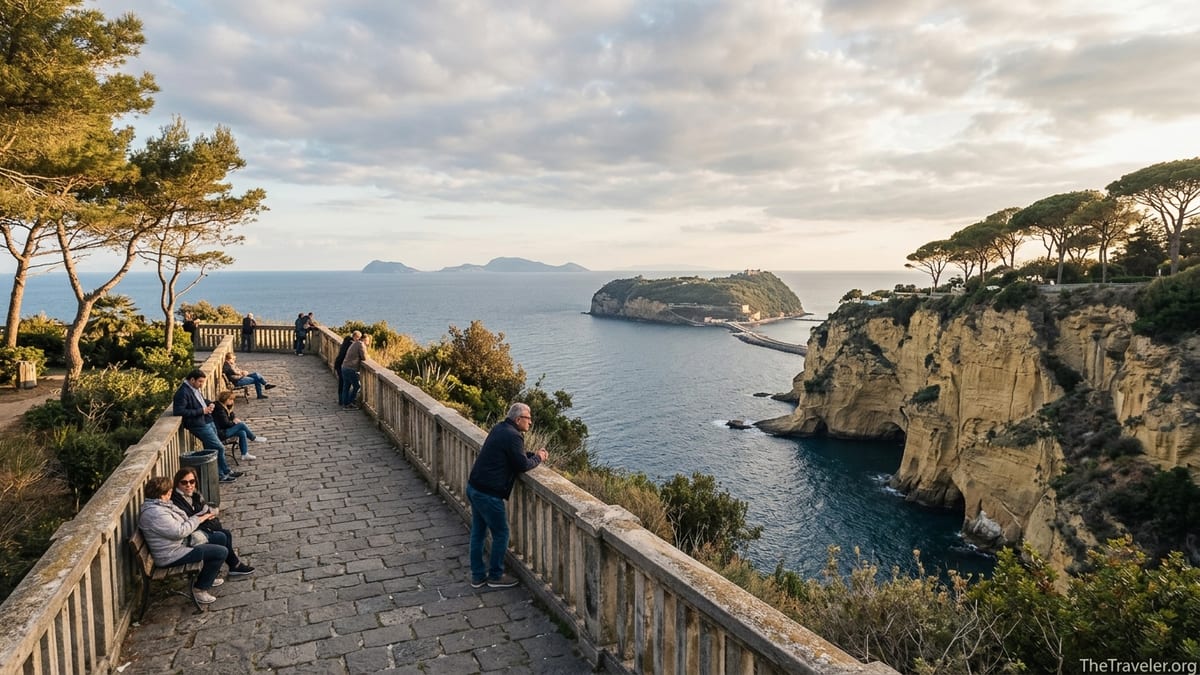
Perched high on the Posillipo cliffs, Parco Virgiliano is famous for one thing: its sweeping, cinematic view over the Bay of Naples. Most visitors arrive in late afternoon, walk straight to the main terrace, take a few photos of Capri and Vesuvius, then leave as quickly as they came. Yet this park, officially known as the Parco della Rimembranza, rewards anyone willing to wander past the obvious viewpoints. Below the postcard skyline, you will find quiet paths, literary corners, children’s rituals, and traces of ancient and modern Naples layered into the landscape.
Get the latest updates straight to your inbox!
Orienting Yourself Beyond the Main Terrace
The monumental entrance of Parco Virgiliano opens onto a broad central avenue leading directly toward the panoramic terraces, which is why almost everyone marches in a straight line to the busiest viewpoint. To see the parts most travelers miss, it helps to slow down right at the gate. Look for the side paths peeling off from the main avenue. These secondary walks descend toward the lower sections of the park and quickly thin out the crowds, especially on weekends when Neapolitan families head straight for the bar kiosk and central playground.
The park spreads across roughly nine hectares on the Posillipo promontory, with a network of terraces stepping down along the tuff cliffs. If you keep to the main axis, your view is mostly of Vesuvius and Castel dell’Ovo across the bay. Wander left or right and the perspective changes completely. To the west you look toward Pozzuoli, Baia and the Phlegraean Fields, an otherworldly volcanic coastline where steam vents and archaeological ruins dot the shoreline. To the south the park opens toward Capri and the Sorrentine Peninsula. Most visitors never realize how wide the visual radius is because they stop at the first railing packed with tripods.
A practical way to break away from the main flow is to come by the C21 bus from Mergellina and simply do the opposite of the crowd when you step through the gate. When people instinctively turn right toward the largest terrace, you turn left and follow the quieter rim path. Even at sunset, you can usually find a low wall or bench to yourself within five minutes of walking, while the central lookout is lined three deep with cameras.
Signage in the park is basic, and there is no detailed visitor map on site, so think of your visit as a loose loop rather than a fixed route. Plan to circle the park clockwise, tasting different vantage points and then cutting back through the interior paths around the amphitheater on your return.
The Overlooked Terraces and the “Valley of the Kings”
From the central roundabout at the park’s highest point, narrow paths drop away through scrubby Mediterranean vegetation into an area locals sometimes call the “Valley of the Kings.” It is not an official name, but it captures the feeling of descending into a shallow amphitheater carved by the tuff cliffs. These lower paths are usually empty except for joggers and dog walkers, even at times when the top terraces feel like a viewing platform on a cruise ship.
Here, the viewpoints sit closer to the edge of the promontory and offer near-private views of the yellow tuff cliffs plunging into the sea. You see detail you miss from the upper railing: caves in the rock, zigzag paths cut centuries ago to reach tiny landings, and the white outlines of villas built improbably into the cliff face. On clear days, you can pick out the Roman tunnels of the Pausilypon archaeological area far below, a reminder that this entire headland has been a luxury refuge since the time of the emperors.
These side terraces are ideal if you prefer a quieter, more reflective experience. Bring a simple picnic from the city, perhaps a folded pizza portafoglio from a takeaway near Mergellina or a paper of fried cuoppo, and slip down to one of the smaller belvederes. Prices for such street food remain relatively modest compared with the waterfront promenade, and you gain a million-euro view without needing to claim table space at a restaurant.
Because the lower paths are less maintained than the main avenue, surfaces can be uneven and slightly dusty, especially after dry spells. Trainers or flat sandals with decent grip are enough, but flimsy flip-flops make the walk less pleasant. If you visit after rain, expect a few puddles and patches of slick tuff. These minor inconveniences keep casual visitors away, which is precisely why the area feels like a secret.
Literary Naples: The Park as a “Grand Tour” Open-Air Anthology
In recent years the city has promoted Parco Virgiliano as a kind of open-air literary park, connected to the legacy of the European Grand Tour. Interpretation panels installed at several viewpoints carry quotations and reflections from 18th and 19th century travelers who wrote about Naples and its gulf. Many visitors walk past these signs without a glance, focusing instead on the horizon line in their smartphone screens. Yet pausing to read them changes the experience of the view.
You might find a line from Goethe or another Grand Tour diarist describing the light over Posillipo or the volcanic drama of the bay. Standing in the same spot, you can compare their words with what you see today: the cranes in the Bagnoli industrial zone, the modern ferries leaving for Ischia, the bright beach umbrellas at Miseno. It turns the panorama into a conversation across centuries, where beauty and human impact sit side by side.
Near some of the central paths you will also notice busts and memorials, including statues dedicated to figures such as Simón Bolívar and Mahatma Gandhi. These are easy to miss because there is little fanfare and, at times, patchy maintenance. Take a few minutes to walk around them and read the inscriptions. They hint at how Naples sees itself: a port city looking beyond Italy, conscious of global struggles and independence movements, yet expressing that awareness in a slightly faded, human way rather than grand marble rhetoric.
For travelers interested in culture, this literary layer makes Parco Virgiliano more than a pretty lookout. Bring a slim travel journal or a notebook. After reading a historical quotation, write a few lines about what you notice that the original author could never have imagined: the hum of scooters below, a low-cost airline appearing over Vesuvius, teenagers filming TikTok dances near the railing. It is a simple exercise, but one that turns a passive viewpoint into a personal travel chapter.
Local Life: Playgrounds, Sports Fields and Evening Rituals
Most guidebooks mention the view but not the way Neapolitans actually use Parco Virgiliano. At the park’s heart there is a playground, open sports field and modest athletics track that draw local families, school groups and amateur teams. In late afternoon you will see children racing around the play structures while parents sit on the low walls chatting, and teenagers practicing five-a-side football on the nearby pitch. For visitors who have only seen Naples’ dense historic center, this is a revealing contrast: here is where local life breathes.
On warm evenings, particularly from late spring to early autumn, a kind of informal passeggiata unfolds. Couples and groups of friends stroll the avenues with gelato from a kiosk or a simple coffee in plastic cups. Elderly residents claim the same bench each evening, greeting neighbors with handshakes and jokes. Street musicians sometimes drift through, playing guitar or portable speakers, not as organized buskers but as part of their own evening outing. None of this is advertised, yet it is the living heartbeat of the park.
If you want to experience this side of Parco Virgiliano, aim to arrive around one to two hours before sunset. Allocate time to sit around the playground area, even if you are not traveling with children. Buy an espresso or bottled water from the small bar and simply watch the choreography unfold. You will likely hear a mix of local Neapolitan dialect, schoolyard Italian and the occasional snatch of English or French from visiting students. Observing this everyday ritual is a reminder that the park is, first of all, a neighborhood space, not a viewing platform built for tourists.
Prices at the kiosks and bars in and around the park are generally in line with the wider Posillipo district. Expect to pay roughly what you would in a normal Naples café for an espresso and slightly more for cold drinks or packaged snacks, reflecting the residential rather than touristy nature of the area. Carry some cash, since small stands sometimes have unreliable card machines.
Hidden Sightlines: Reading the Coast from Nisida to Capri
The main terrace gives visitors a postcard view of Vesuvius and Capri, but the park’s lesser-known balconies reward those who take the time to identify places along the coastline. Look northwest from one of the quieter western terraces and you will see the small, almost circular island of Nisida joined to the mainland by a narrow causeway. Today it hosts a juvenile detention facility and is largely closed to the public, which explains why most tourists crossing it in the distance have no idea what they are looking at.
Beyond Nisida, on a clear day, the dense urban sprawl of Pozzuoli comes into view, leading the eye toward Baia, Bacoli and Monte di Procida. These names might mean little at first glance, but they represent a cluster of archaeological and seaside destinations easily combined with a day in Posillipo. For example, seeing the steam rising from the Phlegraean Fields from above can inspire a later visit to the Solfatara crater or the submerged ruins of Baia, reached in practice by local trains and short taxi rides from Naples.
Turn your gaze south and the line of the coast runs toward Sorrento, with the triangular shape of Capri sitting in the open water. From some of the side terraces in Parco Virgiliano you can see both the Phlegraean Fields and Capri in a single sweep, which gives a better sense of how compact and interconnected this part of Campania really is. Many visitors look at each destination in isolation, planning separate excursions to Capri, Ischia, Procida and the Phlegraean sites without realizing that, from this park, they form a single, continuous amphitheater.
One practical tip is to bring a simple printed map of the bay or download an offline map on your phone and use it as you stand at the railing. Match each headland and island with its name, and your mental map of Naples will snap into place. This makes navigation over the following days far easier: when you take a ferry from Molo Beverello or a local train toward Pozzuoli, you will already have a clear picture of where you are heading because you saw it laid out from Parco Virgiliano.
Combining the Park with Coastal Archaeology Below
Another aspect many visitors miss is how Parco Virgiliano sits directly above one of the most atmospheric archaeological stretches of coastline near Naples. From several viewpoints you can see traces of the Pausilypon archaeological site and the Gaiola Underwater Park below. These areas combine Roman imperial villas, coastal caves and a marine protected zone where ruins continue beneath the water’s surface.
While the park itself is free to enter, visits to Pausilypon and Gaiola usually require advance booking and sometimes guided tours, with modest entrance fees that help control visitor numbers and protect the site. A realistic way to structure your day is to book a morning slot for an archaeological visit, then climb or ride up to Parco Virgiliano afterward for a late picnic and sunset, using the park as a visual overview of the places you have just explored at sea level.
Getting between the two levels is logistically straightforward but not always intuitive for first-time visitors. From central Naples, you can reach the Posillipo area by a combination of metro or Cumana train and then local buses or taxis, with the final stretch often involving a winding climb. Many travelers find it easier to use ride-hailing or a radio taxi for the uphill segment, particularly in hot weather, then descend afterward on the more frequent C21 bus toward Mergellina, where you can rejoin the metro and urban fabric.
This combination of coast and cliff park makes for a full, varied day that rarely appears in standard itineraries. You will move through noble Roman villas, marine ecology, and contemporary neighborhood life before ending with a wide-angle view that stitches every element together.
Practical Strategies to Dodge Crowds and Enjoy the Details
Timing is everything at Parco Virgiliano. The park is most crowded on sunny weekends and bank holidays, when families from across Naples drive or ride scooters up to Posillipo. Street parking in the area around the entrance can become scarce by late afternoon, and the main terraces fill with people positioning for sunset photos. If you have flexibility, visit on a weekday, especially Monday to Thursday outside peak summer, when there is more space to linger and fewer large groups.
Opening hours for Naples’ municipal parks can vary by season and are periodically updated by the city, but in recent years Parco Virgiliano has generally remained open into the late evening, often until around 21:00 on weekdays and later on summer weekends. Before you go, it is wise to confirm current hours through local information channels or your accommodation, because early closing times on specific days can catch visitors off guard.
Public transport to Posillipo is improving but still feels patchy compared with the city center. From the Mergellina area, the C21 bus runs toward the park, climbing through residential streets to a stop near the entrance. Tickets for Naples buses are not typically sold onboard, so you should buy a standard urban ticket or a daily pass in advance from a tobacco shop, newsstand or metro station. Daily passes are often good value if you plan to combine the park with other sightseeing, since they cover buses, metro and funiculars within the city limits.
Once in the park, simple habits help you escape the bottlenecks. Stop at the first small side path you see and follow it away from the main flow; commit to walking for at least ten minutes without chasing the “best” viewpoint; and resist the urge to cluster wherever you see groups gathered. The reward will be small discoveries that never make it into promotional photos: a quiet bench facing Procida, a patch of wildflowers growing from the tuff, or a local reading in the shade of a pine tree, oblivious to the spectacle beyond the railing.
The Takeaway
Parco Virgiliano is widely praised for its panoramic terraces, yet those who only chase the classic sunset shot barely scratch its surface. Venture down the lesser-used paths and you find near-silent viewpoints over cliffs and Roman tunnels. Read the Grand Tour quotations at the railings and the view becomes a dialogue between centuries. Pause by the playground and sports fields at dusk and you witness Naples at home, not on display.
Used well, the park is not a single stop but a framework for understanding the wider Gulf of Naples. From its edges you can read the coast from Nisida to Capri, connect the dots between archaeological sites and beach towns, and decide where to go next. Combined with a morning exploring the shoreline below or a ferry to the nearby islands on another day, a visit here helps you orient both geographically and emotionally.
Plan a weekday visit if you can, bring comfortable shoes, a pre-purchased bus ticket or a budget for a taxi, and give yourself enough time to wander beyond the main terrace. The memories that will stay with you are unlikely to be the same photographs everyone else takes, but the quieter, more personal scenes that unfold once you leave the crowd behind.
FAQ
Q1. How do I get to Parco Virgiliano from central Naples without a car?
From the city center, take the metro or Cumana train toward Mergellina or the western districts, then connect to the C21 bus that climbs to Posillipo and stops near the park entrance. Buy a standard urban bus ticket or day pass in advance from a metro station, newsstand or tobacco shop, since tickets are usually not sold on board.
Q2. Is Parco Virgiliano free to enter?
Yes, entry to Parco Virgiliano is free. You only need to budget for transport to and from Posillipo, plus any food or drinks you buy at kiosks or bars inside and around the park.
Q3. When is the best time of day to visit if I want fewer crowds?
For quieter conditions, aim for late morning on weekdays or early afternoon outside peak summer. Sunset is visually spectacular but also the busiest period, especially on weekends and holidays when local families and couples flock to the terraces.
Q4. Are there facilities like toilets, cafés and playgrounds in the park?
Yes. The central area of the park has a children’s playground, a sports field and basic refreshment options such as a bar or kiosk for coffee, drinks and snacks. Public toilets may be available but maintenance varies, so it is sensible to use facilities in the city or at a café before arriving.
Q5. Can I see Capri and the other islands clearly from Parco Virgiliano?
On clear days you can see Capri, Ischia and Procida, as well as Nisida and the Phlegraean coastline. Visibility depends on weather and haze, so views are usually sharpest in the hours after a rain front or in cooler seasons when the air is clearer.
Q6. Is the park suitable for children and strollers?
The main avenues and central terraces are paved and relatively flat, so they are suitable for strollers and families with young children. Some of the lower paths and side terraces have uneven surfaces and slopes, so it is best to keep to the main routes if you are pushing a stroller or if mobility is limited.
Q7. How long should I plan to spend at Parco Virgiliano?
If you only want the main viewpoint, you could see it in under an hour, but to explore side paths, enjoy the playground or sports area, and experience the evening atmosphere, plan for two to three hours. If you combine the park with archaeological visits below the cliffs, such as Pausilypon or the Gaiola area, a full day in the Posillipo zone makes sense.
Q8. Is it safe to visit Parco Virgiliano in the evening?
The park is a popular gathering place for local families, couples and joggers, and the central areas are usually lively rather than isolated in the early evening. As in any urban park, it is wise to stay on the main paths after dark, avoid very secluded corners, and keep usual travel precautions with valuables.
Q9. Are there shops or restaurants directly inside the park?
Inside the park you will mostly find simple kiosks or bars offering drinks, ice cream and packaged snacks rather than full restaurants. For proper meals, look to the surrounding Posillipo streets, where cafés, pizzerias and trattorias serve everything from quick slices to seafood dinners with sea views.
Q10. Can I combine a visit to Parco Virgiliano with other nearby attractions in one day?
Yes. A common combination is to visit the Pausilypon archaeological area or the Gaiola Underwater Park at sea level in the morning, then head up to Parco Virgiliano for an afternoon walk and sunset. With careful planning of public transport or taxis, you can also fit in a stop in the Mergellina waterfront area on your way back to central Naples.