


The Jersey Shore is more than a string of beaches along the Atlantic. It is a patchwork of Victorian resort towns, neon-lit motels, wooden boardwalks, indie music venues, saltwater taffy shops, and generations of family rituals that return with each summer. From Sandy Hook in the north to Cape May at the southern tip, this 140-mile stretch of coastline offers an experience that feels distinctly and unmistakably Jersey, grounded in everyday pleasures as much as in nostalgia.
Get the latest updates straight to your inbox!
A Coastline of Distinct Personalities
One reason the Jersey Shore feels special is that it is not one destination but many. Each town has its own personality, and travelers often become loyal to “their” beach, returning year after year. In a single day you can move from the quiet dunes of Island Beach State Park to the buzzing arcades of Seaside Heights and then to the live music bars of Asbury Park, all within a relatively compact drive.
Family travelers often gravitate toward Ocean City and Point Pleasant Beach. Ocean City has positioned itself as a dry, family resort with an eight-mile-long beach and a boardwalk lined with mini golf, classic amusement rides, and pizza joints. Point Pleasant Beach, anchored by Jenkinson’s Boardwalk, blends an aquarium, arcades, and kids’ rides with easy rail access for families coming down on the North Jersey Coast Line.
Those looking for a livelier scene often choose Seaside Heights or the Wildwoods. Seaside Heights is known for Casino Pier’s rides, waterfront bars, and late-night pizza slices. The Wildwoods, a cluster of four communities, offer huge, free beaches and a 2-mile boardwalk packed with three amusement piers, two major waterparks, and a skyline of midcentury “Doo Wop” motels that glow in neon after dark.
Further north, Asbury Park has reinvented itself as a creative hub, where Victorian homes meet street art and a storied music scene. Travelers might spend the morning on the sand, the afternoon exploring Cookman Avenue’s coffee shops and boutiques, and the evening at a show at the Stone Pony or the Wonder Bar. Within a few miles, neighboring Bradley Beach and Avon-by-the-Sea offer quieter atmospheres for those who prefer low-key promenades and simple beach days.
The Boardwalk: Heart of the Jersey Shore Experience
The boardwalk is where the character of the Jersey Shore comes into focus. New Jersey has the highest concentration of oceanfront boardwalks in the United States, and each tells a slightly different story. Atlantic City, which built one of the world’s first oceanfront boardwalks in the 19th century, stretches for about five miles, while Sea Bright’s oceanside walkway is famously short. Across the shore, you will find wooden planks, concrete promenades, and modern rebuilds shaped by storms and changing tastes.
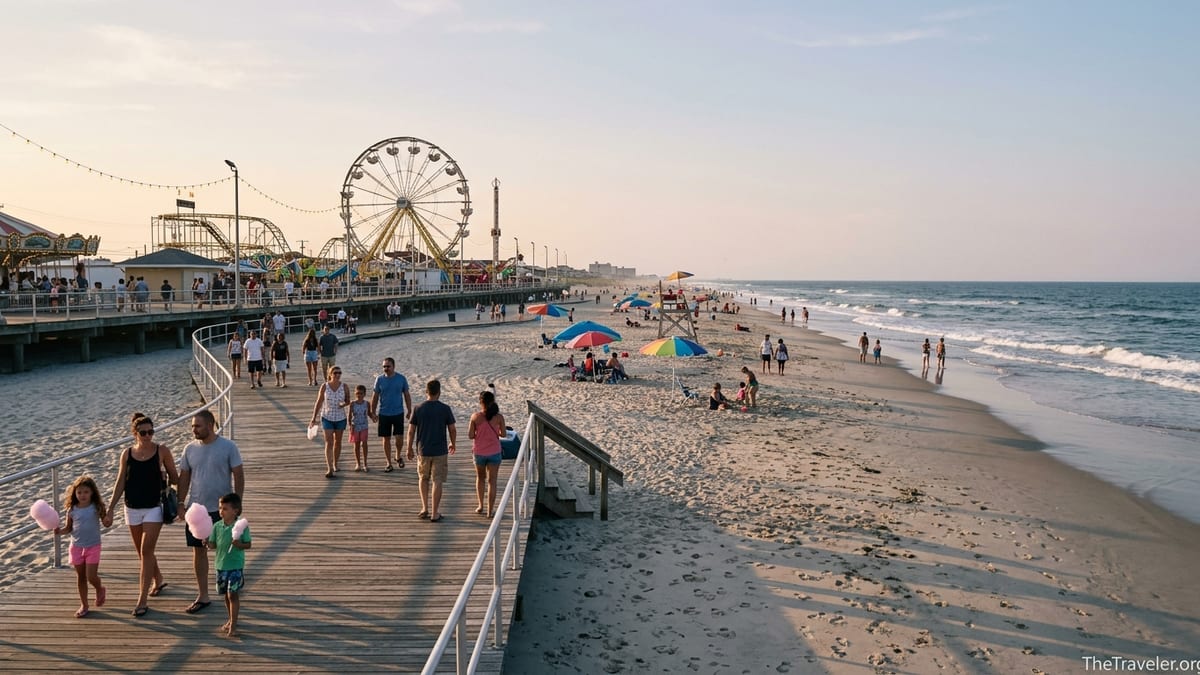
In Seaside Heights, the boardwalk is a dense strip of rides, arcades, and food stands, from funnel cake windows to sausage-and-pepper grills that smoke into the ocean breeze. Casino Pier’s Ferris wheel and roller coasters rise directly over the sand, with ride tickets typically sold in flexible bundles so families can mix a few big coasters with gentler kiddie rides. On a summer evening, the buzz of game barkers mixing with seagulls and the hum of generators captures the classic boardwalk soundscape.
Further south, the Wildwoods boardwalk, often nicknamed “two miles of smiles,” is lined with Morey’s Piers, waterparks, and souvenir shops selling everything from boogie boards to airbrushed T-shirts. The beaches here are famously wide, so visitors often hop on a boardwalk tram car that shuttles between attractions, a convenience that has become a local icon in itself. Families can easily spend a full day moving between water slides, roller coasters, and simple pleasures like grabbing curly fries or fresh lemonade.
In contrast, the Asbury Park boardwalk has shifted toward culture and design. Historic buildings like Convention Hall frame a scene of murals, independent shops, vintage arcades, and small restaurants serving everything from Korean rice bowls to vegan ice cream. Travelers can walk the planks with a craft coffee in hand while listening to a band warming up at the Stone Pony a block away. This softer, arts-forward approach shows how the boardwalk tradition can evolve while preserving the essential ritual of strolling by the sea.
Beach Culture, Badges, and Free Sand
Part of what defines the Jersey Shore is the rhythm of local beach culture. Many municipalities require beach badges in summer to fund lifeguards, maintenance, and facilities. For example, Asbury Park’s 2024 season badges are priced at around the cost of a casual restaurant meal per day for adults, with lower rates for teens and seniors and full-season passes for frequent visitors. Towns often sell discounted preseason badges in spring, so local families line up at municipal buildings or order online to lock in savings before Memorial Day.
This patchwork of policies means the cost of a beach day can vary significantly between towns. Seaside Heights, for instance, has raised badge prices in recent seasons to keep up with rising staffing and maintenance costs, with options that range from daily passes to full-season tags. These badges are checked at beach entrances by attendants, who also provide basic information such as restroom locations and flag conditions. Travelers should budget for both parking and badges when planning a beach-hopping itinerary.
Not all shorelines charge for access. Atlantic City, the Wildwoods, Sandy Hook, and Island Beach State Park offer free or low-cost beach entry, though there may be parking or park fees. Wildwood’s beaches, in particular, are completely free, which is a major draw for larger families who might otherwise spend a substantial amount on daily badges elsewhere. The trade-off is that these free beaches can be among the busiest on peak summer weekends, so arriving early or visiting on weekdays can make the experience more relaxed.
Beyond the logistics, beach culture manifests in familiar rituals. Multi-generation families arrive with rolling carts stacked with umbrellas, coolers, and folding chairs. Children dig elaborate sandcastle complexes near the tide line. Local teens cluster by the lifeguard stands, while older residents walk the water’s edge for low-impact exercise. Late in the day, informal games of paddleball and KanJam spring up as the sun lowers and the lifeguard flags come down. Over time, visitors come to associate specific towns with their own traditions: sunrise walks in Ocean Grove, surf lessons in Belmar, or bonfire chats on a quiet rental-house porch in Cape May.
Food, Treats, and Nightlife by the Sea
Eating at the Jersey Shore is not just about sustenance. It is part of the culture. Classic boardwalk snacks define many travelers’ memories. In Ocean City and Seaside Heights, you are never far from fresh-cut fries served in paper cups, dripping with malt vinegar or cheese sauce. Pizzerias advertise oversized slices on metal trays in their windows, while stands selling sausage and peppers, cheesesteaks, and corn dogs perfume entire stretches of boardwalk.
Desserts follow their own rituals. Saltwater taffy, caramel corn, and fudge shops package sweets in bright boxes designed to be taken back to the office or given to relatives after a weekend away. In many towns, visitors develop brand loyalty to particular taffy makers or fudge counters and will walk past several competitors to reach their favorite. Ice cream is practically a currency of its own, from soft-serve cones dipped in chocolate sprinkles in Point Pleasant to hand-scooped waffle cones in Cape May.
Off the boardwalk, dining has grown more diverse and ambitious. Asbury Park’s downtown has become a restaurant destination, with options ranging from upscale Italian trattorias and small-plate wine bars to ramen shops and vegetarian cafes. In Atlantic City, casino restaurants run full steakhouse, seafood, and chef-driven concepts, so travelers might mix an afternoon on the beach with a dinner that feels like a night in a big city. Even smaller towns like Bradley Beach and Lavallette now feature locally owned bistros with seasonal menus focusing on Jersey tomatoes, corn, and fresh-caught seafood.
Nightlife varies by town, which is part of what makes the shore adaptable to different travelers. The Wildwoods and Seaside Heights appeal to those seeking bars with live DJs, late-night rides, and neon lights reflected in the surf. Asbury Park skews toward live music in more intimate venues, where a traveler can catch a local band for the price of a modest cover charge. Cape May, with its Victorian streetscapes, leans toward wine bars, porch bars in historic inns, and low-key piano lounges, ideal for couples or groups looking for conversation rather than crowds.
History, Resilience, and the Post-Sandy Shore
The Jersey Shore’s culture is shaped by its long history and repeated reinvention. Oceanfront resorts began to develop in the 19th century, when urban residents sought sea air and simple leisure. Atlantic City’s early boardwalk was built in the 1870s as a removable walkway to keep sand out of luxury hotel lobbies, and by the early 20th century its permanent boardwalk had become a showcase of arcades, theaters, and seaside glamour. Other towns soon followed with their own promenades, pavilions, and amusement piers.
That history also includes storms and rebuilding. Superstorm Sandy in 2012 devastated large sections of the coast, tearing up stretches of boardwalk and damaging homes and businesses. In the years since, towns have rebuilt with a mixture of nostalgia and practicality. Some, like Seaside Heights, reconstructed wooden planks and rides to restore the classic feel, while others opted for more storm-resilient materials in certain sections. For travelers today, remnants of that story are visible in plaques, photo displays, and modern structures that stand beside older buildings.
Asbury Park’s trajectory illustrates the shore’s capacity for reinvention. Once a marquee resort, the city went through decades of economic decline before a wave of investment and creative energy reshaped its downtown and boardwalk in the 2000s and 2010s. Historic music venues like the Stone Pony continued to draw fans, while new businesses brought a younger, more diverse crowd. Travelers now experience a layering of eras: century-old architecture, midcentury shore houses, and modern murals and galleries all within a compact walk.
In the Wildwoods, midcentury motels have become part of the cultural fabric. Many were built in the 1950s and 1960s with space-age signage, starburst motifs, and kidney-shaped pools, creating what preservationists refer to as a Doo Wop motel district. While some older properties have been replaced by condos, others have been restored or refreshed, giving visitors the chance to sleep beneath retro neon and wake up a short stroll from the boardwalk. This mix of preservation and evolution is a recurring theme up and down the coast.
Practical Ways to Experience the Shore
Visiting the Jersey Shore does not require an elaborate plan, but a few practical choices can make the experience smoother. Transportation is one. Many travelers drive from New York, Philadelphia, or inland New Jersey, but those without a car can reach towns like Asbury Park, Bradley Beach, Belmar, and Point Pleasant Beach via NJ Transit’s North Jersey Coast Line. Summer weekend trains often carry beachgoers with coolers and umbrellas, and a one-way fare from New York Penn Station to these mid-shore towns typically falls in the mid-teens depending on distance and current pricing.
Lodging ranges from simple motels and vacation rentals to historic inns and casino hotels. In midsummer, a basic motel room in a classic boardwalk town might cost what a midrange chain hotel charges in a major city, especially on weekends. Travelers seeking better value often look at shoulder seasons in late May, early June, or September, when water temperatures are still comfortable and crowds are lighter. In Cape May and Ocean Grove, Victorian bed-and-breakfasts offer porches, home-cooked breakfasts, and included beach badges, which can be welcome perks for guests arriving without their own gear.
Beach logistics matter more than first-time visitors might realize. Many towns allow small coolers and outside food, but ban glass containers and alcohol. Umbrella and chair rentals are widely available, especially near main beach entrances and piers, so visitors flying in from farther away can travel light. Families with children might prioritize beaches with robust lifeguard coverage, restrooms directly off the boardwalk, and nearby playgrounds, such as those in Point Pleasant Beach or Asbury Park’s north side.
Weather can change quickly along the Atlantic, so savvy travelers watch the daily forecast and rip current advisories. Morning fog can burn off into full sun, and afternoon thunderstorms are common on humid days. Most boardwalks remain open in less-than-perfect weather, which makes arcades, aquariums, and shops useful back-up plans. In the off-season, from late fall through early spring, many businesses shorten hours or close entirely, but beach walks, off-season festivals, and calm hotel rates attract a different kind of visitor who prefers windbreakers to bathing suits.
The Takeaway
What ultimately makes the Jersey Shore special is how personal it becomes. For some, it is riding the same wooden roller coaster every summer, buying the same box of fudge from the same storefront, and taking the same family photo at the water’s edge. For others, it is discovering an Asbury Park mural, listening to an unknown band who might one day be famous, or finding a quiet bench in Ocean Grove at sunrise.
Across its many towns, the shore balances workaday accessibility with a sense of escape. It is close enough to major cities that a day trip is realistic, yet rich enough in texture that a full week can feel too short. Boardwalks provide a ready-made stage for simple pleasures: a stroll, a slice of pizza, a pair of flip-flops bought on a whim. Beaches offer both noisy family zones and pockets of solitude.
For travelers, the Jersey Shore is not just a place to visit but a place to return to, often at different stages of life. A teenager who once came for Wildwood’s thrill rides might one day book a quiet Cape May inn. A couple who discovered Asbury Park’s music scene might later bring their children to Point Pleasant’s aquarium. Through all those shifts, the constant is the boardwalk underfoot and the Atlantic in front, inviting one more walk, one more season, and one more story to add to the long-running narrative of the shore.
FAQ
Q1. Do I need a beach badge at every Jersey Shore town?
Many Jersey Shore towns require beach badges in peak season, but some, including Atlantic City, the Wildwoods, and Sandy Hook, offer free beach access, though parking or park fees may still apply.
Q2. Which Jersey Shore town is best for families with young children?
Ocean City and Point Pleasant Beach are popular with families thanks to classic rides, mini golf, aquariums, family-focused events, and generally quieter nightlife compared with party-focused towns.
Q3. Can I reach the Jersey Shore without a car?
Yes. NJ Transit’s North Jersey Coast Line serves towns like Asbury Park, Bradley Beach, Belmar, and Point Pleasant Beach, and local taxis or rideshares can usually handle the last mile from stations.
Q4. What are the most famous boardwalks on the Jersey Shore?
Atlantic City, Wildwood, Seaside Heights, Ocean City, Asbury Park, and Point Pleasant Beach each have well-known boardwalks, ranging from casino-lined promenades to family-focused piers and music-centric walks.
Q5. When is the best time of year to visit the Jersey Shore?
July and August have the warmest ocean temperatures and fullest slate of events, while late May, June, and September often provide milder crowds, lower rates, and plenty of beach-friendly weather.
Q6. Are Jersey Shore beaches suitable for surfing?
Yes. Towns like Belmar, Manasquan, and parts of Ocean City have established surf spots and local surf shops that offer board rentals and lessons throughout the main season.
Q7. Is the Jersey Shore only about nightlife and parties?
No. While places like Seaside Heights and parts of the Wildwoods have lively nightlife, many towns, including Cape May, Ocean Grove, Ocean City, and Bradley Beach, cater more to families, couples, and quieter getaways.
Q8. How expensive is a typical beach day at the Jersey Shore?
Costs vary by town, but visitors should factor in parking, daily beach badges where required, food, and optional extras like ride tickets or rentals; free-beach towns can be more budget-friendly for larger groups.
Q9. What should I know about weather and safety on Jersey Shore beaches?
Summer weather can shift quickly, so check forecasts and follow lifeguard instructions and posted flags, especially regarding rip currents or thunderstorms that may require leaving the water temporarily.
Q10. Are there things to do at the Jersey Shore outside summer?
Yes. Off-season visitors enjoy restaurant weekends, holiday events, birdwatching, lighthouse visits, and quiet beach walks, though many boardwalk businesses operate with limited hours in colder months.