


Perched high above the traffic and grit of central Naples, Vomero feels like a parallel city. Leafy streets, middle class families on evening strolls and sweeping views of Vesuvius create an atmosphere that can surprise visitors who only know Naples for its frenetic alleys and scooters. Understanding what makes Vomero different from the rest of the city helps travelers decide whether to base themselves here, visit for an afternoon or simply ride up for the sunset.
Get the latest updates straight to your inbox!
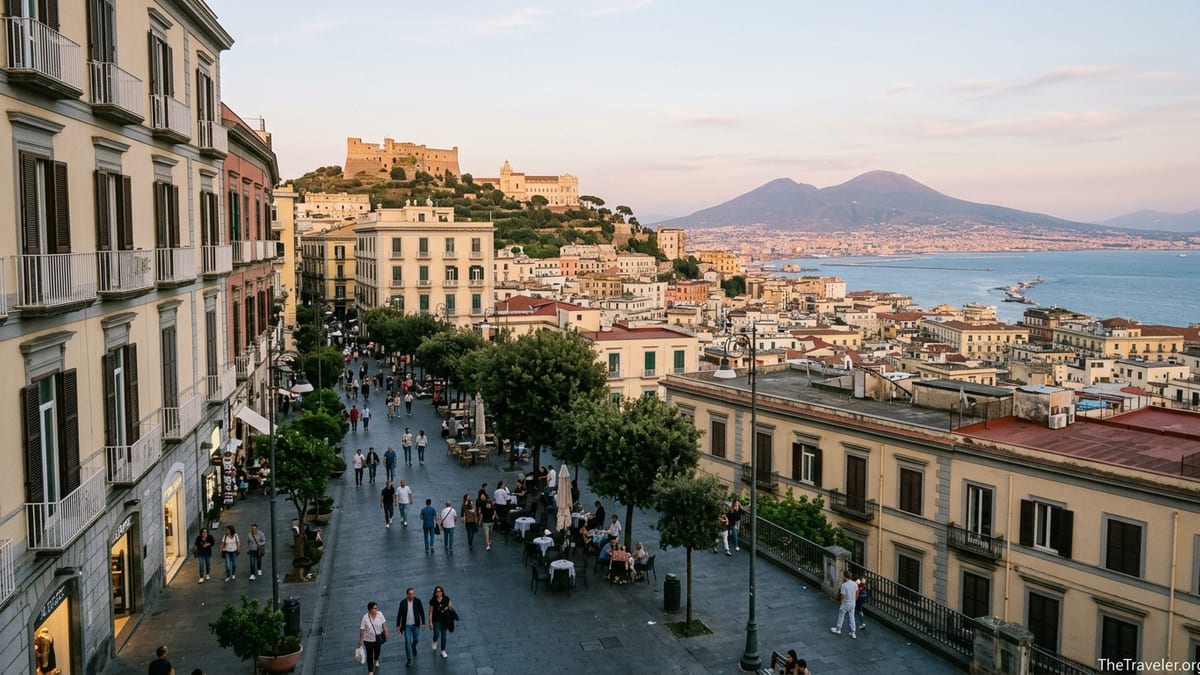
A Hilltop City Within the City
Vomero’s most striking difference is geographic. It sits on a breezy hilltop above the historic center, with elevations high enough that summer evenings feel noticeably cooler than along Via Toledo or in the Spanish Quarters. The climb used to isolate the district, and even today the journey up by funicular feels like passing through an invisible border, leaving behind the dense, noisy grid of old Naples for a more open, residential landscape.
Unlike neighborhoods that grew organically over centuries, Vomero was planned in the late 19th and early 20th centuries as an upscale residential quarter for Naples’ growing middle class. Streets follow a rational grid, sidewalks are wide enough for strollers and dogs, and many buildings were constructed with lifts and courtyards rather than subdivided tenements. Walking around Piazza Vanvitelli at rush hour, you see office workers and students rather than cruise ship crowds, a reflection of Vomero’s enduring role as a place to live rather than a tourist stage set.
This planned character makes Vomero feel self contained. It has its own shopping streets, markets, schools, cinemas and gyms, so residents can do most daily errands without descending to the center. A local might commute to an office near Piazza Municipio, but their supermarket, child’s school, favorite pizzeria and evening aperitivo bar will all be on the hill. For visitors, this translates into a chance to experience a piece of everyday Neapolitan life that is often missing in more touristy zones.
Easier Urban Living and a Different Pace
Atmosphere is where Vomero truly diverges from Naples clichés. Down in the Quartieri Spagnoli, laundry hangs across alleyways and scooters weave between pedestrians. In Vomero, traffic is regulated, streets like Via Scarlatti and Via Luca Giordano are largely pedestrianized, and families feel comfortable strolling with gelato late into the evening. It is still distinctly Neapolitan, with loud conversations and double parked cars, but the overall pace is calmer and more organized than in the centro storico.
Security is another contrast that residents often highlight. While Naples as a whole has improved in recent years, Vomero has a reputation among locals as one of the city’s safer, more orderly districts. Police presence is visible around main squares, and streets are well lit. Visitors returning to hotels near Piazza Vanvitelli after midnight typically find bars still open, shop shutters half down and dog walkers out, a different scene from the more deserted lanes around some central train station areas.
For travelers, this can make Vomero an appealing base, especially for families or solo visitors who prefer quieter evenings. A mid range double room in a small Vomero guesthouse often costs slightly less or roughly comparable to similar accommodation footsteps from Spaccanapoli, but offers better sleep thanks to reduced street noise. Cafes serve quick breakfasts of espresso and cornetti to office workers instead of tour groups, and even chain supermarkets feel like part of a functioning neighborhood rather than a tourist corridor.
Funiculars and Viewpoints: Getting Up and Looking Out
Reaching Vomero is part of its charm. Three historic funicular lines link the hilltop to the city below, an experience that few other Neapolitan neighborhoods offer in the same way. The Central Funicular runs from near Via Toledo up to Piazza Fuga, a short walk from Piazza Vanvitelli, carrying commuters and visitors in about five minutes. The Chiaia Funicular connects the elegant lower district of Chiaia with Via Cimarosa in Vomero, while the Montesanto Funicular rises from the bustling market area of Montesanto to Via Morghen on the hill. Together they serve thousands of passengers per day and make Vomero surprisingly accessible for day trips even from the cruise port or central station area.
These funiculars are not just transport; they are part of the neighborhood’s identity. Morning rides are filled with schoolchildren and office workers, while late afternoon cars often carry a mix of locals returning home and visitors heading up to catch the sunset. Tickets are integrated into the city’s public transport system, so a standard metro ticket purchased at a tobacconist can usually be used for the ride, making it a simple, low cost excursion for travelers watching their budget.
Once at the top, Vomero offers some of the most celebrated viewpoints in Naples. Castel Sant’Elmo, the star shaped medieval fortress that crowns the hill, now hosts a museum and regular cultural events, but many visitors come primarily for the near 360 degree panorama from its ramparts. On clear days you can see from the historic center to the port, across the bay to Capri and the Sorrentine Peninsula, and up toward Vesuvius. Nearby, the Belvedere of San Martino and the terraces of the Certosa di San Martino provide equally impressive views, often with fewer crowds than the castle itself.
Cultural Landmarks Beyond the Historic Center
While most visitors associate Naples’ major heritage sites with the centro storico, Vomero houses some of the city’s most important cultural institutions. The Certosa di San Martino, a former Carthusian monastery just below Castel Sant’Elmo, is a standout. Its cloisters, baroque chapels and terraces offer a tranquil contrast to the bustle of Spaccanapoli, and its museum collection includes historical artifacts and artworks that trace Naples’ evolution as a major Mediterranean capital.
Castel Sant’Elmo itself has been repurposed from defensive fortress to cultural venue. Inside its thick tuff walls, the Museo del Novecento di Napoli focuses on 20th century Neapolitan art, with works that give context to the city’s modern creative currents. Exhibitions and events take place in halls that once housed soldiers and supplies, a reminder that Vomero’s hilltop position was once primarily strategic rather than scenic.
Compared to the archaeological remains along Via dei Tribunali or around the Duomo, these hilltop sites highlight a different layer of Neapolitan history: the shift from medieval stronghold to modern city looking out over an expanding urban landscape. Travelers who spend an afternoon in Vomero often come away with a more rounded sense of Naples’ past, beyond the Roman ruins and baroque churches that dominate the center.
Shopping, Cafes and Nightlife with a Local Feel
Another key difference between Vomero and other neighborhoods is its commercial life. Via Scarlatti and Via Luca Giordano act as the area’s main spines, lined with mid range fashion stores, shoe shops, bookstores, perfumeries and small boutiques. Unlike luxury focused streets such as Via dei Mille in Chiaia, the bulk of Vomero’s retail caters to everyday residents, with prices that reflect a middle class clientele. Travelers looking for Italian brands without the high end markup of designer labels often find good value here.
Cafe culture in Vomero feels resolutely local. Around Piazza Vanvitelli and side streets, classic bars serve espresso, sfogliatelle and croissants to regulars who stand at the counter discussing football or local politics. Outdoor tables are busy in late afternoon when parents gather after the school run. For visitors, this offers an easy way to observe daily life: order a caffè and a small pastry and linger, knowing you are surrounded by people on their normal routine rather than fellow tourists checking off a list.
In the evenings, Vomero’s nightlife is lively but more understated than the chaotic bar clusters near Piazza Bellini or the university area. Wine bars, cocktail spots and casual aperitivo places cluster near the main squares and along pedestrian lanes, attracting young professionals and students from nearby universities. Prices for a drink with complimentary snacks are generally similar to central Naples, but the clientele is more local and the vibe less focused on backpacker bar crawls.
Residential Character and Cost of Staying
Compared with historic districts like the Decumani or the Spanish Quarters, Vomero has far fewer traditional hotels and hostels but a growing number of guesthouses, bed and breakfasts and short stay apartments. Many are carved out of large family apartments in early 20th century buildings, and rooms may have high ceilings, balconies and views over the bay. This residential fabric gives the neighborhood a quieter night time soundscape, with fewer late night revelers and more the hum of TV sets and clinking cutlery from family dinners.
Prices for accommodation vary, but visitors can often find mid range rooms at rates comparable to or slightly below equally comfortable places in highly touristed central areas. The trade off is that you are a funicular or metro ride away from headline sights such as the Duomo or the Archaeological Museum. For some travelers, especially those staying several days or returning to Naples after a previous visit, the chance to base in a lived in, less touristy neighborhood outweighs the extra five to ten minutes of transportation.
Daytime, Vomero feels different from areas dominated by short term rentals. Schoolchildren in uniforms, elderly residents doing their daily shop and delivery drivers navigating tight corners reinforce the sense that this is first and foremost a place where Neapolitans live. Even many of the restaurants and pizzerias cater mainly to locals, with menus that lean toward classic dishes rather than photo friendly novelties. This can be refreshing if you are seeking a more authentic, less curated version of the city.
Green Spaces and Open Air Escapes
Space is a luxury in dense Naples, and Vomero stands out for the relative abundance of trees, small parks and leafy courtyards. Streets around Piazza Medaglie d’Oro and Piazza Quattro Giornate are lined with mature plane trees that provide shade in summer, and small playgrounds allow children to run without the constant proximity of speeding scooters. For travelers with kids, this can make the neighborhood feel more manageable and less exhausting than the continuous hard stone surfaces of the historic center.
While Vomero does not have large destination parks on the scale of some European capitals, its pockets of green and its elevation combine to create an outdoor oriented lifestyle. Residents walk dogs in the cooler evening air, and benches along viewpoints such as the Belvedere of San Martino fill up at sunset. In other central districts, public spaces can feel more contested, with traffic, noise and limited seating; here, the air is clearer and the sightlines stretch out to the sea.
The very journey between Vomero and the lower city can also be an open air experience. Some visitors choose to descend on foot via the historic stairways known as the Pedamentina, which link the hilltop near the Certosa down toward the centro. These stepped paths cut between gardens and older buildings, revealing hidden corners and perspectives on the city that you would never see from a bus or taxi. It is a reminder that Vomero is physically and visually connected to the rest of Naples even as it feels emotionally distinct.
The Takeaway
Vomero differs from other Neapolitan neighborhoods in ways that go beyond its altitude. It is a planned, largely middle class residential district with rational streets, reliable public transport and a strong sense of local identity. Its hilltop setting offers some of the best panoramas in the city and shelters it from some of the urban intensity that characterizes areas closer to the port and train station. For travelers, these differences translate into cooler evenings, quieter nights, accessible cultural sites and an everyday atmosphere that is harder to find in heavily touristed quarters.
Choosing whether to stay in Vomero or to simply visit for an afternoon depends on your priorities. If you want to step out of your door straight into the tangled alleys of the centro storico, another neighborhood may suit you better. If, instead, you prefer to experience Naples at a slightly slower tempo, with easy access to both panoramic viewpoints and local cafes, Vomero can be an excellent base. Either way, riding the funicular up for sunset over Castel Sant’Elmo and the Certosa di San Martino is one of the most rewarding short excursions you can make in the city.
FAQ
Q1. Is Vomero a good area to stay in for first time visitors to Naples?
For many first time visitors who value quieter evenings and easy public transport, Vomero works very well. You trade being steps from the cathedral or Spaccanapoli for a calmer, more residential atmosphere and quick funicular connections to the center.
Q2. How long does it take to reach Vomero from central Naples?
From areas around Via Toledo or Montesanto, the funicular ride up to Vomero usually takes about five minutes, plus a few minutes of walking at each end. Even from the port or central station, a combination of metro and funicular typically brings you to Piazza Vanvitelli in around 30 to 40 minutes depending on connections.
Q3. Is Vomero safe to walk around at night?
Vomero is considered one of Naples’ safer, more orderly districts, with well lit streets and a strong local residential presence. As in any city, normal precautions apply, but many visitors and residents feel comfortable walking between Piazza Vanvitelli, Via Scarlatti and nearby streets late into the evening.
Q4. What is the best way to get to Castel Sant’Elmo and the Certosa di San Martino?
The most convenient way is to ride a funicular up to Vomero, typically the Central Funicular to Piazza Fuga or the Montesanto Funicular to Via Morghen, then follow signs uphill to Castel Sant’Elmo and the nearby Certosa di San Martino. Allow about 15 to 20 minutes on foot from the main squares to reach the entrances.
Q5. How does Vomero compare to Chiaia and Posillipo?
All three are considered desirable residential areas, but they feel different. Chiaia sits by the waterfront with luxury shopping and a sea promenade, Posillipo stretches along the cliffs with villas and sweeping views, while Vomero is a hilltop hub with strong everyday neighborhood life, mid range shopping streets and quick links to the rest of the city via funicular and metro.
Q6. Are there good restaurants and pizzerias in Vomero?
Yes, Vomero has many well regarded pizzerias, trattorias and casual restaurants that primarily serve locals. Menus focus on classic Neapolitan dishes and pizzas at prices similar to other non touristy parts of the city, and popular spots can be busy on weekends, so it can be worth reserving if you have a specific place in mind.
Q7. Is Vomero suitable for families with children?
Vomero is often a good choice for families. Wider sidewalks, small parks, playgrounds and relatively calm pedestrian areas around streets like Via Luca Giordano make it easier to move with strollers, and the cooler hilltop air can be a relief during hot summer days.
Q8. Does staying in Vomero make it harder to visit major sights?
Vomero adds a short funicular or metro ride to most major historic sights, but the connections are frequent and inexpensive. In return, you gain quieter accommodation and a different perspective on Naples. For many travelers, especially those staying several nights, this is a worthwhile trade off.
Q9. What is the atmosphere like in Vomero during the evening?
Evenings in Vomero are lively but not hectic. Locals fill cafes, gelaterias and wine bars, families stroll around Piazza Vanvitelli and along pedestrian streets, and there is a steady but manageable buzz. It feels more like a neighborhood enjoying its free time than a nightlife district geared toward tourists.
Q10. Do I need to book tickets in advance for Castel Sant’Elmo or the Certosa?
For most of the year, visitors can usually buy tickets on arrival without long waits, though weekends and holidays may be busier. If you are visiting during a peak period or when special events are scheduled, checking current opening hours and any reservation recommendations before you go is advisable.