


From the moment the funicular doors slid open at Piazza Vanvitelli, Vomero felt like a different city. The air was cooler, the streets wider, the voices less hurried. I had come expecting another tourist-heavy corner of Naples, anchored by the famous Castel Sant’Elmo and the Certosa di San Martino. Instead, what surprised me most about Vomero was how local it felt: a lived-in hilltop neighborhood where Neapolitans shop, stroll, argue over espresso, and watch the sun set behind Vesuvius as if it were just another evening.
Get the latest updates straight to your inbox!
A Hilltop Neighborhood That Still Belongs to Neapolitans
Stand in the middle of Piazza Vanvitelli at rush hour and you quickly realize that Vomero is not a stage set for visitors. Office workers stream out of Metro Line 1, parents tug children toward after-school lessons, and elderly couples drift toward their regular bar tables. While the funiculars steadily deliver day-trippers from the centro storico, the crowd here is overwhelmingly local, chatting in rapid-fire Neapolitan more than textbook Italian.
Part of this comes from Vomero’s history as an elegant residential quarter rather than a historic core. Developed in the late 19th century with rectilinear streets and Art Nouveau facades, it was designed as a modern, middle-class neighborhood. Today it still feels that way: polished but practical, more about weekly routines than bucket lists. Even near Castel Sant’Elmo, school groups and families often outnumber organized tours, a subtle reminder that this hilltop is first and foremost a place where people live.
What you notice most is the absence of the usual tourist script. There are no touts pushing menus in multiple languages around Piazza Vanvitelli, no lines of souvenir stalls, no hop-on, hop-off buses idling nearby. Instead you see couriers weaving through traffic, teenagers with shopping bags from chain stores, and supermarket trolleys rattling across cobblestones. It is a neighborhood where a visitor feels welcome but not catered to, and that is exactly its charm.
The Daily Rituals Along Via Scarlatti and Via Luca Giordano
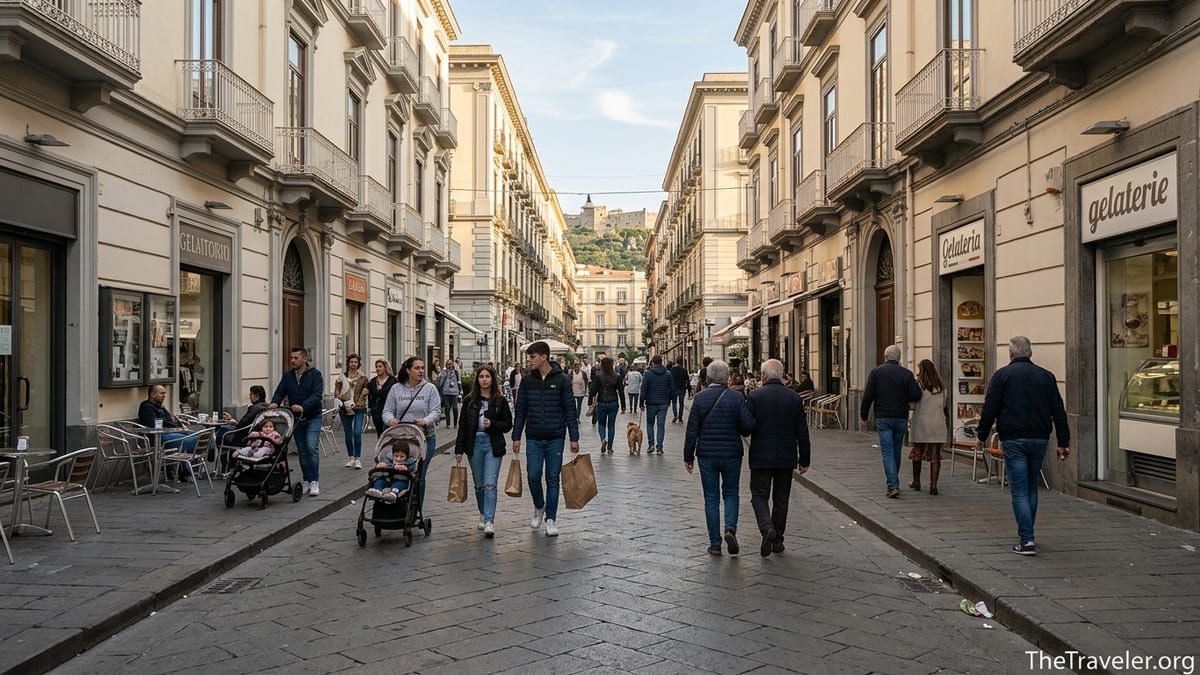
Vomero’s local heart beats along its two main pedestrian axes: Via Alessandro Scarlatti and Via Luca Giordano. These tree-lined streets form a continuous ribbon of shops and cafes, creating what residents describe as their everyday “passeggiata” route. In the late afternoon, strollers, prams, and dogs turn the car-free stretch into an open-air living room, and you can walk for ten minutes surrounded almost entirely by locals.
On Via Scarlatti, global high-street names sit shoulder to shoulder with Italian brands. You might see teenagers comparing sneakers outside Foot Locker, parents ducking into Coin for housewares, or young professionals heading for Zara or Benetton after work. Across from them, smaller clothing boutiques and lingerie stores like Intimissimi and Tezenis serve the city’s fashion-conscious crowd. The scene has the energy of a commercial hub, but it is clearly one designed for residents who come back week after week, not cruise-ship passengers who will never pass this way again.
Turn onto Via Luca Giordano and the pace relaxes slightly. Here the mix shifts toward neighborhood services: opticians, pharmacies, bakeries, gelaterie, and a handful of independent design and book shops. The benches under the plane trees are usually occupied by grandparents minding children while parents run errands. On a recent visit, I watched a nonna calmly feed pieces of sfogliatella to an impatient toddler while gossiping with the florist; beside them, a courier briefly parked his scooter to grab an espresso at the bar next door. It was a snapshot of local life you rarely glimpse in Naples’ more touristed quarters.
Prices reflect this everyday orientation. A sit-down espresso at a bar along Via Luca Giordano might cost around 1.30 to 1.50 euros, only slightly more than in the historic center, and a generous slice of pizza al taglio from a takeaway counter usually runs between 2.50 and 3.50 euros. These are not tourist-inflated figures; they are the regular prices people pay several times a week.
Markets, Bakeries, and the Taste of a Real Neighborhood
If the shopping streets show how Vomero dresses, its food scene shows how it eats. Away from the scenic terraces and rooftop bars, there are bakeries and produce stands that clearly cater to regulars. Early in the morning, carts piled with crates of tomatoes, zucchini flowers, and peaches appear on side streets leading toward the older Antignano area, where the smell of fried cuoppo and fresh bread hangs in the air.
Step inside a typical neighborhood forno and you are likely to find office workers ordering panini stuffed with local salumi, schoolchildren choosing pizza a portafoglio folded to eat on the go, and pensioners buying loaves for lunch. The glass counters often include rustic specialties such as parigina, a soft pizza stuffed with ham and cheese and covered in puff pastry, sold in squares for a few euros. Rather than signs in English, you see handwritten notes listing the day’s offers in Italian, a quiet signal that the shop’s primary conversation is with locals.
Gelato offers another window into ordinary life. In the evening, as families complete their passeggiata, lines snake in front of neighborhood gelaterie. Flavors lean classic rather than avant-garde: pistachio, hazelnut, stracciatella, lemon, and ricotta with candied fruit. A small cup or cone will typically cost around 2.50 to 3 euros, and the clientele is mostly parents bribing small children and teenagers prolonging the night rather than tourists chasing Instagram shots.
Even the way people shop for groceries tells a story. It is common to see customers in workout clothes picking up fruit and vegetables in reusable bags on their way back from the park, or stopping into a salumeria for a few slices of provola affumicata and prosciutto rather than doing a single, massive supermarket shop. This rhythm of small, frequent purchases is typical of Italian cities, but in Vomero it plays out against a backdrop that feels more relaxed and less hurried than the center below.
Reaching Vomero: Funiculars, Metro, and a Change of Pace
One of the most surprising aspects of Vomero’s local feel is how easy it is to reach from the chaotic streets below. Three historic funicular lines connect the hill with different parts of Naples, each taking only a few minutes. From the Augusteo station near the Galleria Umberto I, the Centrale funicular whisks you up to Piazza Fuga, a short walk from Piazza Vanvitelli, while the Montesanto funicular links the neighborhood to the bustling Montesanto district and its trains. For many residents, these funiculars are simply their daily commute.
For visitors, the experience is wonderfully mundane. At the station turnstiles you pay the same urban fare used across ANM’s network: around 1.50 euros for a single metro or funicular ride purchased from a ticket machine, or you simply tap a contactless bank card at the gates, with the system capping your daily spend once you have taken several rides. Locals juggle shopping bags, school backpacks, and dogs on leads as the cars climb the hillside, barely acknowledging the sweeping views unfolding outside the windows.
Metro Line 1 offers another everyday gateway. From central stops like Toledo or Dante, trains run up to Vanvitelli in roughly ten minutes, depositing you directly beneath the square. Commuters emerge from the station in a steady stream, already checking their phones or adjusting jackets as they join the flow across the piazza. Even at peak times the crowd feels manageable compared with the historic center’s crush, and once you step onto the pedestrian stretch of Via Scarlatti, car noise fades to a background hum.
This easy access creates an interesting paradox. Vomero is well connected and home to major attractions like Castel Sant’Elmo, yet it has not (so far) been overwhelmed by visitors. Many travelers focus their limited time on the waterfront, Pompeii, or the islands, leaving Vomero to those who live there. For a traveler curious about everyday Naples, that is excellent news.
Castel Sant’Elmo and Certosa di San Martino: Famous Landmarks in a Local Setting
High above the apartment blocks and shopping streets, Castel Sant’Elmo and the Certosa di San Martino dominate the skyline. Together they form one of Naples’ most recognizable silhouettes, yet the experience of visiting them from Vomero still feels surprisingly low-key. Rather than arriving on a coach tour, you stroll uphill through residential streets, pass a cluster of cafes and small restaurants, and then suddenly the fortress walls rear up in front of you.
Castel Sant’Elmo’s star-shaped ramparts offer some of the most impressive views in the city. From the top walkway, the panorama sweeps across the entire bay, from Posillipo to Vesuvius. Despite its beauty, the atmosphere often remains calm. On a weekday afternoon you may share the walls with a few couples, some amateur photographers with tripods, and a handful of local teenagers sitting on the stone, trading jokes as they gaze down at the city they call home.
Next door, the Certosa di San Martino, a former Carthusian monastery turned museum, tells centuries of Neapolitan history through its cloisters, artworks, and nativity scenes. Locals come not only for the exhibits but also because schools use it as a teaching ground, and its terraces provide another beloved vantage point over the city. The walk up from Via Morghen or the nearby escalators feels like a neighborhood errand rather than an orchestrated “sight,” and when you leave, you reenter ordinary streets lined with apartment buildings, grocery shops, and bus stops instead of a ring of souvenir kiosks.
Practical details likewise have a down-to-earth feel. Entry fees are comparable to other state-run sites in Italy, generally under ten euros for standard adult tickets, with reduced prices for young people and free admission on certain national culture days. Small bars and pizzerias nearby serve simple dishes at everyday prices: a classic margherita pizza in a casual place can still be found for around 6 to 8 euros, while an espresso at the counter remains close to 1.30 euros. Rather than “view tax” pricing, you get the sense of a neighborhood accustomed to regular customers.
Parks, Playgrounds, and the Rhythm of Residential Life
Another element that surprised me in Vomero was its abundance of green pockets and family spaces. While much of Naples is densely paved, the hilltop benefits from tree-lined avenues and small parks that are very much in daily use. In the late afternoon, you will see children racing between playgrounds while parents chat on benches, often with grocery bags at their feet, turning the playground stop into part of an errand loop.
Piazza Vanvitelli itself works as an informal park. The central island, ringed by traffic but shielded by trees, fills with people sitting on low walls, eating takeaway pizza or scrolling their phones. Just off the square, side streets like Via Cimarosa lead to quieter residential corners where dogs are walked, recycling is taken out, and laundry hangs from balconies. It feels far from the noise of Spaccanapoli, even though geographically it is only a few minutes away by funicular.
In the evenings, the soundscape shifts from delivery vans and school bells to television sets and clinking cutlery drifting from open windows. Many ground-floor buildings house garages or small workshops, and it is common to see mechanics chatting with neighbors or residents stopping to check on a bicycle repair. The local parish churches also contribute to the rhythm, with bells marking feast days and parishioners spilling out after Mass into streets that double as community gathering spaces.
For a visitor, simply sitting in one of these small squares or parks can be as revealing as any formal sightseeing. You might watch a group of teenagers improvising a football match with a plastic bottle, a vendor delivering crates of mineral water to a bar, or an elderly man meticulously polishing his small car. None of these moments are unique to Vomero, yet together they create a distinctive neighborhood fabric that many travelers miss in their race between headline attractions.
How to Experience Vomero Like a Local Visitor
To appreciate Vomero’s local character, it helps to slow down. Rather than riding up the funicular, seeing the castle, and heading straight back down, plan to spend at least half a day on the hill. Start mid-morning with a coffee standing at the bar in a place that looks busy with regulars. Order a cappuccino and a cornetto, pay at the till, and then edge into a free spot at the counter. Listen to the banter between staff and regular customers; you will quickly pick up how small and interconnected the neighborhood feels.
Afterward, walk the length of Via Scarlatti and Via Luca Giordano, turning into side streets whenever a fruit stand or bakery catches your eye. Do not rush to buy; instead, notice how people interact, whether they greet the owner by name, and how often parents give children a small coin to pay for something themselves. If you do shop, ask for recommendations in simple Italian; many staff in larger stores speak some English, but making an effort to use local phrases often leads to warmer exchanges.
Time your visit to reach Castel Sant’Elmo and the Certosa di San Martino in the late afternoon, when the light softens and locals come up to watch the sunset over the bay. Bring a light jacket even in summer, as the hilltop can be breezier than the center. After soaking up the views, wander back down into the neighborhood and choose a pizzeria or trattoria that looks busy but not frantic, with most of the tables occupied by Italian speakers. A simple meal of pizza, a shared salad, and a carafe of house wine will usually cost less than dining on the seafront, yet the quality is often excellent.
Finally, linger after dinner for a short passeggiata. Join families and couples as they slowly loop along the pedestrian streets with gelato in hand. You do not need a plan; the point is to share the same unhurried circuit that residents walk several times a week. In those twenty or thirty minutes, you will likely understand more about contemporary Naples than you would from any museum label.
The Takeaway
Vomero’s greatest surprise is not its sweeping views or its medieval fortress, striking as those are, but the fact that this hilltop quarter still feels inherently Neapolitan. While other European neighborhoods with similar access and scenery have tilted heavily toward tourism, Vomero remains anchored in the routines of people who live, work, study, and raise families there.
For travelers willing to venture slightly beyond the classic itinerary, this is a gift. A visit to Vomero offers a glimpse of the city at a different speed, one defined less by taxi horns and street vendors and more by school runs, grocery stops, and after-dinner strolls. It shows Naples not as a postcard but as a place where life goes on, with all its small rituals and familiar routes.
What surprised me most, in the end, was how easy it was to blend into that rhythm. After a few days, I found myself choosing to ride the funicular up to Vomero in the evenings simply to walk its streets and feel, however briefly, part of their everyday story.
FAQ
Q1. How do I get to Vomero from central Naples?
From the historic center, you can reach Vomero by taking Metro Line 1 to Vanvitelli or using one of the funiculars, such as Centrale from near the Galleria Umberto I or Montesanto from the Montesanto district. The ride usually takes around 5 to 10 minutes.
Q2. Is Vomero a good area to stay in for visitors?
Yes, Vomero is a comfortable base if you prefer a quieter, more residential feel with good transport connections. You can easily access the historic center and waterfront by metro or funicular, then return to a calmer, more orderly neighborhood in the evening.
Q3. Are there many restaurants and cafes in Vomero?
Vomero has a wide range of local restaurants, pizzerias, wine bars, and cafes, especially around Piazza Vanvitelli, Via Scarlatti, and Via Luca Giordano. Most places cater primarily to residents, so menus focus on classic Neapolitan dishes at everyday prices rather than tourist set menus.
Q4. What are the must-see attractions in Vomero?
The main attractions are Castel Sant’Elmo, with its panoramic views over the bay, and the Certosa di San Martino, a former monastery now housing a museum. The pedestrian shopping streets of Via Scarlatti and Via Luca Giordano, along with the lively Piazza Vanvitelli, are also essential parts of the experience.
Q5. Is Vomero safe to walk around at night?
Vomero is generally considered one of the safer and more orderly districts of Naples. Streets around the main squares and pedestrian areas stay fairly busy into the evening. As in any city, normal precautions apply: stick to well-lit streets, keep valuables secure, and avoid very quiet corners late at night.
Q6. How expensive is Vomero compared with the historic center?
Prices for everyday items such as coffee, pizza, and groceries are broadly similar to the center, though some boutique shops may be slightly more upscale. An espresso at the bar usually costs around 1.30 to 1.50 euros, and a classic pizza margherita in a casual pizzeria often ranges from about 6 to 8 euros.
Q7. Is Vomero very touristy?
Despite its major landmarks, Vomero remains predominantly local. You will encounter some visitors near Castel Sant’Elmo and the Certosa di San Martino, but the shopping streets, markets, and residential areas are used mainly by Neapolitans going about their daily lives.
Q8. Can I visit Vomero and Castel Sant’Elmo on a half-day trip?
Yes, you can comfortably visit Vomero, walk the main pedestrian streets, and tour Castel Sant’Elmo and the Certosa di San Martino in half a day. However, allowing more time lets you enjoy a meal, an evening passeggiata, and a deeper sense of neighborhood life.
Q9. What is the best time of day to go up to Vomero?
Late afternoon is ideal. You can explore the streets and shops while they are lively, visit the castle and monastery, and then stay for sunset views over the bay. Afterward, you can have dinner and join locals on their evening stroll.
Q10. Is Vomero suitable for families with children?
Vomero is very family-friendly, with wide sidewalks, pedestrian zones, playgrounds, and plenty of cafes and pizzerias where children are welcome. The funicular rides, parks, and hilltop views also tend to be popular with younger travelers.